What does a technical training instructor do?
Technical training instructors install new courseware using technology to develop eLearning courses and WebEx training programs with metrics, and prepare daily lesson plans for student instruction. The instructors may resolve all technical issues for products from the internet to VoIP for all customers and construct PowerPoint presentations and documentation to train staff. They perform ancillary training with flight crew personnel about engine operations, aircraft procedures, and emergency shutdowns. They must be good with analytical and instructional skills and creativity.
Technical training instructor responsibilities
Here are examples of responsibilities from real technical training instructor resumes:
- Instruct representatives on how to maximize functionality of relational database to effectively manage their sales territories and expenses.
- Authore technical courses and white papers relate to UNIX system operation.
- Design, develop and facilitate training material/courses base on the ADDIE model.
- Provide software instruction on the use of multiple PC platform operating systems.
- Lead training class teaching basic pc setup, functions and troubleshooting steps.
- Conduct PLC training and perform testing and evaluation on those taking this training.
- Create eLearning modules ensuring NYULMC registration staff and practice managers maintain HIPAA compliance regarding patient consent.
- Receive training for other plant equipment that include Allen Bradley PLC controllers and other plant equipment.
- Create and update training guides for the LMS systems for multiple departments both in classroom and online.
- Analyze hardware needs, software applications, and LMS systems to launch the first phase of the initiative.
- Construct PowerPoint presentations and testing documentation to train staff.
- Develop and implement Microsoft PowerPoint presentations to enhance classroom lectures.
- Cover the fundamental concepts of chemistry and biology including cell biology, metabolism, microbiology, genetics, evolution and histology.
- Collaborate with leadership regarding business strategy and develop learning objectives, course outlines, and participant/facilitator materials that align both.
Technical training instructor skills and personality traits
We calculated that 9% of Technical Training Instructors are proficient in PowerPoint, Training Programs, and Course Materials. They’re also known for soft skills such as Analytical skills, Communication skills, and Creativity.
We break down the percentage of Technical Training Instructors that have these skills listed on their resume here:
- PowerPoint, 9%
Lectured routinely at Annual International Conference to large audiences regarding best practices via PowerPoint Presentation.
- Training Programs, 8%
Designed, developed and updated instructor led and multimedia environmental and safety training programs based on adult learning principles.
- Course Materials, 6%
Developed curriculum training materials and visual teaching aids to enhance student understanding of course materials.
- Training Materials, 6%
Conducted continuous surveillance and implemented revisions to ensure the effectiveness and validity of the curriculum and training materials.
- Subject Matter Experts, 5%
Collaborate with management and subject matter experts regarding training effectiveness and continuous improvement.
- Curriculum Development, 4%
Directed and executed all aspects of professional training including curriculum development, program implementation, and facilitation in this one-person department.
Common skills that a technical training instructor uses to do their job include "powerpoint," "training programs," and "course materials." You can find details on the most important technical training instructor responsibilities below.
Analytical skills. To carry out their duties, the most important skill for a technical training instructor to have is analytical skills. Their role and responsibilities require that "training and development specialists must evaluate training programs, methods, and materials and choose those that best fit each situation." Technical training instructors often use analytical skills in their day-to-day job, as shown by this real resume: "identified training requirements and strategies by conducting needs analysis with subject matter experts (smes) across departments. "
Communication skills. Many technical training instructor duties rely on communication skills. "training and development specialists must convey information clearly and facilitate learning to diverse audiences.," so a technical training instructor will need this skill often in their role. This resume example is just one of many ways technical training instructor responsibilities rely on communication skills: "monitor potential communications and electrical interferences caused by the sun, promoting data accuracy, testing efficiency, and training effectiveness. "
Creativity. Another skill that relates to the job responsibilities of technical training instructors is creativity. This skill is critical to many everyday technical training instructor duties, as "specialists should be resourceful when developing training materials." This example from a resume shows how this skill is used: "coordinated technical training activities for inbound, inventory control, outbound, and quality assurance departments. "
Instructional skills. technical training instructor responsibilities often require "instructional skills." The duties that rely on this skill are shown by the fact that "training and development specialists deliver employee training programs." This resume example shows what technical training instructors do with instructional skills on a typical day: "gather participant feedback and adjust training materials, instructional techniques or delivery methods. "
The three companies that hire the most technical training instructors are:
Choose from 10+ customizable technical training instructor resume templates
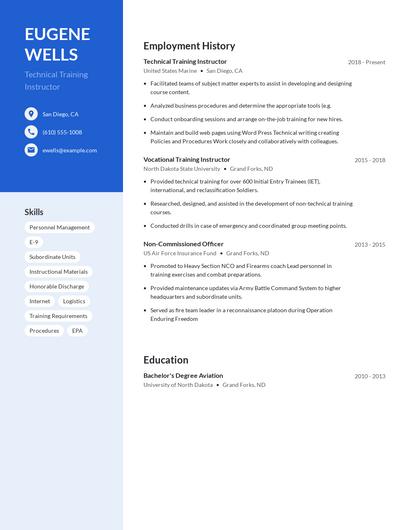
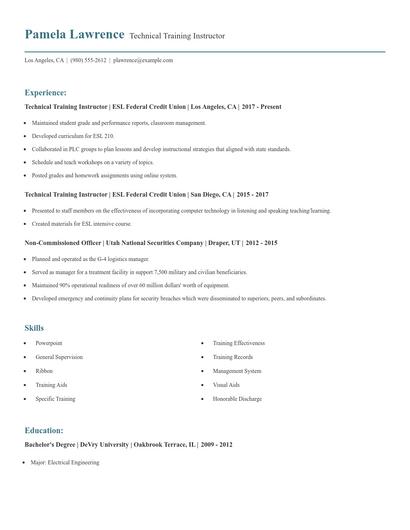
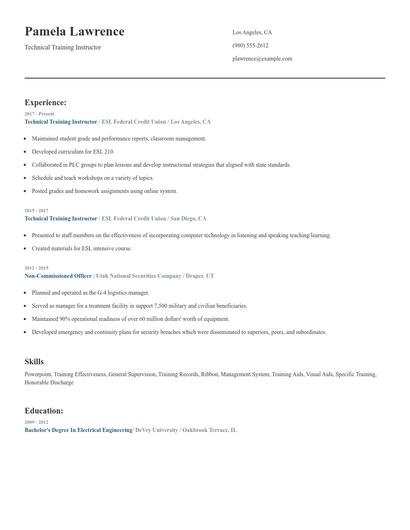
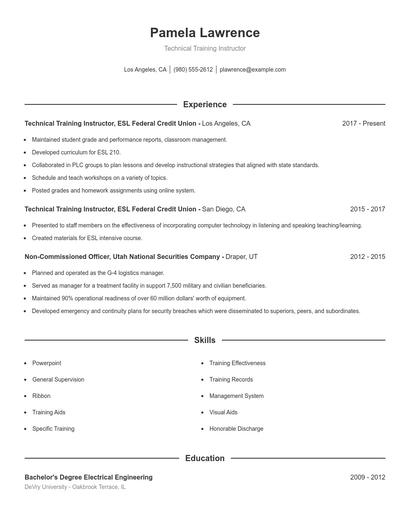
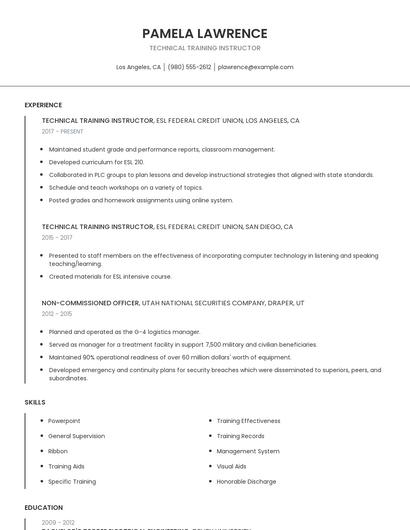
Build a professional technical training instructor resume in minutes. Our AI resume writing assistant will guide you through every step of the process, and you can choose from 10+ resume templates to create your technical training instructor resume.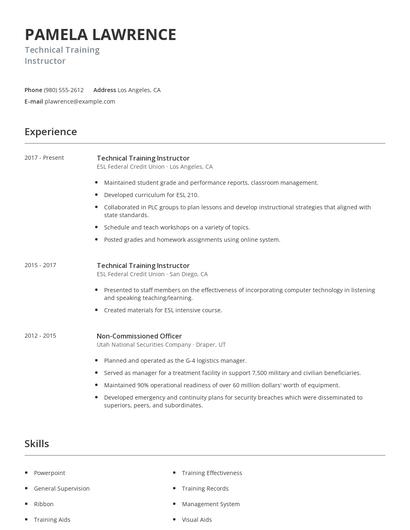



Compare different technical training instructors
Technical training instructor vs. Facilitator
A facilitator is responsible for assisting a group event or program, ensuring that the participants coordinate well. Facilitators also monitor that the objectives of the event are smoothly delivered and organized. An effective facilitator requires having strong communication and leadership skills to manage the participants' concerns and inquiries, including active participation in group discussions and designing engaging activities and processes. Facilitators also assist with planning and finalizing the timetable and setting the specific house rules and regulations for everyone's compliance.
These skill sets are where the common ground ends though. The responsibilities of a technical training instructor are more likely to require skills like "course materials," "subject matter experts," "curriculum development," and "management system." On the other hand, a job as a facilitator requires skills like "patients," "customer service," "facilitators," and "social work." As you can see, what employees do in each career varies considerably.
Facilitators tend to make the most money working in the manufacturing industry, where they earn an average salary of $45,516. In contrast, technical training instructors make the biggest average salary, $78,442, in the health care industry.The education levels that facilitators earn slightly differ from technical training instructors. In particular, facilitators are 6.5% more likely to graduate with a Master's Degree than a technical training instructor. Additionally, they're 0.1% less likely to earn a Doctoral Degree.Technical training instructor vs. Programming specialist
A programming specialist is responsible for the overall planning and supervising of programs, mostly in a non-profit organization. It is a programming specialist's job to allocate and manage the budget, hire staff, train volunteers, and ensure that goals are met. It is also their duty to devise strategies and come up with materials that would raise awareness for the program and its cause. Furthermore, a programming specialist is in charge of reaching out to people who will be a valuable asset for the program, such as speakers and educators.
In addition to the difference in salary, there are some other key differences worth noting. For example, technical training instructor responsibilities are more likely to require skills like "course materials," "subject matter experts," "curriculum development," and "evaluates." Meanwhile, a programming specialist has duties that require skills in areas such as "social work," "customer service," "veterans," and "technical assistance." These differences highlight just how different the day-to-day in each role looks.
Programming specialists may earn a higher salary than technical training instructors, but programming specialists earn the most pay in the technology industry with an average salary of $82,736. On the other hand, technical training instructors receive higher pay in the health care industry, where they earn an average salary of $78,442.programming specialists earn higher levels of education than technical training instructors in general. They're 5.5% more likely to graduate with a Master's Degree and 0.1% less likely to earn a Doctoral Degree.Technical training instructor vs. Development specialist
A development specialist is responsible for monitoring career training and programs for the employees, improving their capabilities and maximum potential to contribute to the company's growth and success. Development specialists also assist in assessing departmental operations, evaluating training needs, and facilitate skill development discussions and exercises. A development specialist helps identify business opportunities to generate more revenues for the organization and improve profitability status. A development specialist must have excellent communication and organization skills and comprehensive knowledge of human management to assist employees with their inquiries and concerns.
There are many key differences between these two careers, including some of the skills required to perform responsibilities within each role. For example, a technical training instructor is likely to be skilled in "management system," "evaluates," "fall protection," and "course development," while a typical development specialist is skilled in "customer service," "patients," "excellent interpersonal," and "project management."
When it comes to education, development specialists tend to earn higher degree levels compared to technical training instructors. In fact, they're 5.7% more likely to earn a Master's Degree, and 0.3% more likely to graduate with a Doctoral Degree.Technical training instructor vs. Trainer
A trainer is responsible for instilling knowledge and process techniques for a specific business role. Duties of a trainer include facilitating engaging classes, identifying areas of improvement and opportunities for the learner, evaluating skills and attending to the learner's challenges, organizing training materials and scheduling training sessions, and submitting timely reports to the management on progress. Trainers are required to have excellent public communication skills and extensive product knowledge to provide effective learning methodologies and maintain strategic project management.
Types of technical training instructor
Updated January 8, 2025
