What does a test technician do?

A test technician is responsible for running multiple diagnostic tests on various tools and equipment to boost optimization and ensure its efficient performance on operations. Test technicians inspect system components and manage calibration, following clients' specifications or the business' needs. A test technician also analyzes the system's design processes and features to understand its complexities and identify necessary upgrades. Test technicians keep a record of system issues and resolutions for reference. A test technician must have excellent knowledge of the technical and mechanical industry to perform tasks and achieve the highest customer satisfaction.
Test technician responsibilities
Here are examples of responsibilities from real test technician resumes:
- Install and manage windows applications for the user, maintain servers and manage help desk operations.
- Manage and distribute cad standards to contributing design consultants and assist with any design issues as necessary.
- Perform in-circuit emulation and boundary scan testing (JTAG).
- Perform extensive testing on CVD, PVD, display and solar tooling.
- Configure bios to better suit the operating system, motherboard and CPU's needs and requirements.
- Use of micrometers, calipers, torque wrenches, rivet and crimping tools, electrical test equipment, drill presses.
- Interpret schematic's ECO's.
- Test and process qualify CVD systems.
- Utilize DVM and oscilloscopes for troubleshooting.
- Test print circuit boards using the ICT fixtures.
- Perform QC inspection from bare boards to finish product.
- Read modulus percent peak strength and evaluate results (ASTM).
- Perform test and troubleshooting to component level for QA of precision timing instruments.
- Install and test of 300MM semiconductor wafer plasma etch systems following specific procedures.
- Perform work in both FOD critical and FOD sensitive environments observe all relate safety procedures.
Test technician skills and personality traits
We calculated that 8% of Test Technicians are proficient in Test Procedures, Test Results, and Hand Tools. They’re also known for soft skills such as Writing skills, Observational skills, and Mechanical skills.
We break down the percentage of Test Technicians that have these skills listed on their resume here:
- Test Procedures, 8%
Determined requirements, reviewed test procedures, and coordinated material needs of spacecraft equipment; communicating regularly with customers and engineers.
- Test Results, 8%
Collaborated with Engineering Department personnel as necessary to facilitate root-cause analyses and investigations of individual components with out-of-specification test results.
- Hand Tools, 7%
Test RF & Wireless IC chips, set-up test devices, used of small hand tools, calibrate, ESD environment.
- Test Data, 5%
Participate in multiple project analysis to improve understanding of proprietary drive test data and ultimately help increase products value to customers.
- RF, 5%
Tested/repaired and troubleshoot analog/digital microprocessors, RF and telecommunications boards to the component level devices.
- Engineering Drawings, 4%
Tested and troubleshooted per engineering drawings using appropriate laboratory procedures and specifications.
Common skills that a test technician uses to do their job include "test procedures," "test results," and "hand tools." You can find details on the most important test technician responsibilities below.
Writing skills. One of the key soft skills for a test technician to have is writing skills. You can see how this relates to what test technicians do because "electrical and electronic engineering technologists and technicians write reports about onsite construction, design problems, or testing results." Additionally, a test technician resume shows how test technicians use writing skills: "assisted with market study in local mcdonalds stores through process development and writing standard operation procedures for data collection. "
Mechanical skills. This is an important skill for test technicians to perform their duties. For an example of how test technician responsibilities depend on this skill, consider that "electronic engineering technologists and technicians must use hand tools and soldering irons on small circuitry and electronic parts to build components by hand." This excerpt from a resume also shows how vital it is to everyday roles and responsibilities of a test technician: "utilized engineering drawings and schematics to troubleshoot printed circuit boards, pneumatic systems and mechanical systems to ensure proper operation".
Math skills. A big part of what test technicians do relies on "math skills." You can see how essential it is to test technician responsibilities because "electrical and electronic engineering technologists and technicians use mathematics for analysis, design, and troubleshooting tasks." Here's an example of how this skill is used from a resume that represents typical test technician tasks: "utilize math lab programs and other testing devises to execute testing on both hardware and software of the units. "
Communication skills. Another skill commonly found on test technician job descriptions is "communication skills." It can come up quite often in test technician duties, since "electrical and electronic engineering technologists and technicians must be able to follow instructions from engineers and others." Here's an example from a resume of how this skill fits into day-to-day test technician responsibilities: "prepare site installation and test reports configures computers and server, communications devices, and peripheral equipment. "
The three companies that hire the most test technicians are:
- U.S. Bank50 test technicians jobs
- BAE Systems36 test technicians jobs
- Boeing35 test technicians jobs
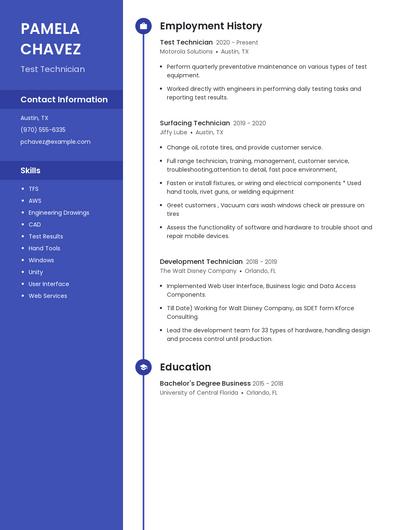
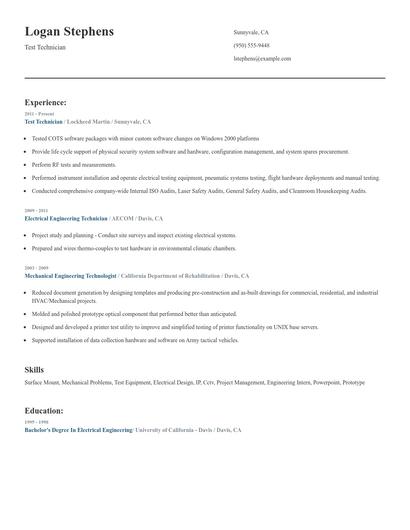
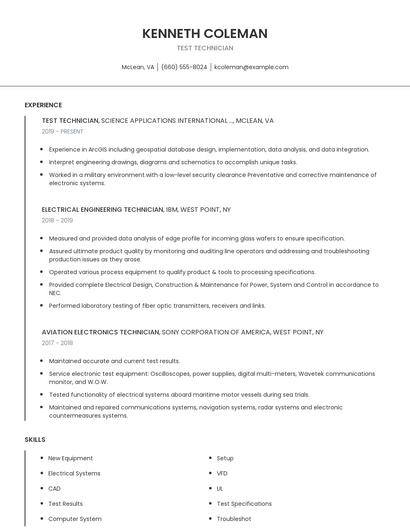
Choose from 10+ customizable test technician resume templates
Build a professional test technician resume in minutes. Our AI resume writing assistant will guide you through every step of the process, and you can choose from 10+ resume templates to create your test technician resume.





Compare different test technicians
Test technician vs. Engineering associate
An engineering associate is an individual whose job duties include analysis of project plans, development of product designs, and maintenance of equipment. The engineering fields where an engineering associate can find a job include civil, mechanical, and environmental. The requirements to qualify for the position include obtaining a bachelor's degree in engineering, familiarity with a specific industry, prior work experience related to the field, and possessing strong technical skills.
There are some key differences in the responsibilities of each position. For example, test technician responsibilities require skills like "test results," "hand tools," "oscilloscopes," and "data acquisition." Meanwhile a typical engineering associate has skills in areas such as "python," "java," "cad," and "c++." This difference in skills reveals the differences in what each career does.
Engineering associates tend to make the most money working in the energy industry, where they earn an average salary of $88,950. In contrast, test technicians make the biggest average salary, $48,786, in the technology industry.On average, engineering associates reach higher levels of education than test technicians. Engineering associates are 6.2% more likely to earn a Master's Degree and 0.5% more likely to graduate with a Doctoral Degree.Test technician vs. Test operator
The job of a test operator is to test the functionality of electronic components, assemblies, units, parts, and systems in a manner consistent with standard procedures. As a test operator, you will perform a variety of duties that include working with engineers to ensure accurate procedures are being followed, perform different mechanical assembly operations, and inspecting products for the correct orientation and placement. Additionally, you will assemble electronics in their boxes and notify the quality/test engineer if the test yields below the acceptable levels.
While some skills are similar in these professions, other skills aren't so similar. For example, resumes show us that test technician responsibilities requires skills like "test data," "engineering drawings," "oscilloscopes," and "data acquisition." But a test operator might use other skills in their typical duties, such as, "test equipment," "safety rules," "frac," and "jsa."
Test operators earn a lower average salary than test technicians. But test operators earn the highest pay in the technology industry, with an average salary of $44,634. Additionally, test technicians earn the highest salaries in the technology with average pay of $48,786 annually.Average education levels between the two professions vary. Test operators tend to reach similar levels of education than test technicians. In fact, they're 1.3% less likely to graduate with a Master's Degree and 0.5% less likely to earn a Doctoral Degree.Test technician vs. Electronics engineering technician
Electronics Engineering Technician helps engineers design and advance electronic devices and components, install electrical equipment, and maintain electronic systems. They usually work in product evaluation and testing. They use diagnostic and measuring devices to test, adjust, and repair equipment. They ensure customer satisfaction by minimizing downtime, correcting and troubleshooting errors. Further duties include training new technicians in troubleshooting various equipment or product, giving management performance recommendations, testing the system by setting up equipment under simulated conditions, and documenting the troubleshooting process.
Some important key differences between the two careers include a few of the skills necessary to fulfill the responsibilities of each. Some examples from test technician resumes include skills like "data acquisition," "math," "dexterity," and "work ethic," whereas an electronics engineering technician is more likely to list skills in "troubleshoot," "lab equipment," "analog," and "wire harnesses. "
Electronics engineering technicians earn the best pay in the technology industry, where they command an average salary of $86,980. Test technicians earn the highest pay from the technology industry, with an average salary of $48,786.electronics engineering technicians typically earn similar educational levels compared to test technicians. Specifically, they're 0.4% less likely to graduate with a Master's Degree, and 0.1% less likely to earn a Doctoral Degree.Test technician vs. Senior engineering technician
A Senior Engineering Technician uses the technical principles of engineering to create and develop a project or product. They also provide technical assistance to professional engineering staff on special projects.
Types of test technician
Updated January 8, 2025
