What does a track worker do?
Track worker responsibilities
Here are examples of responsibilities from real track worker resumes:
- Job duties are to fix wrecks, maintain the karts, and manage the batting cages.
- Used hoists and cranes to lift work pieces to machines.
- Adjust controls to activate jacks, tampers, and scraper blades.
- Operate ballast regulators and tampers.
- Receive and implement combat orders and direct deployment of personnel in offensive, defensive and retrograde operations.
- Operate tamping gun, track mobile, dump truck, bulldozer, tamper, speed swing and bobcat.
- Test mechanical products and equipment after repair or assembly to ensure proper performance and compliance with manufacturers' specifications.
Track worker skills and personality traits
We calculated that 21% of Track Workers are proficient in BARS, Switches, and CDL.
We break down the percentage of Track Workers that have these skills listed on their resume here:
- BARS, 21%
Spray switches, angle bars and joints with oil for lubrication.
- Switches, 16%
Operated non-automatic switches to determine that they are in operating condition.
- CDL, 10%
Operate class B and class A CDL vehicles in company business.
- Drill Holes, 10%
Drill holes through rails for insertions of bolts, using power drills.
- FRA, 8%
Complied with Federal Railroad Administration(FRA).
- Track Components, 8%
Remove and replace track and track components through ties and rail gangs.
Most track workers use their skills in "bars," "switches," and "cdl" to do their jobs. You can find more detail on essential track worker responsibilities here:
The three companies that hire the most track workers are:
- Genesee & Wyoming48 track workers jobs
- Norfolk Southern46 track workers jobs
- RailWorks37 track workers jobs
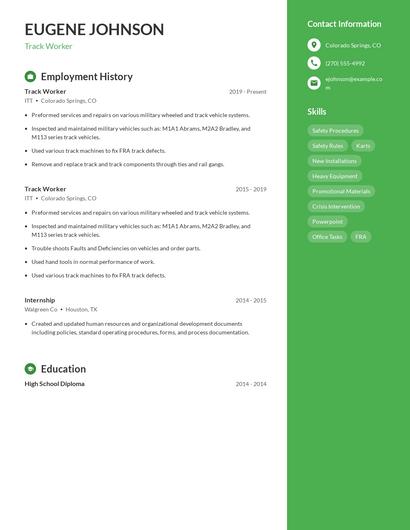
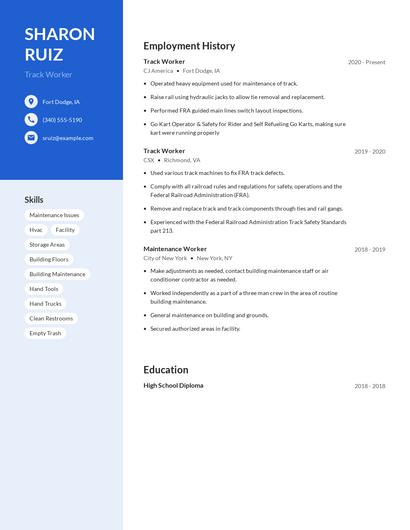
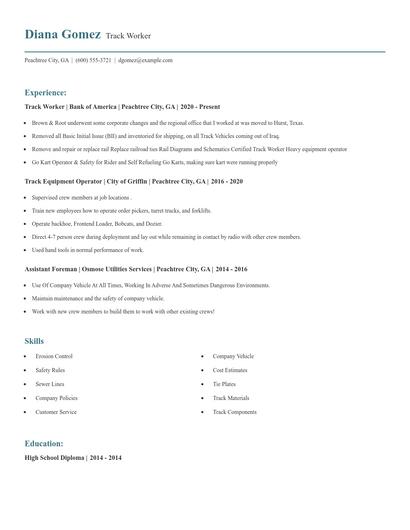
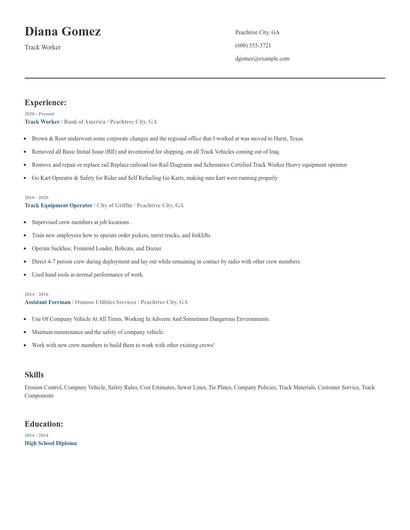
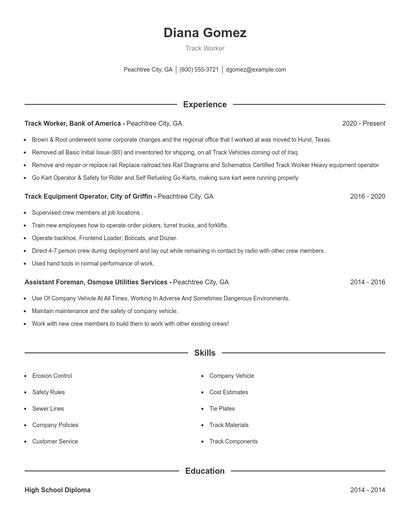
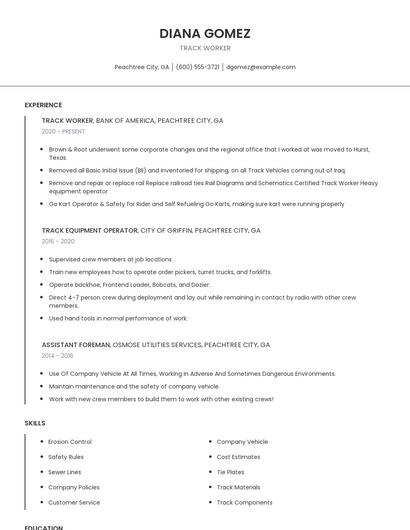
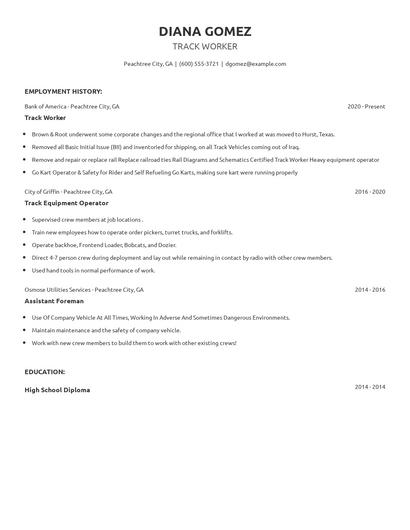
Choose from 10+ customizable track worker resume templates
Build a professional track worker resume in minutes. Our AI resume writing assistant will guide you through every step of the process, and you can choose from 10+ resume templates to create your track worker resume.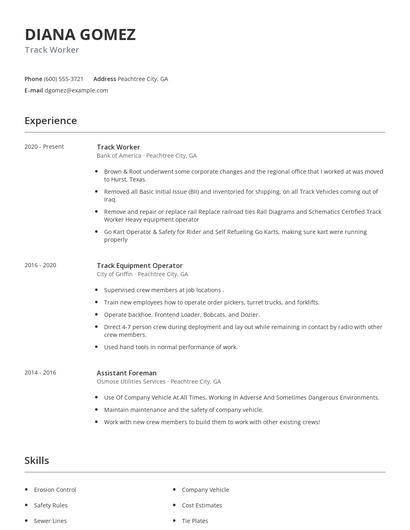
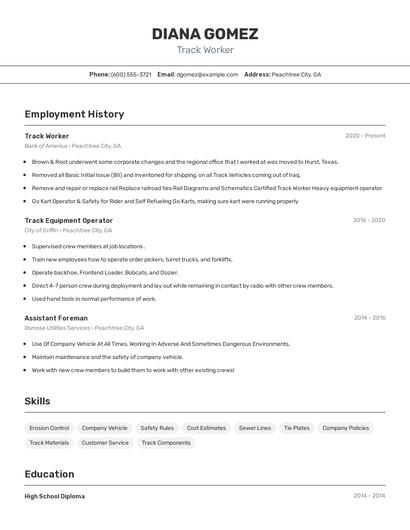
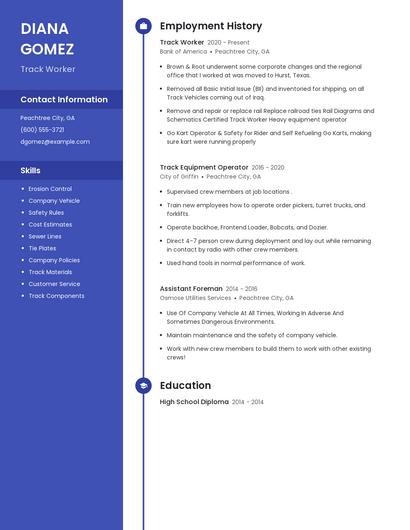
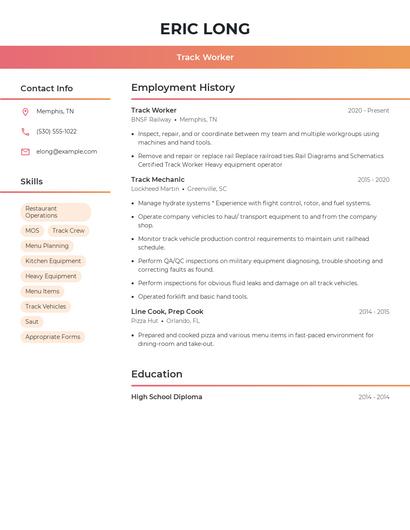

Compare different track workers
Track worker vs. Maintenance equipment operator
There are some key differences in the responsibilities of each position. For example, track worker responsibilities require skills like "bars," "switches," "drill holes," and "fra." Meanwhile a typical maintenance equipment operator has skills in areas such as "asphalt," "hand tools," "dump truck," and "mowing." This difference in skills reveals the differences in what each career does.
Maintenance equipment operators really shine in the energy industry with an average salary of $40,911. Comparatively, track workers tend to make the most money in the transportation industry with an average salary of $47,419.On average, maintenance equipment operators reach similar levels of education than track workers. Maintenance equipment operators are 1.6% less likely to earn a Master's Degree and 0.0% less likely to graduate with a Doctoral Degree.Track worker vs. Special equipment operator
Each career also uses different skills, according to real track worker resumes. While track worker responsibilities can utilize skills like "bars," "switches," "drill holes," and "fra," special equipment operators use skills like "loaders," "production lines," "rf," and "dot."
In general, special equipment operators achieve similar levels of education than track workers. They're 0.6% less likely to obtain a Master's Degree while being 0.0% less likely to earn a Doctoral Degree.Track worker vs. Track equipment operator
Some important key differences between the two careers include a few of the skills necessary to fulfill the responsibilities of each. Some examples from track worker resumes include skills like "bars," "switches," "cdl," and "drill holes," whereas a track equipment operator is more likely to list skills in "track maintenance," "loaders," "inspection reports," and "tamping machines. "
When it comes to education, track equipment operators tend to earn similar degree levels compared to track workers. In fact, they're 2.3% less likely to earn a Master's Degree, and 0.0% less likely to graduate with a Doctoral Degree.Track worker vs. Track grinder operator
Types of track worker
Updated January 8, 2025
