What does a voip engineer do?
A voiceover internet protocol (VoIP) engineer has a couple of responsibilities, including the design, installation, and maintenance of VoIP and telephone systems for both local networks and large networks that cover large regions. Other responsibilities include determining the needs of their company and developing the right network to fit these needs. This position requires expertise in computer science, digital audio hardware, and VoIP software to install cutting-edge technologies.
Voip engineer responsibilities
Here are examples of responsibilities from real voip engineer resumes:
- Work with service providers to order new circuits and to manage and troubleshoot existing services.
- Manage Jenkins security by providing specific access to authorize developers/testers using project base matrix authorization strategy.
- Programme and update Cisco IOS on switches for optimal security & performance for Military/Government network use.
- Replace outdate Cisco switches & routers in existing data centers & installing new Cisco switches & routers.
- Develop new PBX services as well as fulfilled the duties of a VoIP engineer, software developer and Linux engineer.
- Design and implement enterprise network routing architectures using routing protocols such as OSPF, BGP, EIGRP, and static routes.
- Involve in call flow analysis using Wireshark.
- Configure QoS to ensure proper prioritization of traffic.
- Upgrade the network by translating protocols like EIGRP to OSPF.
- Test and upgrade stable IOS to various devices when require.
- Employ LogMeIn rescue console to remotely troubleshoot LAN to resolve registration issues.
- Circuit provisioning, translations, dial-plans, routing tables on Cisco switches/gateways.
- Design and deploy network monitoring solution using SolarWinds NPM and NCM servers.
- Design and install various VPN solutions using Cisco hardware and software products.
- Implement customer VPN to eliminate costs of point-to-point services from a provider.
Voip engineer skills and personality traits
We calculated that 8% of Voip Engineers are proficient in Unity, Unified Communications, and Switches. They’re also known for soft skills such as Communication skills, Analytical skills, and Problem-solving skills.
We break down the percentage of Voip Engineers that have these skills listed on their resume here:
- Unity, 8%
Configured and maintained Cisco Call Manager, Unity and related Cisco Unified Communications configurations.
- Unified Communications, 6%
Designed and implemented Cisco Unified Communications solutions for enterprise clients including; UCCX and CUCM (5.x).
- Switches, 5%
Perform all software and patch upgrades to voice network devices including IOS upgrades for Cisco 4500 L3 series POE switches.
- UCCX, 4%
Managed Cisco's IP Telephony and Unified Contact Center Express (UCCX).
- Cisco Voip, 4%
Configured Cisco VoIP handsets i.e.
- Routers, 4%
Worked with customer IT administrative support teams to configure enterprise-level SonicWALL and Cisco routers.
Most voip engineers use their skills in "unity," "unified communications," and "switches" to do their jobs. You can find more detail on essential voip engineer responsibilities here:
Communication skills. The most essential soft skill for a voip engineer to carry out their responsibilities is communication skills. This skill is important for the role because "administrators must describe problems and their solutions to non-it workers." Additionally, a voip engineer resume shows how their duties depend on communication skills: "installed, configured, and maintained cisco unified communication manager and cisco unity connection voice-mail system. "
Analytical skills. Many voip engineer duties rely on analytical skills. "administrators need to evaluate networks and systems to make sure that they perform reliably and to anticipate new requirements as customers’ needs change.," so a voip engineer will need this skill often in their role. This resume example is just one of many ways voip engineer responsibilities rely on analytical skills: "reviewed circuit provisioning data for correct site information, & circuit type. "
Problem-solving skills. Another skill that relates to the job responsibilities of voip engineers is problem-solving skills. This skill is critical to many everyday voip engineer duties, as "administrators must quickly resolve problems that arise with computer networks." This example from a resume shows how this skill is used: "designed, tested and implemented highly critical acd solution for large field site. "
The three companies that hire the most voip engineers are:
- Apple2 voip engineers jobs
- Vectrus2 voip engineers jobs
- Grande Communications ClearSource, Inc.
2 voip engineers jobs
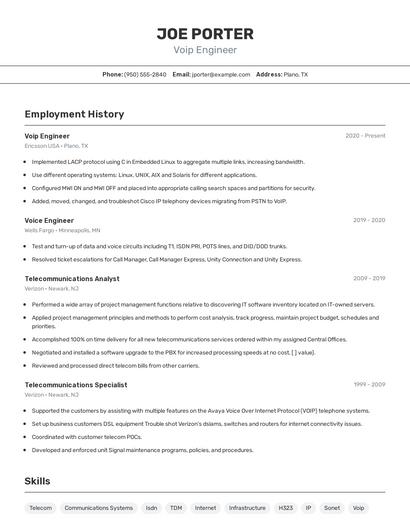
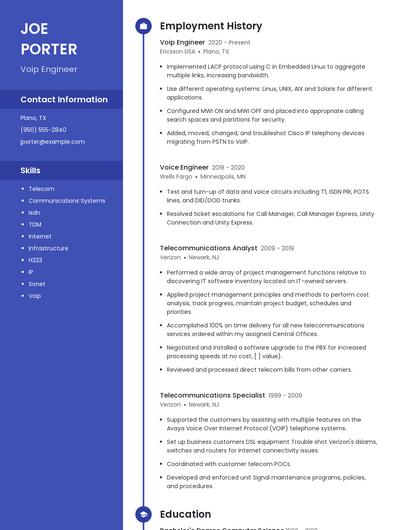
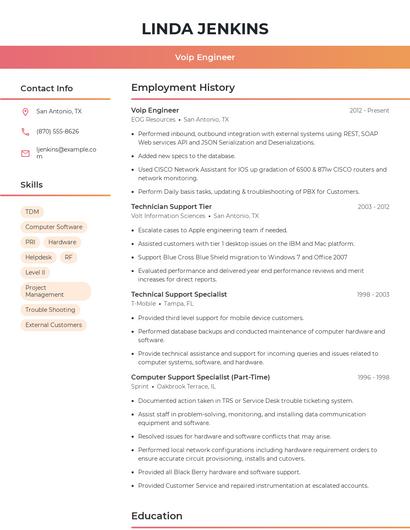
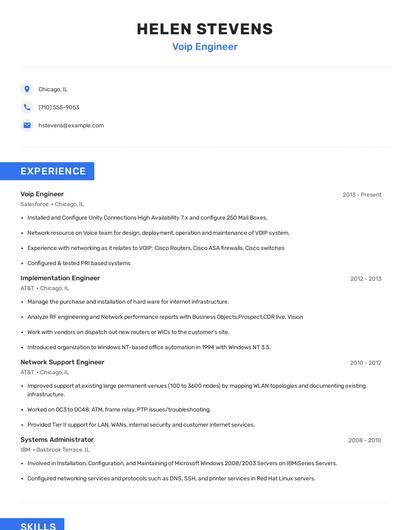
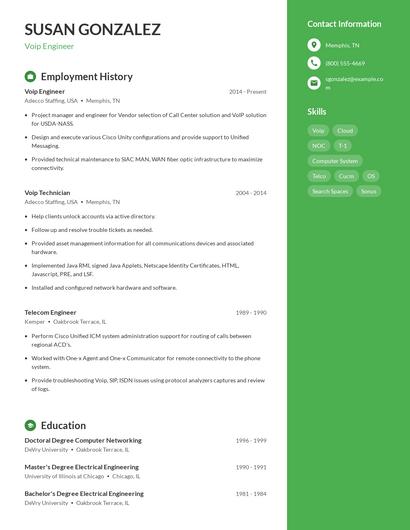
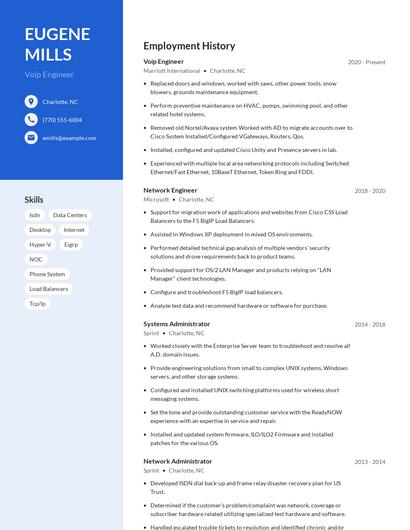
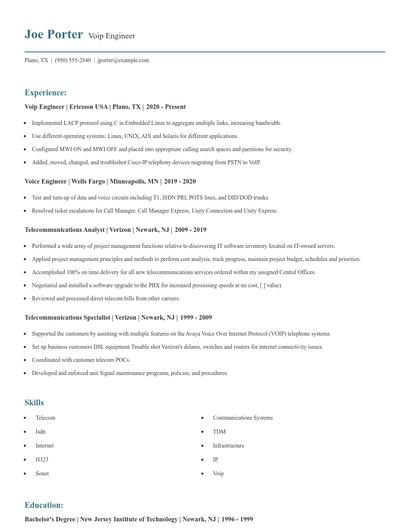
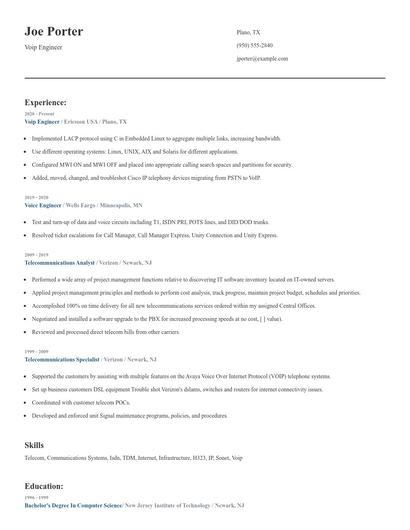
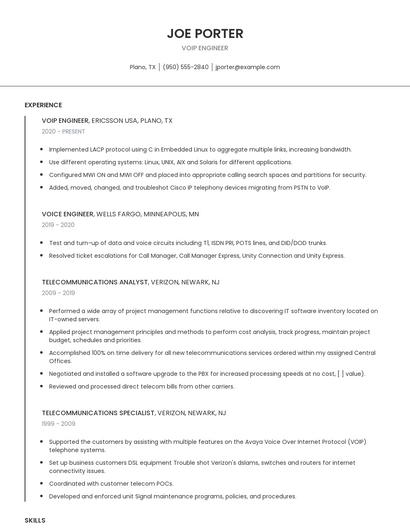
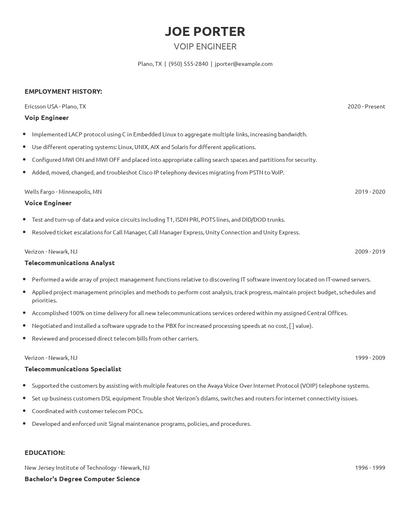
Choose from 10+ customizable voip engineer resume templates
Build a professional voip engineer resume in minutes. Our AI resume writing assistant will guide you through every step of the process, and you can choose from 10+ resume templates to create your voip engineer resume.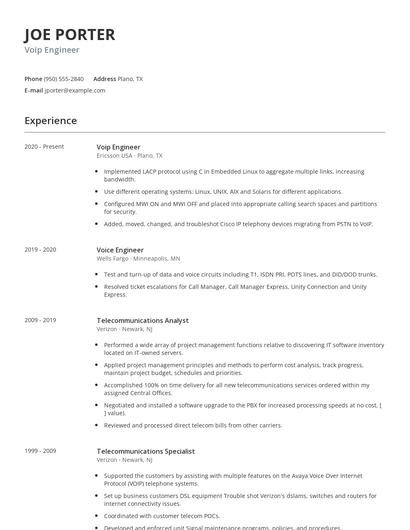

Compare different voip engineers
Voip engineer vs. System technician
A system technician is an individual responsible for supporting users with issues related to the computer system. System technicians conduct appropriate diagnostics on computer issues and must be able to explain technical issues to clients or team members. They should carry out tests on the system so that they can generate error reports to identify and fix any computer system problems. System technicians also can write and maintain computer programs and work with computers and electronics, including circuit boards, computer hardware and software, and computer processors.
There are some key differences in the responsibilities of each position. For example, voip engineer responsibilities require skills like "unity," "uccx," "cisco voip," and "routers." Meanwhile a typical system technician has skills in areas such as "customer service," "hand tools," "preventative maintenance," and "control systems." This difference in skills reveals the differences in what each career does.
System technicians earn the highest salaries when working in the government industry, with an average yearly salary of $58,665. On the other hand, voip engineers are paid more in the internet industry with an average salary of $113,511.On average, system technicians reach lower levels of education than voip engineers. System technicians are 7.7% less likely to earn a Master's Degree and 0.1% more likely to graduate with a Doctoral Degree.Voip engineer vs. Network technician
A network technician is responsible for system malfunction diagnosis and troubleshooting operations. Network technicians duties' include repairing damaged system components, analyzing computer systems and blueprints, installing network connections, and upgrading accessories for efficient operations. Other duties include assisting customers with technical issues, ensuring computer systems' privacy, creating documents of network issues and resolutions, and suggesting alternative equipment for network backups. A network technician must have a broad knowledge of the technology industry and mechanical processes, plus the ability to work under pressure with minimal supervision.
In addition to the difference in salary, there are some other key differences worth noting. For example, voip engineer responsibilities are more likely to require skills like "unity," "uccx," "qos," and "cuc." Meanwhile, a network technician has duties that require skills in areas such as "customer service," "troubleshoot," "pc," and "network infrastructure." These differences highlight just how different the day-to-day in each role looks.
Network technicians earn a lower average salary than voip engineers. But network technicians earn the highest pay in the finance industry, with an average salary of $74,915. Additionally, voip engineers earn the highest salaries in the internet with average pay of $113,511 annually.network technicians earn similar levels of education than voip engineers in general. They're 4.5% less likely to graduate with a Master's Degree and 0.1% more likely to earn a Doctoral Degree.Voip engineer vs. Administrator
Administrators are administrative professionals who oversee the whole office or department. They manage office activities and supervise administrative functions in the office. They work the office calendar and oversee the appointment-setting process. They coordinate office events and ensure that all preparations are made and that there are no conflicting schedules. They also maintain a database of external providers of various office needs. Administrators also oversee office supplies and prepare purchase requisitions. They also manage janitorial services and other functions that are related to the maintenance of the physical office space. Administrators ensure that all fixtures and equipment in the office are functioning well and have no problems.
There are many key differences between these two careers, including some of the skills required to perform responsibilities within each role. For example, a voip engineer is likely to be skilled in "unity," "switches," "uccx," and "cisco voip," while a typical administrator is skilled in "customer service," "data entry," "troubleshoot," and "payroll."
Administrators earn the highest salary when working in the manufacturing industry, where they receive an average salary of $78,798. Comparatively, voip engineers have the highest earning potential in the internet industry, with an average salary of $113,511.Most administrators achieve a similar degree level compared to voip engineers. For example, they're 0.9% more likely to graduate with a Master's Degree, and 1.2% more likely to earn a Doctoral Degree.Voip engineer vs. Systems administrator
Systems administrators are employees who oversee information technology infrastructures in the office. They are skilled information technology professionals who are knowledgeable about the company's network systems and other technology-related infrastructures. They are responsible for installing, configuring, or updating network systems, software, and hardware. They also monitor the different systems and troubleshoot any issues that users may encounter. Systems administrators manage the access of users, ensure the security of the network, and address any challenges that users may have. They conduct repairs and routine maintenance to ensure that the systems in place are in the best shape.
Types of voip engineer
Updated January 8, 2025
