What does a wire harness assembler do?
Wire harness assemblers are tasked with binding wires to form wire harnesses, which are typically used in electrical systems and electronic equipment. They read electrical wiring schemes and binds wires together using sleeves, cable lacing, cable ties, and electrical conduits. They are expected to install wire harnesses, inspect them, and perform soldering as needed.
Wire harness assembler responsibilities
Here are examples of responsibilities from real wire harness assembler resumes:
- Insert wires into coupling run hand crimp machine
- Solder components for connectors and internal switchboards and panels.
- Follow the mylar and run the wires with the connectors.
- Used various wire specific machines to fit wiring into switches and other production products.
- Set up and calibrate new equipment and help to troubleshoot and solve unforeseen setbacks.
- Do wiring for power switches such as lugging, stripping, and crimping for the wires.
- Select by ISO manager to perform internal audits of the companies' compliance with ISO standards.
- Build wire harnesses for Winnebago rv's, test to make sure correct, spot soldier ends.
- Use schematics and pre-built boards to create the wire harness for the different areas of an RV.
- Certify in ISO and F.O.D (foreign object Debra) visual and hand inspection for testing and quality purposes.
- Follow schematic to assemble, solder, and wire wrap telephone transformers, test, troubleshoot and repair problems.
- Read and interpret blueprints and check critical dimensions by using measuring instruments including micrometers, calipers and indicators.
- build ECU's from start to finish (except brazing).
- Promote safe work practices as an ESD coordinator and participate in safety audits.
- Perform assemblies and sub-assemblies on various types of flow meters while following proper ESD procedures.
Wire harness assembler skills and personality traits
We calculated that 10% of Wire Harness Assemblers are proficient in Hand Tools, IPC, and Switches.
We break down the percentage of Wire Harness Assemblers that have these skills listed on their resume here:
- Hand Tools, 10%
Set up the machine that crimps the terminals onto bundles of wire by changing the spools of terminals using hand tools.
- IPC, 9%
Control, and Stockroom personal to ensure all product adheres to IPC Class III standards in meet customer's requirements.
- Switches, 8%
Soldered switches and sensors as well as soldered , resisters, wires to connectors.
- Tape Measure, 7%
Draw templates from blue prints.Ability to use calipers,ruler,tape measure.
- Quality Checks, 7%
Performed quality checks to ensure all equipment was to specifications.
- Mechanical Assembly, 6%
Panel Making, mechanical assembly of machines (plant closed)
Most wire harness assemblers use their skills in "hand tools," "ipc," and "switches" to do their jobs. You can find more detail on essential wire harness assembler responsibilities here:
The three companies that hire the most wire harness assemblers are:
- S&C Electric13 wire harness assemblers jobs
- Siemens8 wire harness assemblers jobs
- Aerotek5 wire harness assemblers jobs
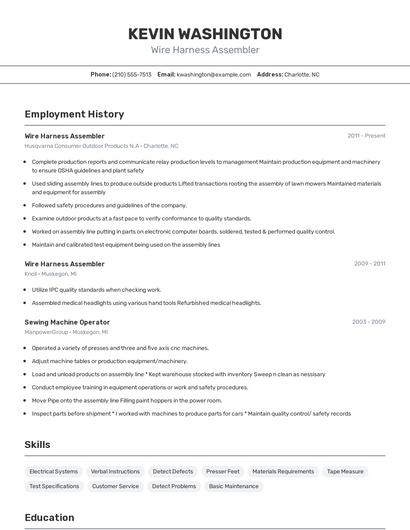
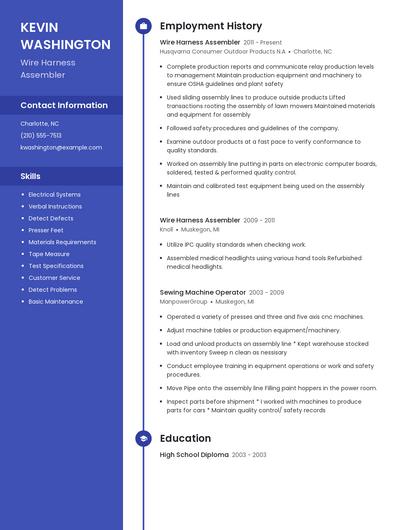
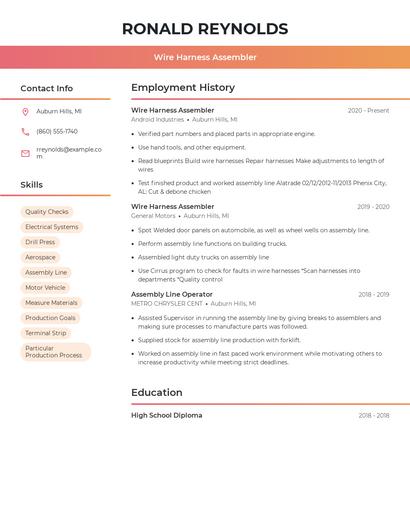
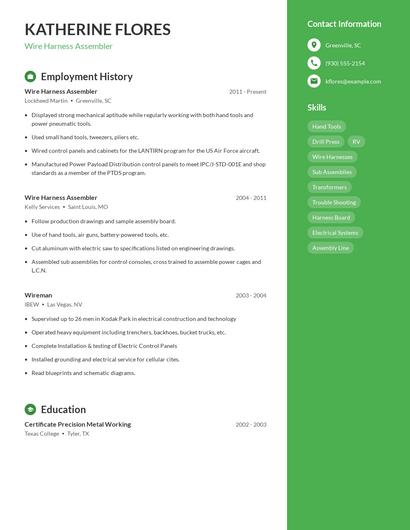
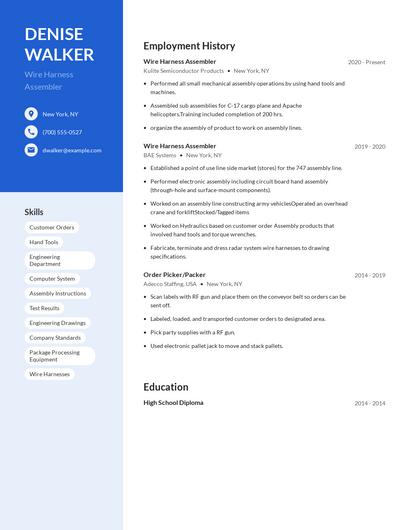
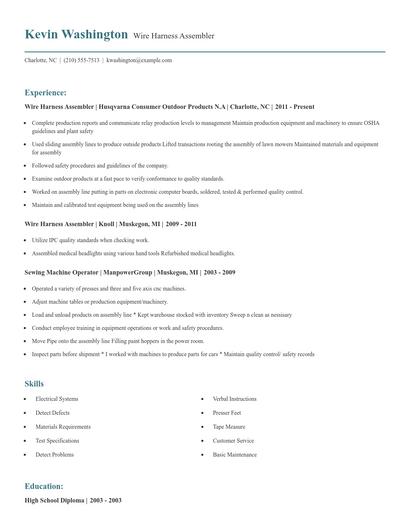
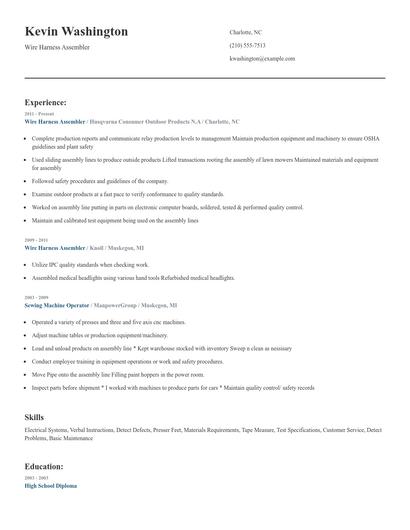
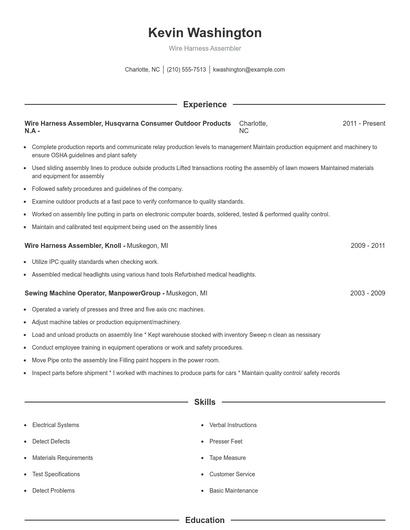
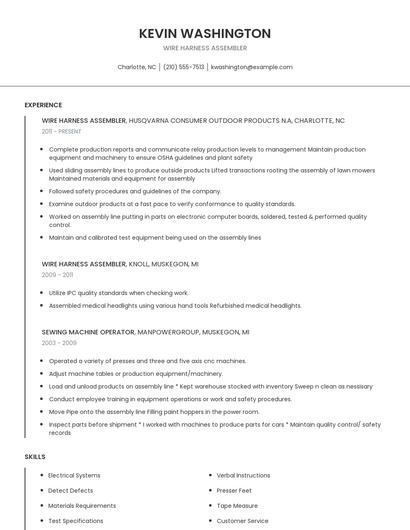
Choose from 10+ customizable wire harness assembler resume templates
Build a professional wire harness assembler resume in minutes. Our AI resume writing assistant will guide you through every step of the process, and you can choose from 10+ resume templates to create your wire harness assembler resume.


Compare different wire harness assemblers
Wire harness assembler vs. Solder technician
While similarities exist, there are also some differences between wire harness assemblers and solder technician. For instance, wire harness assembler responsibilities require skills such as "ipc," "switches," "tape measure," and "quality checks." Whereas a solder technician is skilled in "through-hole," "ipc-a-610," "circuit board assembly," and "dexterity." This is part of what separates the two careers.
On average, solder technicians reach similar levels of education than wire harness assemblers. Solder technicians are 1.0% more likely to earn a Master's Degree and 0.4% more likely to graduate with a Doctoral Degree.Wire harness assembler vs. Assembler & quality control
While some skills are similar in these professions, other skills aren't so similar. For example, resumes show us that wire harness assembler responsibilities requires skills like "hand tools," "switches," "mechanical assembly," and "wire harness assembly." But an assembler & quality control might use other skills in their typical duties, such as, "part numbers," "safety guidelines," "r," and "quality inspection."
On average, assemblers & quality control earn a lower salary than wire harness assemblers. Some industries support higher salaries in each profession. Interestingly enough, assemblers & quality control earn the most pay in the automotive industry with an average salary of $34,668. Whereas wire harness assemblers have higher pay in the finance industry, with an average salary of $36,950.In general, assemblers & quality control achieve similar levels of education than wire harness assemblers. They're 1.0% more likely to obtain a Master's Degree while being 0.4% less likely to earn a Doctoral Degree.Wire harness assembler vs. Assembler musical equipment
Some important key differences between the two careers include a few of the skills necessary to fulfill the responsibilities of each. Some examples from wire harness assembler resumes include skills like "ipc," "switches," "tape measure," and "quality checks," whereas an assembler musical equipment is more likely to list skills in "extreme temperature changes," "fitness equipment," "forks," and "assembly diagrams. "
Assembler musical equipment make a very good living in the manufacturing industry with an average annual salary of $35,148. On the other hand, wire harness assemblers are paid the highest salary in the finance industry, with average annual pay of $36,950.Most assembler musical equipment achieve a similar degree level compared to wire harness assemblers. For example, they're 1.3% more likely to graduate with a Master's Degree, and 0.7% more likely to earn a Doctoral Degree.Wire harness assembler vs. Electronic assembly technician
Types of wire harness assembler
Updated January 8, 2025
