What does a wireless engineer do?
A wireless service engineer is an individual who provides support to Internet and wireless phone subscribers in a specific area. The job of a wireless engineer is to make sure that wireless coverage in a zone remains active, linking all users with their subscription speed and signal strength. The task of a wireless service engineer includes the inspection, monitoring and maintenance of all wireless equipment and facilities in a given area. Wireless networks are an important part of many communities today, particularly as the increase in mobile phone users is at a record level.
Wireless engineer responsibilities
Here are examples of responsibilities from real wireless engineer resumes:
- Process improvement efforts and/or other opportunities to automate these processes with computer applications with C++ and/or Java where applicable.
- Lead safety meetings daily with MW crews.
- Travel to remote locations to troubleshoot network devices.
- Circuit simulation and test of amplifiers and mixers.
- Man the war room accepting MW links and preparing ring audits for commissioning efforts.
- Act as the government lead for contractor engineers and technicians supporting work on SATCOM programs.
- Perform site surveys to assure LOS, space in tower and inside for the IDU.
- Travele to Hilton brand hotels for transition to Cisco wireless access points 2.4/5GHZ and Cisco switches.
- Design various network configuration of LTE network including microwave link network access and IMS VoLTE design.
- Involve in troubleshooting various layer 2 and layer 3 issues relate to MPLS, VRF and BGP.
- Install equipment at the proper locations, configure switches and access points, and test for proper operation.
- Plan and prepare GSM, UMTS and LTE neighbors and parameter configurations for integration of new cell sites.
- Work on new T1 to augment need resources for LTE, AWS and PCS technologies with Stockton switch.
- Create new SSL VPN connections both clientless and with any connect client using web certificate for customers to login.
- Prepare reports for use by high-level DoD planners, weapon systems acquisition offices, combatant commanders and government officials.
Wireless engineer skills and personality traits
We calculated that 8% of Wireless Engineers are proficient in IP, Switches, and WLAN. They’re also known for soft skills such as Analytical skills, Communication skills, and Initiative.
We break down the percentage of Wireless Engineers that have these skills listed on their resume here:
- IP, 8%
Travel to customer site performed IP network planning, UMTS RNC, NodeB, Switch and Router configuration.
- Switches, 7%
Configure, install, and troubleshoot Cisco equipment including: Switches, Access Points, Wireless Controllers, and Prime Infrastructure.
- WLAN, 7%
Applied knowledge of WLAN and 802.11 policies and procedures to support weapons systems development projects.
- Wifi, 6%
Research and Develop (802.11AB and G) WIFI test system for high volume manufacturing.
- Wireless Network, 6%
Provide technical support for the implementation of enterprise wireless network services and outdoor point-to-point microwave systems.
- Troubleshoot, 5%
Required to troubleshoot and repair any equipment malfunctions at customer sites nationwide.
"ip," "switches," and "wlan" are among the most common skills that wireless engineers use at work. You can find even more wireless engineer responsibilities below, including:
Initiative. This is an important skill for wireless engineers to perform their duties. For an example of how wireless engineer responsibilities depend on this skill, consider that "electrical and electronics engineers must apply their knowledge to new tasks in every project they undertake." This excerpt from a resume also shows how vital it is to everyday roles and responsibilities of a wireless engineer: "consult on ran growth design projects (introduction of new or improved hardware) optimization and parameterization initiatives".
Speaking skills. For certain wireless engineer responsibilities to be completed, the job requires competence in "speaking skills." The day-to-day duties of a wireless engineer rely on this skill, as "electrical and electronics engineers work closely with other engineers and technicians." For example, this snippet was taken directly from a resume about how this skill applies to what wireless engineers do: "presented and recommended configuration optimizations for switches and routers during technical peer review meetings. "
Writing skills. Another crucial skill for a wireless engineer to carry out their responsibilities is "writing skills." A big part of what wireless engineers relies on this skill, since "electrical and electronics engineers develop technical publications related to equipment they develop, including maintenance manuals, operation manuals, parts lists, product proposals, and design methods documents." How this skill relates to wireless engineer duties can be seen in an example from a wireless engineer resume snippet: "experience writing scripts in python, java, json and xml. "
Math skills. Lastly, "math skills" is an important element of what a wireless engineer does. Wireless engineer responsibilities require this skill because "electrical and electronics engineers must use the principles of calculus and other advanced math in order to analyze, design, and troubleshoot equipment." This resume example highlights how wireless engineer duties rely on this skill: "monitored daily performance statistics (call drops, call quality, utilization, and interference). "
The three companies that hire the most wireless engineers are:
- Apple12 wireless engineers jobs
- Spectrum8 wireless engineers jobs
- Deloitte6 wireless engineers jobs
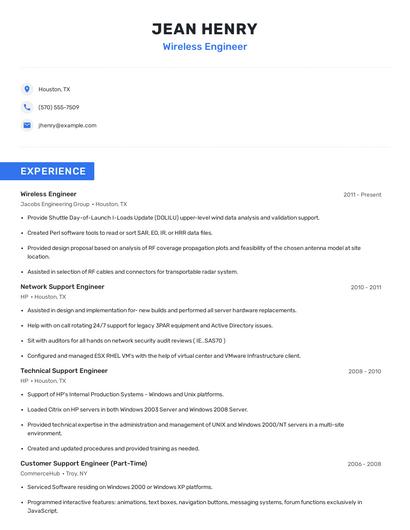
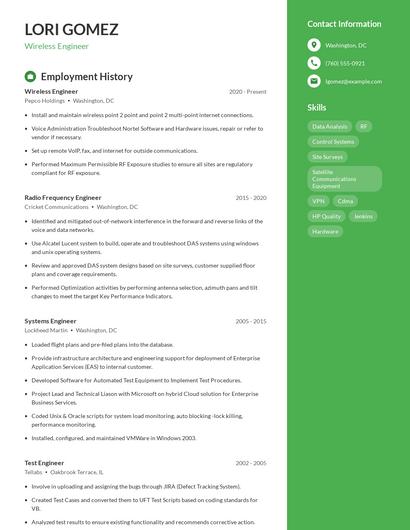
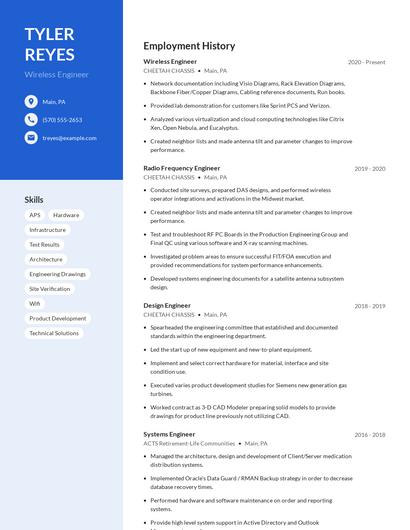
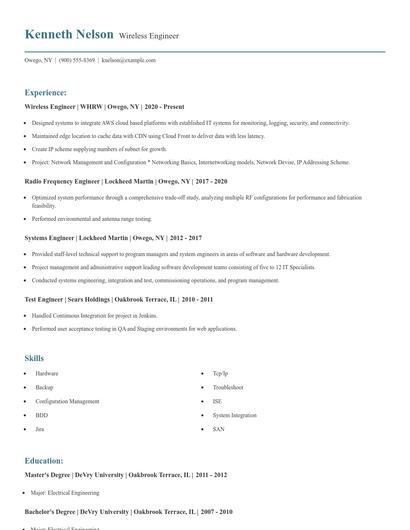
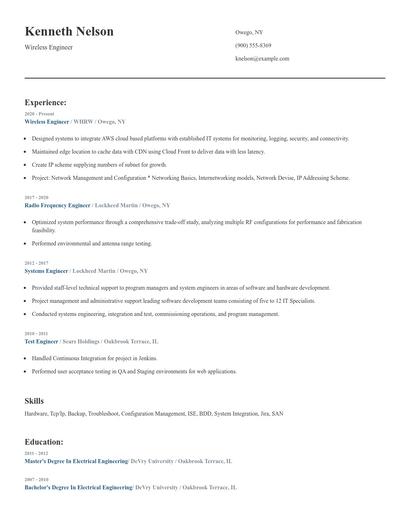
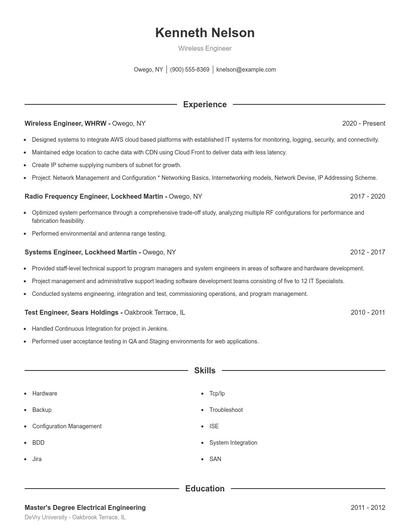
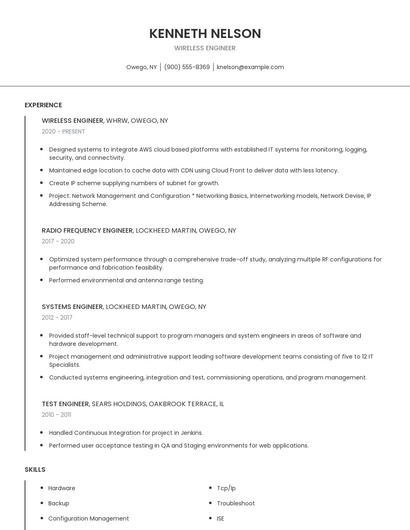
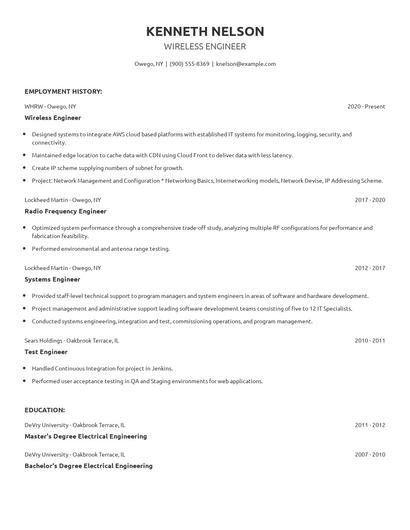
Choose from 10+ customizable wireless engineer resume templates
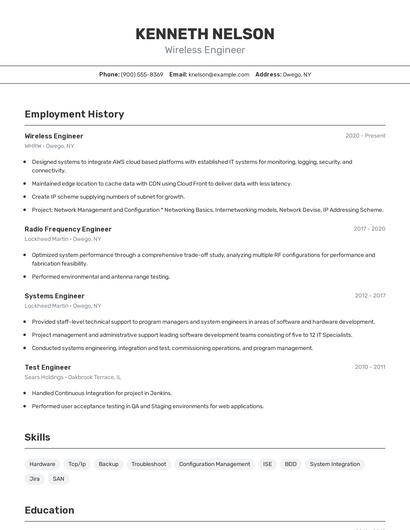
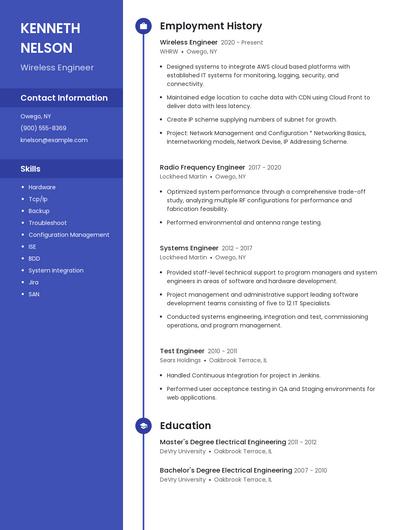
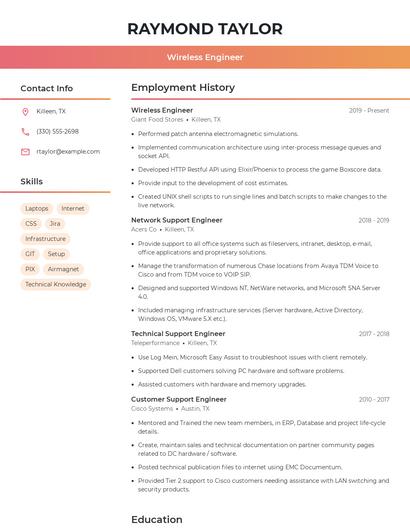
Build a professional wireless engineer resume in minutes. Our AI resume writing assistant will guide you through every step of the process, and you can choose from 10+ resume templates to create your wireless engineer resume.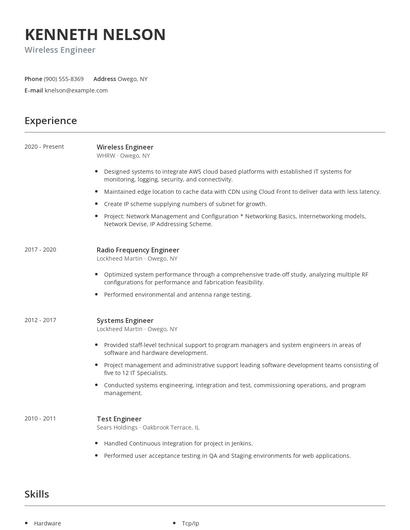
Compare different wireless engineers
Wireless engineer vs. Pcb designer
PCB designers are professionals who use computer software programs to design printed circuit boards (PCBs), an electronic circuit that supports electronic components such as transistors, diodes, and capacitors. These designers must design and implement various circuit boards and perform revisions to apply changes that are based on the specifications of customers and engineers. They need to collaborate with the companies that fabricate and assemble PCBs to discuss the quality, cost-effective, and timely deliveries of PCBs. PCB designers must also use AutoCAD software to design schematics for the PCB systems.
There are some key differences in the responsibilities of each position. For example, wireless engineer responsibilities require skills like "ip," "switches," "wlan," and "wifi." Meanwhile a typical pcb designer has skills in areas such as "rf," "dfm," "pcb layout," and "schematic capture." This difference in skills reveals the differences in what each career does.
Pcb designers earn the highest salaries when working in the telecommunication industry, with an average yearly salary of $90,002. On the other hand, wireless engineers are paid more in the start-up industry with an average salary of $126,690.pcb designers tend to reach lower levels of education than wireless engineers. In fact, pcb designers are 6.7% less likely to graduate with a Master's Degree and 0.8% less likely to have a Doctoral Degree.Wireless engineer vs. Engineering trainee
An engineering trainee is responsible for shadowing engineers in their duties and performing administrative tasks as needed. Engineering trainees assist the engineers in inspecting construction sites and conducting field research. They also identify cost-efficient materials and resources that meet quality standards and client specifications. An engineering trainee must have excellent communication and organizational skills, especially in writing reports, attending meetings, and ensuring that all reports are submitted for management's reviews, such as contracts from suppliers and vendors.
While some skills are similar in these professions, other skills aren't so similar. For example, resumes show us that wireless engineer responsibilities requires skills like "switches," "wlan," "wifi," and "wireless network." But an engineering trainee might use other skills in their typical duties, such as, "excellent interpersonal," "fire protection," "r," and "boilers."
On average, engineering trainees earn a lower salary than wireless engineers. Some industries support higher salaries in each profession. Interestingly enough, engineering trainees earn the most pay in the energy industry with an average salary of $63,253. Whereas wireless engineers have higher pay in the start-up industry, with an average salary of $126,690.In general, engineering trainees achieve higher levels of education than wireless engineers. They're 5.7% more likely to obtain a Master's Degree while being 0.8% less likely to earn a Doctoral Degree.Wireless engineer vs. Senior pcb designer
Controls designers both design and draft systems of hydraulic, pneumatic, and electrical controls for equipment and machines. The designers make diagrams of the logic system for timing and sequence control. They illustrate and describe details for installation and maintenance, such as bearing lubrication and lubrication types. It is part of their job to review schematics with the representatives of customers to answer questions during robot system installation. Also, they may design energy conversion controls.
There are many key differences between these two careers, including some of the skills required to perform responsibilities within each role. For example, a wireless engineer is likely to be skilled in "ip," "switches," "wlan," and "wifi," while a typical senior pcb designer is skilled in "rf," "schematic capture," "pcb layout," and "analog."
Senior pcb designers typically earn lower educational levels compared to wireless engineers. Specifically, they're 9.2% less likely to graduate with a Master's Degree, and 0.8% less likely to earn a Doctoral Degree.Wireless engineer vs. Controls designer
Types of wireless engineer
Updated January 8, 2025
