Find a Job You Really Want In
The past few years have significantly reshaped the workforce landscape, and many companies are now grappling with the challenges of a post-pandemic economy. With the rise of remote and hybrid work models, businesses are reassessing their strategies, leading some to make difficult decisions regarding their workforce.
In recent months, many organizations have been forced to communicate layoffs, furloughs, and restructuring to their employees. These discussions have varied widely in tone and format, from lengthy meetings to quick video calls. While some companies express hope for recovery, others are candid about their financial struggles and the unpredictability of the market.
We analyzed common phrases and messaging used by companies in their layoff communications to better understand their approaches and sentiments.
Summary
- Many companies continue to avoid the term “layoffs” even when announcing workforce reductions.
- Surprisingly, the term “COVID-19” is still used sparingly, reflecting a shift toward more general economic language.
- Even in announcing significant job cuts, companies often maintain a hopeful tone, using words like “temporary,” “furlough,” and “return.”
- While most communications focus on employees (with frequent mentions of “you” and “employees”), some companies prioritize investor language, which can feel alienating to those affected.
- Overall, these statements serve not only to inform employees but also to signal financial health and strategic positioning to the market.
How We Analyzed This Data
We examined the public statements, press releases, and other communications (including leaked emails and social media posts) from 73 companies regarding layoffs, furloughs, and pay cuts in the current economic climate. Our sample included a diverse range of industries, ensuring a balanced view without industry-specific jargon dominating the analysis.
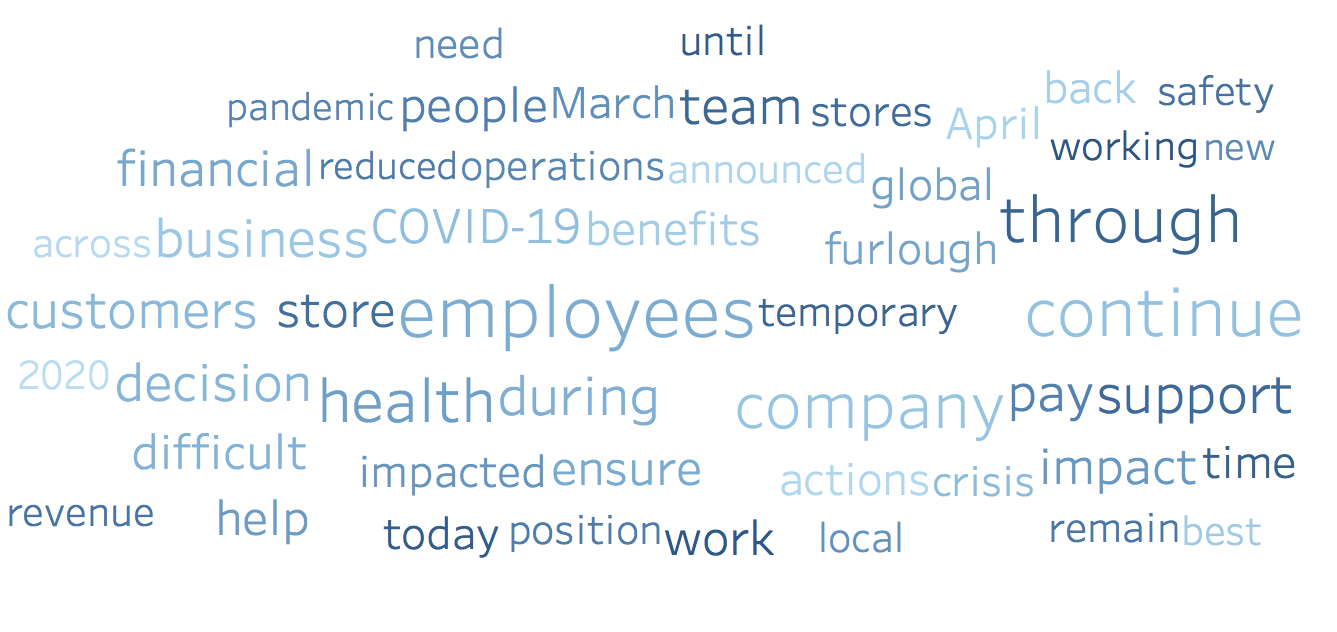
We focused on the frequency of words used across these communications, excluding common stop words. The prominence of each word is reflected in the accompanying word cloud.
A complete list of analyzed companies can be found at the end of this article.
10 Most Commonly Used Words
- Employees
- Continue
- Through
- Company
- Health
- During
- Support
- Customers
- Decision
- Impact
Interestingly, terms like “financial” and “difficult” didn’t make the top ten, although many companies referenced their challenges in vague terms like “current circumstances” or “business adjustments.” Nevertheless, almost all companies acknowledge the significant impact these changes have on their operations.
Companies generally use their communications for two primary purposes:
1.) To inform employees about their decisions and provide clarity on timelines, severance, and available support.
2.) To convey to external stakeholders that they are adapting to market pressures while striving to maintain operations.
Closing Thoughts on Corporate Layoff Communications
The rapid shifts in the economy have left both companies and employees navigating uncertainty. Even established firms are experiencing significant revenue fluctuations, forcing them to reassess their workforce strategies.
How organizations communicate with their employees during these challenging times is crucial for their long-term reputation. As the job market stabilizes, candidates will likely inquire about how businesses handled workforce reductions. Companies that prioritize transparency and compassion in their communications will enhance their image and attract top talent in the future. Conversely, those that fail to engage with their employees meaningfully may struggle to recruit skilled workers.
Companies we analyzed, listed alphabetically:
Academy Sports
Air Canada
AMC
Arconic
Away
Best Buy
Bird
Boeing
Build-A-Bear Workshop
BuzzFeed
Caesars Entertainment Corp.
Caleres
Carnival Cruise
Carta
Cheesecake Factory
Circuit Of The Americas
Cirque du Soleil
ClassPass
Container Store
CQ RollCall
Dish
Disney
Eventbrite
Everlane
eZCater
G/O Media
Gap, Inc.
GE
Greater Philadelphia YMCA
Groupon
Hertz
Hilton
JC Penney
Kohl’s
L Brands
Lennox
Macy’s
MGM Resorts
Mitchell Plastics
Neiman Marcus
New York’s Metropolitan Opera
Nordstrom
NRA
Oneida Nation
Opendoor
Realogy
Redfin
REI
Rent the Runway
Rover
Scandinavian Airlines (SAS)
Schlumberger
Sephora
SolutionHealth
Sonder
StubHub
Tailored Brands
Tesla
TheRealReal
Toast
TripActions
UnderArmour
Union Square Hospitality Group
Urban Outfitters
VSCO
Wing
XFL
Yelp
Zeus Living
ZipRecruiter
Zoox

Author

Kathy is the head of content at Zippia with a knack for engaging audiences. Prior to joining Zippia, Kathy worked at Gateway Blend growing audiences across diverse brands. She graduated from Troy University with a degree in Social Science Education.