- Workplace Statistics
- Time Management Statistics
- Employee Wellness Statistics
- Employment Discrimination Statistics
- Employee Recognition Statistics
- Employee Referral Statistics
- Workplace Violence Statistics
- Gamification Statistics
- Employee Feedback Statistics
- Agile Statistics
- Productivity Statistics
- Meeting Statistics
- Cell Phones At Work Statistics
- Social Media At Work Statistics
- Workplace Injury Statistics
- Workplace Stress Statistics
- Leadership Statistics
- Workplace Collaboration Statistics
- Job Satisfaction Statistics
- Paid Holiday Statistics
- Communication In The Workplace Statistics
- Wasting Time At Work Statistics
- 4-day Workweek Statistics
Research Summary. In today’s fast-paced work environment, effective time management is more crucial than ever. Failure to organize and manage time efficiently can lead to significant losses in productivity, effort, and financial resources. A robust time management system is essential for both individuals and organizations to maximize efficiency and effectiveness.
-
82% of individuals lack a structured time management system.
-
The average employee dedicates 51% of their workday to tasks that add little to no value.
-
39% of work-related stress among U.S. employees is attributed to workload.
-
The average worker experiments with 13 different time management methods throughout their career.
-
Investing 10-12 minutes in daily planning can yield a savings of two hours in productivity.
-
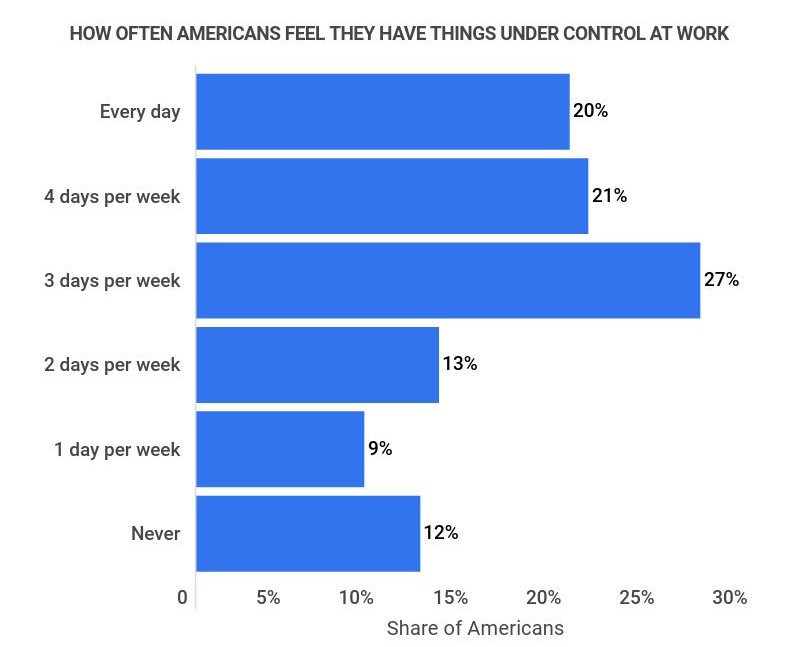
Only 20% of individuals feel in control of their work on a daily basis.
For further insights, we have categorized the data into the following sections:
Worker Methods | Wasted Time | Challenges and Distractions | Benefits

General Time Management Statistics
-
Only 18% of individuals use a formal time management system.
The remaining 82% either rely on manual lists or have no system in place, indicating that a significant portion of the workforce is not achieving optimal efficiency.
-
Relying solely on an ad-hoc approach to daily tasks is the least effective time management technique.
Research indicates that 28% of those who adopt this method report feeling that their work is rarely under control, managing to feel in control only about one day each week on average.
-
The average office worker in the U.S. faces interruptions approximately 11 times an hour, or nearly every six minutes.
These distractions result in an estimated loss of $588 billion annually for U.S. businesses.
Time Management Statistics by Worker Methods
-
Individuals try an average of 13 different time management techniques.
This suggests that many find it challenging to adhere to a specific method. Popular techniques include:
-
Eisenhower Matrix
-
Time Blocking
-
Pickle Jar Theory
-
Eat That Frog Technique
Finding the right fit often requires experimenting with various methods, as each person’s effectiveness may vary.
-
-
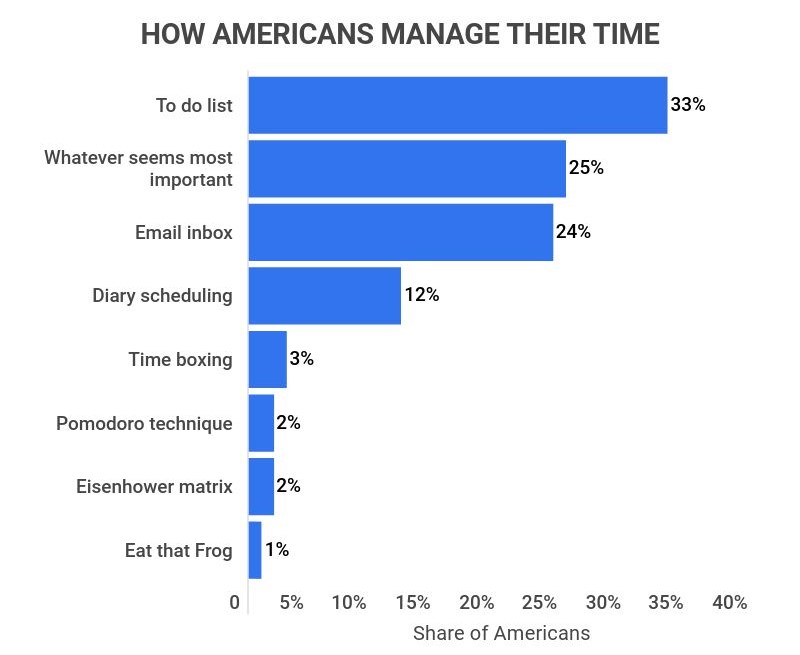
Only 12% of workers plan all their tasks ahead of time.
This highlights a tendency for most individuals to tackle tasks as they arise rather than having a structured approach.
-
33% of individuals rely on to-do lists for task management, while 24% use their email inbox as their primary organizational tool.
Time Management Statistics by Wasted Time
-
Employees spend 51% of their workday on low-value activities.
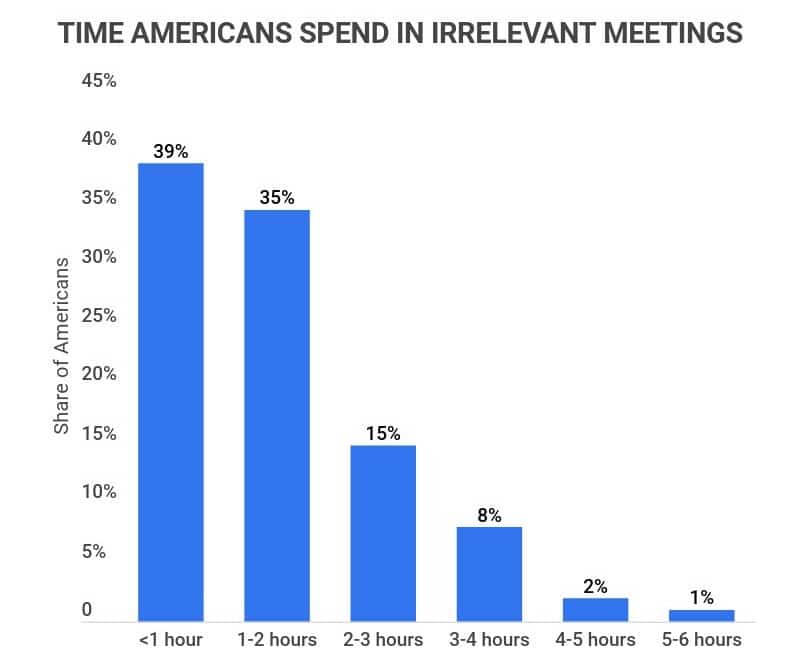
The most common low-value activities include unnecessary commuting (13%), unproductive meetings (16%), and excessive email checking (23%).
-
The average employee wastes 12% of their working hours daily on social media.
Given that the average internet user spends roughly 145 minutes per day on social media, it’s no surprise that many struggle to disconnect during work hours.
-
Employees procrastinate for an average of 2 hours and 11 minutes each day.
This amounts to over 10 hours lost weekly for a five-day work schedule, equating to around one-fourth of their working hours.
-
Research shows that unorganized workspaces waste an average of 45 minutes per day or 4.3 hours per week.
A cluttered workspace not only hampers time efficiency but also contributes to mental distractions and stress.
| Number of Employees | Hours per day | Hours per month | Hours per year |
|---|---|---|---|
| 5 | 14 | 300 | 3,600 |
| 10 | 29 | 600 | 7,200 |
| 20 | 57 | 1,200 | 14,400 |
| 50 | 143 | 3,000 | 36,000 |
| 100 | 285 | 6,000 | 72,000 |
| 250 | 713 | 15,000 | 180,000 |
| 500 | 1,425 | 30,000 | 360,000 |
| 1000 | 2,850 | 60,000 | 720,000 |
| Number of Employees | Civilian | Private Industry | State & Local Gov. |
|---|---|---|---|
| 5 | $132.4K | $124.2K | $183.2K |
| 10 | $264.7K | $248.3K | $366.4K |
| 20 | $529.5K | $496.66K | $732.8K |
| 50 | $1.32M | $1.24M | $1.83M |
| 100 | $2.65M | $2.48M | $3.66M |
| 250 | $6.62M | $6.21M | $9.16M |
| 500 | $13.24M | $12.42M | $18.32M |
| 1000 | $26.47M | $24.83M | $36.64M |
Time Management Statistics by Challenges and Distractions
-
Leaders spend an average of 72% of their workweek in meetings.
Studies reveal that leaders typically conduct around 37 meetings each week.
-
Workplace distractions consume an average of 3 hours of each employee’s day.
This equates to 60 hours lost per month, representing over 37% of each employee’s time wasted monthly.
-
Americans check their phones approximately 96 times daily.
This means individuals check their devices roughly every ten minutes.
-
During an 8-hour workday, employees actively work for only about 4 hours and 12 minutes.
This indicates that nearly half of the workday is lost to distractions, procrastination, or other factors limiting productivity.
Time Management Statistics by Benefits
-
87% of students believe better time management and organizational skills could improve their academic performance.
-
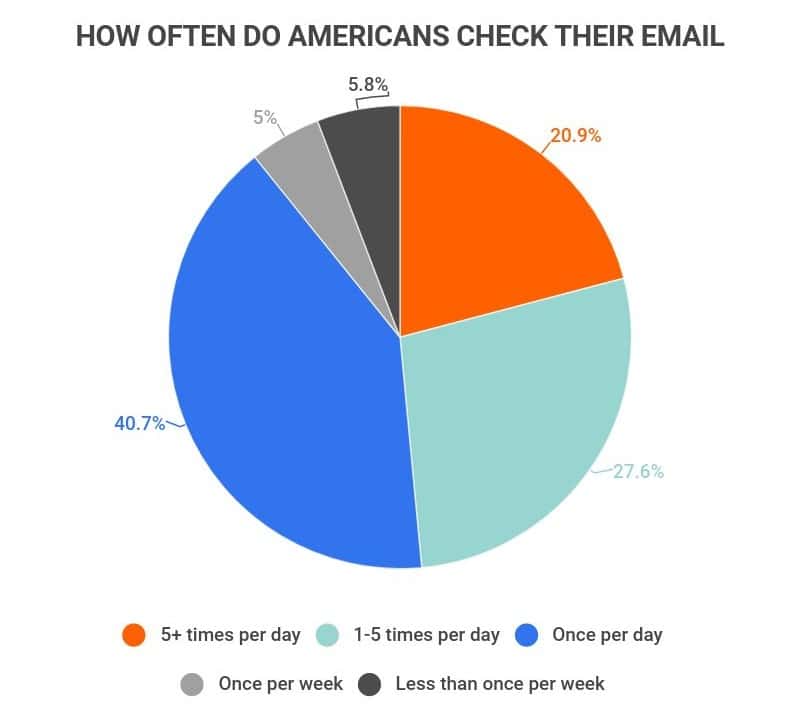
89% of Americans check their email daily, with 21% doing so more than five times a day.
-
Fewer than 3% of individuals have established written goals.
Time Management Statistics FAQ
-
What percentage of individuals implement a time management system?
Only 18% of individuals utilize a time management system, leaving 82% without a formal approach. Approximately 25% of individuals report “just dealing with what seems most urgent,” contributing to only 20% of workers feeling in control on a daily basis.
Among those who adopt time management systems, the Eisenhower Matrix is the most widely used tool for prioritizing tasks.
-
Does planning effectively save time?
Yes, planning does save time. Studies indicate that dedicating 10 to 12 minutes to daily planning can recover up to two hours of productive time throughout the day.
-
What are the consequences of poor time management?
Consequences of inadequate time management include missed deadlines, reduced productivity, and increased costs. Additional effects may include:
-
A stressful work environment
-
Poor customer relations
-
Decreased employee morale
-
Lower workplace focus
Effective time management is crucial for the success of any business or individual.
-
-
What does effective time management entail?
Effective time management involves thorough planning for short- and long-term goals, strategic delegation, and appropriate prioritization of tasks. Maintaining discipline to adhere to your chosen system is key, especially during challenging periods.
Setting boundaries in your professional life and knowing when to decline additional responsibilities is essential to avoid overcommitment and underperformance.
-
What is a prevalent time management error?
A common mistake is failing to plan each day in advance. While this may seem trivial, it can significantly enhance your productivity.
Other frequent mistakes include:
-
Starting the day late
-
Poor task prioritization
-
Giving in to distractions
-
Procrastination
-
Neglecting to create a weekly/monthly to-do list
-
These common time management pitfalls can waste valuable resources for both employees and employers.
Conclusion
Despite being on the clock for eight hours daily, a significant portion of this time remains unproductive. On average, workers actively engage in tasks for only 4 hours and 12 minutes during an 8-hour workday. Approximately 51% of each workday is consumed by low-value activities, adversely impacting productivity and increasing operational costs.
Time is wasted on social media (145 minutes daily), procrastination (2 hours daily), and frequent workplace distractions (11 interruptions per hour). This inefficiency has substantial financial implications, with distractions costing U.S. businesses around $588 billion each year. Many individuals attribute their lack of productivity to the absence of a time management system.
Currently, only 18% of people have a time management system in place, and the average person experiments with 13 different methods throughout their career. Although the notion of adopting a rigorous time management schedule may seem daunting, it can greatly enhance quality of life and work performance.
Taking just 10 to 12 minutes for daily planning can lead to a savings of two hours in productivity, helping to mitigate negative outcomes such as missed deadlines and workplace stress.
References
-
Development Academy. Time Management Statistics (NEW Research for 2021). Accessed on March 29, 2022
-
INC. The Average Worker Spends 51 Percent of Each Workday on These 3 Unnecessary Tasks | Inc.com. Accessed on March 29, 2022
-
Zippia. 40+ Worrisome Workplace Stress Statistics [2022]: Facts, Causes, And Trends – Zippia. Accessed on March 29, 2022
-
Dovico. Time Management Facts and Figures – Dovico Blog. Accessed on March 29, 2022
-
Proofhub. 22 Simple, Effective Time Management Strategies for Work. Accessed on March 29, 2022
-
Reuters. US worker interruptions costly, research shows | Reuters. Accessed on March 29, 2022
-
Zippia. 30 Surprising Social Media At Work Statistics [2022]: What Every Manager Should Know – Zippia. Accessed on March 29, 2022
-
Human Resources Online. How much time are your employees spending procrastinating?. Accessed on March 29, 2022
-
INC. The Negative Relationship Between a Messy Desk and Productivity | Inc.com
-
Harvard Business Review. How CEOs Manage Time. Accessed on March 29, 2022
-
TalkBoxBooth. The Shocking Cost of Workplace Distractions. Accessed on March 29, 2022
-
Asurion. Americans Check Their Phones 96 Times a Day – Asurion. Accessed on March 29, 2022
-
Zippia. Here’s How Many Hours Workers Are Actually Productive (And What They’re Doing Instead) – Zippia. Accessed on March 29, 2022
-
Reliable Planet. College students struggle with organizational skills. Accessed on March 29, 2022
-
Eleventy Group. 22 New Stats Showing How American Adults Use Email. Accessed on March 29, 2022
-
Everything What. What percentage of people have written goals? | EveryThingWhat.com. Accessed on March 29, 2022
-
Trafft. How Poor Time Management Can Make Your Business Suffer. Accessed on March 29, 2022
- Workplace Statistics
- Time Management Statistics
- Employee Wellness Statistics
- Employment Discrimination Statistics
- Employee Recognition Statistics
- Employee Referral Statistics
- Workplace Violence Statistics
- Gamification Statistics
- Employee Feedback Statistics
- Agile Statistics
- Productivity Statistics
- Meeting Statistics
- Cell Phones At Work Statistics
- Social Media At Work Statistics
- Workplace Injury Statistics
- Workplace Stress Statistics
- Leadership Statistics
- Workplace Collaboration Statistics
- Job Satisfaction Statistics
- Paid Holiday Statistics
- Communication In The Workplace Statistics
- Wasting Time At Work Statistics
- 4-day Workweek Statistics

Author

Sky Ariella is a professional freelance writer, originally from New York. She has been featured on websites and online magazines covering topics in career, travel, and lifestyle. She received her BA in psychology from Hunter College.