Average trade school cost research summary: Trade schools remain a highly valuable option for individuals seeking to enhance their skills without the lengthy commitment of traditional college programs. Fields such as plumbing and automotive repair often require specific trade school training.
If you’re exploring the costs associated with trade school in 2026, you’re in the right place. Our recent analysis of trade school costs across the United States reveals the following insights:
Key Takeaways:
-
Trade school costs an average of $17,600.
-
On average, trade school is over 50% less expensive per year than college.
-
Most trade programs can be completed in a few months to 2 years, significantly shorter than the typical 2-4 years required for a college degree.
Average Cost of Trade School by Career Path
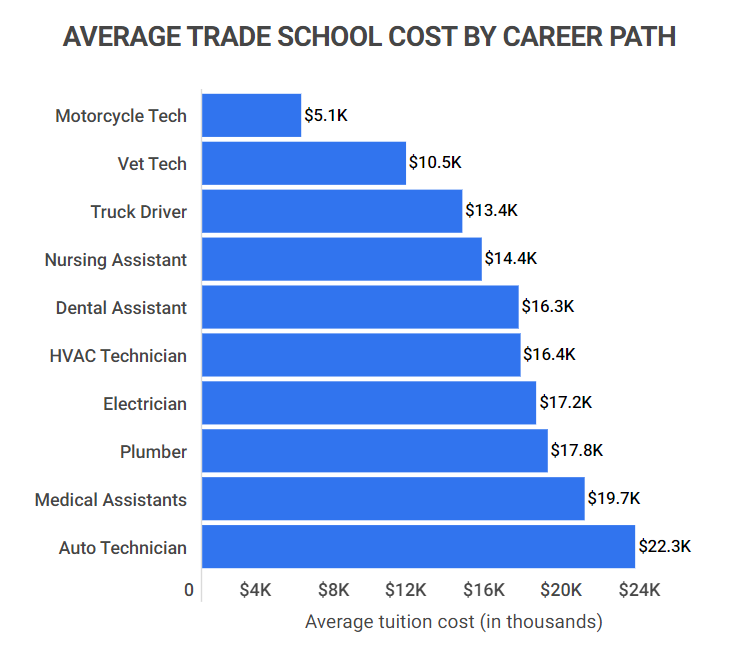
The cost of trade school varies significantly based on career path, as certain professions necessitate more extensive training or equipment. To better understand the costs associated with various career paths, refer to the detailed chart below:
Average Trade School Cost by Career Path
| Career Path | Average Trade School Cost | Average Annual Salary |
|---|---|---|
| Motorcycle Maintenance and Repair Technician | $5,100 | $36,300 |
| Veterinary Technician | $10,500 | $38,800 |
| Truck and Bus Driver | $13,400 | $42,700 |
| Nursing Assistant and Patient Care Aide | $14,400 | $32,900 |
| Dental Assistant | $16,300 | $46,000 |
| HVAC Technician | $16,400 | $48,400 |
| Electrician | $17,200 | $55,200 |
| Plumber | $17,800 | $43,000 |
| Medical and Clinical Assistants | $19,700 | $39,400 |
| Auto Technician | $22,300 | $57,800 |
The Motorcycle Maintenance and Repair Technician career path offers the lowest average trade school cost at $5,100, while the Auto Technician path incurs the highest average cost at $22,300. However, it’s crucial to weigh these costs against potential earnings; Auto Technicians typically earn about 60% more than Motorcycle Technicians, with average salaries of $57,800 compared to $36,300.
Trade School Cost by School Type
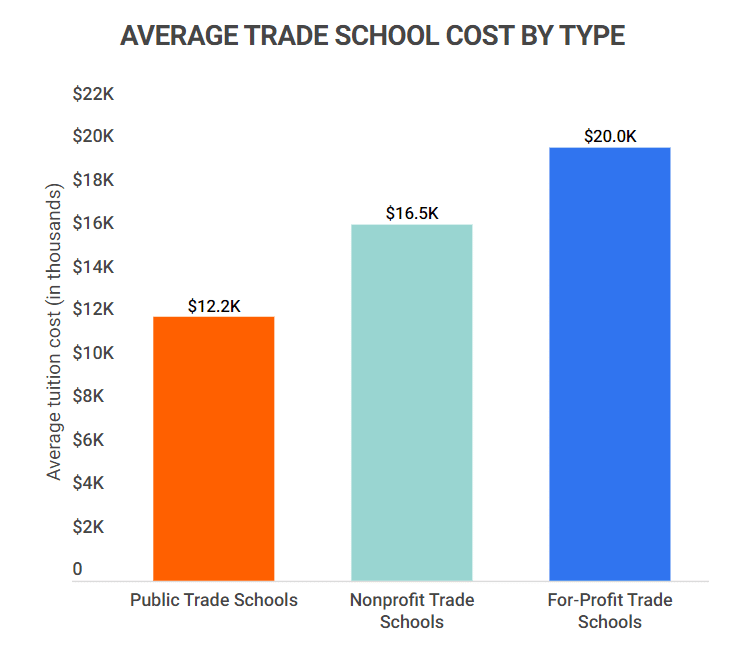
Trade schools vary not only by program but also by institutional type, which can influence average costs. Generally, for-profit trade schools tend to be pricier than public institutions, although they may offer specialized training.
Below are the average costs associated with different types of trade schools, listed from least to most expensive:
Average Trade School Cost by Trade School Type
| Trade School Type | Average Cost |
|---|---|
| Public Trade Schools and Community Colleges | $12,200 |
| Nonprofit Trade Schools | $16,500 |
| For-Profit Trade Schools | $20,030 |
-
Public Trade Schools. These institutions typically provide the most affordable options for trade certificate and Associate degree programs that can enhance your career prospects.
-
Nonprofit Trade Schools. Nonprofit institutions often offer competitively priced trade programs compared to their for-profit counterparts.
-
For-Profit Trade Schools. While these schools provide a diverse range of quality programs, they tend to be more expensive than public or nonprofit schools.
Your choice of school will largely depend on your career aspirations, as different institutions may offer specific programs aligned with your goals.
Average Trade School Cost FAQ
-
Can you use federal student loans for trade school?
Yes, federal student loans are available for some trade schools, but not all. Accreditation is key; if your school is accredited, a public trade school, or a community college, you should qualify for federal aid.
Additional eligibility criteria for federal student loans include:
-
The courses are part of a degree program.
-
The courses will enable certification (or recertification) as a teacher.
-
Your certification program prepares you for a specific career.
If uncertain, consult with your institution and the federal student loan office to clarify your options for funding your education.
-
-
How long do most trade schools take?
Most trade programs last between a few months to 2 years, which is approximately half the duration of a typical college degree that usually spans 2-4 years.
For instance, if a college education costs $35,000 per year, a four-year degree totals $140,000. In contrast, a trade school program costing $20,000 over two years totals just $40,000.
-
What are additional trade school costs?
Besides tuition, there are several additional costs to consider when budgeting for trade school. Here are some common extra expenses:
-
Books and Supplies: $1,500
-
Housing: $8,000-$18,000
-
Apprenticeship: $4,800-$8,700
-
Opportunity Cost: 9-18 Months of Lost Salary
Keep in mind that these costs can vary; many programs may not require apprenticeships, and you may already have housing arrangements. Always be prepared for unexpected expenses.
-
-
How does trade school ROI compare to a bachelor’s degree?
Trade school often provides a higher ROI than a bachelor’s degree, with graduates earning an average of 22 times their educational investment. In contrast, bachelor’s degree holders typically earn around 15 times their education cost.
This discrepancy arises from the generally higher costs and longer durations associated with bachelor’s degrees. While bachelor’s degree holders may earn higher salaries on average, this does not necessarily equate to superior ROI.
Conclusion
As of 2026, the average cost of trade school stands at $17,600, which is over 50% less than the average college tuition of approximately $36,400.
These averages vary by career path and school type, with private trade schools being around 64% more expensive than public institutions, and Auto Technicians incurring costs three times higher than those of Motorcycle Technicians.
Ultimately, it’s essential to consider all potential costs when planning for trade school. Evaluate your desired career path and the school you choose, and account for housing needs and potential time off from work. All these factors will influence the overall cost of your trade school education.
References
-
Midwest Technical Institute – Trade school vs College: a guide to weighing cost, timelines and more

Author

Jack Flynn is a writer for Zippia. In his professional career he’s written over 100 research papers, articles and blog posts. Some of his most popular published works include his writing about economic terms and research into job classifications. Jack received his BS from Hampshire College.