Research Summary: In the United States, significant strides have been made since 1920, from securing the right to vote to gaining access to the same job opportunities as men. Yet, the journey towards gender equality is far from complete.
The gender pay gap continues to be a pressing issue, with women frequently earning less than their male counterparts in similar roles. To shed light on this persistent challenge, we have compiled key gender pay gap statistics that illustrate the current landscape:
-
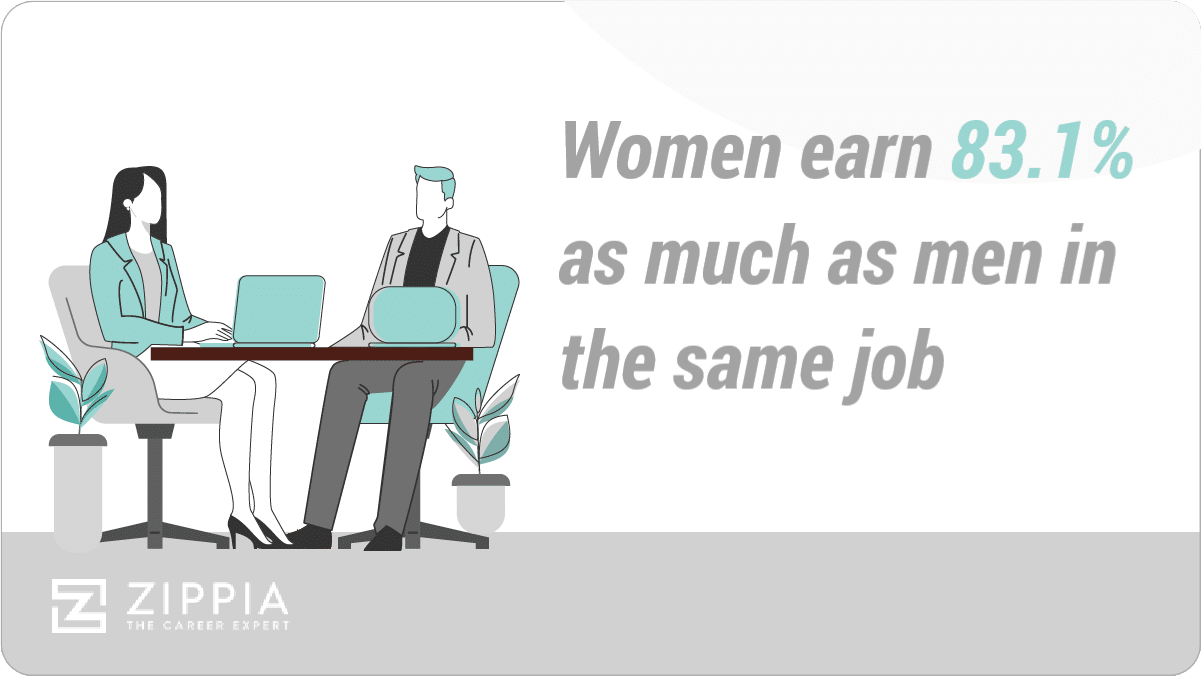
Women earn 83.1% of what men earn for the same job as of 2023.
-
Hispanic women face the greatest disparity, earning only 57 cents for every dollar a white man earns.
-
Asian women slightly surpass white men, earning $1.01 for every dollar they make.
-
Women aged 65 and older experience the most drastic pay gap, earning only 74.25% of what men earn.
-
Women aged 16-24 have the smallest gap, earning 94.11% of their male peers’ earnings.
For a deeper analysis, we have categorized the data by:
Time | Parenting and Motherhood | Demographics | Title | Industry | Location
General Gender Pay Gap Statistics
Understanding the implications of the gender pay gap is vital. Here are some key insights on how it affects women’s earnings in the U.S.:
-
The average woman earns $80,000 less over a 40-year career.
This gap represents a significant financial disadvantage that women endure over their lifetimes.
-
The average businessman earns 60% more than his female counterpart by career’s end.
Graduating businesswomen start at an average of $115,000 compared to $130,000 for men, but this difference magnifies over time.
-
The uncontrolled gender pay gap is 10.25 times worse than the controlled gap.
This disparity highlights the broader systemic issues that contribute to unequal pay across various demographics.
-
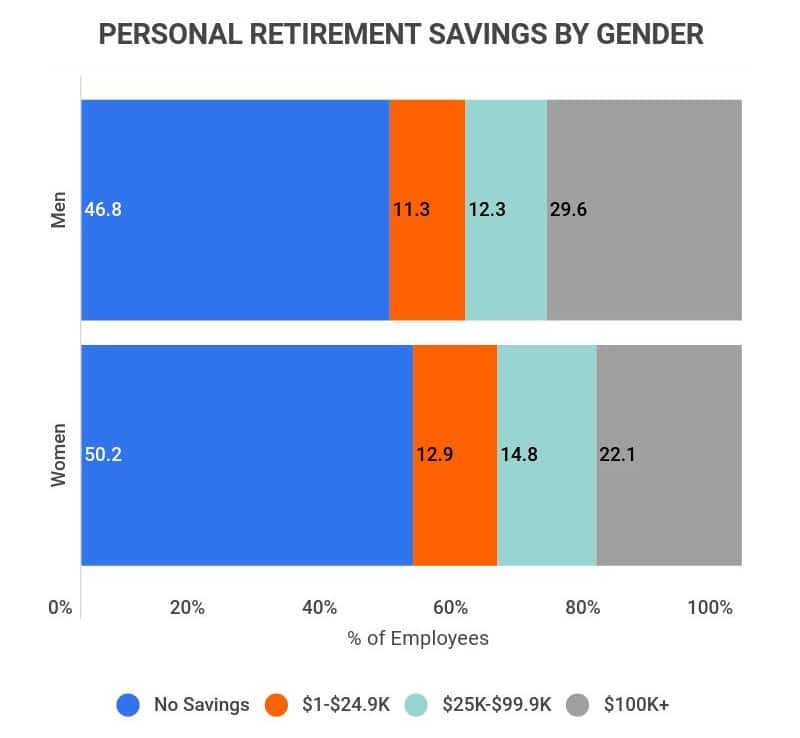
Women are 6.2% less likely to have retirement savings by age 66.
While 47% of men aged 55-66 have no retirement savings, this figure rises to 50% for women, underscoring the financial challenges faced by women.
-
The U.S. ranks fourth among OECD countries for gender pay gap, with a gross earnings decile ratio of 17.7%.
Latvia, Japan, and South Korea have larger gaps, while Bulgaria boasts the smallest at 2.6%.
Gender Pay Gap Statistics Over Time
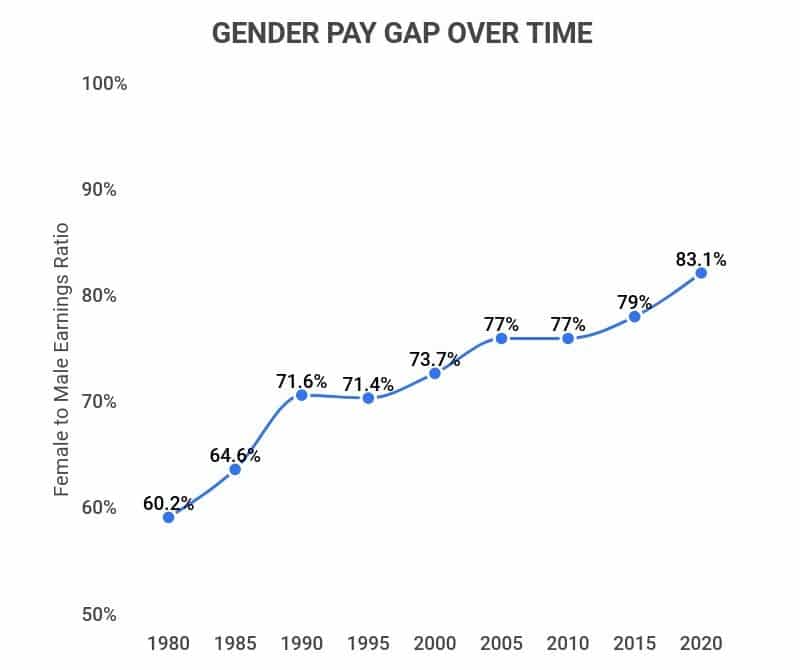
Although the gender pay gap remains a major concern, progress has been made over the decades. Consider the following trends:
-
Since 1980, the gender pay gap has narrowed by 38%.
In 1980, women earned just 60 cents for every dollar men earned, compared to 83 cents today.
-
The gap has narrowed more for workers aged 25-34, now at 93% of male earnings.
This group has seen significant improvements since 1980, when they made only 67 cents for every dollar men earned.
-
Women’s job loss during the pandemic was disproportionately high.
Women lost 5.4 million jobs compared to 4.4 million for men, reflecting the ongoing impact of economic downturns on female employment.
-
Between 1980 and 2016, women’s average hourly rate increased by 63.7%.
In 1980, the average woman earned $12.48 per hour, compared to $19.23 for men by 2016, indicating a narrowing gap but still a significant difference.
-
From 1950 to 2017, women’s workforce participation rose from 33.9% to 57%.
This change reflects a shift towards greater gender equality in the labor market.
Gender Pay Gap Statistics by Parenting and Motherhood
Motherhood has a pronounced impact on women’s careers, often affecting their earnings more significantly than men’s. Here are some statistics related to this issue:
-
40% of mothers report that taking time off for children adversely affects their careers.
In contrast, only 15% of fathers feel the same way, highlighting the unequal burden of caregiving on women.
-
41% of mothers are primary caregivers.
This often entails juggling multiple jobs to meet family needs, while 32% of fathers take on primary caregiving roles.
-
Only 13% of women in the private sector have access to paid maternity leave.
This lack of support contributes to the challenges women face in balancing work and family responsibilities.
Gender Pay Gap Statistics by Demographics
The effects of the gender pay gap vary significantly across different demographics. Here are some key insights:
-
Women aged 25-34 earn 93% of what their male counterparts earn.
Women aged 16-24 earn 94.11%, while those aged 65+ earn only 74.25%.
-
Hispanic women experience the largest pay differential, earning only 57% of what white men do.
Black women face a similar disparity, earning only 64% of white men’s earnings.
-
Asian women earn $1.01 for every dollar white men earn.
However, this varies among different Asian ethnicities, with some earning significantly less.
-
By the end of a 40-year career, the uncontrolled gender pay gap for Hispanic women is $1,163,920.
This figure is even higher for Native American and Black women, highlighting systemic inequities.
Gender Pay Gap Statistics by Job Title
The gender pay gap can vary widely by job title. Here are some highlights:
-
Women represent 58% of workers earning less than $15 per hour.
This is notable given that men and women are evenly split in the workforce.
-
Only 8.2% of Fortune 500 CEOs are women.
Women hold approximately 23% of executive positions, 29% of senior management roles, and 37% of managerial positions.
-
Women make up only 27% of the 117th United States Congress.
Despite a 50% increase over the past decade, this figure remains below parity.
-
Anesthesiologists are the highest-paying profession in the U.S., with only 36.4% being women.
In healthcare, despite women making up 77% of the workforce, they are underrepresented in high-paying roles.
-
Women constitute 55% of laundry workers, the lowest-paid profession.
They also dominate other low-paying jobs such as fast food workers, servers, cashiers, and housekeepers.
Gender Pay Gap Statistics by Industry
The gender pay gap varies across industries. Here are some findings:
-
The Finance & Insurance industry has the highest gender pay gap. Women earn $33,000 less than their male counterparts.
-
The Construction industry has the lowest gender pay gap. Women earn 93.2% of what men do in this sector.
| Industry | Male Median Earnings (in thousands USD) | Female Median Earnings (in thousands USD) | % of a Man’s Income that Women Make |
|---|---|---|---|
| Finance & insurance | $83.7K | $50.5K | 60.3% |
| Professional, scientific, & technical services | $84.7K | $53.2K | 62.7% |
| Agriculture, forestry, fishing & hunting | $32.0K | $20.7K | 64.6% |
| Management of companies & enterprises | $85.2K | $58.7K | 68.9% |
| Retail trade | $30.6K | $21.4K | 70.0% |
| Health care & social assistance | $51.2K | $35.9K | 70.1% |
| Information | $65.5K | $46.6K | 71.1% |
| Transportation & warehousing | $45.0K | $32.3K | 71.9% |
| Manufacturing | $52.0K | $37.7K | 72.5% |
| Arts, entertainment, & recreation | $28.3K | $21.1K | 74.4% |
| Public administration | $66.0K | $50.1K | 75.9% |
| Accommodation & food services | $21.0K | $16.3K | 77.6% |
| Utilities | $76.9K | $60.5K | 78.7% |
| Wholesale trade | $51.4K | $40.6K | 79.0% |
| Administrative & support & waste management services | $31.5K | $25.1K | 79.5% |
| Educational services | $47.5K | $39.7K | 83.6% |
| Real estate | $46.8K | $40.3K | 86.1% |
| Mining, quarrying, & oil and gas extraction | $73.0K | $65.4K | 89.5% |
| Construction | $42.1K | $39.2K | 93.2% |
Gender Pay Gap Statistics by Location
State policies significantly impact the gender pay gap. Here are some insights based on location:
-
Vermont has the smallest gender pay gap, with women earning 91% of what men earn.
Other states with favorable statistics include Hawaii (89%), Maryland (89%), California (88%), and Nevada (87%).
-
Wyoming has the largest gender pay gap, with women making only 65% of what men earn.
Utah (70%), Louisiana (72%), Oklahoma (73%), and Alabama (74%) follow closely behind.
| State | % of a Man’s Income that Women Make |
|---|---|
| Vermont | 91% |
| Hawaii | 89% |
| Maryland | 89% |
| California | 88% |
| Nevada | 87% |
| New York | 86% |
| North Carolina | 86% |
| Rhode Island | 85% |
| Alaska | 85% |
| Connecticut | 84% |
| Arizona | 83% |
| Delaware | 83% |
| Florida | 83% |
| New Hampshire | 82% |
| Minnesota | 81% |
| Massachusetts | 81% |
| Wisconsin | 81% |
| Georgia | 80% |
| Tennessee | 80% |
| New Jersey | 80% |
| Oregon | 80% |
| Missouri | 80% |
| Maine | 80% |
| Nebraska | 80% |
| Colorado | 80% |
| Virginia | 80% |
| Kentucky | 80% |
| Kansas | 80% |
| Texas | 80% |
| Arkansas | 79% |
| Pennsylvania | 79% |
| Ohio | 79% |
| Washington | 79% |
| Illinois | 78% |
| Iowa | 78% |
| Michigan | 78% |
| New Mexico | 78% |
| Montana | 78% |
| South Carolina | 77% |
| Mississippi | 77% |
| West Virginia | 76% |
| North Dakota | 76% |
| Indiana | 76% |
| Idaho | 75% |
| South Dakota | 75% |
| Alabama | 74% |
| Oklahoma | 73% |
| Louisiana | 72% |
| Utah | 70% |
| Wyoming | 65% |
Gender Pay Gap Statistics FAQ
-
How much more do men get paid than women?
The average man earns 17 cents more per dollar than the average woman. Over a 40-year career, this results in an $80,000 earnings gap, compounded by the fact that women tend to work in lower-paying jobs.
-
How is the gender pay gap calculated?
The gender pay gap is calculated using U.S. Census Bureau data. Median salaries of men and women are compared to find the percentage discrepancy, providing insight into overall pay equity.
-
What are the main causes of the gender pay gap?
The gender pay gap results from various factors. These include discrimination, occupational clustering, and time away from work, such as maternity leave. Addressing these root causes is crucial for achieving pay equity.
-
How can we close the gender pay gap?
Five significant strategies can help close the wage gap. Raising the minimum wage, improving schedule regulation, allowing pay transparency, making childcare affordable, and implementing paid medical leave are all essential steps towards equity.
-
What are the challenges in accurately calculating the gender wage gap?
Accurate calculation of the gender wage gap is complex. Factors such as age, race, and industry can skew results, as can the presence of high earners in the data set, making distinctions between controlled and uncontrolled calculations necessary.
-
Does an equitable “controlled gender pay gap” mean that there’s no gender discrimination?
Theoretically, yes. An equitable controlled pay gap indicates that women and men with the same qualifications in the same roles are paid equally, but it must also consider the ongoing disparities in job choices and valuation of female-dominated fields.
-
Nursing is the most common female-dominated profession, with over 2.18 million women employed. Other prevalent roles include teachers, secretaries, managers, and customer service representatives.
Conclusion
Despite progress since the 1980s, the gender pay gap remains a significant issue in 2026, with women earning only 83.1% of what men earn. The gap is even more pronounced for women of color, older women, and those in male-dominated fields.
To achieve true equity, we must implement solutions such as raising the minimum wage, providing affordable childcare, and ensuring paid medical leave. All women, regardless of age or ethnicity, deserve fair compensation for their work.
Sources:
-
CAP. “Women of Color and the Wage Gap.” Accessed on March 27th, 2022.
-
Statista. “Female to male earnings ratio of workers in the U.S. in Q4 2021, by age group.” Accessed on March 27th, 2022.
-
Vox. “A stunning chart shows the true cause of the gender wage gap.” Accessed on March 28th, 2022.
-
Work It Daily. “Working Women: The Latest Statistics On The Gender Pay Gap.” Accessed on March 28th, 2022.
-
United States Census Bureau. “Those Who Married Once More Likely Than Others to Have Retirement Savings.” Accessed on March 28th, 2022.
-
OECD Data. “Gender wage gap.” Accessed on March 28th, 2022.
-
Pew Research Center. “Gender pay gap in U.S. held steady in 2020.” Accessed on March 28th, 2022.
-
Wikimedia Commons. “File:US Gender pay gap, 1980-2009.” Accessed on March 28th, 2022.
-
CAP. “When Women Lose All the Jobs: Essential Actions for a Gender-Equitable Recovery.” Accessed on March 28th, 2022.
-
Pew Research Center. “For Women’s History Month, a look at gender gains – and gaps – in the U.S.” Accessed on March 28th, 2022.
-
Pew Research Center. “Chapter 5: Balancing Work and Family.” Accessed on March 28th, 2022.
-
CAP. “Breadwinning Mothers Continue To Be the U.S. Norm.” Accessed on March 28th, 2022.
-
OSU. “82% of Americans want paid maternity leave – making it as popular as chocolate.” Accessed on March 28th, 2022.
-
CAP. “Raising the Minimum Wage Would Be Transformative for Women.” Accessed on March 28th, 2022.
-
Zippia. “25 Women in Leadership Statistics [2022]: Facts on the Gender Gap in Corporate and Political Leadership.” Accessed on March 28th, 2022.
-
Howmuch. “Visualizing the Massive Gender Pay Gap Across U.S. Industries.” Accessed on March 28th, 2022.

Author

Jack Flynn is a writer for Zippia. In his professional career he’s written over 100 research papers, articles and blog posts. Some of his most popular published works include his writing about economic terms and research into job classifications. Jack received his BS from Hampshire College.