- Facts and Figures
- Social Security Statistics
- Social Media Statistics
- Cell Phone Usage Statistics
- Cryptocurrency Statistics
- White Collar Crime Statistics
- Crowdfunding Statistics
- Branding Statistics
- How Many Emails Are Sent Per Day
- Money Laundering Statistics
- Childcare Availability Statistics
- Cold Calling Statistics
- Automation And Job Loss Statistics
- Student Loan Statistics
- Spam Statistics
- Password Statistics
- Ransomware Statistics
- Christmas Spending Statistics
- Average Grocery Cost By State
- Average Screen Time Statistics
- Average Monthly Expenses
- IoT Statistics
- Gen Z Statistics
Research Summary. Money laundering continues to be a critical concern in the United States and worldwide. Despite its illegality, vast sums are funneled through illicit channels each year. Our updated analysis reveals:
-
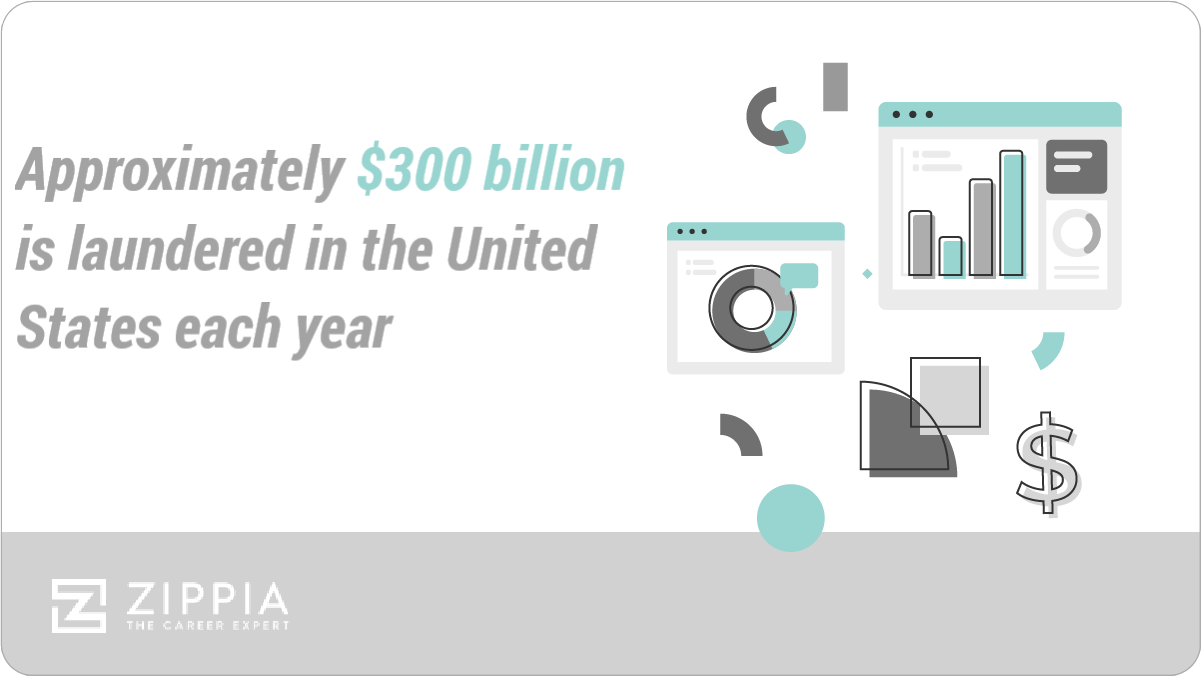
Approximately $300 billion is laundered in the United States annually.
-
Globally, criminals launder between $800 billion and $2 trillion each year.
-
In 2021, global banks faced $10.4 billion in fines for violations related to money laundering.
-
Capital One remains the largest American bank fined, paying $390 million for failing to report suspicious transactions.
-
Money laundering schemes account for 2%-5% of the world’s total GDP.
For additional insights, we categorized the data as follows:
Currency | Over Time | Issues and Causes
General Money Laundering Statistics
Money laundering has significant financial repercussions for individuals and governments alike. Here are key insights from our updated research:
-
Money laundering in the U.S. constitutes 15%-38% of the total laundered worldwide.
With an estimated $300 billion laundered annually in the U.S., it represents a substantial portion of the global total of $800 billion to $2 trillion.
-
While 91.1% of money laundering offenders face imprisonment, 90% of these crimes remain undetected.
The high imprisonment rate belies the rarity of reported cases; for instance, there were only 990 cases reported in the U.S. in 2019.
-
Richmond, Virginia, ranks highest for white-collar crimes, with 7,504 incidents per 10,000 residents.
This figure is stark compared to Miami, which follows with 4,237 white-collar crimes per 10,000 people. Columbus, Ohio, leads for identity theft with 368 crimes per 10,000 residents.
-
Afghanistan poses the highest money laundering risk globally.
With an AML risk score of 8.16, Afghanistan leads the rankings, followed closely by Haiti and Myanmar, with scores of 8.15 and 7.86 respectively. The following section provides further insights into AML risks by country:
-
The average prison sentence for money launderers is approximately 67 months.
While the minimum jail sentence for money laundering is one year, felony cases incur a minimum fine of $250,000.
Highest Number Of White Collar Crimes Per 10,000 People
| U.S. City | # Of White Collar Crimes Per 10,000 People |
|---|---|
| Richmond, VA | 7,504 |
| Miami, FL | 4,237 |
| Atlanta, GA | 3,008 |
| Columbus, OH | 2,788 |
| Riverside, CA | 2,625 |
| San Francisco, CA | 2,466 |
| Orlando, FL | 2,452 |
| Charlotte, NC | 2,065 |
| Denver, CO | 1,782 |
| Tampa, FL | 1,561 |
| Cincinnati, OH | 1,548 |
| Pittsburgh, PA | 1,329 |
| Minneapolis, MN | 1,241 |
| San Jose, CA | 1,116 |
| Las Vegas, NV | 1,056 |
| Boston, MA | 1,046 |
| Dallas, TX | 966 |
| St. Louis, MO | 903 |
| Detroit, MI | 855 |
| Sacramento, CA | 847 |
| Baltimore, MD | 760 |
| Los Angeles, CA | 758 |
| Seattle, WA | 707 |
| Cleveland, OH | 686.0 |
| Houston, TX | 608.0 |
Countries with the Lowest AML Risk
| Country | AML Risk |
|---|---|
| The Democratic Republic Of The Congo | 8.30 |
| Haiti | 8.16 |
| Myanmar | 7.78 |
| Mozambique | 7.68 |
| Madagascar | 7.59 |
| Guinea-Bissau | 7.53 |
| Cambodia | 7.36 |
| Mali | 7.28 |
| Senegal | 7.05 |
| Vietnam | 7.04 |
Countries with the Highest AML Risk
| Country | AML Risk |
|---|---|
| Finland | 2.88 |
| Andorra | 2.89 |
| Sweden | 3.12 |
| Iceland | 3.31 |
| New Zealand | 3.32 |
| San Marino | 3.34 |
| Slovenia | 3.37 |
| Lithuania | 3.43 |
| Norway | 3.50 |
| France | 3.52 |
Crypto vs. Fiat Currency Money Laundering Statistics
As digital currencies gain traction, money laundering methods have evolved beyond traditional fiat currencies. Here are the latest insights:
-
Despite increased cybercrime rates, the use of cryptocurrency for criminal activities has significantly declined.
In 2021, only 0.34% of cybercrimes involved cryptocurrency, down from 2.1% in 2019.
-
Over 99% of cryptocurrency transactions are processed through AML-compliant exchanges.
This includes Bitcoin (BTC), Ethereum (ETH), Stellar (XLM), Binance Coin (BNB), among others.
-
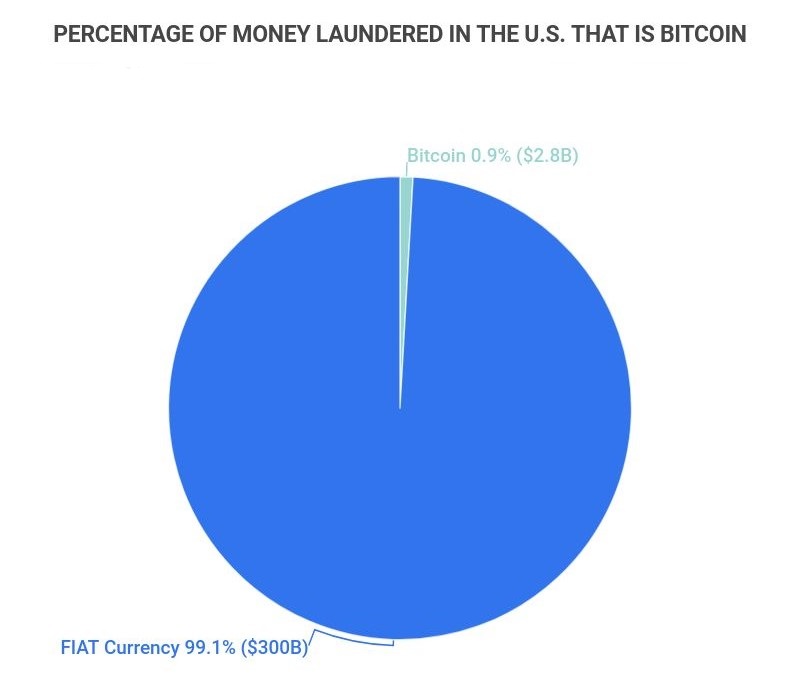
Bitcoin accounts for only 0.9% of money laundering in the U.S. and 0.3% globally.
In 2019, $2.8 billion worth of Bitcoin was involved in criminal activity, a small fraction compared to the global money laundering estimates.
-
The IRS has seized $1.2 billion in cryptocurrency as of 2021.
This amount reflects a significant increase, from $700,000 in 2019 to $137 million in 2020, signifying the growing enforcement in this area.
Money Laundering Over Time Statistics
Money laundering remains a persistent issue, with trends indicating continued growth. Here are the facts:
-
Post-pandemic, money laundering fines have escalated dramatically.
Although there was a 13% drop in cases from 2018 to 2019, fines have surged, reflecting the ongoing challenges in combating this crime.
-
The anti-money laundering software market is projected to grow at a CAGR of 14% from 2021 to 2025.
Initially valued at $879 million in 2017, it is set to reach approximately $2.09 billion by 2025.
-
Financial crime compliance costs have surged by 95% since 2019.
For institutions with assets over $10 billion, these costs are expected to reach $27.8 million in 2021, a significant increase compared to previous years.
Money Laundering Issues and Causes
Money laundering remains a global challenge. Here are some key contributing factors:
-
41% of financial institutions are inadequately equipped to meet AML and sanctions compliance standards.
This is concerning, especially as 67% of institutions reported increased spending on compliance in the past year.
-
Anti-money laundering efforts currently recover only 0.1% of laundered funds.
Fines are often imposed, but the original illicit funds remain largely unrecovered, leaving perpetrators free to exploit their stolen money.
Money Laundering Statistics FAQ
-
Money laundering refers to the process of disguising funds obtained from illegal activities as legitimate income. For instance, someone who earns money from drug trafficking may attempt to make it appear as though it originated from a legitimate restaurant business.
-
How much money is laundered each year?
In the U.S., approximately $300 billion is laundered annually. This figure rises to between $800 billion and $2 trillion on a global scale.
-
How much money is lost to money laundering?
Between 2% and 5% of the world’s total GDP is lost to money laundering each year.
-
What is the money laundering capital of the world?
While London has historically been a significant hub for money laundering, British Columbia has emerged as a key location, with an estimated $5 billion in dirty money laundered in 2019.
-
How many people are affected by money laundering?
Although quantifying the number of affected individuals is challenging, there are nearly 1,000 documented cases in the U.S. each year. The financial impact is staggering, with approximately $300 billion laundered annually, representing 15%-38% of the global total.
Determining the indirect effects on individuals is complex, given the vast sums involved.
-
What is the most common form of money laundering?
Smurfing, or structuring, is the most prevalent method of money laundering. This technique involves breaking down large cash amounts into smaller deposits to evade detection. Other common strategies include commodity trading, investing in unrelated assets (such as real estate), gambling, and counterfeiting.
Conclusion
Money laundering results in an estimated $300 billion in losses in the U.S. and up to $2 trillion globally, representing a pressing global challenge. Alarmingly, 90% of money laundering crimes often evade detection.
Although digital currencies like Bitcoin are changing the landscape, most money laundering activities still occur with fiat currencies, with cybercrime accounting for less than 1% of global estimates.
The U.S. must intensify efforts to combat this issue, as 15%-38% of the world’s laundered money originates here. While AML and sanctions compliance are crucial, the reality remains that 41% of financial institutions struggle to meet the growing expectations, potentially exacerbating the problem.
Sources
-
ABA Banking Journal. “Treasury: U.S. Money-Laundering Totals $300B Annually.” Accessed on September 30th, 2021.
-
The Economist. “The war against money-laundering is being lost.” Accessed on September 30th, 2021.
-
Johnson City Press. “Risk Solutions Study Reveals Sharp Rise of Financial Crime Compliance Costs, Now Nearly $49.9 Billion Per Year for Financial Institutions in the United States and Canada.” Accessed on September 30th, 2021.
-
Charlotte Stories. “Charlotte Ranked Among The Top 10 Worst Cities In America For ‘White Collar Crime’.” Accessed on September 30th, 2021.
-
CriminalDefenceLawyer. “Money Laundering.” Accessed on September 30th, 2021.
-
Payments Journal. “Cryptocurrency is Better for Anti-Money Laundering than You Might Think.” Accessed on September 30th, 2021.
-
LinkedIn. “Comparing Money Laundering With Cryptocurrencies and Fiat.” Accessed on September 30th, 2021.
-
CNBC. “The IRS has seized $1.2 billion worth of cryptocurrency this fiscal year – here’s what happens to it.” Accessed on September 30th, 2021.
-
Forbes. “Watchdogs Hit Money Launderers With Record Fines.” Accessed on October 1st, 2021.
-
Cision. “Anti-Money Laundering (AML) Software Market to grow over $ 2 Bn during 2021-2025 | COVID-19 Impact Analysis | 17,000+ Technavio Research Reports.” Accessed on October 1st, 2021.
-
International Banker. “The Top Challenges in Anti-Money Laundering and Sanctions Compliance.” Accessed on October 1st, 2021.
-
Taylor Francis Online. “Anti-money laundering: The world’s least effective policy experiment? Together, we can fix it.” Accessed on October 1st, 2021.
-
Sanction Scanner. “Major Money Laundering Countries.” Accessed on March 29th, 2023.
- Facts and Figures
- Social Security Statistics
- Social Media Statistics
- Cell Phone Usage Statistics
- Cryptocurrency Statistics
- White Collar Crime Statistics
- Crowdfunding Statistics
- Branding Statistics
- How Many Emails Are Sent Per Day
- Money Laundering Statistics
- Childcare Availability Statistics
- Cold Calling Statistics
- Automation And Job Loss Statistics
- Student Loan Statistics
- Spam Statistics
- Password Statistics
- Ransomware Statistics
- Christmas Spending Statistics
- Average Grocery Cost By State
- Average Screen Time Statistics
- Average Monthly Expenses
- IoT Statistics
- Gen Z Statistics

Author

Chris Kolmar is a co-founder of Zippia and the editor-in-chief of the Zippia career advice blog. He has hired over 50 people in his career, been hired five times, and wants to help you land your next job. His research has been featured on the New York Times, Thrillist, VOX, The Atlantic, and a host of local news. More recently, he's been quoted on USA Today, BusinessInsider, and CNBC.