- How To Quit
- The Process
- Leaving The Office
- Other Ways To Leave
- Paperwork
-
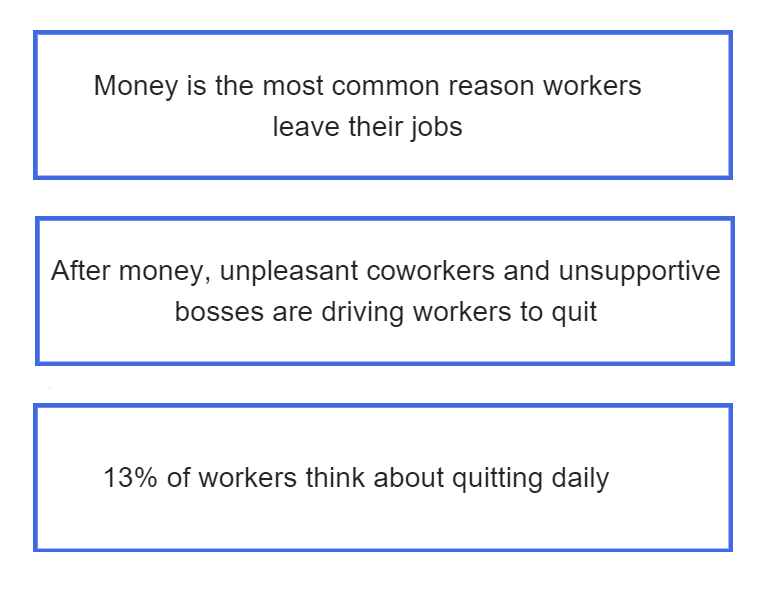
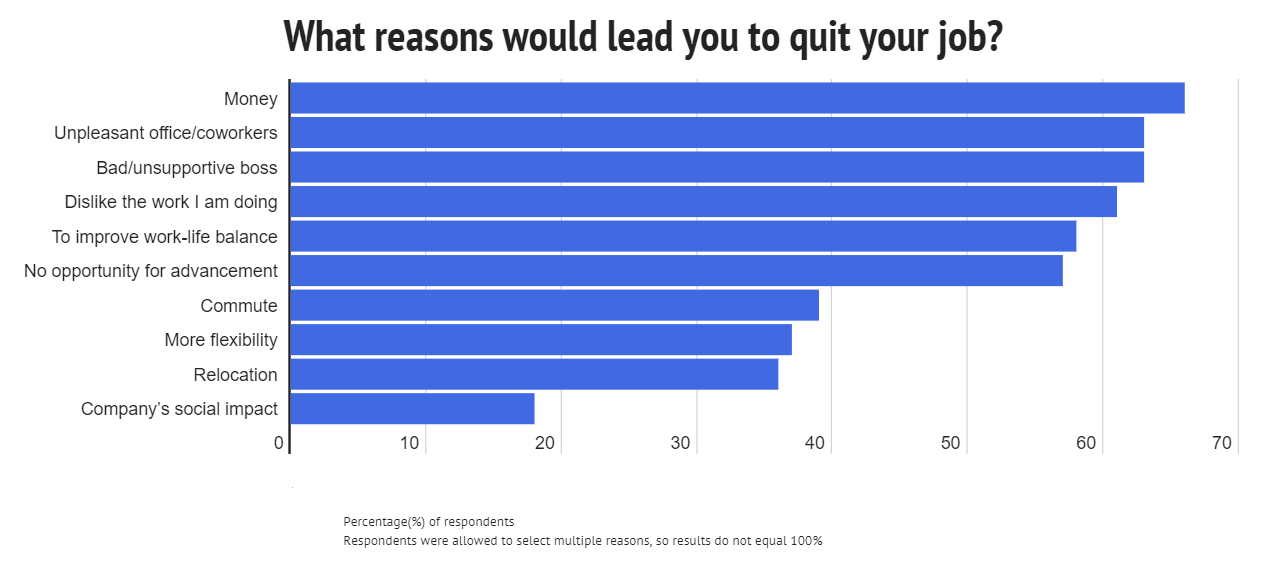
66% of employees cite financial reasons as the leading cause for leaving their jobs, highlighting the importance of compensation.
-
Only 18% of respondents indicated a company’s social impact as a reason for quitting, making it the least common factor.
-
The second most prevalent reasons for resignation include toxic coworkers and poor management, both reported by 63% of respondents.
-
Additionally, 64% of employees admit to contemplating quitting their jobs at some point.
What drives good employees to resign?
Is it solely financial incentives or the allure of a prestigious title? Perhaps they yearn for something more profound, such as a healthy work-life balance or fulfilling work. The saying, “people don’t quit jobs, they quit managers,” remains relevant.
We conducted a survey of 2,000 U.S. workers to gain insights into the factors motivating them to resign and what might encourage them to stay.
The findings reveal that while money is a significant motivator, it is not the only reason prompting employees to update their resumes.
Quick Facts
Other Notable Findings
-
42% of employees report they would never resign without securing another job first.
-
Meanwhile, 22% feel confident they can find another job soon if they decide to quit, while 36% would leave regardless of their job search status.
-
A majority of workers, 60%, have never made an impulsive decision to quit a job.
-
However, 15% of employees are planning to resign within the next three months.
-
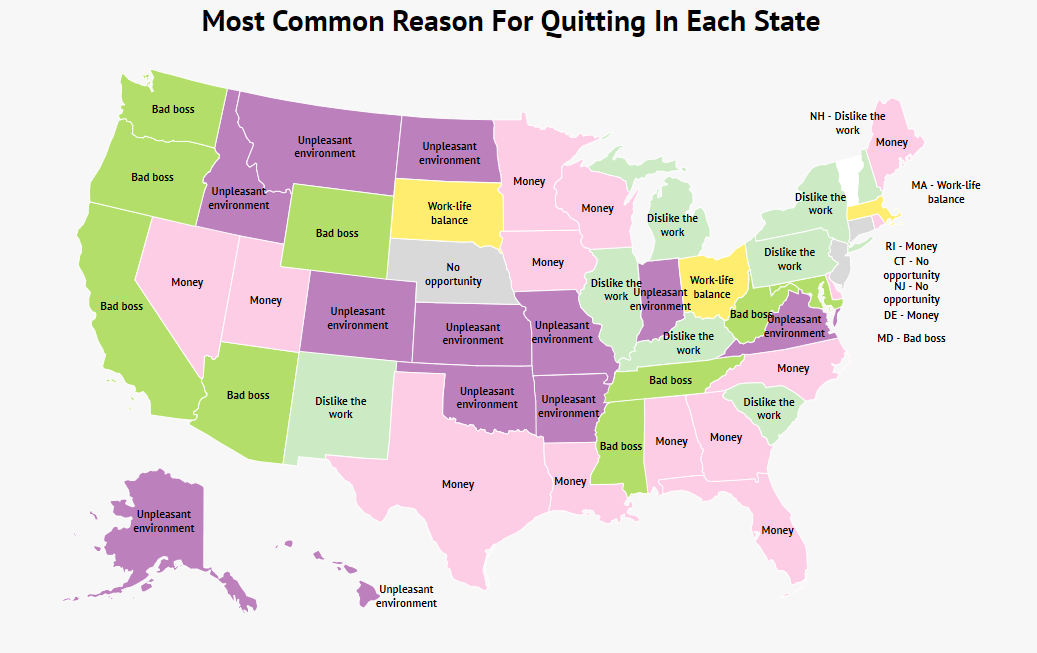
States like Massachusetts, Ohio, and South Dakota emphasize living well rather than merely working.
-
West Coast states, particularly California, Washington, and Oregon, face significant issues with employee dissatisfaction due to poor management.
-
To improve retention in New Jersey, organizations should focus on providing opportunities for advancement!
-
8 states report that dislike for their work is a key reason for employees leaving their jobs.
Reasons Employees Resign
Given that most individuals work primarily for financial gain, it’s unsurprising that money is the top motivator for job transitions.
However, financial considerations are not the sole reasons for departures. Over 60% of employees acknowledge that an unpleasant work environment, lack of support from management, and disinterest in their tasks accelerate their decision to leave.
Life is fleeting, and being stuck in a job that one despises with coworkers that one does not enjoy can make the hours drag on.
-
Inciting incidents
-
Mental health considerations
-
Hostile work environments
-
Physical health issues
-
Improved financial situations
-
Workplace changes
-
Favoritism at work
Interestingly, many employees report that a single inciting incident can trigger their resignation. While many leave for better opportunities or long-standing dissatisfaction, a specific event can prompt an immediate exit.
This incident could be a significant confrontation or even a dismissive remark. One worker shared, “Once I realized my boss had no respect for me, I knew I had to go.”
We also encountered some unconventional yet amusing responses such as “hungover,” “spring break,” and “the new Call of Duty game.” For those without hefty mortgages or career aspirations, a trip to Panama City Beach might be all the motivation needed to leave.
METHODOLOGY
Zippia.com, a career resource platform, conducted a comprehensive study of 2,000 U.S. workers to analyze why employees resign from their roles.
Participants were asked a series of questions about their motivations for quitting and their job histories. Vermont was excluded from the analysis due to inadequate sample size.
“You Can’t Fire Me, I Quit!”
Media often dramatizes resignations with flashy scenes. While a noteworthy 40% of workers admit to having impulsively quit a job at some point, this is not the norm.
Most employees plan their exits carefully, weighing their options.
In fact, 42% of workers would not leave a job voluntarily without having another offer secured. Financial realities often dictate these choices.
However, even dedicated employees who never consider leaving still think about quitting regularly.
So, what can employers do to retain their workforce? While competitive salaries may help, they are not a panacea for retention challenges.
Many employees leave for multifaceted reasons, primarily stemming from dissatisfaction with their roles or workplace environments.
It can require significant financial investment to foster employee satisfaction. Organizations aiming for retention might find it more effective, albeit more complex, to address cultural issues contributing to high turnover.
Most Common Reasons for Quitting
| State | Most Common Reason |
|---|---|
| Alabama | Money |
| Alaska | Unpleasant environment |
| Arizona | Bad boss |
| Arkansas | Unpleasant environment |
| California | Bad boss |
| Colorado | Unpleasant environment |
| Connecticut | No opportunity |
| Delaware | Money |
| Florida | Money |
| Georgia | Money |
| Hawaii | Unpleasant environment |
| Idaho | Unpleasant environment |
| Illinois | Dislike the work |
| Indiana | Unpleasant environment |
| Iowa | Money |
| Kansas | Unpleasant environment |
| Kentucky | Dislike the work |
| Louisiana | Money |
| Maine | Money |
| Maryland | Bad boss |
| Massachusetts | Work-life balance |
| Michigan | Dislike the work |
| Minnesota | Money |
| Mississippi | Bad boss |
| Missouri | Unpleasant environment |
| Montana | Unpleasant environment |
| Nebraska | No opportunity |
| Nevada | Money |
| New Hampshire | Dislike the work |
| New Jersey | No opportunity |
| New Mexico | Dislike the work |
| New York | Dislike the work |
| North Carolina | Money |
| North Dakota | Unpleasant environment |
| Ohio | Work-life balance |
| Oklahoma | Unpleasant environment |
| Oregon | Bad boss |
| Pennsylvania | Dislike the work |
| Rhode Island | Money |
| South Carolina | Dislike the work |
| South Dakota | Work-life balance |
| Tennessee | Bad boss |
| Texas | Money |
| Utah | Money |
| Virginia | Unpleasant environment |
| Washington | Bad boss |
| West Virginia | Bad boss |
| Wisconsin | Money |
| Wyoming | Bad boss |
- How To Quit
- The Process
- Leaving The Office
- Other Ways To Leave
- Paperwork

Author

Kathy is the head of content at Zippia with a knack for engaging audiences. Prior to joining Zippia, Kathy worked at Gateway Blend growing audiences across diverse brands. She graduated from Troy University with a degree in Social Science Education.