What does an all source intelligence technician do?
An all-source intelligence technician is someone who specializes in surveillance equipment meant for gathering intelligence. This type of intelligence gathering system is usually found in military installations or companies that require strict securities such as banks, top-level corporation headquarters, and the likes. An all-source intelligence technician works on planning, setting up, and installing surveillance systems customized to the specifics of a given location. All-source intelligence technicians need to have expert skills in intelligence gathering and troubleshooting for this type of gadget.
All source intelligence technician responsibilities
Here are examples of responsibilities from real all source intelligence technician resumes:
- Manage all data in iCIMS for accurate metric tracking.
- Create and maintain targeting database and profiles within the Iraq AOR.
- Sanitize floors, surfaces, windows, and furniture.
- Perform criminal history checks using FCIC and NCIC system.
- Generate new GPS points to further expand survey efforts.
- File subpoenas and other documents, and research dispositions.
- Provide production support and monitor the daily ETL routines.
- Access DAVID to research Florida driver license and vehicle information.
- Lead analyst in monitoring and tracking developments in air/air defense capabilities in EUCOM and PACOM AOR's.
- Maintain a log of sensitive documents; assemble large volumes of classify material using resources internally and externally to DIA.
- Document all design and ETL process flow changes/documentation/support.
- Evaluate combat effectiveness of attack sorties during employment exercises.
- Reorganize SCIF operations to run more efficiently and maintain database for classify materials.
- Receive and maintain all necessary certifications require, including but not limit to CJIS certification.
- Coordinate with other internal and external DIA elements to locate and retrieve imagery and other intelligence information.
All source intelligence technician skills and personality traits
We calculated that 26% of All Source Intelligence Technicians are proficient in Applicant Tracking Systems, Infrastructure, and HR. They’re also known for soft skills such as Communication skills, Leadership skills, and Physical strength.
We break down the percentage of All Source Intelligence Technicians that have these skills listed on their resume here:
- Applicant Tracking Systems, 26%
Utilized internal Applicant Tracking Systems, Boolean searches, as well as social networking to identify and engage potential candidates.
- Infrastructure, 13%
Recruited new graduates for technical roles including Software Engineers, Site Reliability Engineers and Software Engineers in Tools and Infrastructure.
- HR, 7%
Worked closely with hiring managers ranging from Sr. Directors, HR partners and Executives to effectively sourced top-notch candidates.
- Phone Screens, 6%
Scheduled initial phone screens as well as technical phone screens with engineers.
- Candidate Pipeline, 6%
Support various recruiting department teams with the objective of increasing the candidate pipeline through assessing qualifications and discussing appropriate job opportunities.
- Cloud, 6%
Tasked to hire elite engineers to build out a new Cloud technology team at corporate headquarters.
Common skills that an all source intelligence technician uses to do their job include "applicant tracking systems," "infrastructure," and "hr." You can find details on the most important all source intelligence technician responsibilities below.
Communication skills. One of the key soft skills for an all source intelligence technician to have is communication skills. You can see how this relates to what all source intelligence technicians do because "police and detectives must be able to speak with people and to express details in writing about an incident." Additionally, an all source intelligence technician resume shows how all source intelligence technicians use communication skills: "served as s6 (communications nco) responsible for filling radios with top secrete encrypted communication security keys, weekly. "
Leadership skills. Many all source intelligence technician duties rely on leadership skills. "police officers must be comfortable with being a highly visible member of their community, as the public looks to them for help in emergencies.," so an all source intelligence technician will need this skill often in their role. This resume example is just one of many ways all source intelligence technician responsibilities rely on leadership skills: "provided intelligence updates to leadership of 3rd bn, 20th special group, weekly. "
Physical strength. Another skill that relates to the job responsibilities of all source intelligence technicians is physical strength. This skill is critical to many everyday all source intelligence technician duties, as "police officers must be strong enough to physically apprehend suspects and to assist people in precarious situations." This example from a resume shows how this skill is used: "provided physical and personal security for the 4th infantry division's combat aviation brigade. "
The three companies that hire the most all source intelligence technicians are:
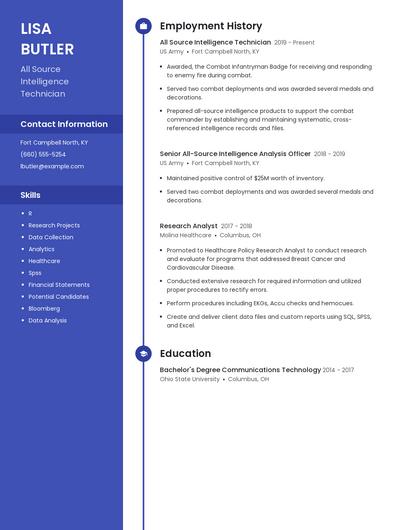
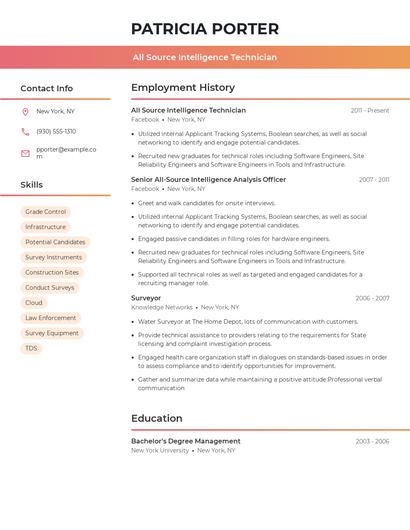
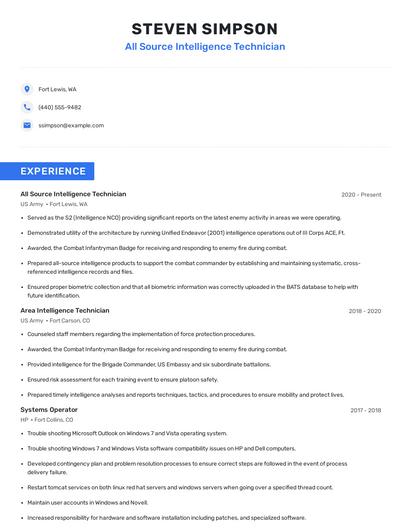
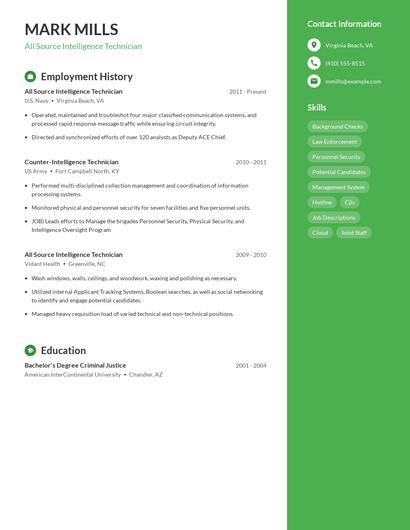
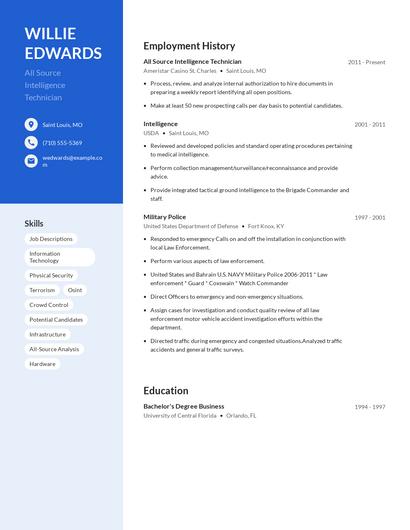
Choose from 10+ customizable all source intelligence technician resume templates
Build a professional all source intelligence technician resume in minutes. Our AI resume writing assistant will guide you through every step of the process, and you can choose from 10+ resume templates to create your all source intelligence technician resume.



Compare different all source intelligence technicians
All source intelligence technician vs. Combat engineer
A combat engineer is responsible for developing and installing defense systems on a military base to protect the camp during combat situations and battles. Combat engineers carefully evaluate the premises for conducting operations with the highest accuracy, especially on locating explosive devices and other hazardous materials. They also assist with training, implementing defensive positions for survival operations. A combat engineer must have excellent knowledge of the engineering and mechanical industry, utilizing hand tools and equipment to perform heavy duties with maximum efficiency.
These skill sets are where the common ground ends though. The responsibilities of an all source intelligence technician are more likely to require skills like "applicant tracking systems," "infrastructure," "hr," and "phone screens." On the other hand, a job as a combat engineer requires skills like "demolition," "vehicle maintenance," "weapon systems," and "platoon." As you can see, what employees do in each career varies considerably.
The education levels that combat engineers earn slightly differ from all source intelligence technicians. In particular, combat engineers are 8.8% less likely to graduate with a Master's Degree than an all source intelligence technician. Additionally, they're 1.3% less likely to earn a Doctoral Degree.All source intelligence technician vs. Engineering officer
Combat engineers are vital outfits in a military unit. They construct and repair critical structures needed for military advances and defenses and destroy areas denying enemy control. The combat engineers also prepare road networks for the fast transportation of units. Also, engineers construct roads, temporary bridges, airfields, and temporary bivouac and forward command posts. Engineers are also responsible for increasing the defense of an area and is vital during a defensive stance. Combat engineers function amid extreme danger and are among the specialized units in the army.
Each career also uses different skills, according to real all source intelligence technician resumes. While all source intelligence technician responsibilities can utilize skills like "applicant tracking systems," "infrastructure," "hr," and "phone screens," engineering officers use skills like "logistics," "combat," "emergency operations," and "diesel engines."
Average education levels between the two professions vary. Engineering officers tend to reach similar levels of education than all source intelligence technicians. In fact, they're 3.8% more likely to graduate with a Master's Degree and 1.3% less likely to earn a Doctoral Degree.All source intelligence technician vs. 12b combat engineer
The required skills of the two careers differ considerably. For example, all source intelligence technicians are more likely to have skills like "applicant tracking systems," "infrastructure," "hr," and "phone screens." But a 12b combat engineer is more likely to have skills like "mos," "ait," "demolition," and "cad."
12b combat engineers typically earn lower educational levels compared to all source intelligence technicians. Specifically, they're 10.2% less likely to graduate with a Master's Degree, and 1.5% less likely to earn a Doctoral Degree.All source intelligence technician vs. Joint strategic plans and policy officer
Types of all source intelligence technician
Updated January 8, 2025
