What does an architectural project manager do?
An architectural project manager is someone who leads an architectural project from the conception stage to its implementation. His/Her or her tasks include leading a team of designers and junior architects, assessing existing facilities, and reformulating building programs. The skills that an architectural project manager should possess include knowledge of building administrative codes and good communication, decision-making, and problem-solving skills. Other requirements to qualify for the position include possessing a bachelor's degree in architecture, civil engineering, or a related field and prior architecture-related work experience.
Architectural project manager responsibilities
Here are examples of responsibilities from real architectural project manager resumes:
- Lead safety compliance by conducting regular safety meetings with subcontractors and strictly enforcing safety policies and procedures, including OSHA regulations.
- Utilize REVIT to create a BIM model of the house before construction.
- Develop drawings of architectural, structural, and MEP.
- Prepare detailed working drawing and bill of quantities and estimate in Revit.
- Staff management, design solutions , 3D modeling, rendering, and visualization.
- Develop specifications, solicit and evaluate bids, award contracts, and carry out QA inspections.
- Coordinate with MEP consultants to establish scope, budget and critical path to streamline city/county/health inspections and approvals.
- Help onshore QA lead to understand the defects log by offshore and in turn conduct the defect review meeting.
- Field verifications for condominiums in the forensic department.
- Produce BIM designs base on state-of-the-art laser digitize building scans.
- Lead safety compliance by conducting regular safety meetings with subcontractors and strictly enforcing safety policies and procedures, including OSHA regulations.
- Develop marketing strategies, contract and BIM templates for future projects.
- Implement several purchasing and RFP procedures.
- Coordinate and develop contract and scope RFP for subcontract trade.
- Collaborate with SMEs to collect content for training solutions and obtain approval of complete solution.
Architectural project manager skills and personality traits
We calculated that 20% of Architectural Project Managers are proficient in Revit, Project Management, and Healthcare. They’re also known for soft skills such as Business skills, Customer-service skills, and Initiative.
We break down the percentage of Architectural Project Managers that have these skills listed on their resume here:
- Revit, 20%
Worked on the tower curtain wall system, residential units and casino floor plan using Revit Architecture.
- Project Management, 13%
Project management and construction administration services as a consultant and representing various property owners, through design and/or construction projects.
- Healthcare, 6%
Delivered thorough construction documentation, focused detailing, and contract administration for a firm engaged in private educational and healthcare work.
- Building Codes, 5%
Verify and supervise field fixes, changes and insure contractor complies with construction documents, building codes and all applicable specifications.
- Architectural Project, 5%
Managed coordination of architectural project teams through all aspects of various high-end corporate interior and facility management projects.
- CAD, 3%
Implemented CAD directory system to efficiently manage company drawing files, blocks, prototype drawings, and company standards.
"revit," "project management," and "healthcare" are among the most common skills that architectural project managers use at work. You can find even more architectural project manager responsibilities below, including:
Business skills. To carry out their duties, the most important skill for an architectural project manager to have is business skills. Their role and responsibilities require that "construction managers need to prepare and follow project budgets, hire and manage staff, and coordinate with other workers and managers." Architectural project managers often use business skills in their day-to-day job, as shown by this real resume: "assist with marketing/business development and identify and implement opportunities to increase contract scope and longevity. "
Leadership skills. architectural project manager responsibilities often require "leadership skills." The duties that rely on this skill are shown by the fact that "construction managers must effectively delegate tasks to construction workers, subcontractors, and other lower level managers to ensure that projects are completed accurately and on time." This resume example shows what architectural project managers do with leadership skills on a typical day: "provided strategic vision, planning, leadership, and project management for a number of key enterprise-wide projects. "
The three companies that hire the most architectural project managers are:
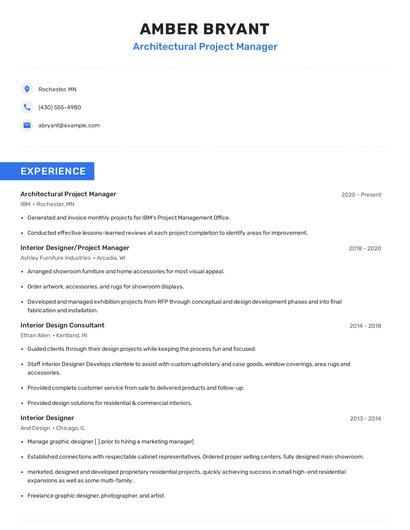
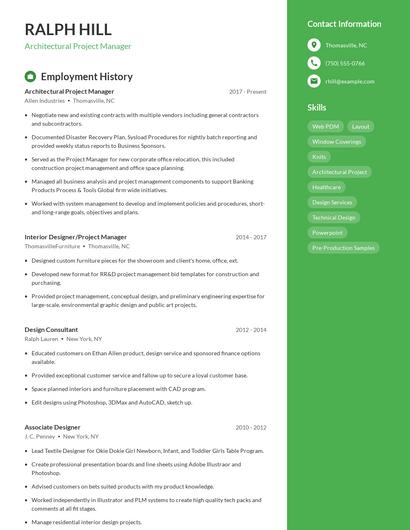
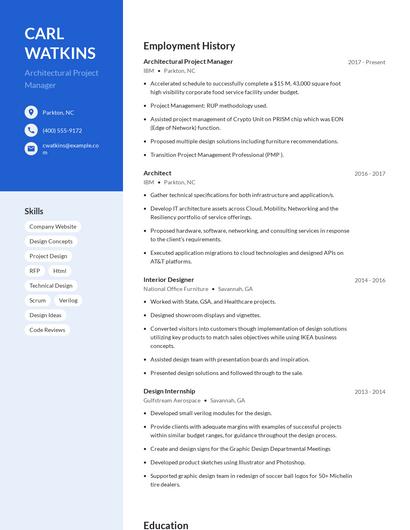
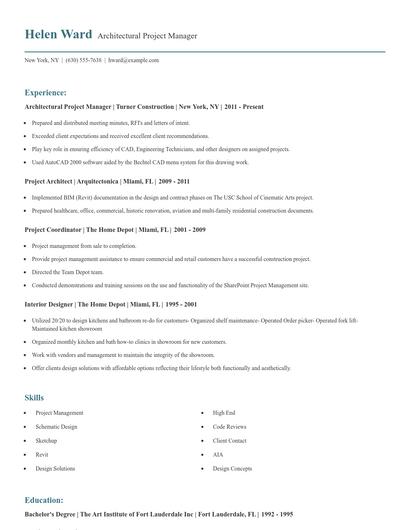
Choose from 10+ customizable architectural project manager resume templates
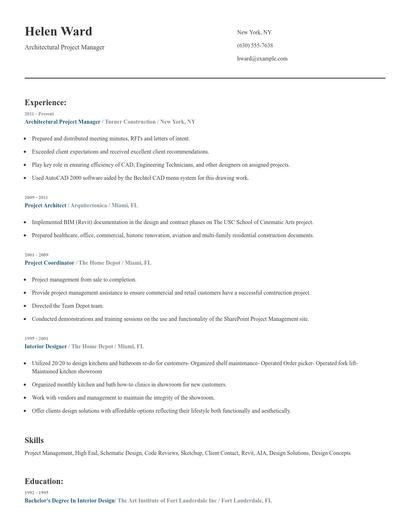
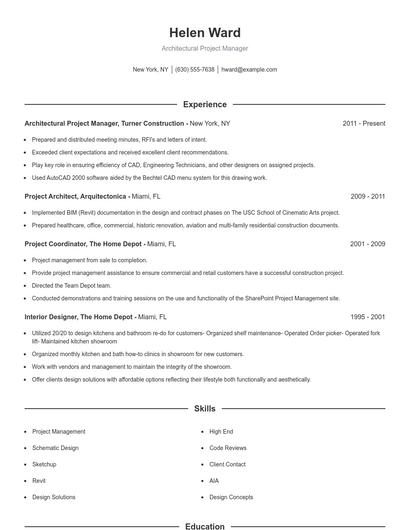
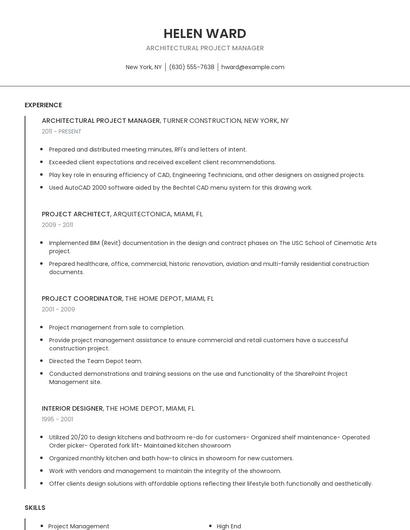
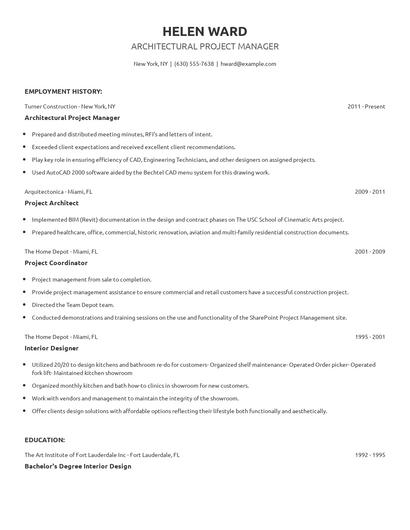
Build a professional architectural project manager resume in minutes. Our AI resume writing assistant will guide you through every step of the process, and you can choose from 10+ resume templates to create your architectural project manager resume.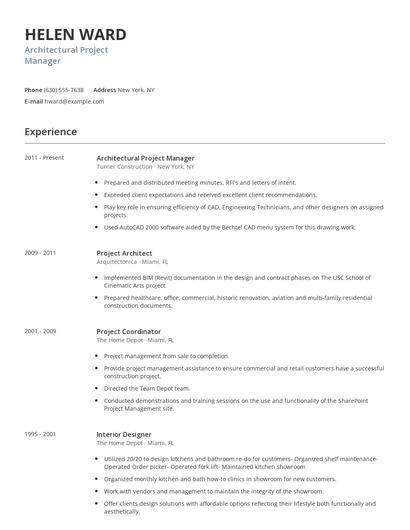
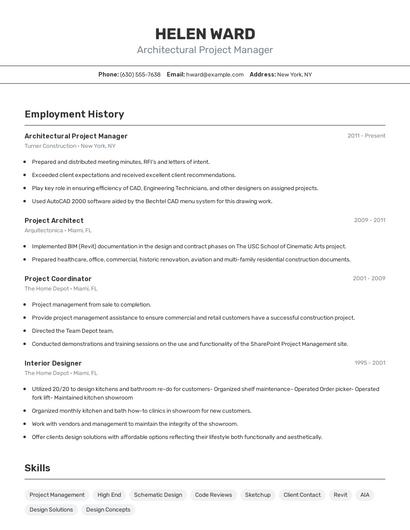
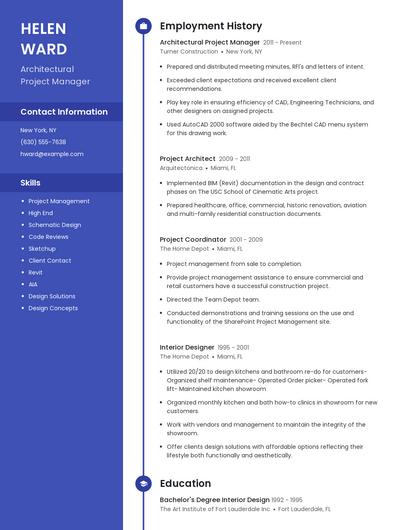
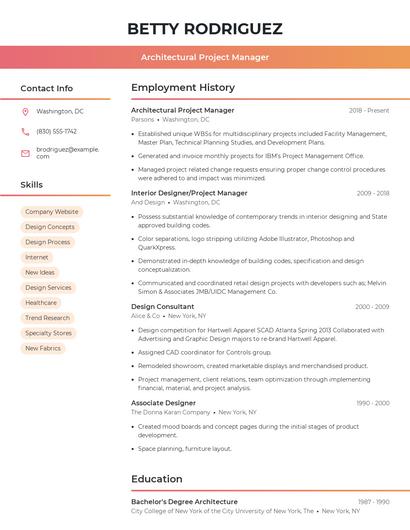
Compare different architectural project managers
Architectural project manager vs. Construction superintendent
A construction superintendent's role is to oversee all construction plans and operations, ensuring quality completion within a specified timeframe. Some of their responsibilities are to inspect all sites, coordinate with contractors and engineers, manage the budget and expenditure, purchase necessary materials and equipment, and make schedules. Aside from producing daily progress reports, a construction superintendent also addresses issues and concerns should there be any. Furthermore, they must implement all safety regulations and policies to maintain a safe and healthy environment for everyone.
These skill sets are where the common ground ends though. The responsibilities of an architectural project manager are more likely to require skills like "revit," "healthcare," "architectural project," and "cad." On the other hand, a job as a construction superintendent requires skills like "osha," "construction sites," "safety program," and "quality standards." As you can see, what employees do in each career varies considerably.
Construction superintendents earn the highest salaries when working in the energy industry, with an average yearly salary of $99,237. On the other hand, architectural project managers are paid more in the professional industry with an average salary of $106,298.On average, construction superintendents reach lower levels of education than architectural project managers. Construction superintendents are 9.7% less likely to earn a Master's Degree and 0.5% less likely to graduate with a Doctoral Degree.Architectural project manager vs. General contractor
The job of general contractors is to oversee the day-to-day operations of projects in the organization. General contractors are considered seasoned experts when it comes to home improvement. They provide the material, equipment, labor, and services for a construction project. Often, they hire specialized subcontractors who will be working on some part of the construction work. They should have attained a bachelor's or associate's degree in construction management. Their experience in the industry is highly coveted.
In addition to the difference in salary, there are some other key differences worth noting. For example, architectural project manager responsibilities are more likely to require skills like "revit," "project management," "healthcare," and "architectural project." Meanwhile, a general contractor has duties that require skills in areas such as "safety regulations," "contract negotiations," "drywall installation," and "payroll." These differences highlight just how different the day-to-day in each role looks.
General contractors earn lower levels of education than architectural project managers in general. They're 9.6% less likely to graduate with a Master's Degree and 0.5% less likely to earn a Doctoral Degree.Architectural project manager vs. Project architect
A project architect spearheads and oversees a construction project's design and development procedures from the planning stages to its completion, ensuring it adheres to standards, budgets, and deadlines. They primarily coordinate with the clients to understand and identify project needs, leading the engineers and contractors throughout the project. They are also typically in charge of preparing all of the necessary documents and ensuring that procedures adhere to state and federal laws, including the environmental, zoning, and safety standards. Additionally, a project architect maintains an open communication line with the clients, updating them regularly.
There are many key differences between these two careers, including some of the skills required to perform responsibilities within each role. For example, an architectural project manager is likely to be skilled in "architectural project," "oversight," "real estate," and "project budget," while a typical project architect is skilled in "autocad," "sketchup," "design intent," and "schematic design."
Project architects make a very good living in the construction industry with an average annual salary of $89,231. On the other hand, architectural project managers are paid the highest salary in the professional industry, with average annual pay of $106,298.Most project architects achieve a similar degree level compared to architectural project managers. For example, they're 4.0% more likely to graduate with a Master's Degree, and 0.2% more likely to earn a Doctoral Degree.Architectural project manager vs. Project superintendent
The construction or project superintendent's role is to oversee the operations of construction sites, from the planning phase to completion. They have varied duties and responsibilities based on specific projects that include scheduling and budgeting, communicating and negotiating with external partners, and acquiring materials and equipment. A construction superintendent also earns construction permits, resolving on-site emergencies and issues, and supervising staff. This position requires several skills, including a degree in construction management or a similar field, relevant experience, and in-depth knowledge of construction processes and operations.
Types of architectural project manager
Updated January 8, 2025
