What does an assistant project scientist do?
Assistant project scientist responsibilities
Here are examples of responsibilities from real assistant project scientist resumes:
- Develop and manage third party claim investigations and contractor remedial oversight for various insurance companies.
- Learned to develop and perform ELISA assays.
- Perform ELISA assay to identify the potential inhibitor from different natural products sources obtain from NCI
- Participate in laboratory and clinical research design to provide clinically-relevant insights into blood cell formation and function in cancer patients.
- Discover the contribution of unique immune cell population towards fibrosis and peritonitis.
Assistant project scientist skills and personality traits
We calculated that 15% of Assistant Project Scientists are proficient in Data Analysis, Research Projects, and Molecular Biology.
We break down the percentage of Assistant Project Scientists that have these skills listed on their resume here:
- Data Analysis, 15%
Provided data analysis and technical report preparation.
- Research Projects, 10%
Collaborated on research projects with University research teams - Facilitated technology transfer between academia and industry - Mentored graduate and undergraduate students
- Molecular Biology, 8%
Trained postdoctoral fellow in molecular biology techniques.
- Cell Biology, 7%
Composed slide decks and presented findings at multiple departmental seminars and American Society for Cell Biology annual meetings.
- Scientific Journals, 7%
Manage research outcome for publication including patents and scientific journals.
- CRISPR, 5%
Created ion channel protein knockout T cell line by using CRISPR technology.
"data analysis," "research projects," and "molecular biology" are among the most common skills that assistant project scientists use at work. You can find even more assistant project scientist responsibilities below, including:
Communication skills. The most essential soft skill for an assistant project scientist to carry out their responsibilities is communication skills. This skill is important for the role because "medical scientists must be able to explain their research in nontechnical ways." Additionally, an assistant project scientist resume shows how their duties depend on communication skills: "conducted comprehensive asbestos surveys of telecommunication facilities. "
Observation skills. Another essential skill to perform assistant project scientist duties is observation skills. Assistant project scientists responsibilities require that "medical scientists conduct experiments that require monitoring samples and other health-related data." Assistant project scientists also use observation skills in their role according to a real resume snippet: "performed an evaluation of the cam simulations by the comparisons with observational data involving extensive data analysis. "
The three companies that hire the most assistant project scientists are:
- SWCA Environmental Consultants2 assistant project scientists jobs
- Celerion
1 assistant project scientists jobs
- County of Contra Costa1 assistant project scientists jobs
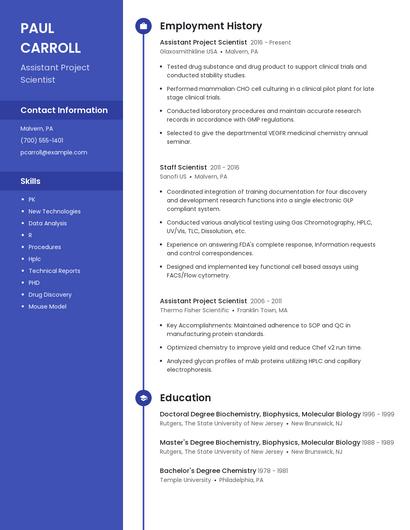
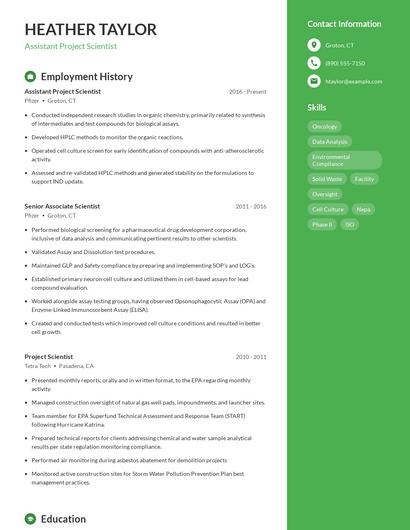
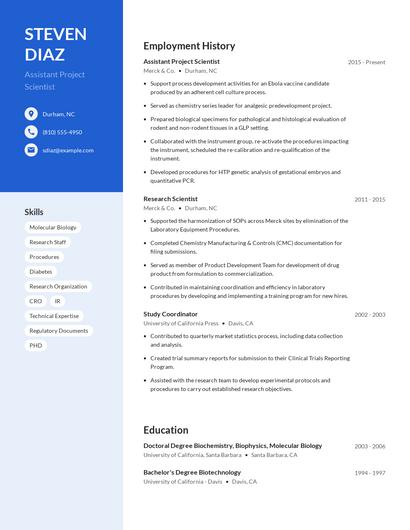
Choose from 10+ customizable assistant project scientist resume templates
Build a professional assistant project scientist resume in minutes. Our AI resume writing assistant will guide you through every step of the process, and you can choose from 10+ resume templates to create your assistant project scientist resume.





Compare different assistant project scientists
Assistant project scientist vs. Fellow
A fellow's responsibility will depend on the organization or industry where one belongs. However, most of the time, a fellow's duty will revolve around conducting research and analysis, presiding discussions and attending dialogues, handle lectures while complying with the guidelines or tasks set by supervisors, and assist in various projects and activities. Furthermore, a fellow must adhere to the institution or organization's policies and regulations at all times, meet all the requirements and outputs involved, and coordinate with every person in the workforce.
While similarities exist, there are also some differences between assistant project scientists and fellow. For instance, assistant project scientist responsibilities require skills such as "molecular biology," "cell biology," "scientific journals," and "crispr." Whereas a fellow is skilled in "patients," "professional development," "veterans," and "mathematics." This is part of what separates the two careers.
Fellows tend to make the most money working in the professional industry, where they earn an average salary of $67,978. In contrast, assistant project scientists make the biggest average salary, $68,527, in the education industry.The education levels that fellows earn slightly differ from assistant project scientists. In particular, fellows are 1.8% more likely to graduate with a Master's Degree than an assistant project scientist. Additionally, they're 25.9% less likely to earn a Doctoral Degree.Assistant project scientist vs. Laboratory researcher
Laboratory researchers are professionals who manage a research laboratory while performing cellular and biochemical experiments with the primary researcher. These researchers must work with hazardous chemicals and should show expertise in handling lab equipment such as glassware and field equipment. They are required to assist with research projects and interpret the test data of an experiment. They must manage the order of all lab equipment by filling up the purchase requisition forms. Laboratory researchers are required to work with students in all aspects of laboratory research.
In addition to the difference in salary, there are some other key differences worth noting. For example, assistant project scientist responsibilities are more likely to require skills like "research projects," "cell biology," "scientific journals," and "biochemistry." Meanwhile, a laboratory researcher has duties that require skills in areas such as "lab procedures," "pcr," "chemistry," and "laboratory research." These differences highlight just how different the day-to-day in each role looks.
Laboratory researchers may earn a lower salary than assistant project scientists, but laboratory researchers earn the most pay in the education industry with an average salary of $30,412. On the other hand, assistant project scientists receive higher pay in the education industry, where they earn an average salary of $68,527.In general, laboratory researchers achieve similar levels of education than assistant project scientists. They're 4.5% less likely to obtain a Master's Degree while being 25.9% less likely to earn a Doctoral Degree.What technology do you think will become more important and prevalent for assistant project scientists in the next 3-5 years?
Afzal Upal
Professor & Department Chair, University of Wisconsin - Platteville
Assistant project scientist vs. Research laboratory manager
Research laboratory managers are management professionals who are responsible for ensuring the smooth operation of laboratories by implementing safety lab procedures. These managers are required to coordinate the repair and maintenance of lab equipment while training lab technicians and assistants on the correct use of equipment. They must perform experimental studies and analyze the research data collected for research projects. Research laboratory managers must also manage the inventory of laboratory equipment while coordinating the purchase of lab supplies.
Some important key differences between the two careers include a few of the skills necessary to fulfill the responsibilities of each. Some examples from assistant project scientist resumes include skills like "molecular biology," "scientific journals," "mouse model," and "extraction," whereas a research laboratory manager is more likely to list skills in "lab equipment," "lab safety," "patients," and "research lab. "
Research laboratory managers earn the best pay in the health care industry, where they command an average salary of $70,475. Assistant project scientists earn the highest pay from the education industry, with an average salary of $68,527.research laboratory managers typically earn higher educational levels compared to assistant project scientists. Specifically, they're 5.1% more likely to graduate with a Master's Degree, and 31.3% more likely to earn a Doctoral Degree.Assistant project scientist vs. Research fellow
A research fellow is an academic researcher who conducts research and analysis of comprehensive literature, data, and results and provides literature reviews. He/She supervises research assistants and recruits study participants to interview them for a particular study. To become a research fellow, a candidate should have a doctorate in a relevant discipline and publish peer-reviewed papers. Also, a research fellow can be an independent investigator or be supervised by a principal investigator.
Even though a few skill sets overlap between assistant project scientists and research fellows, there are some differences that are important to note. For one, an assistant project scientist might have more use for skills like "molecular biology," "biochemistry," "extraction," and "laboratory equipment." Meanwhile, some responsibilities of research fellows require skills like "patients," "immunology," "python," and "rna. "
In general, research fellows earn the most working in the non profits industry, with an average salary of $57,261. The highest-paying industry for an assistant project scientist is the education industry.The average resume of research fellows showed that they earn similar levels of education compared to assistant project scientists. So much so that theyacirc;euro;trade;re 4.1% more likely to earn a Master's Degree and less likely to earn a Doctoral Degree by 7.8%.Types of assistant project scientist
Updated January 8, 2025
