What does a bi architect do?
A BI architect, also known as a business intelligence architect, specializes in designing and developing business management systems and architecture, focusing on data organization. Their job entails conducting research and analyses, gathering and analyzing data from BI analysts, troubleshooting programs, creating and implementing test systems, and modifying structures when necessary. They are also responsible for conducting regular maintenance checks on systems, resolving issues promptly and efficiently. Moreover, a BI architect may communicate directly with clients, providing them with technical support and data assistance.
Bi architect responsibilities
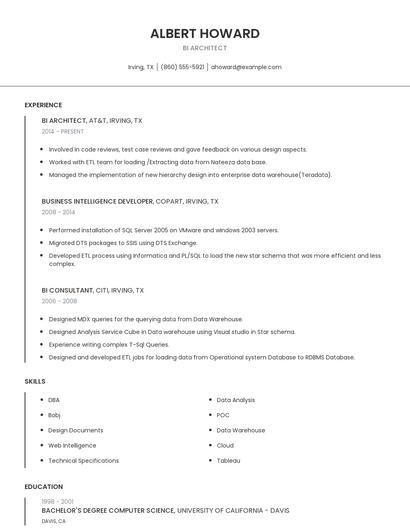
Here are examples of responsibilities from real bi architect resumes:
- Lead framework design to enable parallel loading for multiple sources data to warehouse using teradata global temporary table.
- Implement SharePoint portals to manage application development projects.
- Implement QlikView desktop and publisher, manage user authentication, establish publisher tasks, streamline loading procedures and review log.
- Develop SharePoint solutions with SSRS reports and web parts for external clients base on data render by SSAS cubes.
- Design and development of SSAS cubes.
- Develop SSAS data mining models for predictive analysis for sales and marketing.
- Drive and specify global design and development principles to be deploy for OLAP reporting.
- Modify Multiload, FastLoad, TPT and TPUMP scripts to be compatible with Linux.
- Used that calculate measures in SSRS reports by using source connection as cube in SSRS.
- Develop complex rag hierarchies for sales and market into flat structures for reporting on OLAP.
- Develop documentation of changes and procedures to move code changes from development to QA and production.
- Involve in documenting the deployment plan and the unit test plan and other UAT relate documents.
- Involve in performance tuning of the analytics by increasing the caching size, overriding the existing SQL.
- Automate creation of custom InfoObjects using LSMW tool and create custom extraction programs to load data into BW system.
- Provide technology guidance, best practices, visualization, development standards, JavaScript libraries and SDLC/ALM process definition and implementation.
Bi architect skills and personality traits
We calculated that 9% of BI Architects are proficient in Power Bi, Analytics, and Dashboards. They’re also known for soft skills such as Detail oriented, Problem-solving skills, and Analytical skills.
We break down the percentage of BI Architects that have these skills listed on their resume here:
- Power Bi, 9%
Developed executive Dashboards and Reports using Tableau and Power BI.
- Analytics, 9%
Developed a sales analytics system using Tableau used by every executive at BaxAlta to predict future business needs.
- Dashboards, 6%
Performed data validation and unit testing on developed reports and dashboards.
- ETL, 6%
Ensured data accuracy across application interfaces by documenting ETL job process flow and communicating necessary application recovery procedures to team members.
- Tableau, 5%
Contributed towards standards development for Tableau Data Visualization tool.
- Data Warehouse, 4%
Fostered strong relationships with data architecture, database administration and data consumers including designs for both OLTP and Data Warehouse/BI structures.
Most bi architects use their skills in "power bi," "analytics," and "dashboards" to do their jobs. You can find more detail on essential bi architect responsibilities here:
Detail oriented. To carry out their duties, the most important skill for a bi architect to have is detail oriented. Their role and responsibilities require that "developers often work on many parts of an application or system at the same time and must therefore be able to concentrate and pay attention to detail." Bi architects often use detail oriented in their day-to-day job, as shown by this real resume: "design a detailed new security approach for pfizer bo xi r2 security problems users were facing. "
Problem-solving skills. Many bi architect duties rely on problem-solving skills. "because developers are in charge of software from beginning to end, they must be able to solve problems that arise throughout the design process.," so a bi architect will need this skill often in their role. This resume example is just one of many ways bi architect responsibilities rely on problem-solving skills: "managed a team of 5 members to implement bi solution using bo suites partnered with sap to implement and develop supm. "
Analytical skills. This is an important skill for bi architects to perform their duties. For an example of how bi architect responsibilities depend on this skill, consider that "developers must analyze users’ needs and then design software to meet those needs." This excerpt from a resume also shows how vital it is to everyday roles and responsibilities of a bi architect: "trained and mentored on different data visualization tools. ".
Communication skills. bi architect responsibilities often require "communication skills." The duties that rely on this skill are shown by the fact that "developers must be able to give clear instructions to others working on a project." This resume example shows what bi architects do with communication skills on a typical day: "worked on java script for complex validation, navigation, communication and format customization. "
Creativity. Another common skill required for bi architect responsibilities is "creativity." This skill comes up in the duties of bi architects all the time, as "developers are the creative minds behind new computer software." An excerpt from a real bi architect resume shows how this skill is central to what a bi architect does: "developed cubes for inventory, purchase and sales modules in ssas using data warehouse as source. "
The three companies that hire the most bi architects are:
- Salesforce54 bi architects jobs
- Capgemini5 bi architects jobs
- Newell Brands2 bi architects jobs
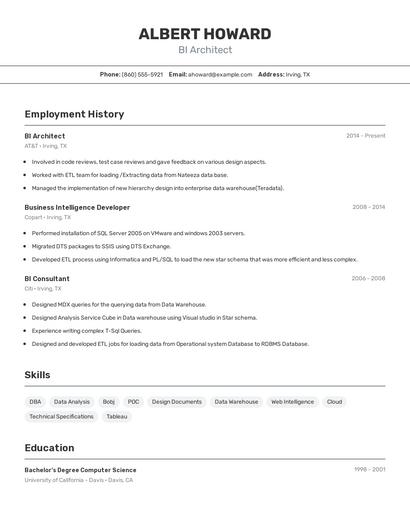
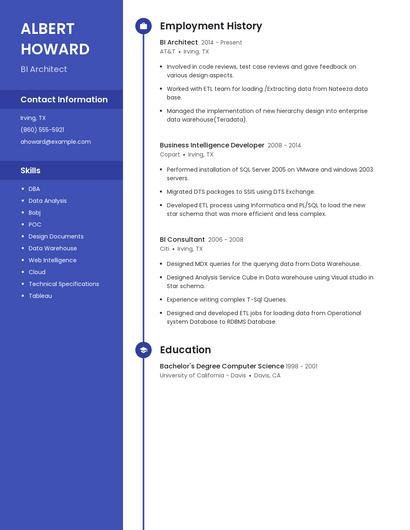
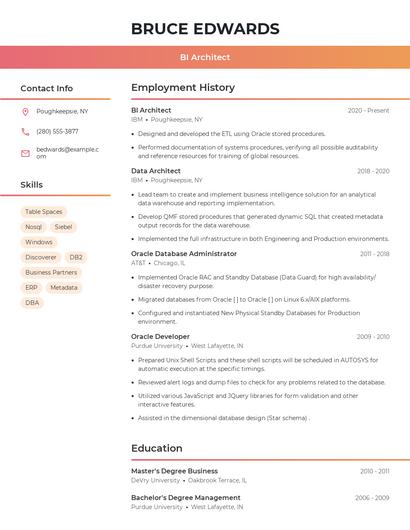
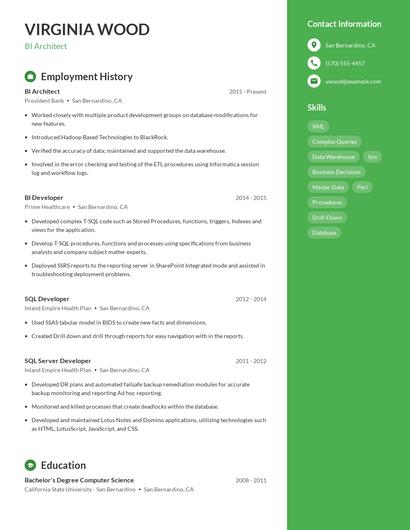
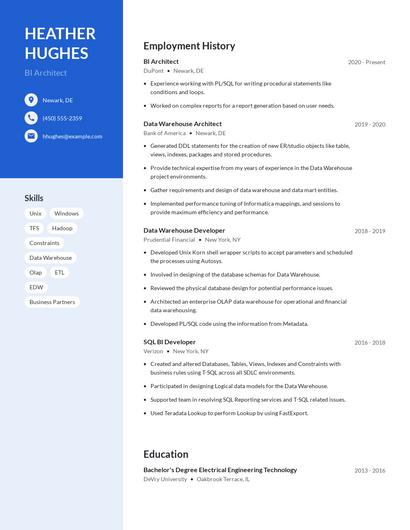
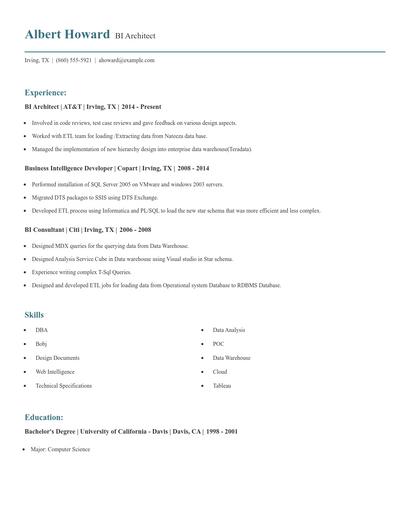
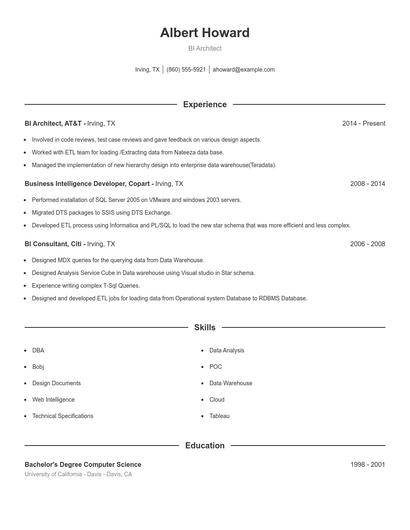
Choose from 10+ customizable bi architect resume templates
Build a professional bi architect resume in minutes. Our AI resume writing assistant will guide you through every step of the process, and you can choose from 10+ resume templates to create your bi architect resume.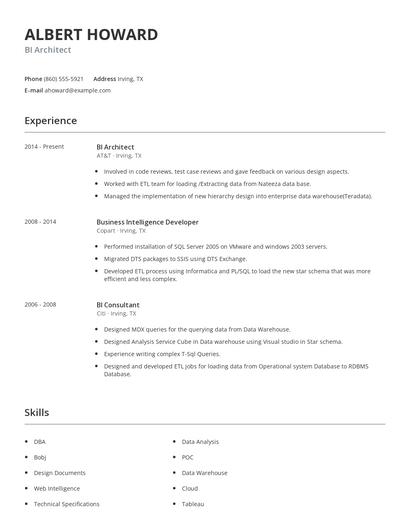


Compare different bi architects
Bi architect vs. Developer
Developers are usually system or application developers in a company who work on specific projects related to networks or applications from conception to implementation. They attend planning sessions to ensure that the program is feasible. They are responsible for designing the system through coding and basic user interface design. They also work on troubleshooting any challenges that may be met at the testing stage of the program's development. They solve challenges and ensure that minimal problems will arise upon publishing the system or application. They also manage the evaluation to ensure that the program's goals are accomplished and that the end-users are satisfied with the results.
These skill sets are where the common ground ends though. The responsibilities of a bi architect are more likely to require skills like "power bi," "analytics," "dashboards," and "tableau." On the other hand, a job as a developer requires skills like "javascript," "python," "c++," and "api." As you can see, what employees do in each career varies considerably.
Developers tend to make the most money working in the finance industry, where they earn an average salary of $104,286. In contrast, bi architects make the biggest average salary, $119,984, in the finance industry.On average, developers reach lower levels of education than bi architects. Developers are 15.0% less likely to earn a Master's Degree and 0.3% more likely to graduate with a Doctoral Degree.Bi architect vs. Applications developer
An application developer is responsible for creating program applications for devices based on clients' specifications and business needs. Application developers must have excellent knowledge of computer systems, as well as a strong command of programming languages to develop customized programs. Duties of an application developer also include running diagnostic tests to ensure the application's performance and stability, providing instruction manuals for reference, performing troubleshooting for any inconsistencies, upgrading design codes for optimization, and launching the application following the client's timetable.
In addition to the difference in salary, there are some other key differences worth noting. For example, bi architect responsibilities are more likely to require skills like "analytics," "dashboards," "tableau," and "data warehouse." Meanwhile, an applications developer has duties that require skills in areas such as "javascript," "c++," "database," and "html." These differences highlight just how different the day-to-day in each role looks.
On average, applications developers earn a lower salary than bi architects. Some industries support higher salaries in each profession. Interestingly enough, applications developers earn the most pay in the finance industry with an average salary of $103,905. Whereas bi architects have higher pay in the finance industry, with an average salary of $119,984.applications developers earn lower levels of education than bi architects in general. They're 15.7% less likely to graduate with a Master's Degree and 0.3% more likely to earn a Doctoral Degree.What technology do you think will become more important and prevalent for bi architects in the next 3-5 years?
Christy Graves
Professor/Program Manager, Seminole State College of Florida
Bi architect vs. Software developer
A software developer is responsible for designing application systems to support the user and business' needs. Duties of a software developer include testing software codes, performing diagnostic programs and troubleshooting, interpreting system data and establishing efficient parameters, and ensuring the compatibility of the systems. A software developer must have an excellent knowledge of computer programs and programming languages to understand its complexities, especially on detecting system defects and malfunctions. A software developer must have strong attention to detail, communication, and decision-making skills to coordinate with the team and also work independently under minimal supervision.
There are many key differences between these two careers, including some of the skills required to perform responsibilities within each role. For example, a bi architect is likely to be skilled in "power bi," "analytics," "dashboards," and "tableau," while a typical software developer is skilled in "python," "c++," "software development," and "javascript."
Software developers earn the best pay in the finance industry, where they command an average salary of $96,138. Bi architects earn the highest pay from the finance industry, with an average salary of $119,984.software developers typically earn lower educational levels compared to bi architects. Specifically, they're 14.5% less likely to graduate with a Master's Degree, and 0.4% less likely to earn a Doctoral Degree.Bi architect vs. Software engineer
A software engineer is a computer science professional who is responsible for the development of information systems, designing and building computer systems software and applications software. They often prefer to call themselves as a software developer or computer programmer. They have substantial knowledge of programming languages, software development, and computer operating systems, and other technologies. They use these to turn a plan into a final output. They can create a design, test, and develop software based on the needs of their clients.
Types of bi architect
Updated January 8, 2025
