What does a business continuity manager do?
Business continuity managers are management professionals who create crisis management plans to keep an organization functioning after experiencing disruptive events. These managers are required to design and implement business continuity plans for all business offices to ensure that they always remain in a state of readiness. They must enhance integrated risk management principles while coordinating all activities for disaster recovery and business continuity exercises worldwide. Business continuity managers must also partner with other businesses to develop business recovery strategies.
Business continuity manager responsibilities
Here are examples of responsibilities from real business continuity manager resumes:
- Construct and manage SharePoint site for program area.
- Collaborate with other teams and leadership to accomplish target ROI levels and customer SLAs.
- Establish and manage team responsible for build out, simplification and support services of business enterprise process model.
- Lead emergency operation procedures for mobility business continuity plans during regional/national disaster events, and declare emergencies to support business customers.
- Spearhead improvements to daily functions to establish BCP backups.
- Develop process driven KPIs that influence call center metrics and the company's customer experience scorecard.
- Establish organization as Microsoft's top-performing supplier by improving KPIs.
- Deal encompass SAP/R3, e-commerce and legacy applications as well as infrastructure components
- Pass several stringent audit and regulatory examinations by maintaining BC documentation online in SharePoint.
- Identify, document and test myriad business needs against company infrastructure and identify recovery strategies and gaps.
- Lead highly productive DR team of disparate groups of professionals providing recovery administration, planning and operational functions.
- Develop A3 s for generating savings and reducing and eliminating waste
- Incorporate ITIL and ISO [] standards within the proposal.
- Provide documentation as required for all receiving facilities in accordance with current HIPPA requirements.
Business continuity manager skills and personality traits
We calculated that 10% of Business Continuity Managers are proficient in Crisis Management, Business Continuity, and Business Impact Analysis.
We break down the percentage of Business Continuity Managers that have these skills listed on their resume here:
- Crisis Management, 10%
Established and directed training and exercise programs for BCP/DR, emergency and crisis management corporate-wide to ensure operational success.
- Business Continuity, 9%
Conduct enterprise wide Business Impact Analysis and Risk Assessment to establish and validate line of business continuity requirements and recovery priorities.
- Business Impact Analysis, 9%
Motivated departmental subject matter experts to complete Business Impact Analysis questionnaires despite competing time demands and frequent organizational changes.
- Risk Management, 7%
Project manager responsible for leading EHS-Risk Management preparations to launch new Animal Health Company via public offering.
- Business Continuity Management, 7%
Lead internal and external communications to key Aviva stakeholders specific to Business Continuity Management.
- Impact Analysis, 7%
Performed impact analysis in conjunction with business leaders to determine recovery time and recovery point objectives.
"crisis management," "business continuity," and "business impact analysis" are among the most common skills that business continuity managers use at work. You can find even more business continuity manager responsibilities below, including:
The three companies that hire the most business continuity managers are:
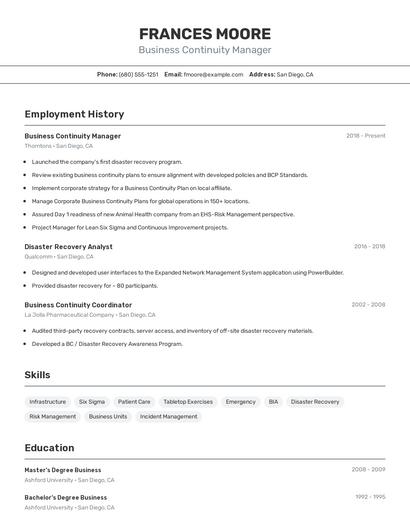
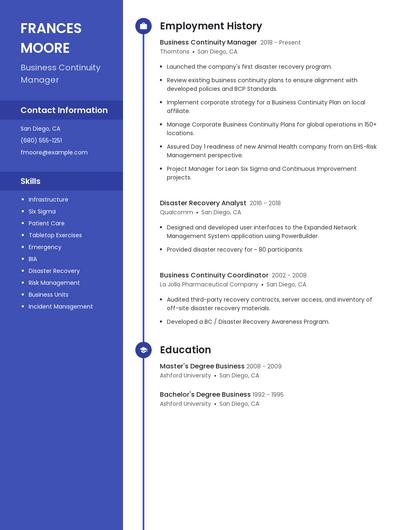
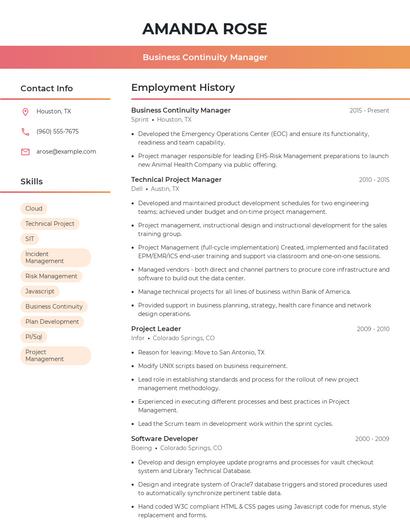
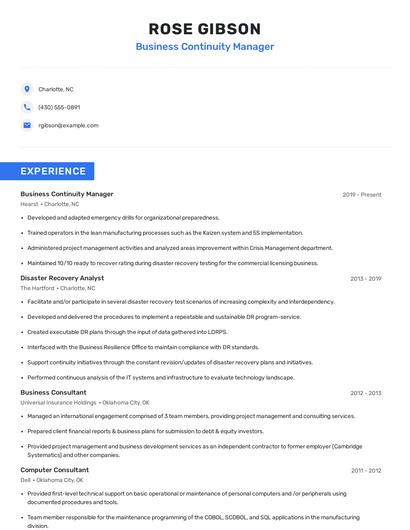
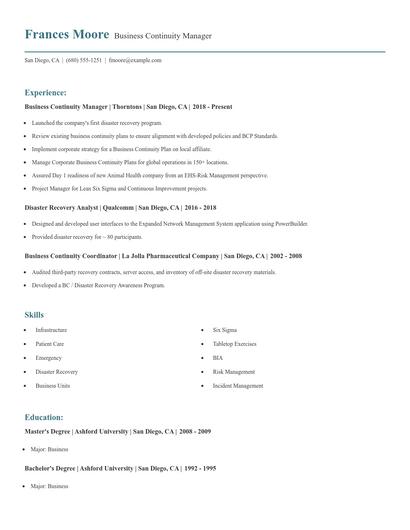
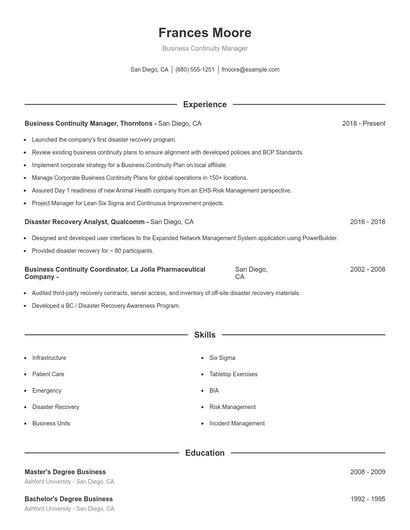
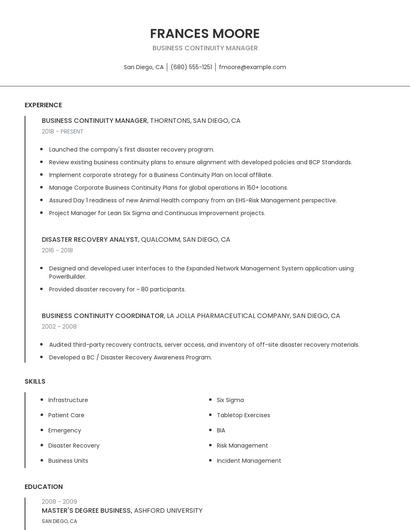
Choose from 10+ customizable business continuity manager resume templates
Build a professional business continuity manager resume in minutes. Our AI resume writing assistant will guide you through every step of the process, and you can choose from 10+ resume templates to create your business continuity manager resume.




Compare different business continuity managers
Business continuity manager vs. Data recovery planner
A disaster recovery specialist helps businesses protect software, hardware, and data from different kinds of disasters. They are primarily in charge of creating recovery and continuity plans, helping companies run smoothly and efficiently despite issues brought by the disasters. Their duties also include performing research and analyses, obtaining data from different departments, coordinating with fellow specialists, conducting systems tests and inspections, and utilizing research findings to develop plans and recommendations. Moreover, a disaster recovery specialist may also train staff and provide technical support as necessary.
These skill sets are where the common ground ends though. The responsibilities of a business continuity manager are more likely to require skills like "crisis management," "risk management," "business continuity management," and "impact analysis." On the other hand, a job as a data recovery planner requires skills like "server configurations," "microsoft project," "capacity planning," and "san." As you can see, what employees do in each career varies considerably.
The education levels that data recovery planners earn slightly differ from business continuity managers. In particular, data recovery planners are 5.5% less likely to graduate with a Master's Degree than a business continuity manager. Additionally, they're 0.6% less likely to earn a Doctoral Degree.Business continuity manager vs. Disaster recovery specialist
A disaster recovery analyst supports a company's disaster recovery team in planning and implementing continuity and recovery plans to protect data and networks from security breaches or other kinds of disasters. They primarily focus on conducting research and analyses, performing audits and risk assessments, gathering and analyzing data from different departments, and developing training and learning materials for staff. Through their research findings, a disaster recovery analyst may develop solutions against vulnerable areas and strategies to optimize operations.
In addition to the difference in salary, there are some other key differences worth noting. For example, business continuity manager responsibilities are more likely to require skills like "crisis management," "risk management," "business continuity management," and "incident management." Meanwhile, a disaster recovery specialist has duties that require skills in areas such as "grants management," "infrastructure," "technical assistance," and "community development." These differences highlight just how different the day-to-day in each role looks.
In general, disaster recovery specialists achieve lower levels of education than business continuity managers. They're 7.4% less likely to obtain a Master's Degree while being 0.6% more likely to earn a Doctoral Degree.Business continuity manager vs. Disaster recovery analyst
A senior management consultant is an experienced professional who is in charge of a team of management consultants to help an organization solve issues, maximize growth, and improve business performance. Senior management consultants must conduct company research so that they can better understand the organization. They prepare business proposals and presentations as well as identify issues to form hypotheses and solutions. Senior management consultants must also implement recommendations or solutions and ensure that an organization receives the necessary assistance to carry it all out.
There are many key differences between these two careers, including some of the skills required to perform responsibilities within each role. For example, a business continuity manager is likely to be skilled in "crisis management," "risk management," "business continuity management," and "incident management," while a typical disaster recovery analyst is skilled in "infrastructure," "strong analytical," "sql," and "windows."
Disaster recovery analysts earn the best pay in the finance industry, where they command an average salary of $76,919. Business continuity managers earn the highest pay from the education industry, with an average salary of $100,079.disaster recovery analysts typically earn lower educational levels compared to business continuity managers. Specifically, they're 8.4% less likely to graduate with a Master's Degree, and 0.1% less likely to earn a Doctoral Degree.Business continuity manager vs. Senior management consultant
Even though a few skill sets overlap between business continuity managers and senior management consultants, there are some differences that are important to note. For one, a business continuity manager might have more use for skills like "crisis management," "business continuity," "business impact analysis," and "business continuity management." Meanwhile, some responsibilities of senior management consultants require skills like "analytics," "business process," "business development," and "portfolio. "
Senior management consultants enjoy the best pay in the technology industry, with an average salary of $135,771. For comparison, business continuity managers earn the highest salary in the education industry.In general, senior management consultants hold similar degree levels compared to business continuity managers. Senior management consultants are 4.6% more likely to earn their Master's Degree and 1.3% more likely to graduate with a Doctoral Degree.Types of business continuity manager
Updated January 8, 2025
