What does a circuit design engineer do?
A circuit design engineer specializes in designing and developing electrical components and circuits in devices and machinery. Among their responsibilities include identifying the needs of every project, developing strategies to attain optimal quality, developing diagrams and test structures, troubleshooting, and repairing issues. They must also perform regular maintenance checks on existing systems and perform upgrades and corrective measures as needed. Moreover, a circuit design engineer typically works in a team setting, which requires an active communication line for a smooth and efficient workflow.
Circuit design engineer responsibilities
Here are examples of responsibilities from real circuit design engineer resumes:
- Lead cross-site LVR task force to get full set of schematics match to functional target RTL model.
- Process orders for VPN long distance service and manage the VPN dial plan to ensure no duplications.
- Manage client order request generate from sales, provisioning and designing data, voice and IP network services.
- Size transistors to reduce RC time constant in dynamic flip-flops and to achieve equivalent performance in high frequency.
- Lead a small design team to deliver a 90 nm LP 125 MHz medium-size Gigabit Ethernet PHY DSP.
- Manage a team that include hardware engineers, software engineers, and verifications engineers to evaluate the McORE 200 microprocessor.
- Experience with high-speed digital designs, RF circuits, power supplies, and analog circuits.
- Assist the FPGA emulation team to validate the full system by constructing and debugging test cases.
- Design schematics and custom layout test structures to validate DRC, LVS and DFM run sets.
- Implement MPLS and MLPPP solutions, routing, encapsulation, VPN, and error pattern testing.
- Provide technical expertise in support of the operation of Comcast's national TCP/IP public broadband network.
- Create several hand-held electronic games base on embed microcontrollers, including various user interfaces and discrete digital and analog circuits.
- Design SMSC's first CMOS chip.
- Design for EMI, EMC, UL & CSA compliance and work with independent test agencies.
- Optimize macro power, timing.
Circuit design engineer skills and personality traits
We calculated that 14% of Circuit Design Engineers are proficient in Circuit Design, CMOS, and RF. They’re also known for soft skills such as Initiative, Speaking skills, and Writing skills.
We break down the percentage of Circuit Design Engineers that have these skills listed on their resume here:
- Circuit Design, 14%
Formalized circuit design format requirements for the provisioning of domestic and international circuits.
- CMOS, 6%
Gate Array I/O (3/5V) buffers Development: Apply CMOS technologies to develop I/O buffers.
- RF, 6%
Design and development of both RF and Mixed Signal PCB products from bread board to production.
- Verilog, 5%
Implemented and simulated the RX and LDP module in Verilog.
- CAD, 4%
Used CAD tools for mask design and layout to correct timing and design rule violations in place and route designs.
- FPGA, 4%
Process Improvement - FPGA Design Process - Teamed with peers to create design review checklists for FPGA design process.
Most circuit design engineers use their skills in "circuit design," "cmos," and "rf" to do their jobs. You can find more detail on essential circuit design engineer responsibilities here:
Initiative. To carry out their duties, the most important skill for a circuit design engineer to have is initiative. Their role and responsibilities require that "electrical and electronics engineers must apply their knowledge to new tasks in every project they undertake." Circuit design engineers often use initiative in their day-to-day job, as shown by this real resume: "contract position) provide the technical project support for state agencies within virginia as part of the mpls network transformation initiative. "
Speaking skills. Many circuit design engineer duties rely on speaking skills. "electrical and electronics engineers work closely with other engineers and technicians," so a circuit design engineer will need this skill often in their role. This resume example is just one of many ways circuit design engineer responsibilities rely on speaking skills: "addressed false transition design issue and pll lock detect with current controlled (dac) issue. "
Writing skills. circuit design engineers are also known for writing skills, which are critical to their duties. You can see how this skill relates to circuit design engineer responsibilities, because "electrical and electronics engineers develop technical publications related to equipment they develop, including maintenance manuals, operation manuals, parts lists, product proposals, and design methods documents." A circuit design engineer resume example shows how writing skills is used in the workplace: "created mops (writing & interpreting) for ds1, trunk, and ethernet designs. "
Math skills. A big part of what circuit design engineers do relies on "math skills." You can see how essential it is to circuit design engineer responsibilities because "electrical and electronics engineers must use the principles of calculus and other advanced math in order to analyze, design, and troubleshoot equipment." Here's an example of how this skill is used from a resume that represents typical circuit design engineer tasks: "designed matlab mathematical simulation tools to study and predict frequency/phase acquisition lock-up in the pll synthesizer architecture. "
The three companies that hire the most circuit design engineers are:
- Honeywell81 circuit design engineers jobs
- Digital Prospectors56 circuit design engineers jobs
- Apple43 circuit design engineers jobs
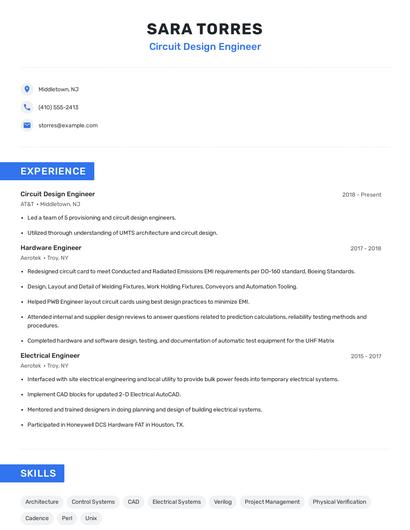
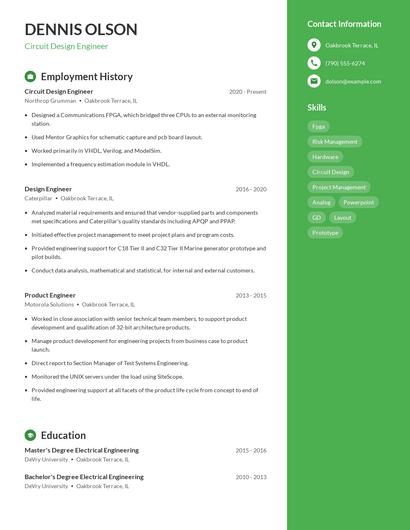
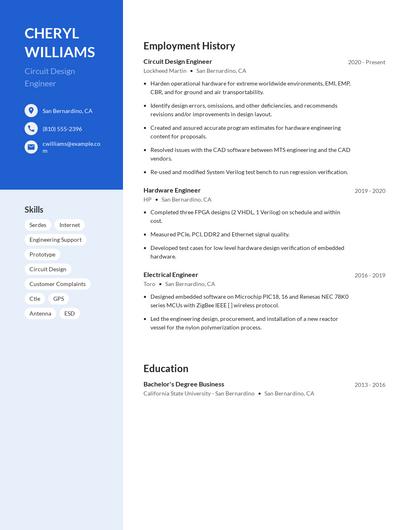
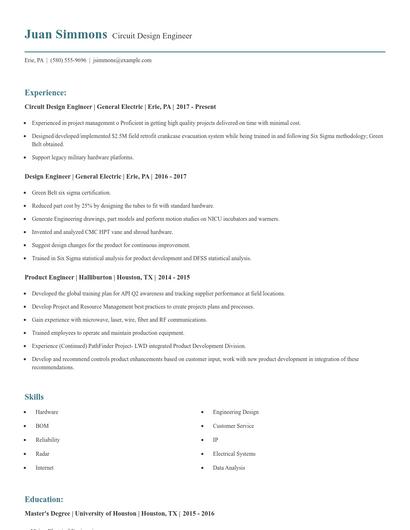
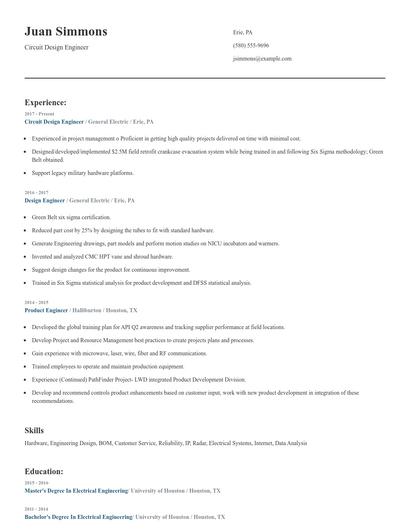
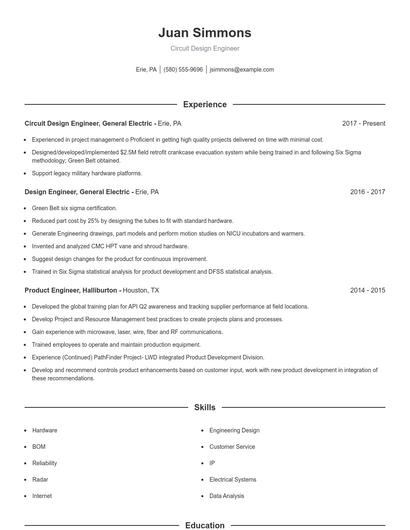
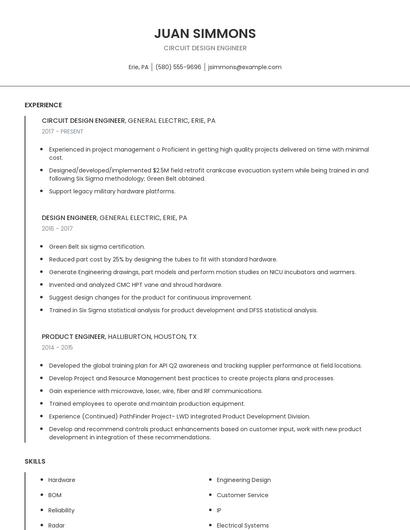
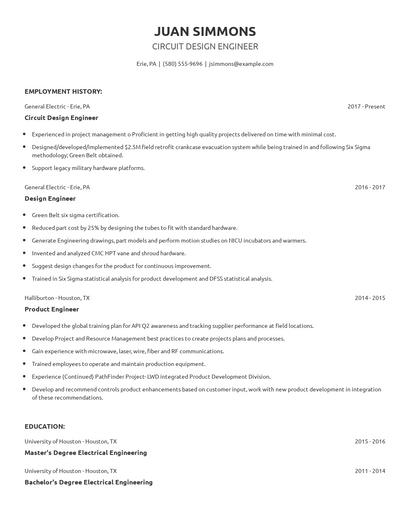
Choose from 10+ customizable circuit design engineer resume templates
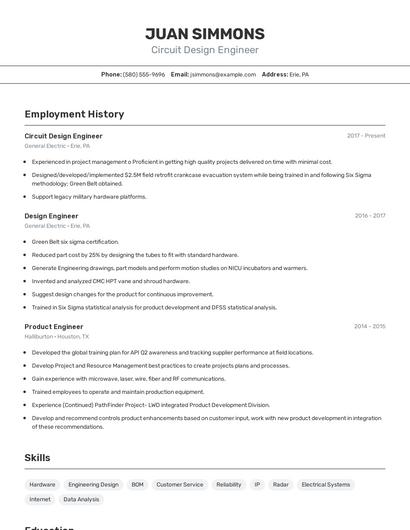
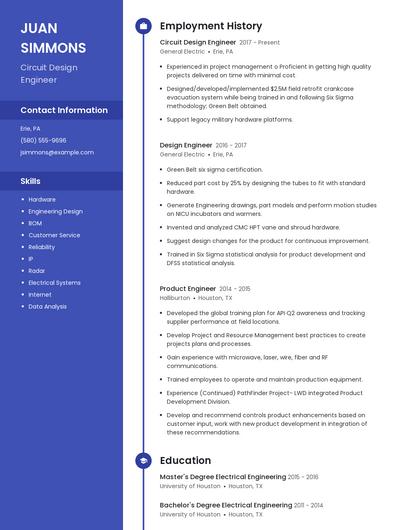
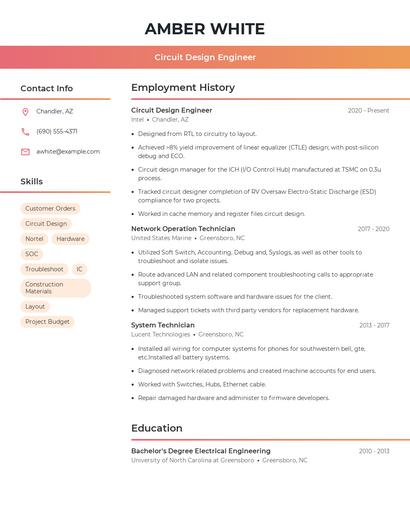
Build a professional circuit design engineer resume in minutes. Our AI resume writing assistant will guide you through every step of the process, and you can choose from 10+ resume templates to create your circuit design engineer resume.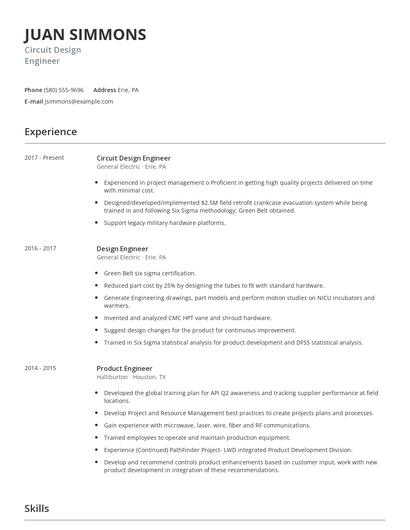
Compare different circuit design engineers
Circuit design engineer vs. Engineering technician
An Engineering Technician's duties vary according to the industry or company, whether mechanical, industrial, civil, agricultural, or more. However, most of the time, the responsibilities often revolve around resolving technical issues, working with and assisting Engineers in building, assembling, designing, gathering and testing data, and conducting more manual activities. Furthermore, Engineering Technicians can specialize and work in various fields after a certain training period, closely mentored or monitored by an engineer or someone with extensive expertise.
There are some key differences in the responsibilities of each position. For example, circuit design engineer responsibilities require skills like "circuit design," "cmos," "verilog," and "fpga." Meanwhile a typical engineering technician has skills in areas such as "technical support," "data collection," "test equipment," and "asphalt." This difference in skills reveals the differences in what each career does.
Engineering technicians really shine in the technology industry with an average salary of $76,126. Comparatively, circuit design engineers tend to make the most money in the technology industry with an average salary of $114,509.The education levels that engineering technicians earn slightly differ from circuit design engineers. In particular, engineering technicians are 11.6% less likely to graduate with a Master's Degree than a circuit design engineer. Additionally, they're 1.9% less likely to earn a Doctoral Degree.Circuit design engineer vs. Engineering trainee
An engineering trainee is responsible for shadowing engineers in their duties and performing administrative tasks as needed. Engineering trainees assist the engineers in inspecting construction sites and conducting field research. They also identify cost-efficient materials and resources that meet quality standards and client specifications. An engineering trainee must have excellent communication and organizational skills, especially in writing reports, attending meetings, and ensuring that all reports are submitted for management's reviews, such as contracts from suppliers and vendors.
Each career also uses different skills, according to real circuit design engineer resumes. While circuit design engineer responsibilities can utilize skills like "circuit design," "cmos," "cad," and "fpga," engineering trainees use skills like "excellent interpersonal," "fire protection," "technical support," and "r."
On average, engineering trainees earn a lower salary than circuit design engineers. Some industries support higher salaries in each profession. Interestingly enough, engineering trainees earn the most pay in the energy industry with an average salary of $63,253. Whereas circuit design engineers have higher pay in the technology industry, with an average salary of $114,509.Average education levels between the two professions vary. Engineering trainees tend to reach similar levels of education than circuit design engineers. In fact, they're 0.7% less likely to graduate with a Master's Degree and 1.9% less likely to earn a Doctoral Degree.Circuit design engineer vs. Electrical engineer internship
The electrical engineer internship offers tasks to undergraduate engineering students related to electrical systems analysis and branch circuiting, site investigations, lighting calculations, and design drawings by complementing theoretical knowledge with practical duties on the job to gain experience and increase marketability. Through the internship, the undergraduate engineering students may develop professional aptitude, strengthen their character, and may increase their confidence in their work as it prepares them for what to expect in their field.
The required skills of the two careers differ considerably. For example, circuit design engineers are more likely to have skills like "cmos," "ic," "matlab," and "integrated circuit design." But a electrical engineer internship is more likely to have skills like "c++," "c #," "analog," and "revit."
Electrical engineer interns make a very good living in the hospitality industry with an average annual salary of $66,132. On the other hand, circuit design engineers are paid the highest salary in the technology industry, with average annual pay of $114,509.electrical engineer interns typically earn lower educational levels compared to circuit design engineers. Specifically, they're 6.2% less likely to graduate with a Master's Degree, and 1.9% less likely to earn a Doctoral Degree.Circuit design engineer vs. Radio frequency engineer
A radio frequency engineer, also known as RF engineer, specializes in designing and developing communication systems using radio waves. One of their primary responsibilities revolves around creating networks and systems and testing equipment. They make sure that equipment is up to high standards by traveling to different areas as needed, troubleshooting issues to identify the root of problems and performing corrective measures required. Furthermore, a radio frequency engineer must continuously optimize equipment quality and ensure efficiency while adhering to the laws and regulations.
Even though a few skill sets overlap between circuit design engineers and radio frequency engineers, there are some differences that are important to note. For one, a circuit design engineer might have more use for skills like "circuit design," "cmos," "rf," and "verilog." Meanwhile, some responsibilities of radio frequency engineers require skills like "test equipment," "antenna," "system performance," and "system design. "
Radio frequency engineers enjoy the best pay in the technology industry, with an average salary of $94,522. For comparison, circuit design engineers earn the highest salary in the technology industry.In general, radio frequency engineers hold similar degree levels compared to circuit design engineers. Radio frequency engineers are 3.5% more likely to earn their Master's Degree and 0.9% less likely to graduate with a Doctoral Degree.Types of circuit design engineer
Updated January 8, 2025
