
Automatically apply for jobs with Zippia
Upload your resume to get started.
Clerical associate skills for your resume and career

15 clerical associate skills for your resume and career
1. Patients
- Interview and register patients in the Emergency Department by obtaining biographic demographic and financial information.
- Communicated effectively with all patients and their relatives and associates concerning the treatment process.
2. Data Entry
Data entry means entering data into a company's system with the help of a keyboard. A person responsible for entering data may also be asked to verify the authenticity of the data being entered. A person doing data entry must pay great attention to tiny details.
- Checked records for accuracy of information and for conformity with established policy and procedures; perform daily data entry.
- Entered alphabetical, numeric and symbolic data from source documents into computer using data entry device.
3. Customer Service
Customer service is the process of offering assistance to all the current and potential customers -- answering questions, fixing problems, and providing excellent service. The main goal of customer service is to build a strong relationship with the customers so that they keep coming back for more business.
- Attained necessary skills in order to acquire promotion to Customer Service Representative for high-level accounts.
- Offered excellent customer service to approximately fifty clients on a daily basis.
4. Phone Calls
Phone calls are a wireless or wired connection made over a telephone or a mobile phone between two people. Two parties are involved in a phone call, the caller and the receiver. A caller dials the number of the one he wants to call, and the recipient hears a bell or a tune to which he picks up the call. The call establishes a connection between them through which they can communicate. The voice is converted into signals and is transmitted through wired or wireless technology.
- Handled heavy incoming phone calls, received and distributed messages appropriately.
- Handled all showroom sales, handled all incoming phone calls, insurance phone calls, arrangement of home deliveries, etc.
5. Clerical Functions
- Performed required clerical functions not limited to filing and telephone correspondence.
- Perform clerical functions, maintain records and perform other support duties within job scope.
6. Patient Care
Patient care entails the diagnosis, recovery, and control of sickness as well as the maintenance of physical and emotional well-being through the use of healthcare providers' services. Patient care is described as services provided to patients by health practitioners or non-professionals under guidance.
- Performed administrative tasks and projects to facilitate patient care.
- Educated all staff in the ICU on new policies and procedures involving all aspects of patient care and satisfaction.
Choose from 10+ customizable clerical associate resume templates
Build a professional clerical associate resume in minutes. Our AI resume writing assistant will guide you through every step of the process, and you can choose from 10+ resume templates to create your clerical associate resume.7. Office Equipment
- Operated office equipment i.e., voice mail messaging systems, word processing, spreadsheet, and other software applications.
- Maintained inventory control of stationary stock, office equipment, and ensured patient chart contain necessary medical forms.
8. Computer System
- Verify patient demographic information and accurately enter data into computer system.
- Utilized computer systems for distribution and payroll figures for clerical office.
9. Clerical Support
Clerical support performs activities that must be done in every workplace in order to support the company going forward. These duties, which come within the category of clerical support, are typically delegated to entry-level employees since they are simple and easy to learn. Even though clerical duties like printing and filing are easy, they require time and in many instances, other workers are preoccupied with other activities and unable to keep up with all that needs to be accomplished. As a result, many businesses employ clerical support staff who are solely responsible for these duties.
- Provide administrative and clerical support to critical, time sensitive projects related to compliance reporting, data tracking and information gathering.
- Maintained switchboard operations, provided clerical support assisting with faxing filing and copying projects.
10. Medical Terminology
- Demonstrated proficiency in medical terminology and office procedures, as well as guaranteeing quality patient interactions.
- Transcribe reports for patients and referring physicians, explaining post exam results using medical terminology.
11. Physician Orders
Physician orders are an instruction or a set of instructions given to a patient by a doctor. This could range from being put on bedrest to being given a prescription to fill and take.
- Transcribed physician orders as appropriate.
- Entered Physician orders into computer.
12. Scheduling Appointments
Scheduling appointments is the practice of finding a free slot with the person(s) you want to meet. The process of scheduling appointments involves finding mutually free time, negotiating follow-ups, sending reminders, and creating new appointments. Scheduling appointments is important to ensure that the timings of consecutive meetings do not clash with each other.
- Calendar management which included organizing and scheduling appointments.
- Performed general office duties such as answering phones, scheduling appointments, filing, faxing, copying, and typing.
13. Insurance Verification
- Experienced in patient insurance verification; and following through with authorizations for high radiology and referrals.
- Interviewed patients for intake, demographics and insurance verification.
14. Telephone Calls
Telephone calls are a communication means through which a caller is connected to the called party. The call is done through a telecommunications device called a telephone. The caller can use a landline, mobile phone, or satellite phone to make the call.
- Received and directed telephone calls and relay conversation and pertinent messages to others while maintaining accuracy, clarity and confidentiality.
- Fielded telephone calls and answered customer inquiries about policies; interpreted for Spanish-speaking customers; performed Daily Payment Reminder calls.
15. Patient Charts
- Safeguard and maintains patient charts while ensuring that all patient documents contain required demographic information.
- Created patient charts and verified collection of necessary admitting documentation.
5 Clerical Associate resume examples
Build a professional clerical associate resume in minutes. Browse through our resume examples to identify the best way to word your resume. Then choose from 5+ resume templates to create your clerical associate resume.

What skills help Clerical Associates find jobs?
Tell us what job you are looking for, we’ll show you what skills employers want.
List of clerical associate skills to add to your resume
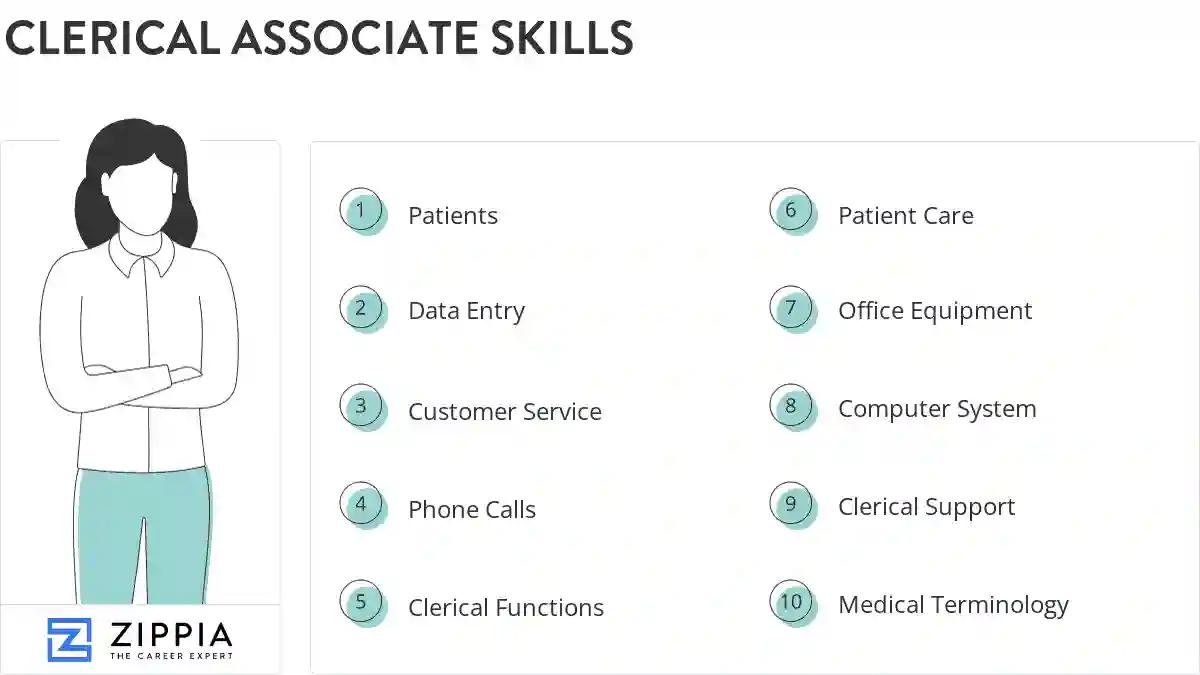
The most important skills for a clerical associate resume and required skills for a clerical associate to have include:
- Patients
- Data Entry
- Customer Service
- Phone Calls
- Clerical Functions
- Patient Care
- Office Equipment
- Computer System
- Clerical Support
- Medical Terminology
- Physician Orders
- Scheduling Appointments
- Insurance Verification
- Telephone Calls
- Patient Charts
- Payroll
- Radiology
- Clerical Tasks
- Emergency Room
- Patient Registration
- Word Processing
- NYC
- Front Desk
- Medicaid
- EMR
- Patient Insurance
- Hippa
- Patient Appointments
- Multi-Line Telephone System
- Patient Demographics
- Insurance Eligibility
- Switchboards
- HIPAA
- Allergies
- Collating
- PowerPoint
- Direct Calls
- Transferring Calls
- MRI
- Multi-Line Phone System
- Safety Hazards
- Telephone Inquiries
- Administrative Tasks
- Medical Charts
- Office Machines
- Statistical Reports
- Fax Machines
- Reminder Calls
Updated January 8, 2025
