What does a control systems technician do?
A control systems technician specializes in installing and repairing heating and ventilation systems, ensuring efficiency and smooth workflow. Typically working for establishments and offices, their responsibilities often revolve around identifying the root of issues through troubleshooting and system testing, replacing components, cleaning out dirt and other obstructions, and conducting regular maintenance checks. They may also install and fix air conditioning systems, cleaning them as needed. Furthermore, as a control systems technician, it is essential to maintain an active communication line with team members, coordinating every step of the way.
Control systems technician responsibilities
Here are examples of responsibilities from real control systems technician resumes:
- Develop and implement a weekly schedule on SQL databases to automate the execution of maintenance plans.
- Perform standardized safety inspections on all chemical handling and manufacturing equipment to ensure OSHA / GMP compliance.
- Experience in Marconi ATM switches and CISCO Ethernet switches and understand switch configurations, and detect incorrect settings.
- Programme and maintain the Allen-Bradley ControlLogix redundant Ethernet link ControlNet PLC safety alarm and shutdown system.
- Interface with Profibus, ASI, and Ethernet.
- Program total flow, HMI's & networking systems.
- Service, repair, and installation of rough and finish plumbing.
- Configure public address sound reinforcement systems for events in Washington DC.
- Assemble components such as switches, electrical controls, and junctions using various tools.
- Maintain and adjust temperature, humidity, water supply, and ventilation airflow rates for buildings.
- Maintain update copies of all software and files ensuring all programs are DOD authorize and secure.
- Install and service telecommunication cabling (fiber optic and coaxial, VOIP, Ethernet, etc . )
- Install low voltage signal cabling require for access control, intrusion detection, intercom and CCTV systems.
- Perform coaching for PID controllers tuning as required and assist in training efforts request by plant operations.
- Create and edit custom web-base graphics for user front end access and manipulation for HVAC and lighting control.
Control systems technician skills and personality traits
We calculated that 13% of Control Systems Technicians are proficient in HVAC, PLC, and HMI. They’re also known for soft skills such as Multitasking skills, Problem-solving skills, and Analytical skills.
We break down the percentage of Control Systems Technicians that have these skills listed on their resume here:
- HVAC, 13%
Automated Control Systems, including HVAC, Lighting Security and Energy management at multiple locations nationally.
- PLC, 13%
Programmed and maintained the Allen-Bradley ControlLogix redundant Ethernet linked ControlNet PLC safety alarm and shutdown system.
- HMI, 9%
Ensured system values displayed on HMI screens located at the Contractor-work station match the values in the PLC/Data Logger registers.
- Test Equipment, 8%
Utilized schematics/wiring diagrams and associated test equipment to maintain, test, troubleshoot, install and repair aircraft electrical/electronic indicating systems.
- Electrical Components, 6%
Draw schematics, run lists and mechanical fastening designs for the electrical components on automated machinery using AutoCAD and OrCAD.
- Hand Tools, 5%
Adjusted, repaired, or replaced malfunctioning components or assemblies, using various hand tools.
"hvac," "plc," and "hmi" are among the most common skills that control systems technicians use at work. You can find even more control systems technician responsibilities below, including:
Multitasking skills. The most essential soft skill for a control systems technician to carry out their responsibilities is multitasking skills. This skill is important for the role because "administrators may have to work on many problems and tasks at the same time." Additionally, a control systems technician resume shows how their duties depend on multitasking skills: "blood drawing iv starts wound care patient education multitasking while helping doctors and nurses problem solving"
Problem-solving skills. Many control systems technician duties rely on problem-solving skills. "administrators must quickly resolve problems that arise with computer networks.," so a control systems technician will need this skill often in their role. This resume example is just one of many ways control systems technician responsibilities rely on problem-solving skills: "performed troubleshooting of plc ladder logic, diagnosed and resolved problems. "
Analytical skills. This is an important skill for control systems technicians to perform their duties. For an example of how control systems technician responsibilities depend on this skill, consider that "administrators need to evaluate networks and systems to make sure that they perform reliably and to anticipate new requirements as customers’ needs change." This excerpt from a resume also shows how vital it is to everyday roles and responsibilities of a control systems technician: "revised technical data to diagnose and solve maintenance problems on aircraft systems which decreased downtime 10% across fleet. ".
Communication skills. For certain control systems technician responsibilities to be completed, the job requires competence in "communication skills." The day-to-day duties of a control systems technician rely on this skill, as "administrators must describe problems and their solutions to non-it workers." For example, this snippet was taken directly from a resume about how this skill applies to what control systems technicians do: "maintain communication network between computers, plc's and plant controls using lan, radio, and fiber technologies. "
The three companies that hire the most control systems technicians are:
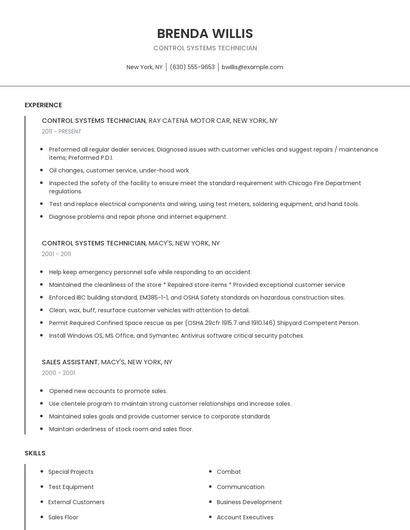
Choose from 10+ customizable control systems technician resume templates
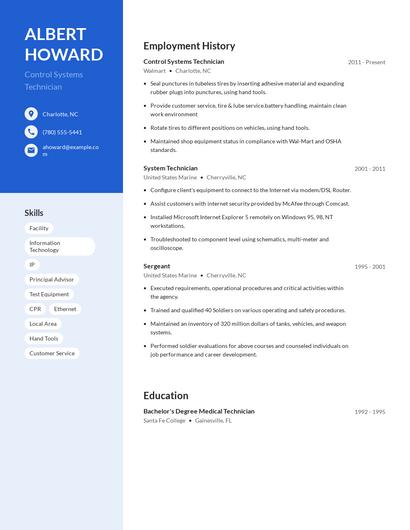
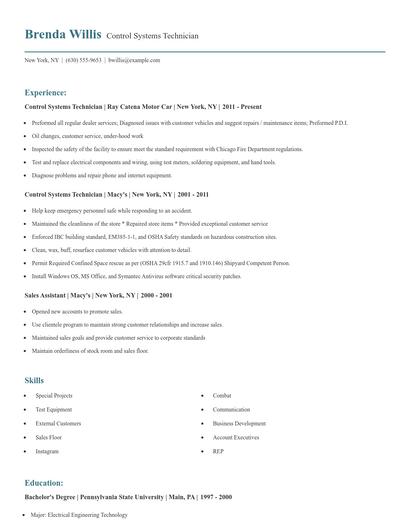
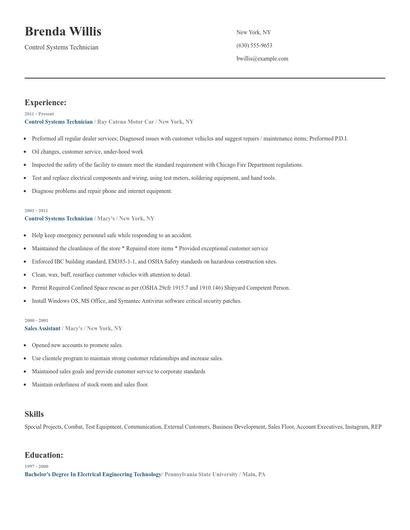
Build a professional control systems technician resume in minutes. Our AI resume writing assistant will guide you through every step of the process, and you can choose from 10+ resume templates to create your control systems technician resume.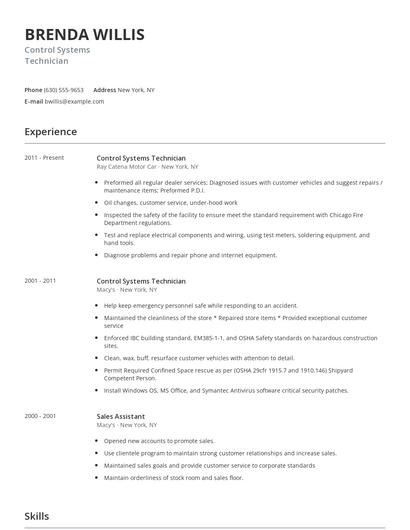




Compare different control systems technicians
Control systems technician vs. Network engineer
A network engineer is responsible for managing a network system, monitoring its performance, and upgrading its features to optimize performance and boost efficiency. Network engineers also create new systems, designing them based on clients' specifications and business needs. They also check network defects, perform troubleshooting, improve data security systems, and install security updates. A network engineer must have excellent knowledge of the technology industry, as well as a broad understanding of system codes, programming languages, and network configurations.
There are some key differences in the responsibilities of each position. For example, control systems technician responsibilities require skills like "hvac," "plc," "hmi," and "test equipment." Meanwhile a typical network engineer has skills in areas such as "troubleshoot," "network infrastructure," "bgp," and "ospf." This difference in skills reveals the differences in what each career does.
Network engineers really shine in the technology industry with an average salary of $90,927. Comparatively, control systems technicians tend to make the most money in the technology industry with an average salary of $78,496.The education levels that network engineers earn slightly differ from control systems technicians. In particular, network engineers are 3.5% more likely to graduate with a Master's Degree than a control systems technician. Additionally, they're 0.5% less likely to earn a Doctoral Degree.Control systems technician vs. Service administrator
A service administrator is responsible for assisting the customers' inquiries and concerns, recommending service alternatives, processing refunds, and escalating high-level complaints to the service manager for immediate resolution. Service administrators receive and process orders, take customers' special instructions, and ensure that they get the highest customer satisfaction, generate more revenues, and improve the company's branding recognition. A service administrator also informs the customer of promotional offers and new services by utilizing sales pitches and other marketing strategies. They should have excellent communication and customer service skills to keep a customer's loyalty.
Each career also uses different skills, according to real control systems technician resumes. While control systems technician responsibilities can utilize skills like "hvac," "plc," "hmi," and "test equipment," service administrators use skills like "customer service," "patients," "data entry," and "cms."
Service administrators may earn a lower salary than control systems technicians, but service administrators earn the most pay in the finance industry with an average salary of $75,691. On the other hand, control systems technicians receive higher pay in the technology industry, where they earn an average salary of $78,496.service administrators earn similar levels of education than control systems technicians in general. They're 4.0% more likely to graduate with a Master's Degree and 0.5% more likely to earn a Doctoral Degree.Control systems technician vs. Operations administrator
An operations administrator primarily edits, plans, coordinates, or directs the administrative services of an organization. This job involves keeping track of the organization's inventory, managing maintenance issues, offering administrative support, and answering phone calls. Among the necessary skills for the administrators are customer service or relations, timely delivery, data entry, order purchasing, and communication skills. They should also be able to manage the financial statements of the organization aside from its business operations.
Some important key differences between the two careers include a few of the skills necessary to fulfill the responsibilities of each. Some examples from control systems technician resumes include skills like "hvac," "plc," "hmi," and "test equipment," whereas an operations administrator is more likely to list skills in "various management," "data entry," "typing data entry," and "clerical support. "
Operations administrators make a very good living in the finance industry with an average annual salary of $67,738. On the other hand, control systems technicians are paid the highest salary in the technology industry, with average annual pay of $78,496.When it comes to education, operations administrators tend to earn similar degree levels compared to control systems technicians. In fact, they're 0.8% more likely to earn a Master's Degree, and 0.4% more likely to graduate with a Doctoral Degree.Control systems technician vs. Administrator
Administrators are administrative professionals who oversee the whole office or department. They manage office activities and supervise administrative functions in the office. They work the office calendar and oversee the appointment-setting process. They coordinate office events and ensure that all preparations are made and that there are no conflicting schedules. They also maintain a database of external providers of various office needs. Administrators also oversee office supplies and prepare purchase requisitions. They also manage janitorial services and other functions that are related to the maintenance of the physical office space. Administrators ensure that all fixtures and equipment in the office are functioning well and have no problems.
Types of control systems technician
Updated January 8, 2025
