
Automatically apply for jobs with Zippia
Upload your resume to get started.
Database analyst skills for your resume and career

15 database analyst skills for your resume and career
1. Database Management
- Participated in the development of data architectures and database management policies and standards.
- Coordinated database development applying knowledge of database design standards and database management system.
2. Database Design
- Provided requirements analysis, data modeling, database design, and metadata management/reporting for ODS and data warehouse development projects.
- Interviewed system end users to gather user requirements, and incorporate business requirements into database design.
3. Data Analysis
- Locate and identify data discrepancies, investigate for solutions using data analysis practices and prepare analysis reports.
- Established data cleansing and enrichment through careful data analysis using data modeling tool SQL Navigator.
4. Backup Recovery
- Develop and implement database backup recovery plan.
- Performed database backup recovery processes, identified and resolved all problems, and ensured appropriate tracking.
5. ETL
- Developed ETL procedures and monitored scheduled loads to support Data Warehouse.
- Used SQL Server Data Transformation Services (DTS) to facilitate the extract, transform, load (ETL) process.
6. Data Warehouse
Data warehouse, often abbreviated as either DW or DWH is a system used in computing for data analysis as well reporting. The DW is also considered to be an integral component of business intelligence as they also provide storage facilities for both real-time and historical data. ETL and ELT are the two driving forces behind a data warehouse system.
- Designed and developed logical and physical data models, data warehouses and databases.
- Design and develop Databases, Data Warehouses and Multidimensional Databases.
Choose from 10+ customizable database analyst resume templates
Build a professional database analyst resume in minutes. Our AI resume writing assistant will guide you through every step of the process, and you can choose from 10+ resume templates to create your database analyst resume.7. PL/SQL
- Developed procedure and functions using PL/SQL and Developed critical reports.
- Developed various Oracle sub functions like Stored Procedures, Functions, and Packages using PL/SQL as per the Design Documents.
8. Data Quality
- Analyze and interpret statistical data in order to improve data quality and make recommendations regarding training needs and database enhancements.
- Created stored procedures and functions, ensuring data quality by cross referencing and validating data prior to marketing distribution.
9. Data Collection
Data collection means to analyze and collect all the necessary information. It helps in carrying out research and in storing important and necessary information. The most important goal of data collection is to gather the information that is rich and accurate for statistical analysis.
- Performed data collection for analog-to-digital migration of WGN affiliates.
- Interview customers to obtain data collection requirements and specifications.
10. Data Integrity
Data integrity denotes the consistency or accuracy validation of data in the whole lifecycle of data. It ensures the security of traceability and search-ability of all data in a person's device to the source.
- Managed and updated data integrity for internal database to ensure correct data is uploaded to minimize risk and exposure.
- Reviewed existing data structures for potential performance, data integrity, and referential integrity improvements.
11. Microsoft SQL Server
- Produced daily database monitoring reports using Microsoft SQL Server reporting services and disseminate to management to report progress.
- Served as primary Microsoft SQL Server database administrator for unemployment compensation taxation and benefit online systems.
12. Ssis
SSIC stands for Singapore Standard Industrial Classification. It is a national standard for classifying economic activities such as population censuses, household and business surveys, financial databases etc.
- Deployed SSIS Package into Production using Package configuration to export various package properties to make package environment independent.
- Extracted, Transformed, and Loaded data by using SSIS package and also through SQL Server Management Studio (SSMS).
13. Windows
Windows is a chain of operating systems that controls a computer and is developed by Microsoft. Every version of Windows consists of GUI (graphical user interface), with a desktop that allows the user to open their files.
- Resolved intermediate technical problems related to Microsoft Windows environments and applications, internal proprietary software, and company websites.
- Administered Windows Server, managed users and general account management including network backups.
14. Troubleshoot
Troubleshooting is the process of analyzing and fixing any kind of problem in a system or a machine. Troubleshooting is the detailed yet quick search in the system for the main source of an issue and solving it.
- Analyze and troubleshoot data inconsistencies and anomalies that may occur during user generated reporting.
- Participate in peer-based design reviews and technical reviews and Troubleshoot performance issues.
15. Database Systems
- Investigated and recommended efficient, user-friendly database interface designs for all users by utilizing acquired experience and knowledge of database systems.
- Maintained current database system by designing user-friendly forms, reports that improved efficiency and management of database.
5 Database Analyst resume examples
Build a professional database analyst resume in minutes. Browse through our resume examples to identify the best way to word your resume. Then choose from 5+ resume templates to create your database analyst resume.

What skills help Database Analysts find jobs?
Tell us what job you are looking for, we’ll show you what skills employers want.
What database analyst skills would you recommend for someone trying to advance their career?
Pavel Chernyavskiy Ph.D.
Assistant Professor of Statistics, University of Wyoming
What type of skills will young database analysts need?
Zhixin Wu Ph.D.
Associate Professor, DePauw University
What soft skills should all database analysts possess?
Jason Imbrogno Ph.D.
Associate Professor, University of North Alabama
What hard/technical skills are most important for database analysts?
Jason Caudill Ph.D.
Professor of Business, King University
List of database analyst skills to add to your resume
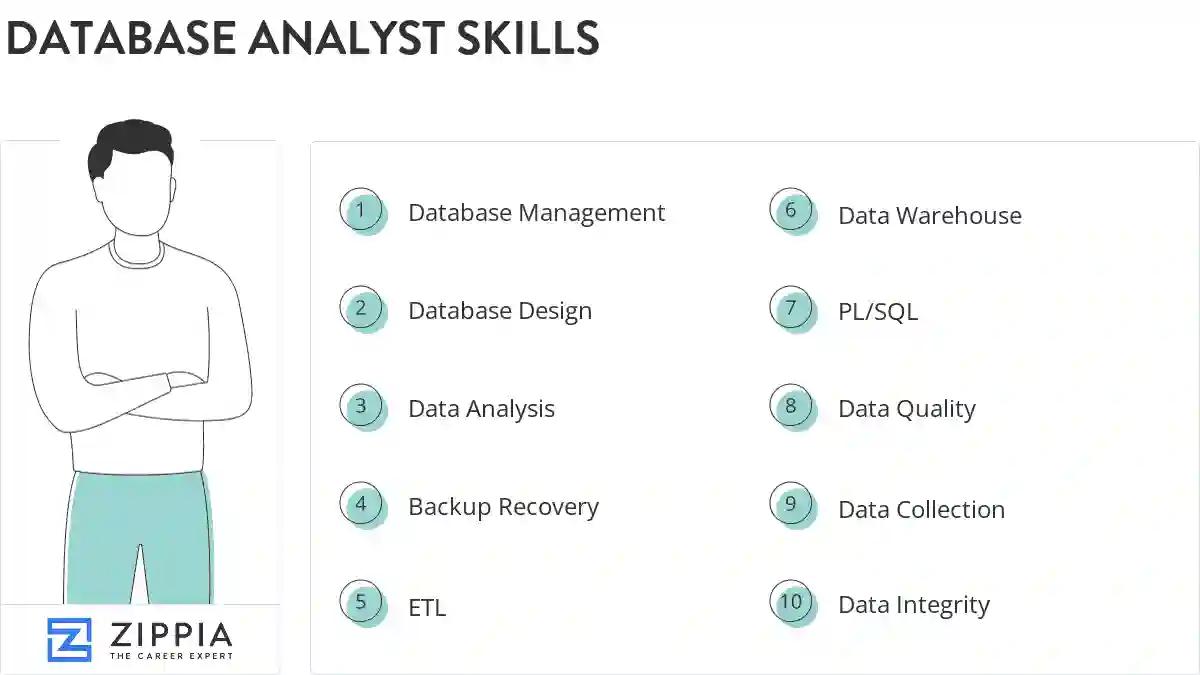
The most important skills for a database analyst resume and required skills for a database analyst to have include:
- Database Management
- Database Design
- Data Analysis
- Backup Recovery
- ETL
- Data Warehouse
- PL/SQL
- Data Quality
- Data Collection
- Data Integrity
- Microsoft SQL Server
- Ssis
- Windows
- Troubleshoot
- Database Systems
- Power Bi
- BI
- Unix
- SSRS
- Linux
- Java
- Relational Databases
- VBA
- T-SQL
- Teradata
- Management System
- DBA
- Data Warehousing
- Data Entry
- Data Models
- SAS
- Database Performance
- PowerPoint
- SDLC
- Database Development
- DB2
- Statistical Analysis
- Business Analysts
- JavaScript
- Pivot Tables
- QA
- Oracle Sql
- Data Extraction
- Business Processes
- SharePoint
- SSAS
- Access Database
Updated January 8, 2025
