What does a deployment lead do?
Deployment lead responsibilities
Here are examples of responsibilities from real deployment lead resumes:
- Maintain and manage network and fiber optic cables for servers and switches.
- Manage PC deployments through mass refreshes base on PC age and user job function.
- Develop and manage SharePoint sites for migration pilots.
- Recognize for outstanding ability to consistently manage workload and successfully troubleshoot desktop support issues.
- Lead team that develop an integrate database with a web-base user interface that allow repair crews in locating information and equipment.
- Perform SQL queries to validate the data and generate reports.
- Locate and identify users in need of system (OS) upgrade.
- Create, test and implement VPN to entire company, with documentation.
- Establish and publish service metrics to report on customer SLA and service growth.
- Develop and maintain a virtual infrastructure to facilitate development, QA, and customer testing.
- Oversee end user device placement and conduct quality assurance (QA) checks after installation.
- Provide SQL database administration and maintenance while providing software deployment support to clients, vendors, and end users.
- Partner with key stakeholders in the DoD and external agencies to thoroughly understand requirements for successful deployment of mission critical systems.
- Develop SharePoint site with all gp-relate training documents.
- Develop a go-live checklist for ensuring completion of all cutover activities.
Deployment lead skills and personality traits
We calculated that 13% of Deployment Leads are proficient in Project Management, Continuous Improvement, and Sigma. They’re also known for soft skills such as Customer-service skills, Listening skills, and Problem-solving skills.
We break down the percentage of Deployment Leads that have these skills listed on their resume here:
- Project Management, 13%
Improved new product margins by structuring project management phase-gates and by continuously improving process clarity.
- Continuous Improvement, 9%
Inspired knowledge sharing and collaboration across departments by establishing cross-practitioner groups focused on continuous improvement and convergence of identified best practices.
- Sigma, 7%
Facilitated internal and external Six Sigma forums and training sessions.
- HR, 7%
Optimized, simplified and documented complex/historic HR processes (Payroll/Timekeeping/Workforce Administration).
- Architecture, 4%
Collaborated with test and evaluation teams to identify mission requirements and develop enterprise network architecture.
- ERP, 4%
Lead deployment team consisting of 15 -35 resources responsible for training/support of plant on new ERP system implementation.
"project management," "continuous improvement," and "sigma" are among the most common skills that deployment leads use at work. You can find even more deployment lead responsibilities below, including:
Customer-service skills. One of the key soft skills for a deployment lead to have is customer-service skills. You can see how this relates to what deployment leads do because "computer support specialists must be patient and sympathetic." Additionally, a deployment lead resume shows how deployment leads use customer-service skills: "coach and mentor for project management team and all process improvement/lss projects and efforts within the customer care/call center organization. "
Listening skills. Another essential skill to perform deployment lead duties is listening skills. Deployment leads responsibilities require that "support workers must be able to understand the problems that their customers are describing and know when to ask questions to clarify the situation." Deployment leads also use listening skills in their role according to a real resume snippet: "documented and communicated requirements to ensure business as usual throughout the deployment process. "
Problem-solving skills. Another skill that relates to the job responsibilities of deployment leads is problem-solving skills. This skill is critical to many everyday deployment lead duties, as "support workers must identify both simple and complex computer problems, analyze them, and solve them." This example from a resume shows how this skill is used: "transition the rba solution to rba l2 support team and work with them for any deployment issues. "
Speaking skills. deployment lead responsibilities often require "speaking skills." The duties that rely on this skill are shown by the fact that "support workers must describe the solutions to computer problems in a way that a nontechnical person can understand." This resume example shows what deployment leads do with speaking skills on a typical day: "hired, trained bi-lingual resources (spanish-english speaking) to support go-live activities especially in areas of sap testing. "
Writing skills. Another common skill required for deployment lead responsibilities is "writing skills." This skill comes up in the duties of deployment leads all the time, as "strong writing skills are useful for preparing instructions and email responses for employees and customers, as well as for real-time web chat interactions." An excerpt from a real deployment lead resume shows how this skill is central to what a deployment lead does: "created standardized technical writing procedures for document business processes and system support. "
The three companies that hire the most deployment leads are:
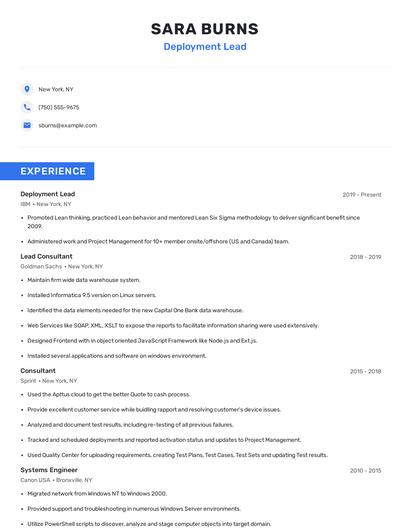
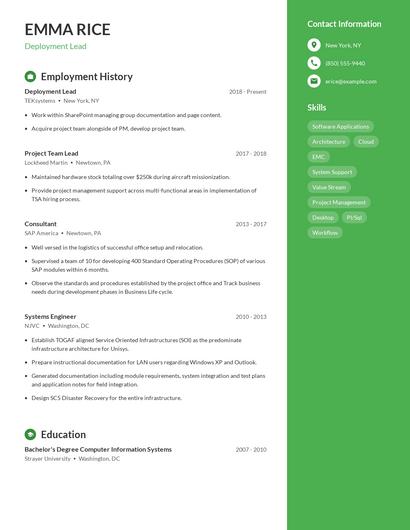
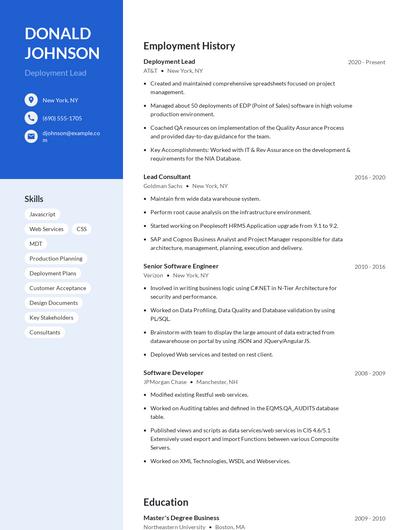
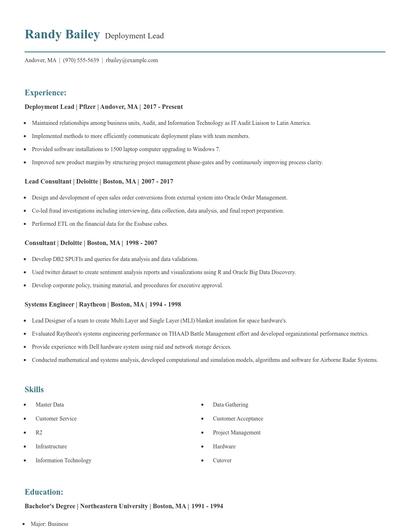
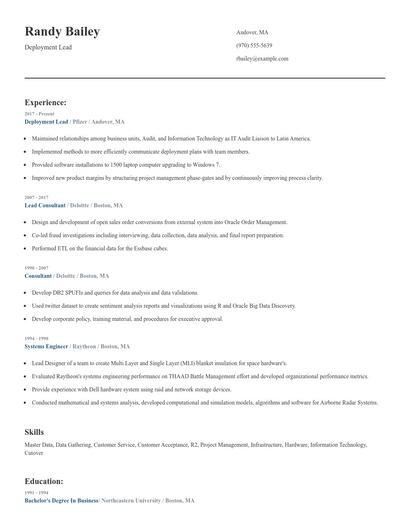
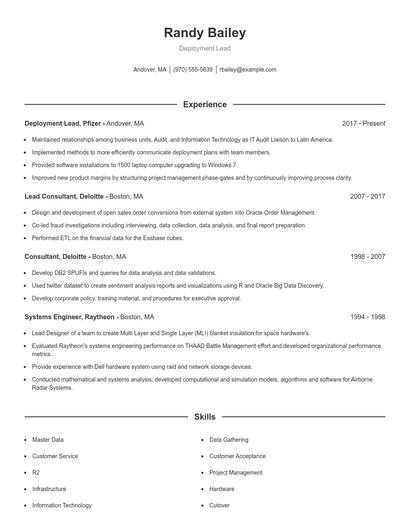
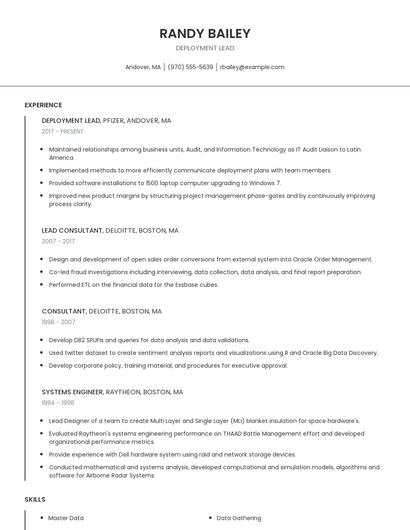
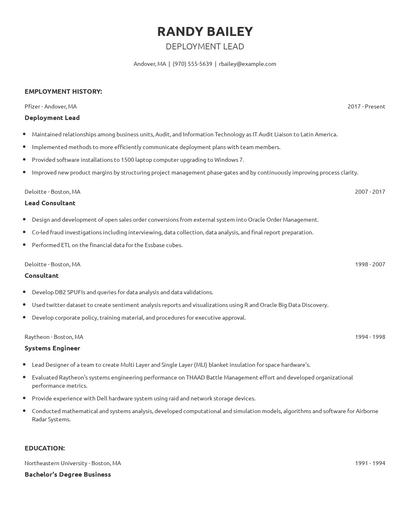
Choose from 10+ customizable deployment lead resume templates
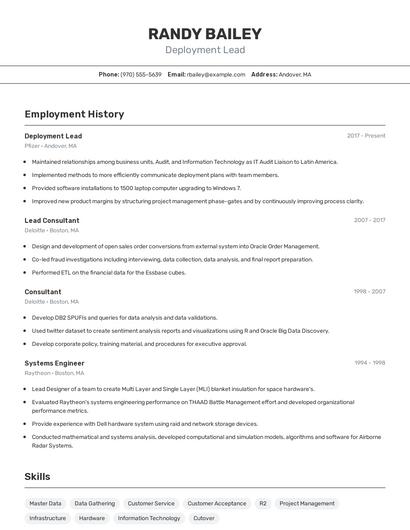
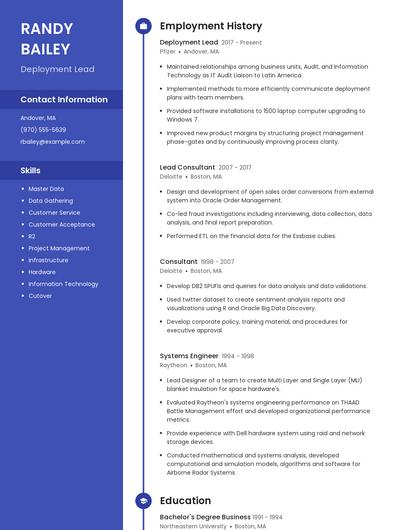
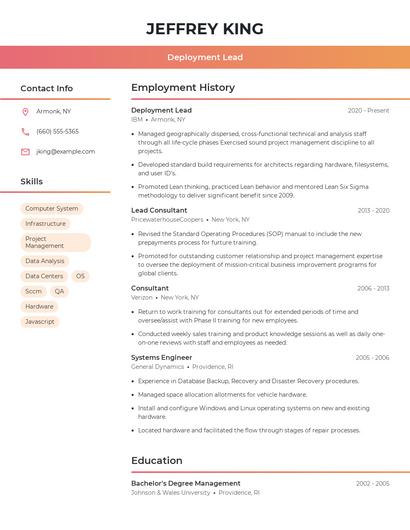
Build a professional deployment lead resume in minutes. Our AI resume writing assistant will guide you through every step of the process, and you can choose from 10+ resume templates to create your deployment lead resume.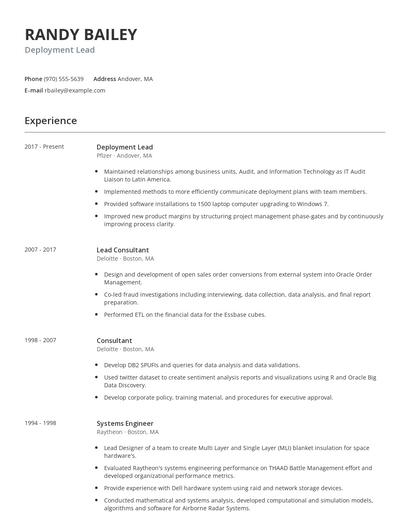
Compare different deployment leads
Deployment lead vs. Configuration manager
A configuration manager is in charge of spearheading configuration management procedures, ensuring efficiency and smooth workflow. Their responsibilities revolve around devising strategies to optimize operations, coordinating with supervisors and analysts in establishing guidelines, and addressing various issues, resolving them promptly and effectively. They must also manage budgets, schedule audits, monitor the progress of every operation, and recommend improvements as needed. Furthermore, as a configuration manager, it is essential to lead and encourage the team to reach goals, all while implementing the company's policies and regulations.
These skill sets are where the common ground ends though. The responsibilities of a deployment lead are more likely to require skills like "project management," "continuous improvement," "sigma," and "hr." On the other hand, a job as a configuration manager requires skills like "database," "version control," "infrastructure," and "software configuration management." As you can see, what employees do in each career varies considerably.
Configuration managers earn the highest salaries when working in the telecommunication industry, with an average yearly salary of $113,009. On the other hand, deployment leads are paid more in the technology industry with an average salary of $107,132.On average, configuration managers reach similar levels of education than deployment leads. Configuration managers are 4.4% less likely to earn a Master's Degree and 0.3% less likely to graduate with a Doctoral Degree.Deployment lead vs. Scrum master
A scrum master is a job that's rooted in leadership. It is the scrum master's responsibility to ensure a scrum process over the development of a project. They are not directly involved in the decision-making but guide the team in completing the scrum process with their experience and expertise. Also, a scrum master must be adept at being agile in approaching a project and also be able to schedule meetings during the process. In addition, the scrum master acts as a coach as well, helping the scrum teamwork cross-functionally.
While some skills are similar in these professions, other skills aren't so similar. For example, resumes show us that deployment lead responsibilities requires skills like "sigma," "hr," "architecture," and "erp." But a scrum master might use other skills in their typical duties, such as, "jira," "software development," "agile scrum," and "kanban."
On average, scrum masters earn a lower salary than deployment leads. Some industries support higher salaries in each profession. Interestingly enough, scrum masters earn the most pay in the energy industry with an average salary of $110,550. Whereas deployment leads have higher pay in the technology industry, with an average salary of $107,132.scrum masters earn higher levels of education than deployment leads in general. They're 7.2% more likely to graduate with a Master's Degree and 0.3% less likely to earn a Doctoral Degree.Deployment lead vs. Senior consultant, information technology
A senior consultant of information technology is primarily responsible for developing strategies and procedures to optimize a company's information technology systems and infrastructure. It is their duty to assess existing networks and systems to identify their strengths and weaknesses, develop solutions in problem areas, perform risk assessments, and provide advice on how to achieve the best information technology practices. Furthermore, as a senior consultant, it is essential to lead the efforts and serve as a role model for the workforce, all while implementing the company's policies and regulations.
The required skills of the two careers differ considerably. For example, deployment leads are more likely to have skills like "continuous improvement," "sigma," "lean six sigma," and "technical issues." But a senior consultant, information technology is more likely to have skills like "client facing," "healthcare," "shared services," and "cloud."
Senior consultants, information technology earn the highest salary when working in the finance industry, where they receive an average salary of $117,869. Comparatively, deployment leads have the highest earning potential in the technology industry, with an average salary of $107,132.senior consultants, information technology typically earn similar educational levels compared to deployment leads. Specifically, they're 2.7% more likely to graduate with a Master's Degree, and 0.7% more likely to earn a Doctoral Degree.Deployment lead vs. Senior analyst/project manager
A senior analyst project manager's main job is to track the milestones of their company's important projects. They also manage the clients' databases. They are responsible for distributing databases to the sales representatives. They also help in automating their company.
Types of deployment lead
Updated January 8, 2025
