What does a design analyst do?
The duties of a design analyst depend on one's line of work or industry of employment. In a corporate setting, their responsibilities typically revolve around performing research and analysis to identify the company or the client's needs, determining areas needing improvement, and designing new systems to optimize business operations. Aside from utilizing their expertise to recommend efficient designs, a design analyst is also responsible for providing technical support and information assistance to staff, all while implementing the company's policies and regulations.
Design analyst responsibilities
Here are examples of responsibilities from real design analyst resumes:
- Administer and manage external websites and company s SharePoint site.
- Use SSRS in conjunction with SQL schedule processes to automate frequent processing tasks.
- Manage business requirements gathering for functionality development and interface definition from the legacy systems to the CRM and SA management applications.
- Compile, analyze and present data integrity findings for data in ASCII, HTML, SGML, XML and DTD specifications.
- Create VISIO diagrams for DS1 and DS3 circuits.
- Automate IE web pages using VBA.
- Create graphics for machine manuals using Photoshop CC4.
- Interface XML to EDI to meet Shortlines requirements.
- Implement event handling using Java, AJAX, and JavaScript.
- Create documentation and flowcharts for complicate VBA and SQL scripts.
- Assist designer in UI development which are key to the platform.
- Provide oversight and supervision for a team of 20+ GIS technicians.
- Design low and high fidelity wireframes using Axure, Photoshop and prototypes.
- Train incoming personnel how proper techniques for the cad procedure and QA/QC standards.
- Utilize TRM rules and java scripts to customize MAXIMO for company specific needs.
Design analyst skills and personality traits
We calculated that 7% of Design Analysts are proficient in Project Management, Design Process, and Management System. They’re also known for soft skills such as Analytical skills, Communication skills, and Creativity.
We break down the percentage of Design Analysts that have these skills listed on their resume here:
- Project Management, 7%
Implemented Project Management Office insuring project management disciplines used throughout the business unit resulting in standard practices and common behavior.
- Design Process, 7%
Conducted audience analyses, researched and analyzed business processes and other information to develop, design/redesign processes and procedural material.
- Management System, 5%
Participate training user community for migration of documentation from legacy data management system to Windchill.
- CAD, 5%
Use of proprietary cad software for modifying and creating detailed cabling maps for design, layout, and signal deterioration calculation.
- Visualization, 5%
Experience with tableau for data acquisition and data visualization.
- Data Analysis, 4%
Performed Data Analysis on preset data to identify trends and patterns in the data.
Common skills that a design analyst uses to do their job include "project management," "design process," and "management system." You can find details on the most important design analyst responsibilities below.
Analytical skills. The most essential soft skill for a design analyst to carry out their responsibilities is analytical skills. This skill is important for the role because "analysts must interpret complex information from various sources and decide the best way to move forward on a project." Additionally, a design analyst resume shows how their duties depend on analytical skills: "used informatics power center for (etl) extraction, transformation and loading data from heterogeneous source systems. "
Communication skills. Another soft skill that's essential for fulfilling design analyst duties is communication skills. The role rewards competence in this skill because "analysts work as a go-between with management and the it department and must explain complex issues in a way that both will understand." According to a design analyst resume, here's how design analysts can utilize communication skills in their job responsibilities: "collaborate with peers and subject matter experts via professional communication channels. "
Creativity. This is an important skill for design analysts to perform their duties. For an example of how design analyst responsibilities depend on this skill, consider that "because analysts are tasked with finding innovative solutions to computer problems, an ability to “think outside the box” is important." This excerpt from a resume also shows how vital it is to everyday roles and responsibilities of a design analyst: "incorporated creative problem solving for elearning, instructor-led training, and on-the-job training. ".
The three companies that hire the most design analysts are:
- Highmark85 design analysts jobs
- Workday15 design analysts jobs
- FIS10 design analysts jobs
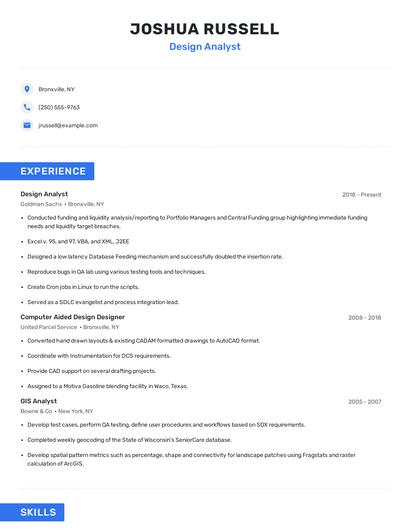
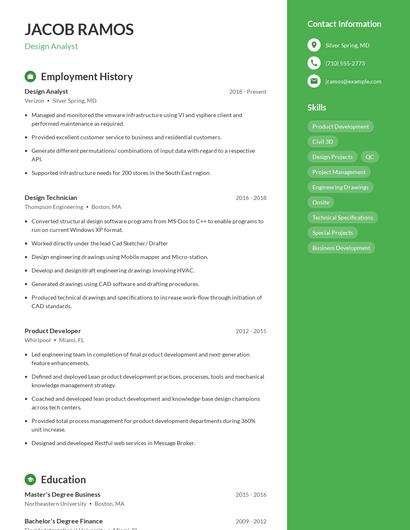
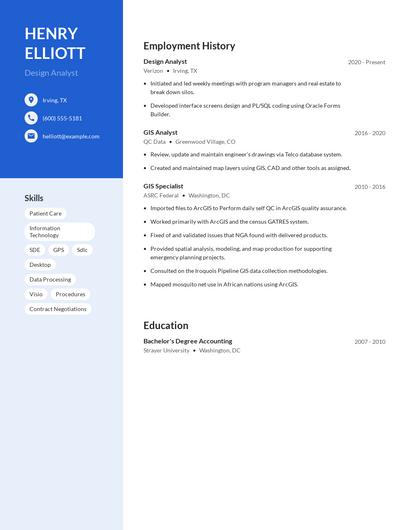
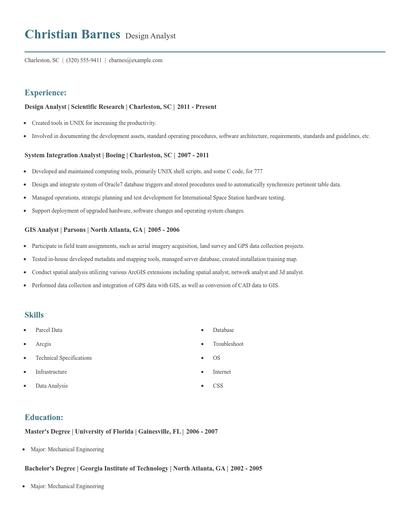
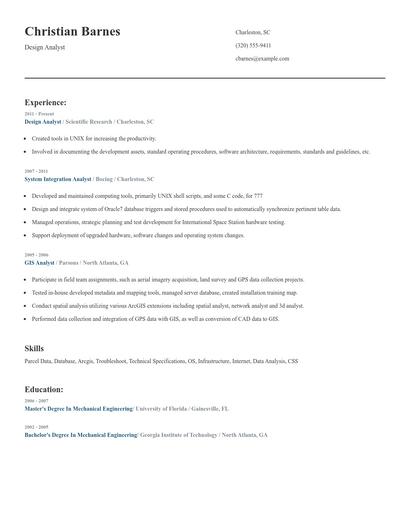
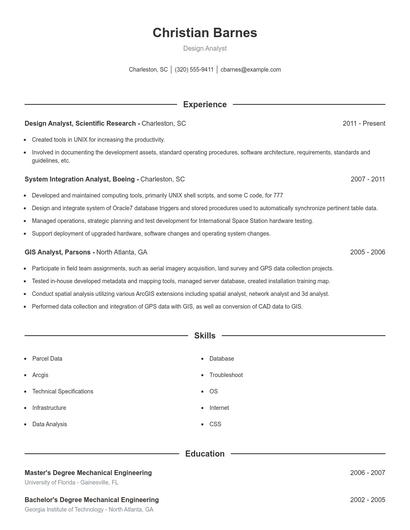
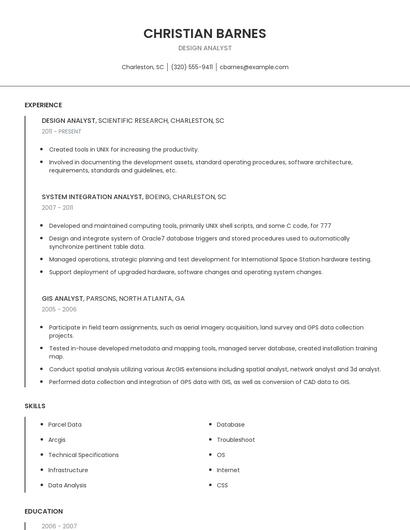
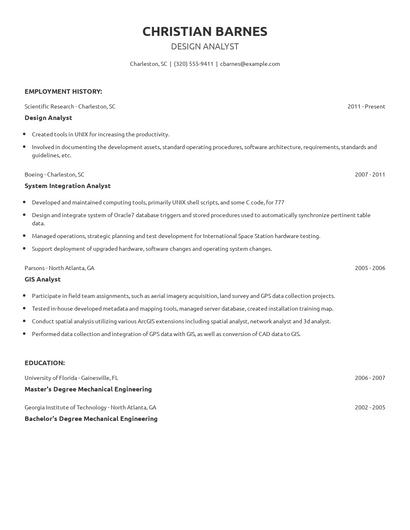
Choose from 10+ customizable design analyst resume templates
Build a professional design analyst resume in minutes. Our AI resume writing assistant will guide you through every step of the process, and you can choose from 10+ resume templates to create your design analyst resume.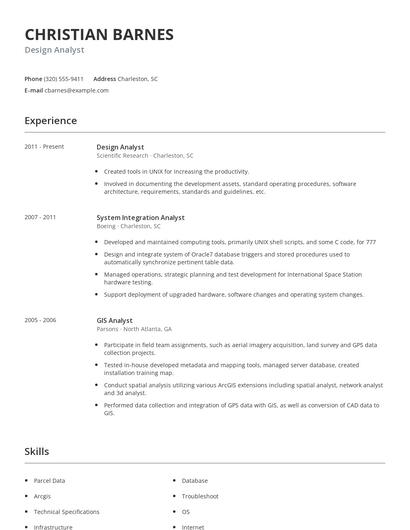
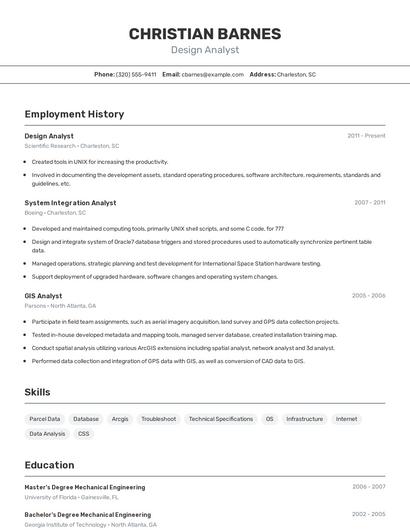
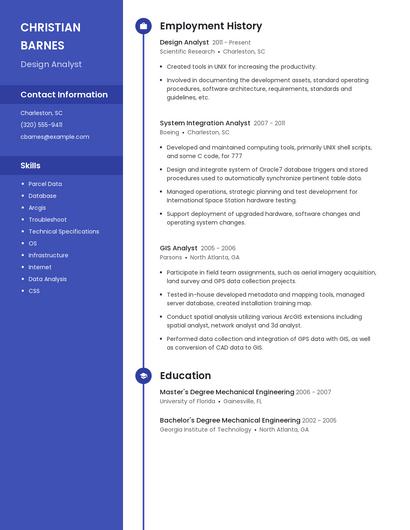
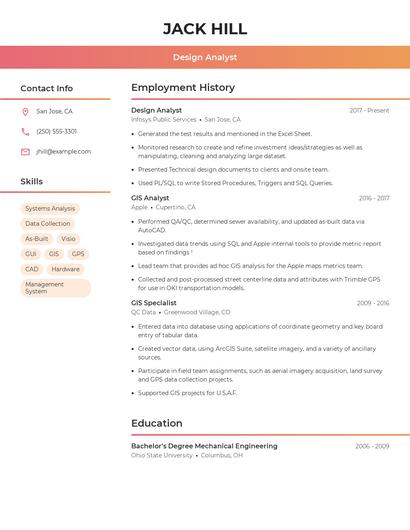
Compare different design analysts
Design analyst vs. Business analyst/quality analyst
A business analyst/quality analyst is responsible for evaluating business outputs and operational processes to ensure that everything adheres to the quality standards and business regulations. Business analysts/quality analysts support senior management in determining solutions to improve the company's services and provide the highest satisfaction for the customers and clients. They also conduct data and statistical analysis by assessing the market trends to identify opportunities that would generate more revenue resources and increase profitability for the business.
These skill sets are where the common ground ends though. The responsibilities of a design analyst are more likely to require skills like "project management," "design process," "management system," and "cad." On the other hand, a job as a business analyst/quality analyst requires skills like "microsoft visio," "business process," "regression," and "application development." As you can see, what employees do in each career varies considerably.
Business analysts/quality analysts earn the highest salaries when working in the finance industry, with an average yearly salary of $94,836. On the other hand, design analysts are paid more in the utilities industry with an average salary of $93,600.On average, business analysts/quality analysts reach higher levels of education than design analysts. Business analysts/quality analysts are 9.3% more likely to earn a Master's Degree and 0.0% more likely to graduate with a Doctoral Degree.Design analyst vs. Information technology analyst
An information technology analyst is responsible for identifying business opportunities by creating and designing technology systems that would help business operations perform efficiently and accurately. Information technology analysts manage systems maintenance, upgrade and install updates for better optimization, and perform feature revisions and adjustments based on the end-user experience. They analyze client and business specifications and research a multiple system approach to generate technology solutions. An information technology analyst must have excellent analytical skills, as well as broad knowledge of the technology industry.
Each career also uses different skills, according to real design analyst resumes. While design analyst responsibilities can utilize skills like "design process," "cad," "visualization," and "google earth," information technology analysts use skills like "infrastructure," "customer service," "security policies," and "switches."
On average, information technology analysts earn a higher salary than design analysts. Some industries support higher salaries in each profession. Interestingly enough, information technology analysts earn the most pay in the technology industry with an average salary of $94,506. Whereas design analysts have higher pay in the utilities industry, with an average salary of $93,600.Average education levels between the two professions vary. Information technology analysts tend to reach similar levels of education than design analysts. In fact, they're 1.9% less likely to graduate with a Master's Degree and 0.0% less likely to earn a Doctoral Degree.What technology do you think will become more important and prevalent for design analysts in the next 3-5 years?
Erik Johnson Ph.D.
Assistant Professor of Economics, Carthage College
Design analyst vs. Senior applications analyst
Senior Application Analysts are information technology (IT) professionals. They are responsible for addressing requests and concerns related to software applications. They may specialize in specific software or may be assigned to address concerns on a wide array of applications. They create reports related to software concerns. They take note of troubleshooting logs and how they were able to fix problems. Senior Application Analysts are in charge of understanding why such problems arise. They analyze the concerns and identify patterns to help mitigate any future problems.
The required skills of the two careers differ considerably. For example, design analysts are more likely to have skills like "design process," "cad," "visualization," and "google earth." But a senior applications analyst is more likely to have skills like "healthcare," "home health," "sr," and "provide management."
Senior applications analysts make a very good living in the finance industry with an average annual salary of $120,833. On the other hand, design analysts are paid the highest salary in the utilities industry, with average annual pay of $93,600.Most senior applications analysts achieve a similar degree level compared to design analysts. For example, they're 0.6% more likely to graduate with a Master's Degree, and 0.2% more likely to earn a Doctoral Degree.Design analyst vs. Information systems analyst
An information systems analyst specializes in conducting cost-efficient research and analysis to determine how information technology can improve a company's business process and growth. One of their primary responsibilities is to collaborate with information systems experts to develop upgrades and all-new systems, respond to inquiries and concerns, provide corrective measures, and meet the IT needs of employees all over the company. Furthermore, it is essential to run tests on systems and determine areas that need improvement.
Even though a few skill sets overlap between design analysts and information systems analysts, there are some differences that are important to note. For one, a design analyst might have more use for skills like "design process," "cad," "visualization," and "extraction." Meanwhile, some responsibilities of information systems analysts require skills like "customer service," "technical issues," "dod," and "win10. "
Information systems analysts enjoy the best pay in the finance industry, with an average salary of $92,013. For comparison, design analysts earn the highest salary in the utilities industry.information systems analysts reach similar levels of education compared to design analysts, in general. The difference is that they're 3.1% more likely to earn a Master's Degree, and 0.0% more likely to graduate with a Doctoral Degree.Types of design analyst
Updated January 8, 2025
