What does a development/resource manager do?
Resource development managers are management professionals who are responsible for developing annual workplace campaigns and individual donor engagement for the public and private sectors. These managers are required to cultivate and manage relationships with current and prospective donors by providing donor recognition and appreciation. They must facilitate workplace campaigns and related events by coordinating materials needed for the campaigns. Resource development managers must also maintain quality relationships with volunteers and train them to support the annual campaigns.
Development/resource manager responsibilities
Here are examples of responsibilities from real development/resource manager resumes:
- Manage partner relations across multiple departments, including, Cisco, Microsoft, EMC, VMware, Citrix.
- Lead LSS QA department in reduction of labor cost of $70,000 by creating new crewing matrix guidelines.
- Manage a hospital cafeteria which include cash control and payroll procedures.
- Manage operations and logistics, coordinating transportation of personnel, equipment, and supplies to ensure on-time arrival/departure.
- Lead development efforts with aggressive time-lines on many web-base java projects in a dynamic environment concluding in successful on-time deliveries.
- Train personnel in support of monitoring assets procure from DOD agencies.
- Cash management and supervise payroll department for accuracy.
- Work with DoD budget officials in prioritizing requirements for military and civilian manpower and critical DoD programs.
- Thank and recognize donors in an appropriate and timely manner and manage and maintain donor database including updating and managing files.
- Craft innovative plan for rebranding agency image; plan and implement new outreach focusing on culturally aware approaches.
Development/resource manager skills and personality traits
We calculated that 30% of Development/Resource Managers are proficient in Applicant Tracking Systems, Customer Service, and Resource Development. They’re also known for soft skills such as Speaking skills, Leadership skills, and Interpersonal skills.
We break down the percentage of Development/Resource Managers that have these skills listed on their resume here:
- Applicant Tracking Systems, 30%
Leveraged all company Applicant Tracking Systems to drive reporting and recruiting processes.
- Customer Service, 24%
Provide excellent customer service, anticipating and exceeding the needs of our volunteers, donors and families.
- Resource Development, 16%
Devised a comprehensive and measurable resource development plan including special events, grants, individual contributions and volunteer contributions.
- Human Resources, 14%
Assist human resources in escorting clients to various departments, explaining rules and answering common questions.
- ATS, 3%
Placed candidates at new accounts in Boston, Memphis TN and Austin TX Utilized Sendouts/Bullhorn for ATS.
- Affordable Housing, 3%
Project manager for development and funding for affordable housing in San Jose area.
Most development/resource managers use their skills in "applicant tracking systems," "customer service," and "resource development" to do their jobs. You can find more detail on essential development/resource manager responsibilities here:
Leadership skills. Another essential skill to perform development/resource manager duties is leadership skills. Development/resource managers responsibilities require that "human resources managers must coordinate work activities and ensure that staff complete the duties and responsibilities of their department." Development/resource managers also use leadership skills in their role according to a real resume snippet: "provided leadership and strategic direction for partnership development and collaboration. "
Interpersonal skills. Another skill that relates to the job responsibilities of development/resource managers is interpersonal skills. This skill is critical to many everyday development/resource manager duties, as "human resources managers regularly interact with people, such as to collaborate on teams, and must develop working relationships with their colleagues." This example from a resume shows how this skill is used: "determined company needs for leadership development, succession planning, career management, interpersonal skills, and communication training. "
Organizational skills. A big part of what development/resource managers do relies on "organizational skills." You can see how essential it is to development/resource manager responsibilities because "human resources managers must be able to prioritize tasks and manage several projects at once." Here's an example of how this skill is used from a resume that represents typical development/resource manager tasks: "leveraged human capital knowledge to drive improvements in organizational metrics and kpi s."
The three companies that hire the most development/resource managers are:
- Americorps8 development/resource managers jobs
- SMOC1 development/resource managers jobs
- Texas Children's Hospital1 development/resource managers jobs
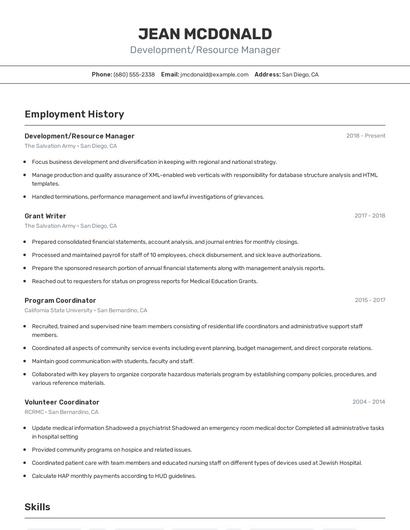
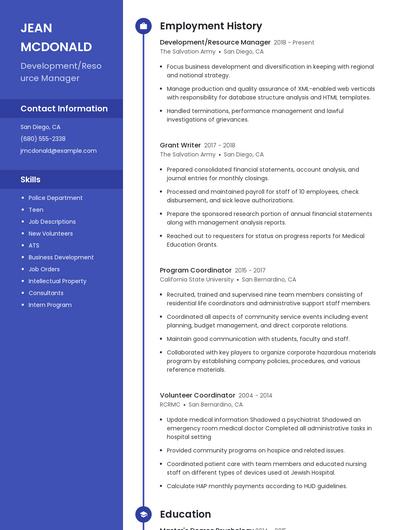
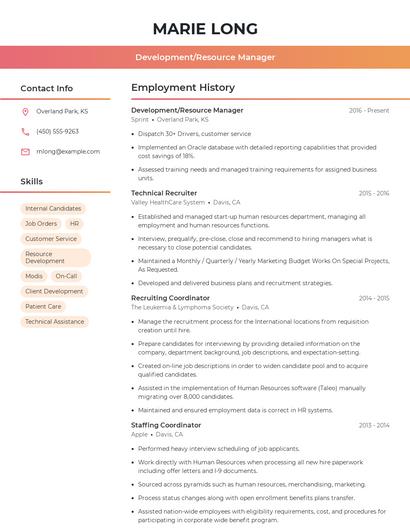
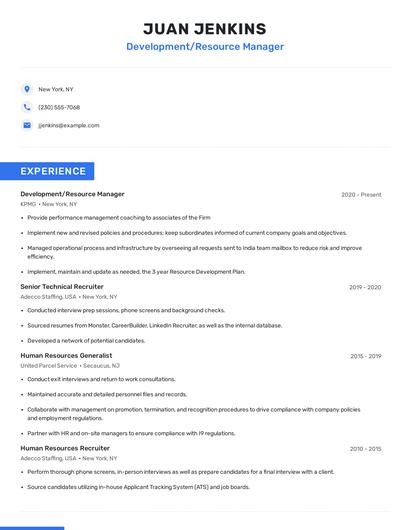
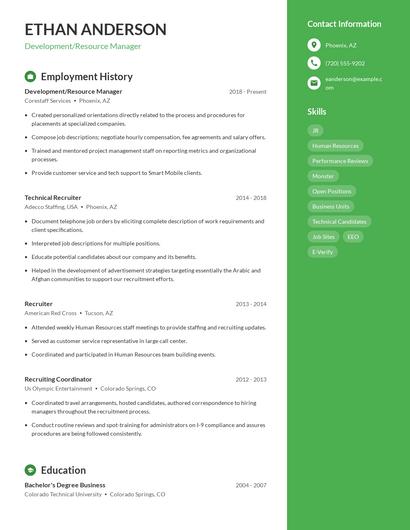
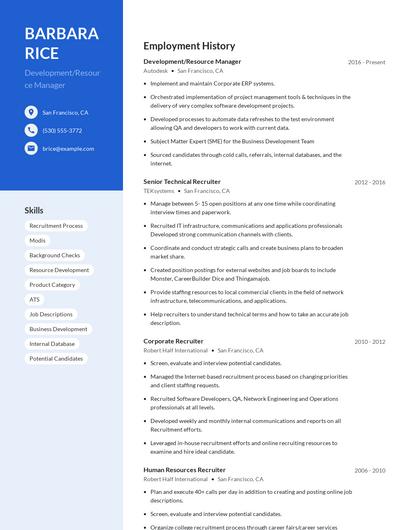
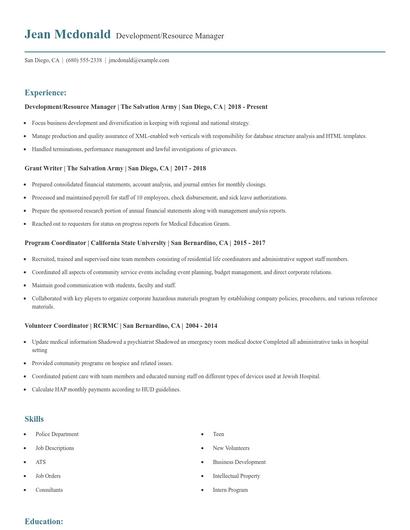
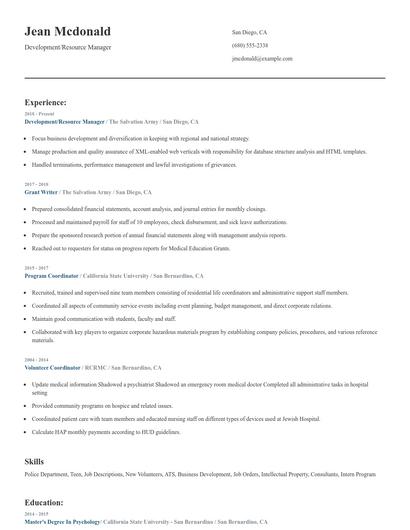
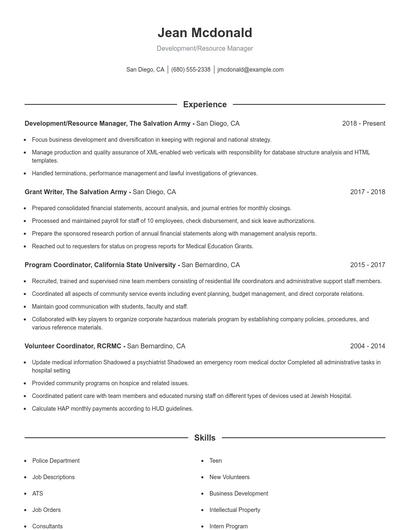
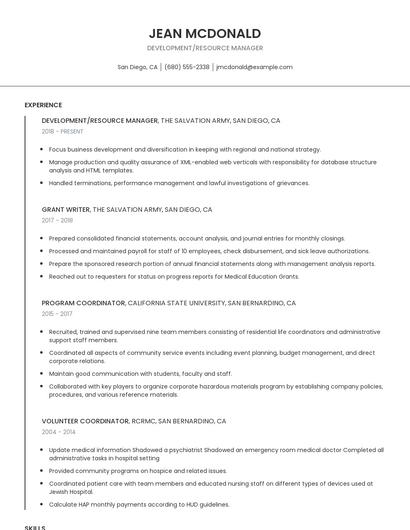
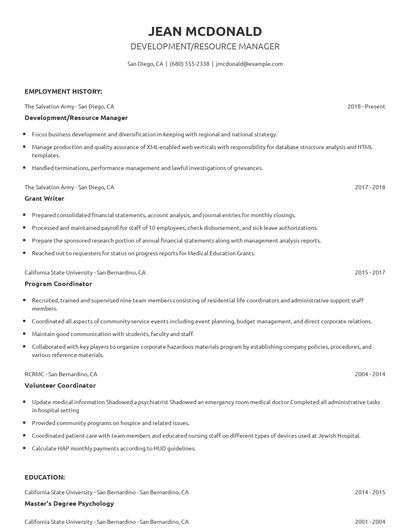
Choose from 10+ customizable development/resource manager resume templates
Build a professional development/resource manager resume in minutes. Our AI resume writing assistant will guide you through every step of the process, and you can choose from 10+ resume templates to create your development/resource manager resume.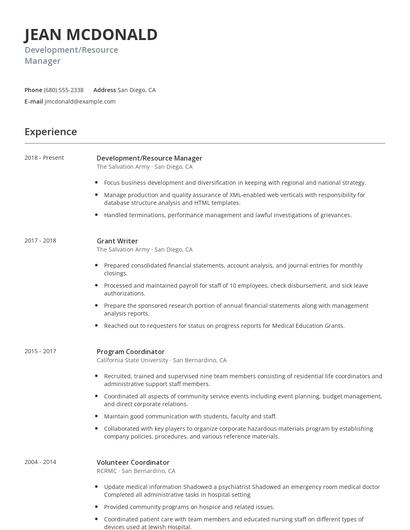
Compare different development/resource managers
Development/resource manager vs. Director of talent acquisition
A director of talent acquisition is primarily responsible for spearheading the development of strategies that will help a company to narrow down and acquire talented individuals. Typically, they must set goals and budgets, coordinate with stakeholders or higher-ranking officials, review and assess the performance of the talent acquisition team, and conduct training and meetings. Furthermore, as director, it is essential to implement all policies and regulations, craft new ones if necessary, all while shaping the team into an efficient workforce.
While similarities exist, there are also some differences between development/resource managers and director of talent acquisition. For instance, development/resource manager responsibilities require skills such as "powerpoint," "resource development," "affordable housing," and "donor database." Whereas a director of talent acquisition is skilled in "ta," "healthcare," "continuous improvement," and "project management." This is part of what separates the two careers.
Directors of talent acquisition earn the highest salaries when working in the manufacturing industry, with an average yearly salary of $135,636. On the other hand, development/resource managers are paid more in the pharmaceutical industry with an average salary of $95,266.directors of talent acquisition tend to reach similar levels of education than development/resource managers. In fact, directors of talent acquisition are 2.0% more likely to graduate with a Master's Degree and 0.8% more likely to have a Doctoral Degree.Development/resource manager vs. Recruitment director
A recruitment director is an executive professional who is responsible for directing the recruitment processes and employment programs for an organization. This director is required to assess the external labor market conditions while developing the most effective and appropriate recruiting channels and methods. The director must ensure that all their recruiting activities are following the policies and standards of the organization. This director must also maintain good relationships with all agencies that are involved with advertisement and employee recruitment.
Each career also uses different skills, according to real development/resource manager resumes. While development/resource manager responsibilities can utilize skills like "customer service," "powerpoint," "resource development," and "affordable housing," recruitment directors use skills like "healthcare," "recruitment efforts," "professional development," and "career fairs."
Recruitment directors earn a higher average salary than development/resource managers. But recruitment directors earn the highest pay in the technology industry, with an average salary of $114,999. Additionally, development/resource managers earn the highest salaries in the pharmaceutical with average pay of $95,266 annually.recruitment directors earn similar levels of education than development/resource managers in general. They're 0.8% less likely to graduate with a Master's Degree and 0.8% more likely to earn a Doctoral Degree.Development/resource manager vs. Staffing manager
A staffing manager is responsible for overseeing the overall staffing operations of the company, identifying the staffing needs for each department by coordinating with hiring managers for their requirements and specific instructions for job postings. Staffing managers monitor the performance of the staff, delegating tasks, and ensuring that the recruitment operations adhere to the company's policies and structured guidelines. They also update the company's online job boards, eliminating closed job posts, and reviewing the qualifications of potential candidates, scheduling them for interviews and assessments based on the hiring department's instructions.
The required skills of the two careers differ considerably. For example, development/resource managers are more likely to have skills like "powerpoint," "resource development," "affordable housing," and "donor database." But a staffing manager is more likely to have skills like "client relationships," "phone calls," "customer satisfaction," and "customer issues."
Staffing managers earn the best pay in the manufacturing industry, where they command an average salary of $52,083. Development/resource managers earn the highest pay from the pharmaceutical industry, with an average salary of $95,266.When it comes to education, staffing managers tend to earn similar degree levels compared to development/resource managers. In fact, they're 4.5% less likely to earn a Master's Degree, and 0.7% less likely to graduate with a Doctoral Degree.Development/resource manager vs. Human resources vice president
Human resources (HR) vice presidents play a vital role in the effective administration and operation of an organization's HR department. These executives are responsible for directing an organization's staffing goals and developing strategies to support the company's profitable and productive business operations. HR vice presidents also perform other duties and responsibilities, including planning payroll and employee benefits, facilitating the enforcement of standardized HR processes, and recommending new measures for employee performance evaluations. The skills and qualifications for this position include previous experience as an HR director, strong leadership skills, and in-depth knowledge of HR processes.
Types of development/resource manager
Updated January 8, 2025
