What does a distribution analyst do?
A distribution analyst plays an essential part in the business decision-making process of suppliers. You will be supporting customer service initiatives and communicate pricing. Other duties include developing partnerships with several logistics providers, providing technical support to field personnel and dealership about logistics and ordering system, and overseeing all the logistics of purchases such as order verification and shipment monitoring. As a distribution analyst, it is also your responsibility to track real-time call flow and schedule adherence.
Distribution analyst responsibilities
Here are examples of responsibilities from real distribution analyst resumes:
- Implement and manage contract renewal process through SalesForce.
- Perform daily data queries using SQL to analyze magazine distribution.
- Monitor order status, modifications, cancellations, order approval & EDI issues.
- Create and execute SQL queries in the production environment to fix data issues that are business critical.
- Provide analysis and interpretation of monthly and YTD distribution costs for logistics and business managers.
- Develop and implement a scrap process which include coordinating with production, warehouse, logistics and management personal.
- Utilize Nielsen data to create category reviews, new product presentations, and attend customer meetings to support customer category managers.
- Used expertise to set-up new accounts on VMI.
- Travele and augment teams at fielding missions, CONUS and OCONUS.
- Prepare and present reports detailing compliance review findings and solutions to GSA's senior-level executives and organizational acquisition operations directors.
Distribution analyst skills and personality traits
We calculated that 18% of Distribution Analysts are proficient in Supply Chain, Logistics, and Data Analysis. They’re also known for soft skills such as Detail oriented, Analytical skills, and Communication skills.
We break down the percentage of Distribution Analysts that have these skills listed on their resume here:
- Supply Chain, 18%
Served as sole Midwest supply chain liaison (purchaser) between distribution centers and vendor procurement to ensure inventory availability.
- Logistics, 18%
Develop and implemented a scrap process which included coordinating with production, warehouse, logistics and management personal.
- Data Analysis, 7%
Develop knowledge of geographic and shop-attribute performance through data analysis and field communication.
- SQL, 7%
Update and manage Windows 2000 and 2003 servers, SQL servers and MS Terminal servers.
- Process Improvement, 5%
Initiated and implemented strategic analysis and business process improvements to significantly decrease the cycle time for allocating payments to music publishers.
- Inventory Control, 3%
Monitored product flow via distribution center to maintain appropriate inventory control.
Common skills that a distribution analyst uses to do their job include "supply chain," "logistics," and "data analysis." You can find details on the most important distribution analyst responsibilities below.
Detail oriented. To carry out their duties, the most important skill for a distribution analyst to have is detail oriented. Their role and responsibilities require that "market research analysts must pay attention to minutiae to evaluate data." Distribution analysts often use detail oriented in their day-to-day job, as shown by this real resume: "ordered merchandise from agents and suppliers, ensuring all purchase order details, including pre-ticketing requirements, were accurately communicated. "
Analytical skills. Another soft skill that's essential for fulfilling distribution analyst duties is analytical skills. The role rewards competence in this skill because "market research analysts must evaluate large amounts of data and information related to market conditions." According to a distribution analyst resume, here's how distribution analysts can utilize analytical skills in their job responsibilities: "provide quantitative and qualitative analysis on various distribution processes. "
Communication skills. Another skill that relates to the job responsibilities of distribution analysts is communication skills. This skill is critical to many everyday distribution analyst duties, as "market research analysts must be able to clearly convey information when gathering material, interpreting data, and presenting results to clients." This example from a resume shows how this skill is used: "review sales with assigned buyer team and act as chief liaison for communication flow from distribution centers and stores. "
The three companies that hire the most distribution analysts are:
- Mark Travel5 distribution analysts jobs
- Axos Bank3 distribution analysts jobs
- Nuveen Investments3 distribution analysts jobs
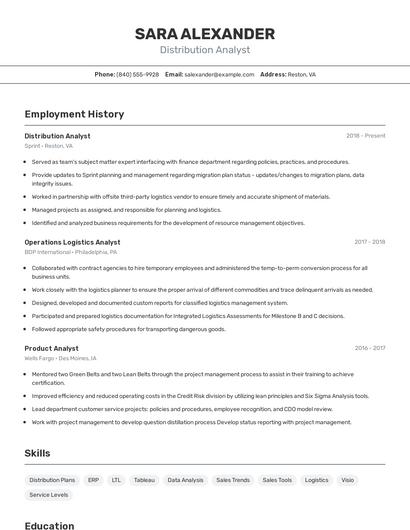
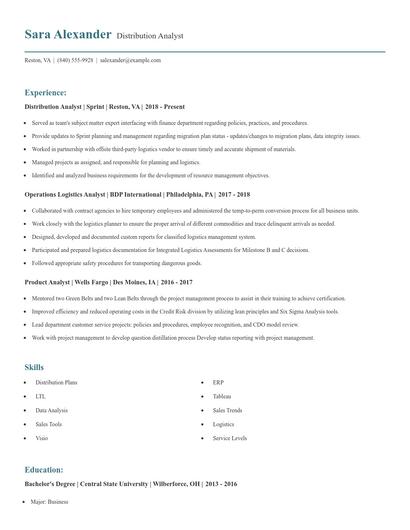
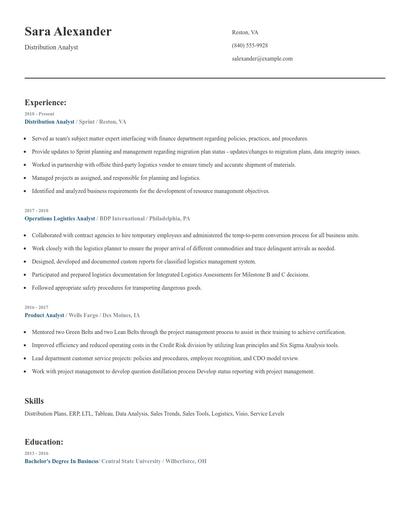
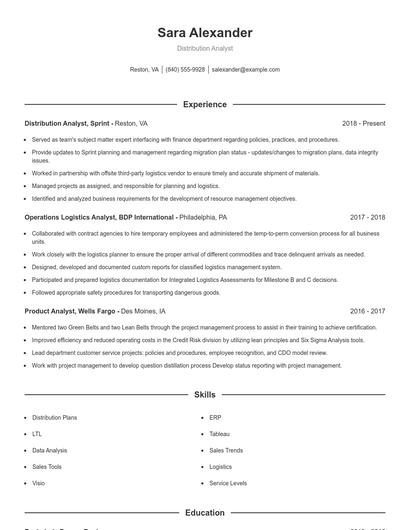
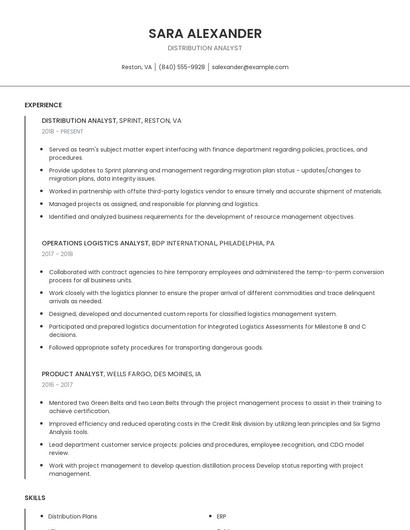
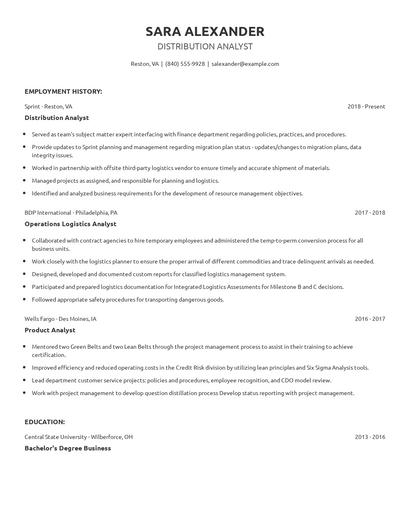
Choose from 10+ customizable distribution analyst resume templates
Build a professional distribution analyst resume in minutes. Our AI resume writing assistant will guide you through every step of the process, and you can choose from 10+ resume templates to create your distribution analyst resume.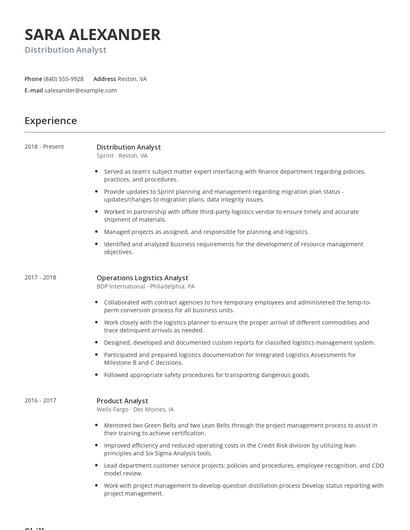


Compare different distribution analysts
Distribution analyst vs. Logistics internship
In a logistics internship, an intern's duties depend on the directives of a supervising staff or manager. Typically, their responsibilities revolve around processing documentation, producing progress reports, maintaining records, updating databases, answering calls and correspondence, disseminating information, and running errands. They may also participate in coordinating deliveries, devise strategies to optimize processes according to schedules, liaise with clients, and participate in preparing presentations. Should there be any problems or concerns, it is essential to report to the manager right away.
These skill sets are where the common ground ends though. The responsibilities of a distribution analyst are more likely to require skills like "logistics," "product flow," "business processes," and "distribution processes." On the other hand, a job as a logistics internship requires skills like "logistics intern," "chain management," "continuous improvement," and "logistics operations." As you can see, what employees do in each career varies considerably.
On average, logistics interns reach similar levels of education than distribution analysts. Logistics interns are 1.8% more likely to earn a Master's Degree and 0.3% more likely to graduate with a Doctoral Degree.Distribution analyst vs. Marketing coordinator
A marketing coordinator supports the marketing department on deciding strategies and business efforts to develop the brand image and boost customer satisfaction. Marketing coordinators' duties include assisting in advertising campaigns, scheduling promotional events, monitoring sales status, researching current market trends, maintaining a record of existing and potential clients, and contributing ideas to improve the brand's profitability. A marketing coordinator must have excellent critical thinking and writing skills to help with the creation of social media advertisements and marketing content. It also requires impressive time-management and multi-tasking skills, especially on meeting deadlines and making adjustments on the initial plans as needed.
Each career also uses different skills, according to real distribution analyst resumes. While distribution analyst responsibilities can utilize skills like "supply chain," "logistics," "data analysis," and "sql," marketing coordinators use skills like "digital marketing," "customer service," "marketing campaigns," and "powerpoint."
Marketing coordinators earn a lower average salary than distribution analysts. But marketing coordinators earn the highest pay in the technology industry, with an average salary of $53,831. Additionally, distribution analysts earn the highest salaries in the energy with average pay of $73,417 annually.marketing coordinators earn similar levels of education than distribution analysts in general. They're 2.0% less likely to graduate with a Master's Degree and 0.3% more likely to earn a Doctoral Degree.What technology do you think will become more important and prevalent for distribution analysts in the next 3-5 years?
Benjamin Clark Ph.D.
Associate Professor, University of Oregon
Distribution analyst vs. Marketing internship
Marketing interns are usually marketing students or fresh graduates who are interested in getting actual work experiences before taking on a full-time job. They usually have an interest or academic background related to marketing. They assist marketing teams in most of their daily activities, sit in their meetings, record minutes of these meetings, take note of action plans, and attend other events related to marketing. They also assist in preparing collateral and other marketing materials, join brainstorming sessions, or any other activity that will help enrich their experience.
The required skills of the two careers differ considerably. For example, distribution analysts are more likely to have skills like "supply chain," "logistics," "sql," and "process improvement." But a marketing internship is more likely to have skills like "digital marketing," "powerpoint," "facebook," and "marketing campaigns."
Marketing interns make a very good living in the technology industry with an average annual salary of $33,333. On the other hand, distribution analysts are paid the highest salary in the energy industry, with average annual pay of $73,417.Most marketing interns achieve a similar degree level compared to distribution analysts. For example, they're 2.9% less likely to graduate with a Master's Degree, and 0.2% less likely to earn a Doctoral Degree.Distribution analyst vs. Analyst sales
Analyst sales, or a sales analyst, is an individual who is responsible for increasing sales and revenue of a company by running competitive analysis and making recommendations on how the marketing and sales team should move forward. Sales analysts must assist in the review of monthly financial statements and prepare complex financial statements for retail and service businesses. They develop and provide market intelligence data solutions for the sales team to maximize territory sales efforts. Sales analysts must also maintain a business relationship with key account top management to deliver outstanding customer service and assistance.
Types of distribution analyst
Updated January 8, 2025
