What does an elementary educator do?
An Elementary Educator is mainly responsible for teaching basic academics among children while facilitating their social skills development. They are in charge of developing lesson plans and learning materials, organizing individual and group activities, creating quizzes and tests, utilizing audio and visual equipment, and developing strategies to meet the students' needs. They also monitor the students' academic progress and behavior, updating parents or guardians regularly. Moreover, an Elementary Educator develops various learning approaches while maintaining a safe and healthy classroom environment for everyone.
Elementary educator responsibilities
Here are examples of responsibilities from real elementary educator resumes:
- Provide departmentalized instruction in language arts, mathematics, and social studies.
- Provide general classroom support with administrative duties such as obtaining and distributing worksheets, reading packets and math packets for students.
- Recommend and implement online math programs for school wide implementation.
- Develop high quality standards-base lessons including extension menus, differentiate instruction, depth and complexity charts, and literature circles.
- Adapt curricula to meet the specific needs and interests of students from Pre-K all the way through high school.
- Strengthen student's cumulative learning and preparedness with FCAT reinforcement lessons.
Elementary educator skills and personality traits
We calculated that 13% of Elementary Educators are proficient in Mathematics, Math, and Elementary Education. They’re also known for soft skills such as Physical stamina, Communication skills, and Patience.
We break down the percentage of Elementary Educators that have these skills listed on their resume here:
- Mathematics, 13%
Instructed students in all subject areas: Mathematics, Earth Science, Language Arts, and Social Studies.
- Math, 13%
Selected Contributions: - Developed innovative math program for approximately 450 students.
- Elementary Education, 7%
Provide instruction and innovative programming to elementary education students, creating purposeful lesson plans and implementing innovative programming.
- Public Schools, 7%
Provide customized, one-on-one academic tutoring for students attending public schools designated in need of improvement by the Albuquerque Public School System
- Kindergarten, 6%
Created developmentally appropriate activities for kindergarten and first grade students.
- Autism, 6%
Supported students in a high-needs Autism Spectrum Disorder program
Most elementary educators use their skills in "mathematics," "math," and "elementary education" to do their jobs. You can find more detail on essential elementary educator responsibilities here:
Physical stamina. To carry out their duties, the most important skill for an elementary educator to have is physical stamina. Their role and responsibilities require that "working with kindergarten- and elementary-age students can be tiring." Elementary educators often use physical stamina in their day-to-day job, as shown by this real resume: "developed individual educational plans (iep's) designed to promote students' educational, physical, and social development. "
Communication skills. Another essential skill to perform elementary educator duties is communication skills. Elementary educators responsibilities require that "teachers need to discuss students’ needs with parents and administrators." Elementary educators also use communication skills in their role according to a real resume snippet: "initiated and maintained continuous channels of communication with parents regarding the academic performance of their children. "
Patience. Another skill that relates to the job responsibilities of elementary educators is patience. This skill is critical to many everyday elementary educator duties, as "kindergarten and elementary school teachers must respond with patience when students struggle with material." This example from a resume shows how this skill is used: "exhibited patience and skill in teaching several students with english as a second language (esl). "
The three companies that hire the most elementary educators are:
- Denver Public Schools17 elementary educators jobs
- Soccer Shots5 elementary educators jobs
- Educate!2 elementary educators jobs
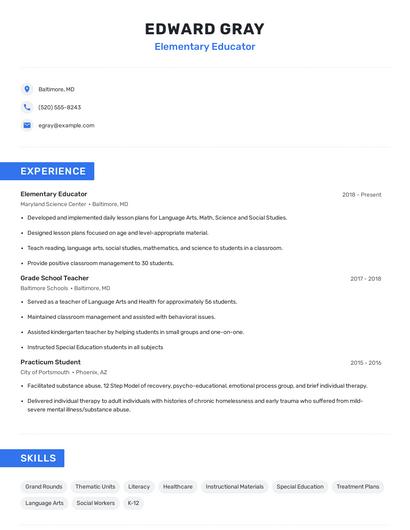
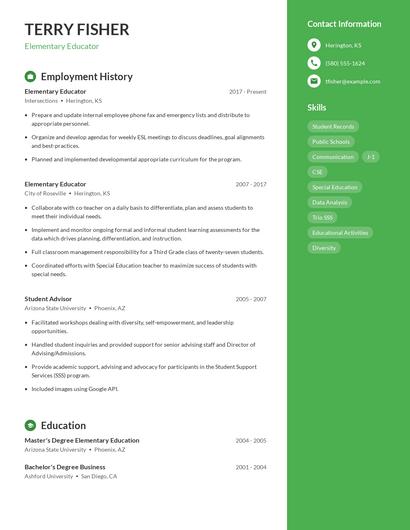
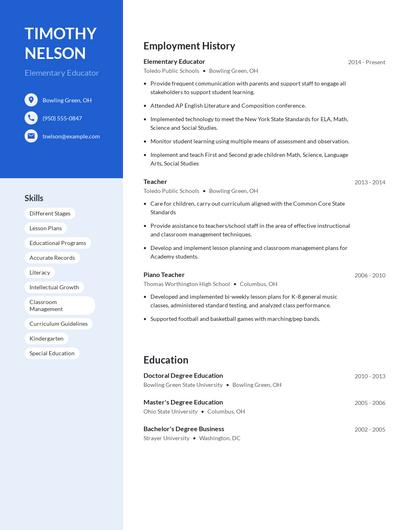
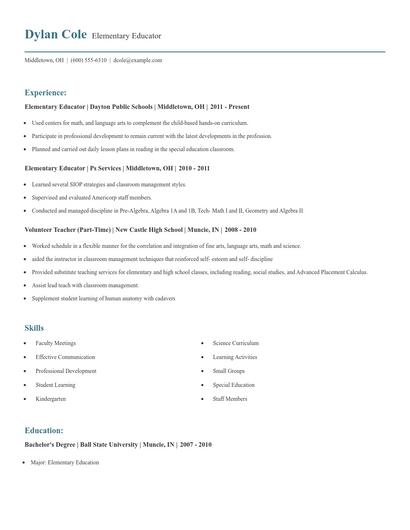
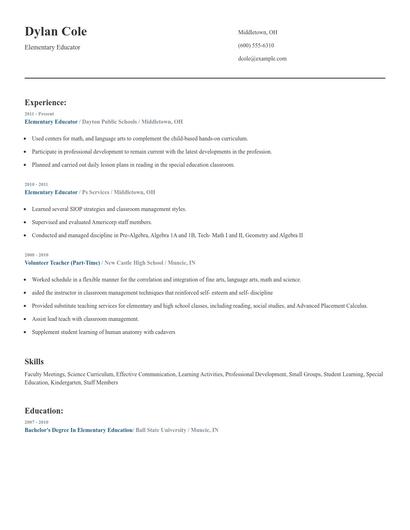
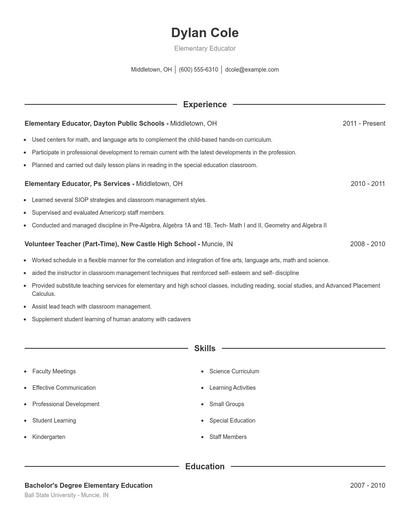
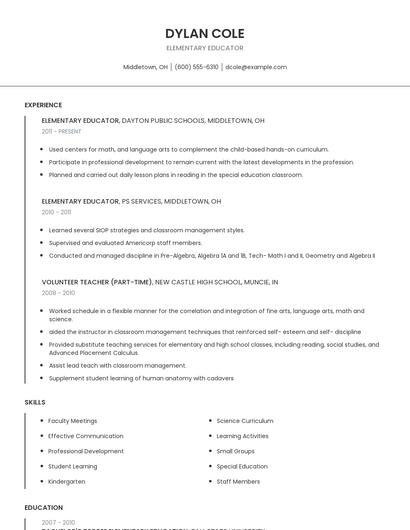
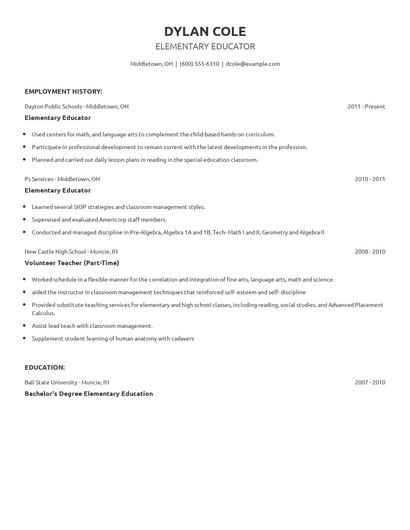
Choose from 10+ customizable elementary educator resume templates
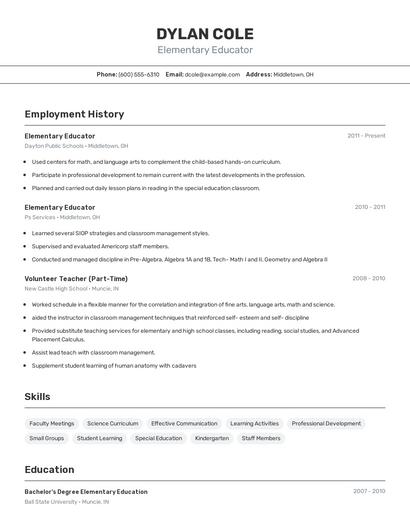
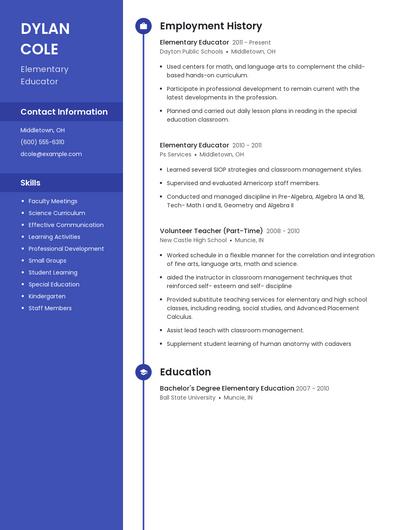
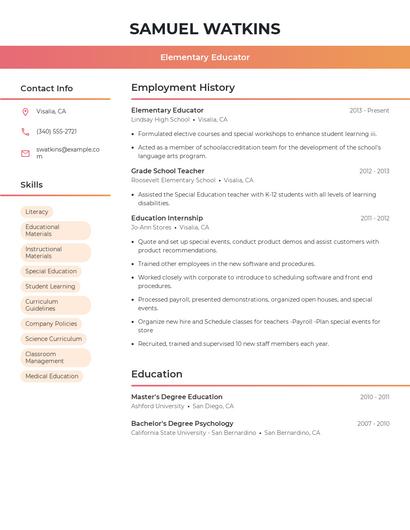
Build a professional elementary educator resume in minutes. Our AI resume writing assistant will guide you through every step of the process, and you can choose from 10+ resume templates to create your elementary educator resume.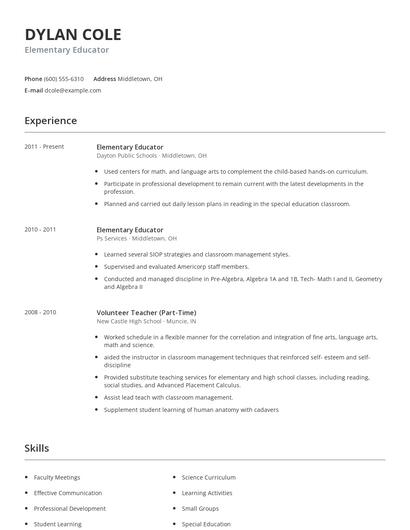
Compare different elementary educators
Elementary educator vs. Language arts teacher
A language arts teacher is responsible for teaching the English language to the students, improving their written and oral English communication by sharing the best practices, conducting engaging lesson plans, assigning group activities, and providing comprehensive educational materials. Language arts teachers strictly adhere to the learning curriculum, as well as monitoring the students' progress through individual evaluation, identifying their areas of improvement, and adjust learning strategies to address the difficulties. They also encourage the students to attend workshops, programs, and other extracurricular activities relating to the subject matter.
There are some key differences in the responsibilities of each position. For example, elementary educator responsibilities require skills like "math," "elementary education," "kindergarten," and "autism." Meanwhile a typical language arts teacher has skills in areas such as "literature," "grammar," "language," and "learning process." This difference in skills reveals the differences in what each career does.
Language arts teachers tend to make the most money working in the education industry, where they earn an average salary of $48,676. In contrast, elementary educators make the biggest average salary, $36,218, in the education industry.On average, language arts teachers reach higher levels of education than elementary educators. Language arts teachers are 8.8% more likely to earn a Master's Degree and 0.1% less likely to graduate with a Doctoral Degree.Elementary educator vs. Summer school teacher
A Summer School Teacher is a teacher who works during the summer period. They develop and implement schemes of work and lesson plans in line with curriculum objectives. Generally, they have the same duties as a school teacher.
While some skills are similar in these professions, other skills aren't so similar. For example, resumes show us that elementary educator responsibilities requires skills like "elementary education," "kindergarten," "autism," and "general education." But a summer school teacher might use other skills in their typical duties, such as, "kids," "professional development," "cpr," and "english language."
Summer school teachers may earn a higher salary than elementary educators, but summer school teachers earn the most pay in the education industry with an average salary of $51,590. On the other hand, elementary educators receive higher pay in the education industry, where they earn an average salary of $36,218.In general, summer school teachers achieve similar levels of education than elementary educators. They're 4.1% more likely to obtain a Master's Degree while being 0.1% less likely to earn a Doctoral Degree.What technology do you think will become more important and prevalent for elementary educators in the next 3-5 years?
Dr. Stephen Graves Ph.D
Director of Undergraduate Studies, Assistant Professor, University of Missouri
Elementary educator vs. First grade teacher
First-grade teachers are the first instructors of children after they finished the kindergarten level. They play an essential role as children aged six to seven move to more structured learning. Generally, they set an exciting tone of learning for the fundamental skills in writing, reading, and math. These teachers create and give effective learning activities to the children to enhance their physical, emotional, intellectual, and social development. They have to effectively manage the classroom and ensure that all students are safe. Also, they give regular assessments to children to evaluate if their teaching method is effective and to determine the learning style of each child. Additionally, they need to communicate with parents, guardians, and principals on the progress of the children.
There are many key differences between these two careers, including some of the skills required to perform responsibilities within each role. For example, an elementary educator is likely to be skilled in "mathematics," "elementary education," "autism," and "general education," while a typical first grade teacher is skilled in "professional development," "literacy program," "learning process," and "open communication."
First grade teachers make a very good living in the education industry with an average annual salary of $50,770. On the other hand, elementary educators are paid the highest salary in the education industry, with average annual pay of $36,218.When it comes to education, first grade teachers tend to earn higher degree levels compared to elementary educators. In fact, they're 5.0% more likely to earn a Master's Degree, and 0.9% more likely to graduate with a Doctoral Degree.Elementary educator vs. Long term substitute teacher
A long term substitute teacher is responsible for covering the duties of a teacher who is away for a long time. Long term substitute teachers proceed with the lesson plan outlines and the regular teacher's curriculum depending on their expertise. They monitor and assess the students' behavior, create an engaging learning environment, evaluate the students' learning progress by conducting a series of tests, create reports of the students' performance, and help students struggling with the subject.
Even though a few skill sets overlap between elementary educators and long term substitute teachers, there are some differences that are important to note. For one, an elementary educator might have more use for skills like "mathematics," "elementary education," "autism," and "general education." Meanwhile, some responsibilities of long term substitute teachers require skills like "long-term substitute," "professional development," "social development," and "learning process. "
In general, long term substitute teachers earn the most working in the education industry, with an average salary of $44,729. The highest-paying industry for an elementary educator is the education industry.The average resume of long term substitute teachers showed that they earn similar levels of education compared to elementary educators. So much so that theyacirc;euro;trade;re 4.4% more likely to earn a Master's Degree and less likely to earn a Doctoral Degree by 0.6%.Types of elementary educator
Updated January 8, 2025
