What does an engineering technical analyst do?
Engineering technical analysts can help any business or corporation's projects and strategies align with its goals. They are the ones who have the technical skills and knowledge necessary to lead the team towards efficient and quality development. They are the ones who oversee a project, from analyzing the plan, assigning tasks to personnel to finding solutions to problems when they arise during the project course. They are present in various industries, including healthcare and manufacturing.
Engineering technical analyst responsibilities
Here are examples of responsibilities from real engineering technical analyst resumes:
- Manage lab operations including ISO standardization and audit preparation.
- Work on Java script for the client side validations.
- Work with offshore DW team on ETL requirements and QA of feed.
- Develop WCF service and an API that manipulates XML as per the UI expect from the mobile front end.
- Reduce maintenance costs for firm by $10k per server each year by migrating servers to high performance Linux platform.
- Work with designers and project managers, translating their ideas into full sites, W3C-valid HTML pages, and e-mail newsletters.
- Install and configure Linux base firewall software.
- Develop HTML email templates for monthly security newsletter.
- Used XML extensively for transferring messages between multiple applications.
- Re-Engineer business process from mainframe legacy system to distribute J2EE system.
- Perform data migrations using ETL tool to implement data warehousing solution.
- Resolve technical issues surrounding PC configuration, firewall settings and application access.
- Develop re-usable Unix scripts and queries that reduce the duration of production deployment validation activities.
- Perform systems administration functions for clients including file security, restoration and PC emulation application configuration.
- Translate business needs into technological systems, design specifications and solutions with UNIX command driven interface.
Engineering technical analyst skills and personality traits
We calculated that 17% of Engineering Technical Analysts are proficient in Cloud, Infrastructure, and Java. They’re also known for soft skills such as Analytical skills, Communication skills, and Creativity.
We break down the percentage of Engineering Technical Analysts that have these skills listed on their resume here:
- Cloud, 17%
Developed application to monitor cloud infrastructure and set alerts.
- Infrastructure, 15%
Measured Power Load for Infrastructure in the data center.
- Java, 8%
Implemented the Singleton design pattern and written Java class for Error and Exception logging.
- XML, 5%
Create XML for Group Policy and remotely manage WMI as needed on a per client basis.
- Technical Support, 4%
Provided technical support for corporate office.
- C #, 4%
Developed Online CSV Protocol system using ASP.NET, C #, SQL and Web Services.
Common skills that an engineering technical analyst uses to do their job include "cloud," "infrastructure," and "java." You can find details on the most important engineering technical analyst responsibilities below.
Analytical skills. To carry out their duties, the most important skill for an engineering technical analyst to have is analytical skills. Their role and responsibilities require that "analysts must interpret complex information from various sources and decide the best way to move forward on a project." Engineering technical analysts often use analytical skills in their day-to-day job, as shown by this real resume: "analyzed and tested critical factory applications (web-based, c, java, dos) and sql databases. "
Communication skills. Another essential skill to perform engineering technical analyst duties is communication skills. Engineering technical analysts responsibilities require that "analysts work as a go-between with management and the it department and must explain complex issues in a way that both will understand." Engineering technical analysts also use communication skills in their role according to a real resume snippet: "designed xml based communication with archive using stax and sax based parsing of xml response document to retrieve the information. "
Creativity. Another skill that relates to the job responsibilities of engineering technical analysts is creativity. This skill is critical to many everyday engineering technical analyst duties, as "because analysts are tasked with finding innovative solutions to computer problems, an ability to “think outside the box” is important." This example from a resume shows how this skill is used: "led and developed project to combine two dated inventory applications within sharepoint, streamlining the inventory request process. "
The three companies that hire the most engineering technical analysts are:
- Bank of America8 engineering technical analysts jobs
- Fiserv4 engineering technical analysts jobs
- ManTech2 engineering technical analysts jobs
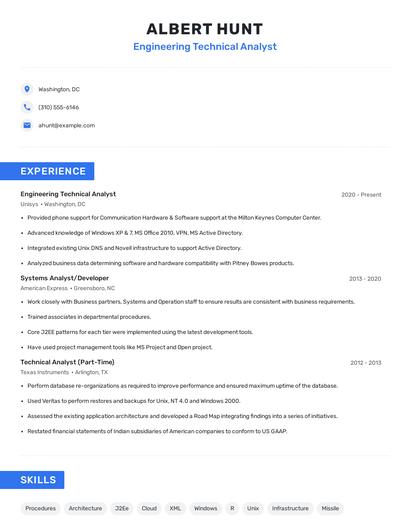
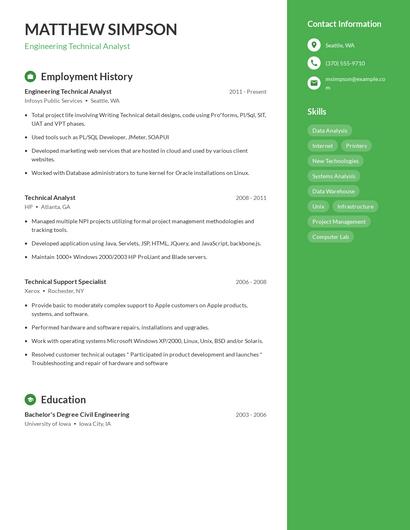
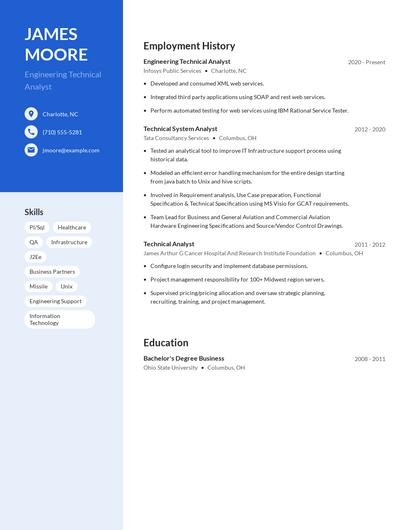
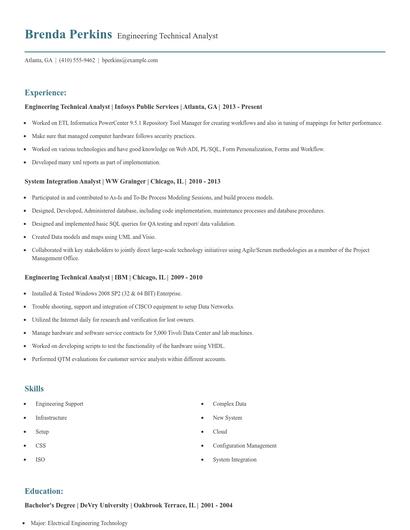
Choose from 10+ customizable engineering technical analyst resume templates
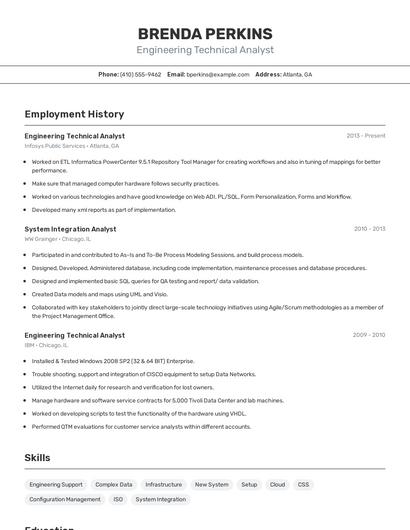
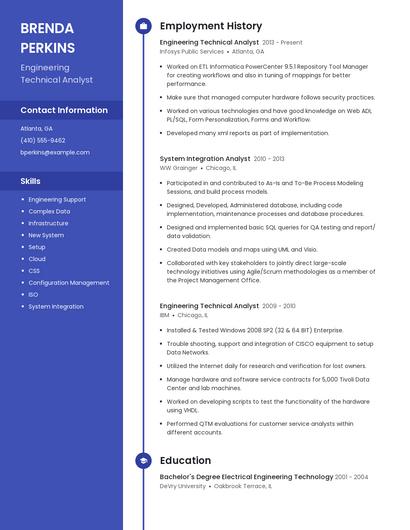
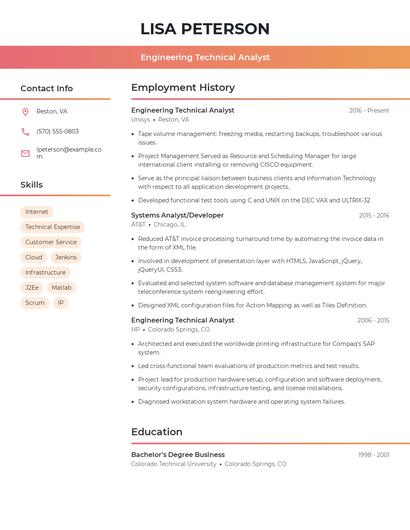
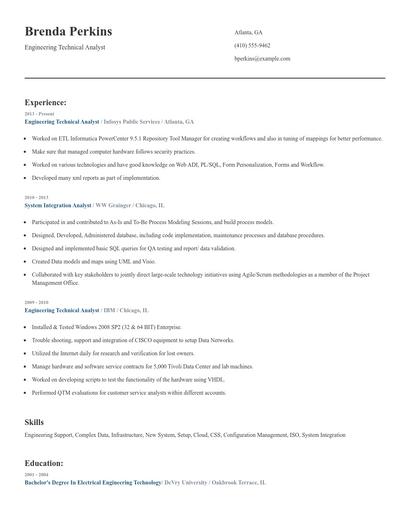
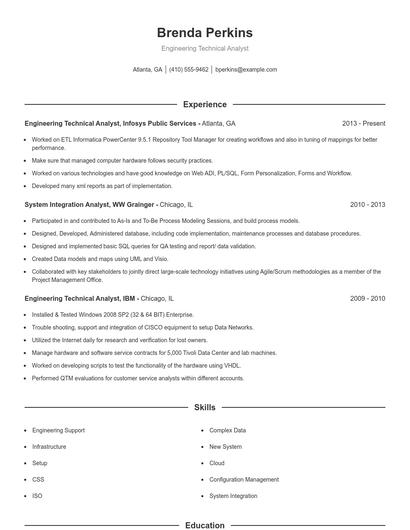
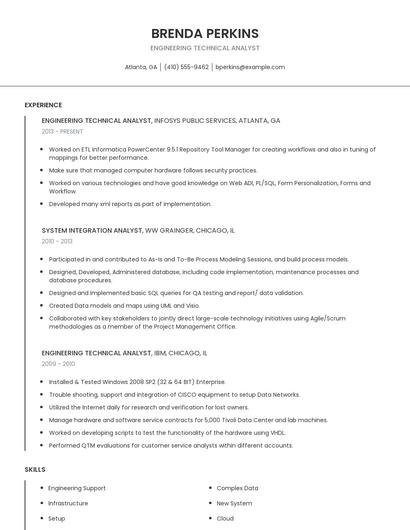
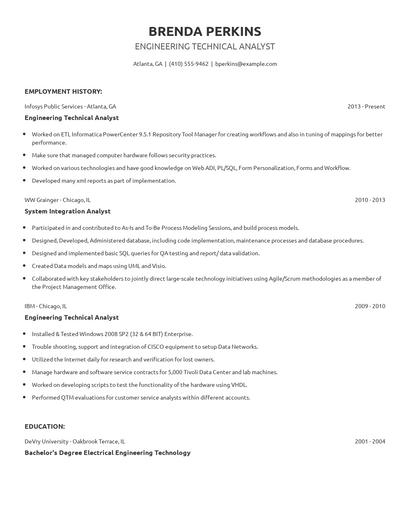
Build a professional engineering technical analyst resume in minutes. Our AI resume writing assistant will guide you through every step of the process, and you can choose from 10+ resume templates to create your engineering technical analyst resume.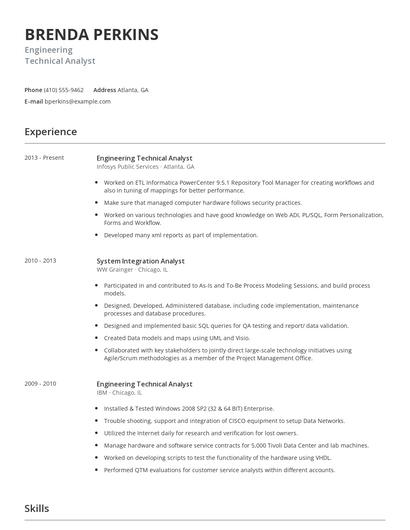
Compare different engineering technical analysts
Engineering technical analyst vs. Analyst lead
The duties of an analyst lead depend on one's line of work or industry of employment. Typically, their responsibilities revolve around performing research and analysis, coordinating with different departments to gather leads and data, reviewing findings, and producing reports and presentations for the stakeholders and other higher-ranking officials. Through the results, an analyst lead can provide advice, devise strategies for business optimization, spearhead the development of processes, identify strengths and weaknesses, and offer recommendations on areas in need of improvement. All of this is done while in adherence to the company's vision and mission.
These skill sets are where the common ground ends though. The responsibilities of an engineering technical analyst are more likely to require skills like "cloud," "infrastructure," "technical support," and "web services." On the other hand, a job as an analyst lead requires skills like "analytics," "project management," "customer service," and "excellent interpersonal." As you can see, what employees do in each career varies considerably.
Analyst leads earn the highest salaries when working in the finance industry, with an average yearly salary of $110,488. On the other hand, engineering technical analysts are paid more in the professional industry with an average salary of $85,104.The education levels that analyst leads earn slightly differ from engineering technical analysts. In particular, analyst leads are 8.2% more likely to graduate with a Master's Degree than an engineering technical analyst. Additionally, they're 0.8% more likely to earn a Doctoral Degree.Engineering technical analyst vs. Analyst
Analysts are employees or individual contributors with a vast experience in a particular field that help the organization address challenges. They help the organization improve processes, policies, and other operations protocol by studying the current processes in place and determining the effectiveness of those processes. They also research industry trends and data to make sound inferences and recommendations on what the company should do to improve their numbers. Analysts recommend business solutions and often help the organization roll out these solutions. They ensure that the proposed action plans are effective and produce the desired results.
While some skills are similar in these professions, other skills aren't so similar. For example, resumes show us that engineering technical analyst responsibilities requires skills like "cloud," "infrastructure," "technical support," and "c #." But an analyst might use other skills in their typical duties, such as, "customer service," "management system," "project management," and "strong analytical."
Analysts earn a lower average salary than engineering technical analysts. But analysts earn the highest pay in the technology industry, with an average salary of $79,330. Additionally, engineering technical analysts earn the highest salaries in the professional with average pay of $85,104 annually.analysts earn similar levels of education than engineering technical analysts in general. They're 2.9% more likely to graduate with a Master's Degree and 0.8% more likely to earn a Doctoral Degree.Engineering technical analyst vs. Application support analyst
An application support analyst is responsible for responding to and resolving customer issues about smartphone or computer applications. They do a variety of applications ranging from banking software and mobile games, and they usually deal with a great number of clients daily. It is also their task to report to a next level member of staff, such as an information technology (IT) manager or a senior systems analyst. Moreover, they spend their time working in an office setting and can be employed by software companies, game developers, technology creators, and other types of organizations.
There are many key differences between these two careers, including some of the skills required to perform responsibilities within each role. For example, an engineering technical analyst is likely to be skilled in "cloud," "c #," "web services," and "javascript," while a typical application support analyst is skilled in "application support," "customer service," "itil," and "incident management."
Application support analysts make a very good living in the finance industry with an average annual salary of $108,929. On the other hand, engineering technical analysts are paid the highest salary in the professional industry, with average annual pay of $85,104.When it comes to education, application support analysts tend to earn similar degree levels compared to engineering technical analysts. In fact, they're 1.1% more likely to earn a Master's Degree, and 0.2% more likely to graduate with a Doctoral Degree.Engineering technical analyst vs. Gis analyst
A GIS Analyst is responsible for the development and implementation of geographic information systems. They provide expertise, support, assistance, and guidance to various geographic variables in a specific area.
Types of engineering technical analyst
Updated January 8, 2025
