What does a finance quantitative analyst do?
In stock trading, a quantitative finance analyst provides analytical services to help businesses make investment decisions. They typically work together with mathematicians and other experts in developing strategies that adhere to a company's vision and mission. They are usually responsible for conducting extensive research and analysis, performing risk assessments and background checks, reviewing financial histories, and keeping abreast with the latest trends and technologies. Moreover, through the findings of their research, they must produce reports and presentations for the clients.
Finance quantitative analyst responsibilities
Here are examples of responsibilities from real finance quantitative analyst resumes:
- Manage treasury workstation steering team for automation of core treasury operations for increase reliability of financial reporting and decision making.
- Develop automated reports using VBA and SAS
- Implement time series models, including ARMA, ARIMA and GARCH, in Matlab.
- Research about the effect of media stock owners on other organizations' performance using SAS.
- Work closely with bank s traders, quantitative trading strategists and valuation review group to resolve derivative pricing issues.
- Work on various consulting projects that focuse on reviewing client derivative valuation models and valuation methodologies.
- Handle username, password authentication via Java to necessary web servers to maintain database integrity and accuracy.
- Evaluate and integrate consolidated financial reports from foreign entities to ensure integrity and accuracy of data and compliance with GAAP.
- Integrate INTEX library in ICAT application.
- Manage treasury workstation steering team for automation of core treasury operations for increase reliability of financial reporting and decision making.
Finance quantitative analyst skills and personality traits
We calculated that 22% of Finance Quantitative Analysts are proficient in Python, Risk Management, and SQL. They’re also known for soft skills such as Analytical skills, Communication skills, and Computer skills.
We break down the percentage of Finance Quantitative Analysts that have these skills listed on their resume here:
- Python, 22%
Developed efficient analytic tool using Python and VBA to model relationship between spread and excess return volatility.
- Risk Management, 13%
Pan India Topper - Risk Management Certification Program & Winner - BACI Bankers' Writing Challenge
- SQL, 11%
Maintained SQL data warehouse: introduced and supervised changes, immediately troubleshot every system bug.
- SAS, 7%
Support presentations with supporting analysis, assumptions, calculations and conclusions Skills Used SAS and VBA programming, modeling, statistical analysis
- Governance, 4%
Led efforts for PPNR Data Governance and created models for PPNR-Markets
- C++, 4%
Programmed own financial trading systems in MetaTrader(similar to C++) .
"python," "risk management," and "sql" are among the most common skills that finance quantitative analysts use at work. You can find even more finance quantitative analyst responsibilities below, including:
Analytical skills. One of the key soft skills for a finance quantitative analyst to have is analytical skills. You can see how this relates to what finance quantitative analysts do because "financial analysts must evaluate a range of information in finding profitable investments." Additionally, a finance quantitative analyst resume shows how finance quantitative analysts use analytical skills: "automated manual processes by utilizing vba on various hyperion essbase reporting scorecards to ensure accuracy and efficiency in data retrieval. "
Communication skills. Many finance quantitative analyst duties rely on communication skills. "financial analysts must be able to clearly explain their recommendations to clients.," so a finance quantitative analyst will need this skill often in their role. This resume example is just one of many ways finance quantitative analyst responsibilities rely on communication skills: "create master list of all customers and respective business units to increase communication flow between sales, customer service and finance. "
Computer skills. This is an important skill for finance quantitative analysts to perform their duties. For an example of how finance quantitative analyst responsibilities depend on this skill, consider that "financial analysts must be adept at using software to analyze financial data and trends, create portfolios, and make forecasts." This excerpt from a resume also shows how vital it is to everyday roles and responsibilities of a finance quantitative analyst: "implement general ledger computer systems. ".
Detail oriented. For certain finance quantitative analyst responsibilities to be completed, the job requires competence in "detail oriented." The day-to-day duties of a finance quantitative analyst rely on this skill, as "financial analysts must pay attention when reviewing a possible investment, as even small issues may have large implications for its health." For example, this snippet was taken directly from a resume about how this skill applies to what finance quantitative analysts do: "provided monthly financial analysis on captive insurance company detailing where assets were held and what rate each was earning. "
Math skills. Another common skill required for finance quantitative analyst responsibilities is "math skills." This skill comes up in the duties of finance quantitative analysts all the time, as "financial analysts use mathematics to estimate the value of financial securities." An excerpt from a real finance quantitative analyst resume shows how this skill is central to what a finance quantitative analyst does: "performed quantitative analysis on large data sets to better understand the relationship between business performance variables. "
The three companies that hire the most finance quantitative analysts are:
- Bank of America134 finance quantitative analysts jobs
- Google5 finance quantitative analysts jobs
- Capital One3 finance quantitative analysts jobs
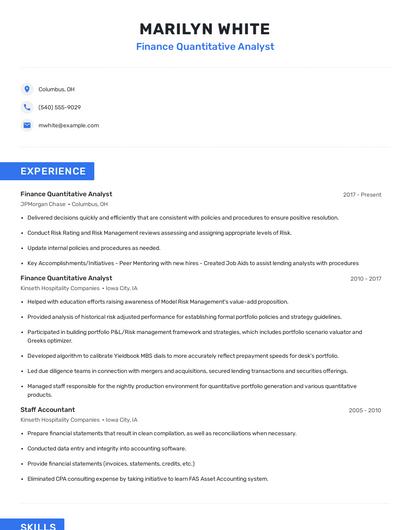
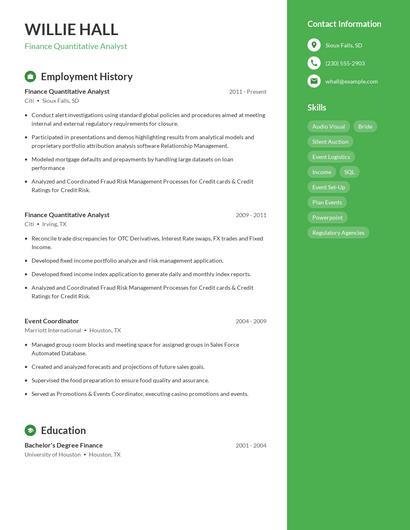
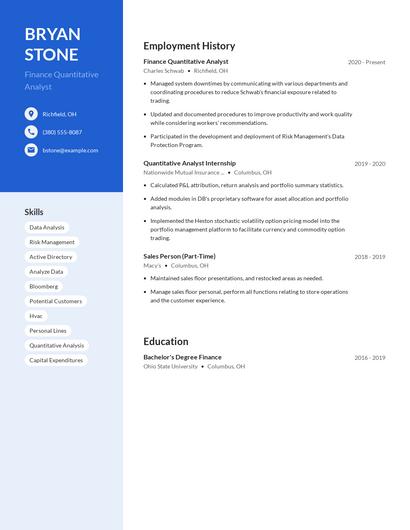
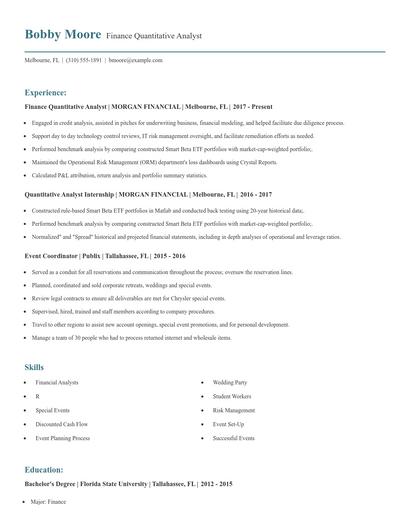
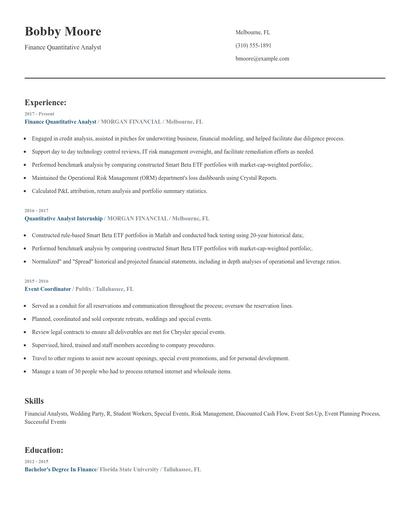
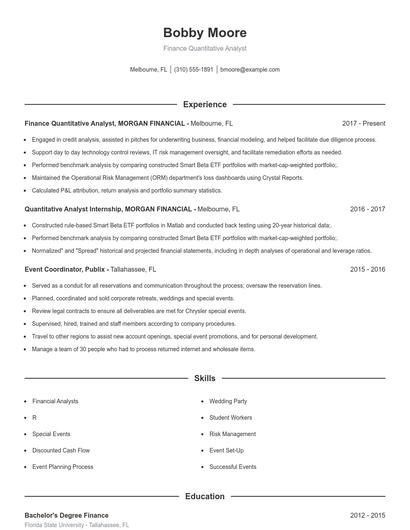
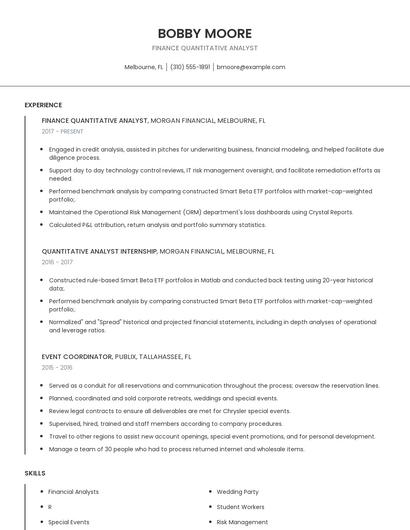
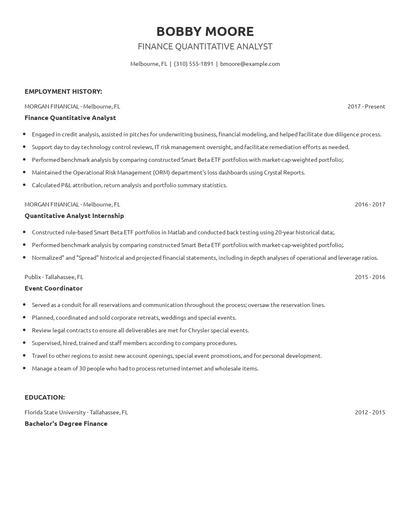
Choose from 10+ customizable finance quantitative analyst resume templates
Build a professional finance quantitative analyst resume in minutes. Our AI resume writing assistant will guide you through every step of the process, and you can choose from 10+ resume templates to create your finance quantitative analyst resume.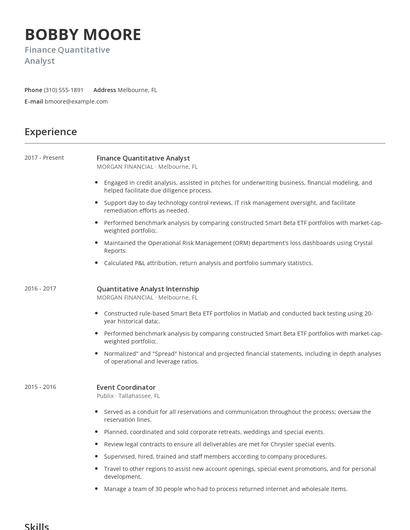
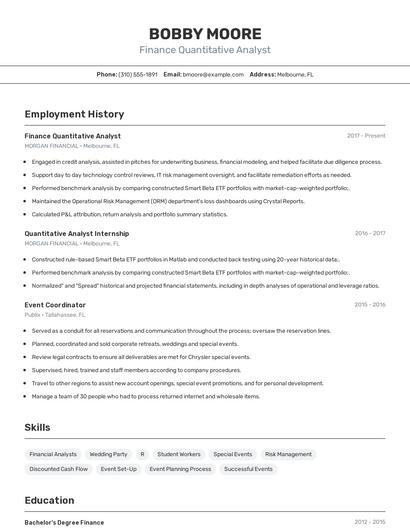
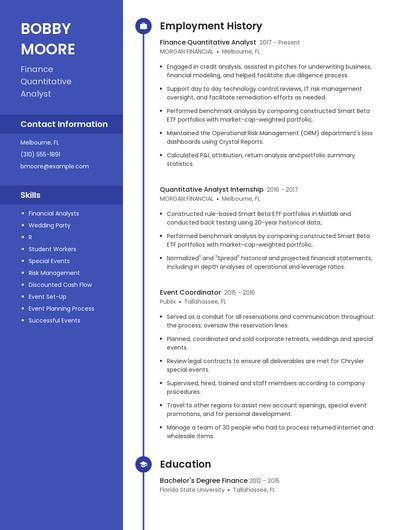
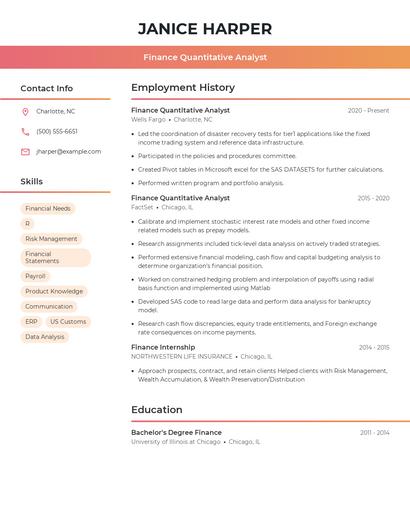
Compare different finance quantitative analysts
Finance quantitative analyst vs. Investment associate
An investment associate's primary role is to review a company's financial data, recommend investment strategies, oversee the distribution of stocks, and calculate possible risks for business mergers. They also serve as a mediator during agreements between companies during takeovers, monitors stock inventory, sell stocks, and details all financial transactions. In the course of these responsibilities, an investment associate provides administrative support and timely response to client requests as needed, acting as an additional point of communication for clients.
There are some key differences in the responsibilities of each position. For example, finance quantitative analyst responsibilities require skills like "python," "risk management," "sql," and "economics." Meanwhile a typical investment associate has skills in areas such as "powerpoint," "customer service," "client service," and "due diligence." This difference in skills reveals the differences in what each career does.
Investment associates really shine in the technology industry with an average salary of $117,651. Comparatively, finance quantitative analysts tend to make the most money in the professional industry with an average salary of $97,244.On average, investment associates reach lower levels of education than finance quantitative analysts. Investment associates are 27.7% less likely to earn a Master's Degree and 6.0% less likely to graduate with a Doctoral Degree.Finance quantitative analyst vs. Analyst
Analysts are employees or individual contributors with a vast experience in a particular field that help the organization address challenges. They help the organization improve processes, policies, and other operations protocol by studying the current processes in place and determining the effectiveness of those processes. They also research industry trends and data to make sound inferences and recommendations on what the company should do to improve their numbers. Analysts recommend business solutions and often help the organization roll out these solutions. They ensure that the proposed action plans are effective and produce the desired results.
In addition to the difference in salary, there are some other key differences worth noting. For example, finance quantitative analyst responsibilities are more likely to require skills like "python," "risk management," "sql," and "economics." Meanwhile, an analyst has duties that require skills in areas such as "customer service," "troubleshoot," "data analysis," and "management system." These differences highlight just how different the day-to-day in each role looks.
Analysts may earn a lower salary than finance quantitative analysts, but analysts earn the most pay in the technology industry with an average salary of $79,330. On the other hand, finance quantitative analysts receive higher pay in the professional industry, where they earn an average salary of $97,244.analysts earn lower levels of education than finance quantitative analysts in general. They're 29.4% less likely to graduate with a Master's Degree and 6.0% less likely to earn a Doctoral Degree.What technology do you think will become more important and prevalent for finance quantitative analysts in the next 3-5 years?
Dr. Todd Steen
The Granger Professor of Economics, Hope College
Finance quantitative analyst vs. Summer analyst
Summer analysts are people who undertake an internship within a banking institution. These professionals perform analyses of detailed financial and corporate information. They establish statistical exhibits analyzing comparative financial performance. It is their responsibility to create models illustrating projected financial results, which is of great value to the companies. The skills necessary for this job include knowledge of financial statements, equity, portfolio companies, and financial models. They should also develop due diligence, strong communication, asset allocation knowledge, and attention to detail.
There are many key differences between these two careers, including some of the skills required to perform responsibilities within each role. For example, a finance quantitative analyst is likely to be skilled in "economics," "model risk," "governance," and "c++," while a typical summer analyst is skilled in "strong analytical," "capital markets," "salesforce," and "financial analysis."
When it comes to education, summer analysts tend to earn lower degree levels compared to finance quantitative analysts. In fact, they're 27.7% less likely to earn a Master's Degree, and 6.5% less likely to graduate with a Doctoral Degree.Finance quantitative analyst vs. Reporting analyst
As a reporting analyst, you are responsible for collecting relevant reports, analyzing raw data, writing, and delivering executive-ready qualitative and/or quantitative reports as per clients' requirements. The results collected will be communicated to managers or clients, who will then provide suggestions based on their findings. This person must have excellent quantitative & qualitative analytical skills, a strong eye for detail, strong organizational and multitasking abilities, and be able to work on tight deadlines. Intermediate to advanced knowledge of Excel is a must for this position.
Types of finance quantitative analyst
Updated January 8, 2025
