What does a formulation scientist do?
A formulation scientist specializes in conducting different scientific experiments to create new products and enhance existing formulations. They usually work at laboratories to establish plans and objectives, conduct extensive research and analyses to design and develop a formula, create test structures to evaluate products, and set strategies to meet budgets, goals, and timelines. They also assess existing products to determine their weaknesses and strengths, developing solutions against potential issues and existing problems. Additionally, a formulation scientist maintains records of all procedures and implements protocols and safety regulations.
Formulation scientist responsibilities
Here are examples of responsibilities from real formulation scientist resumes:
- Manage sample inventory via in-house laboratory information management system (LIMS) and implement additional systems for sample and chemical organization.
- Gather experience on the FDA, ICH, cGMP guidelines.
- Detail orientate techniques in compliance with FDA regulations with GLP guelines.
- Develop nasal formulations and prepare several batches under GLP and cGMP for preclinical and clinical studies.
- Conduct numerous transfers of analytical methods from NVO (Holland) and QC laboratory for various projects (Solids/Parenterals).
- Perform API testing for batch releases.
- Author and review CMC sections of BLA/MAAs.
- Prepare and monitor stability protocols per ICH guidelines.
- Analyze drug release profile of lipid formulation using HPLC.
- Write up IQ/OQ/PQ protocols, formulation reports, BMRs.
- Gain in-depth knowledge of tablets, suspension and capsules reverse engineering.
- Authore multiple sections of pharmaceutical development report for a new product NDA.
- Scale up and develop process techniques and edit CMC for ANDA submission.
- Examine and recognize FDA deficiency, prepare protocol and report to justify the FDA response.
- Develop crude HPLC methods to test raw drug solubility and drug content in finish research products.
Formulation scientist skills and personality traits
We calculated that 11% of Formulation Scientists are proficient in Dosage Forms, Scale-Up, and GMP.
We break down the percentage of Formulation Scientists that have these skills listed on their resume here:
- Dosage Forms, 11%
Performed physical characterization of pharmaceutical dosage forms and intermediates during development to improve manufacturing efficiency and formulation quality.
- Scale-Up, 8%
Perform Reverse engineering of existing products, Pilot Phase development, Scale-up phase development and process of manufacturing.
- GMP, 6%
Travel to customer site to introduce, combine and verified GMP operating procedures into customer's existing manufacturing facilities.
- QC, 5%
Coordinate timelines with Analytical R & D, Manufacturing, QC and QA to ensure timely completion of projects.
- Drug Products, 4%
Designed, wrote and implemented protocols for testing compatibility and stability of protein drug products with containers and delivery systems.
- HPLC, 4%
Develop crude HPLC methods to test raw drug solubility and drug content in finished research products.
Common skills that a formulation scientist uses to do their job include "dosage forms," "scale-up," and "gmp." You can find details on the most important formulation scientist responsibilities below.
Communication skills. One of the key soft skills for a formulation scientist to have is communication skills. You can see how this relates to what formulation scientists do because "medical scientists must be able to explain their research in nontechnical ways." Additionally, a formulation scientist resume shows how formulation scientists use communication skills: "coordinated and maintained communication between multiple cros for the production of monoclonal antibodies. "
Observation skills. Many formulation scientist duties rely on observation skills. "medical scientists conduct experiments that require monitoring samples and other health-related data.," so a formulation scientist will need this skill often in their role. This resume example is just one of many ways formulation scientist responsibilities rely on observation skills: "communicated detailed observations and intermediate data analysis to study director and management. "
The three companies that hire the most formulation scientists are:
- Thermo Fisher Scientific9 formulation scientists jobs
- Kelly Services5 formulation scientists jobs
- Corteva5 formulation scientists jobs
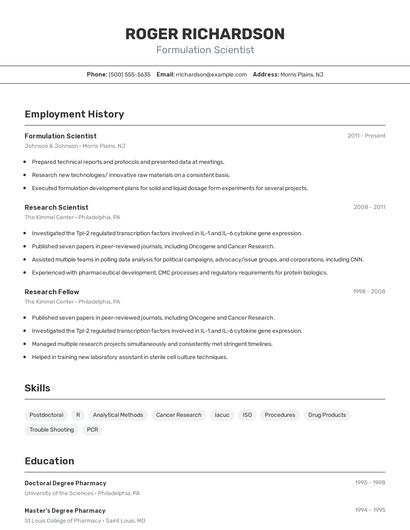
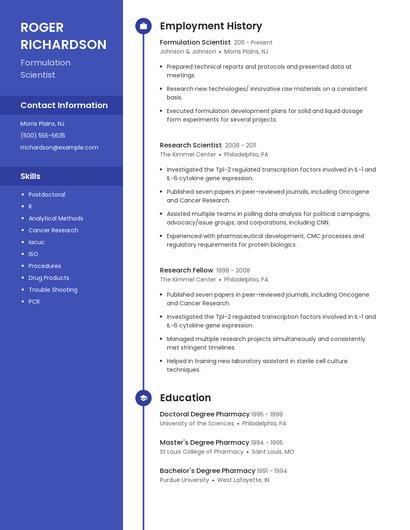
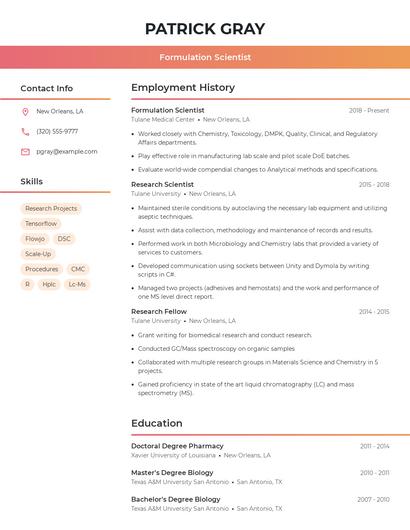
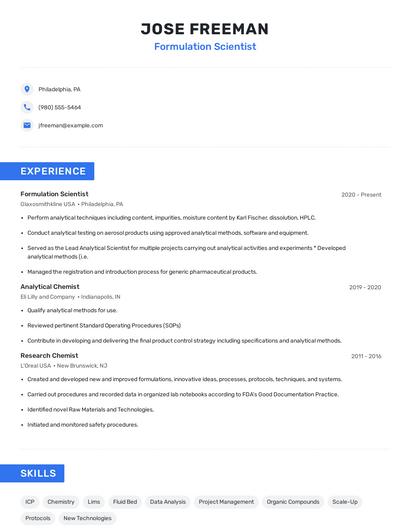
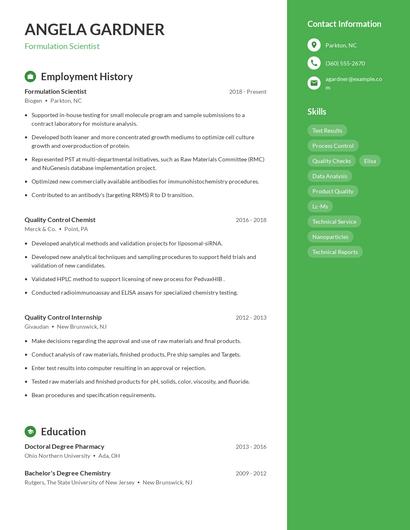
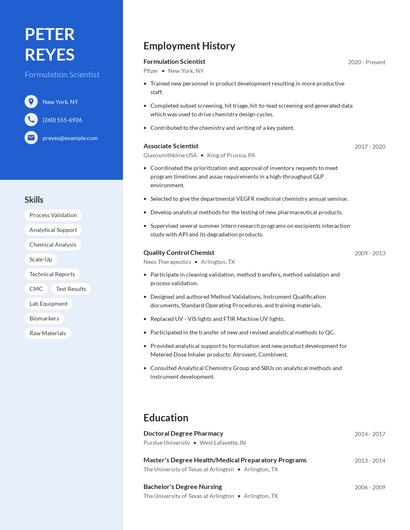
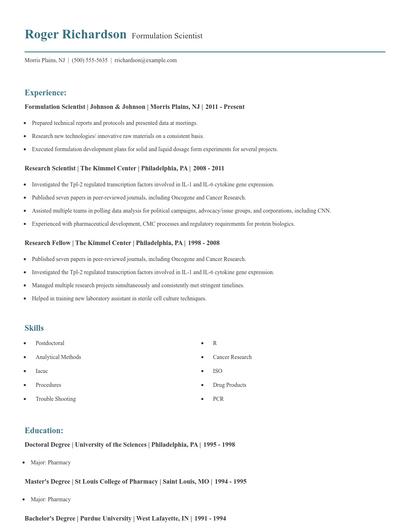
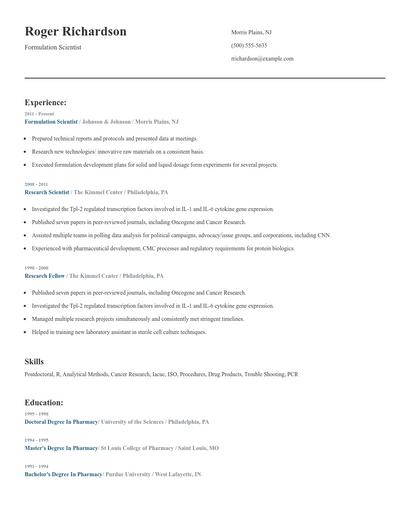
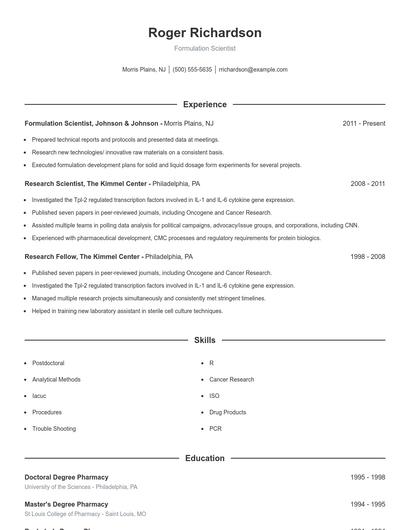
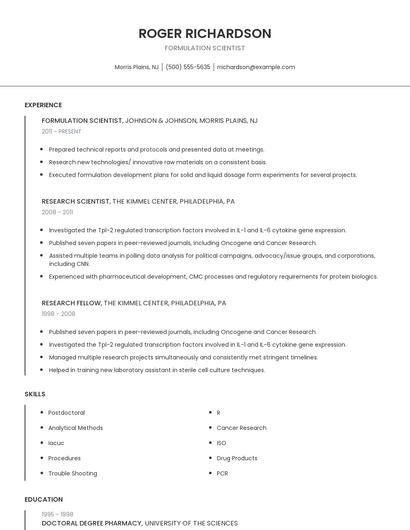
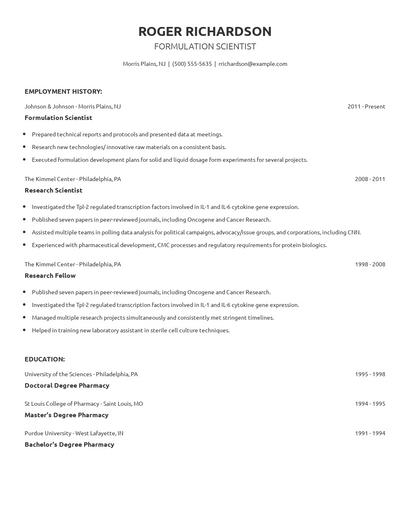
Choose from 10+ customizable formulation scientist resume templates
Build a professional formulation scientist resume in minutes. Our AI resume writing assistant will guide you through every step of the process, and you can choose from 10+ resume templates to create your formulation scientist resume.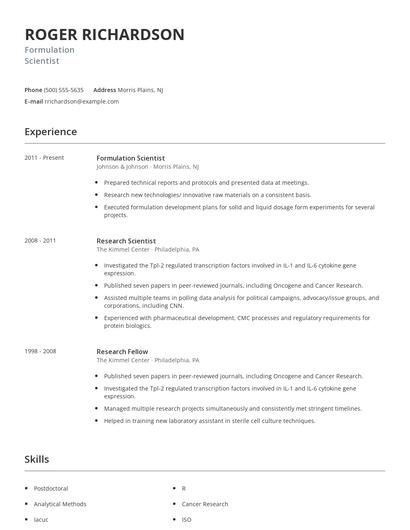
Compare different formulation scientists
Formulation scientist vs. Chemistry laboratory assistant
Chemical Laboratory Assistants are professionals who help researchers and scientists in performing lab experiments and tests. Their tasks involve the maintenance, cleanliness, or sterilization of laboratory equipment or instruments. They perform physical or chemical laboratory tests assisting scientists in the quantitative or qualitative analyses of liquids, gaseous materials, and solids. The necessary skills and knowledge for this job include chemistry, lab reporting, chemical solutions, and safety procedures.
There are some key differences in the responsibilities of each position. For example, formulation scientist responsibilities require skills like "dosage forms," "scale-up," "gmp," and "qc." Meanwhile a typical chemistry laboratory assistant has skills in areas such as "lab equipment," "lab safety," "chemistry lab," and "lab experiments." This difference in skills reveals the differences in what each career does.
Chemistry laboratory assistants tend to make the most money working in the education industry, where they earn an average salary of $37,906. In contrast, formulation scientists make the biggest average salary, $98,647, in the agriculture industry.On average, chemistry laboratory assistants reach lower levels of education than formulation scientists. Chemistry laboratory assistants are 19.1% less likely to earn a Master's Degree and 9.4% less likely to graduate with a Doctoral Degree.Formulation scientist vs. Research associate
A research associate is responsible for assisting the research team, organizing and interpreting findings, and verifying information before presenting the study to the board. Research associates duties also include gathering and comparing data from multiple sources, analyzing the current industry trends, creating draft outlines for reports, collecting individual contacts for interview purposes, and helping with the development of research procedures. A research associate must have excellent time-management skills and ability to multi-task, especially on meeting strict deadlines and conducting studies.
While some skills are similar in these professions, other skills aren't so similar. For example, resumes show us that formulation scientist responsibilities requires skills like "scale-up," "drug products," "cmc," and "stability studies." But a research associate might use other skills in their typical duties, such as, "patients," "research projects," "data analysis," and "data collection."
Research associates may earn a lower salary than formulation scientists, but research associates earn the most pay in the finance industry with an average salary of $84,005. On the other hand, formulation scientists receive higher pay in the agriculture industry, where they earn an average salary of $98,647.research associates earn similar levels of education than formulation scientists in general. They're 3.9% less likely to graduate with a Master's Degree and 9.4% more likely to earn a Doctoral Degree.What technology do you think will become more important and prevalent for formulation scientists in the next 3-5 years?
Dr. Betsy Smith
Assistant Professor of Chemistry, Elmira College
Formulation scientist vs. Quality control associate
In a manufacturing setting, a quality control associate is in charge of conducting various tests to ensure that the products meet the company's standard criteria. Their responsibilities revolve around inspecting the workforce and workload involved in the production process, identifying errors or inconsistencies, recommending solutions and alterations, and maintaining records and documentation. Furthermore, as a quality control associate, it is essential to coordinate with department staff and produce progress reports, all while adhering to the company's policies and regulations.
The required skills of the two careers differ considerably. For example, formulation scientists are more likely to have skills like "scale-up," "cmc," "technical reports," and "project management." But a quality control associate is more likely to have skills like "qc testing," "test methods," "test results," and "lims."
Quality control associates earn the best pay in the health care industry, where they command an average salary of $54,631. Formulation scientists earn the highest pay from the agriculture industry, with an average salary of $98,647.Most quality control associates achieve a lower degree level compared to formulation scientists. For example, they're 16.2% less likely to graduate with a Master's Degree, and 10.4% less likely to earn a Doctoral Degree.Formulation scientist vs. Research chemist
A research chemist specializes in conducting studies and experiments to develop new products. Their duties primarily focus on conducting research and assessments, gathering and analyzing chemical samples, developing ideas, conducting tests to study chemical reactions, maintaining records of all procedures, and utilizing previous studies. Their research findings can be used to create new medicines, enhance existing products, and lead to innovations. When it comes to employment, a research chemist may work for pharmaceutical companies, private laboratories, government agencies, and learning institutions.
Even though a few skill sets overlap between formulation scientists and research chemists, there are some differences that are important to note. For one, a formulation scientist might have more use for skills like "scale-up," "qc," "drug products," and "cmc." Meanwhile, some responsibilities of research chemists require skills like "analytical chemistry," "polymer," "organic synthesis," and "gc-ms."
Research chemists enjoy the best pay in the energy industry, with an average salary of $92,565. For comparison, formulation scientists earn the highest salary in the agriculture industry.The average resume of research chemists showed that they earn lower levels of education compared to formulation scientists. So much so that theyacirc;euro;trade;re 8.7% less likely to earn a Master's Degree and less likely to earn a Doctoral Degree by 0.4%.Types of formulation scientist
Updated January 8, 2025
