What does a framer/carpenter do?

Framer/carpenter responsibilities
Here are examples of responsibilities from real framer/carpenter resumes:
- Lay shingles, filt paper, and ridge caps down.
- Prepare, coordinate other staff for sheetrock and electrical installation also in accordance to blueprint specifications.
- Participate in process improvement and strategic planning initiatives with leadership team.
Framer/carpenter skills and personality traits
We calculated that 26% of Framer/Carpenters are proficient in Install Windows, Safety Rules, and Nail Guns. They’re also known for soft skills such as Business skills, Detail oriented, and Dexterity.
We break down the percentage of Framer/Carpenters that have these skills listed on their resume here:
- Install Windows, 26%
Frame, sheet and roof houses, trim out interior of houses, install windows and doors.
- Safety Rules, 17%
Observed and followed all safety rules and procedures, including wearing required personal safety equipment.
- Nail Guns, 9%
Used framing equipment such as nail guns, rotary saws, and reciprocating saws, etc.
- Tape Measure, 8%
Read tape measure cut material and frame houses to customer preference
- Store Remodels, 6%
Framed new construction projects and remodels; formed, poured, and finished concrete for driveways, patios and sidewalks.
- Residential Homes, 3%
Facilitated communication between Spanish speaking employees and the foreman; Residential homes $250 K - $1 Million.
"install windows," "safety rules," and "nail guns" are among the most common skills that framer/carpenters use at work. You can find even more framer/carpenter responsibilities below, including:
Business skills. The most essential soft skill for a framer/carpenter to carry out their responsibilities is business skills. This skill is important for the role because "self-employed carpenters must conduct activities such as bidding on new jobs, tracking inventory, and directing workers." Additionally, a framer/carpenter resume shows how their duties depend on business skills: "assisted the frame shop manager in the daily operations of the custom framing business. "
Detail oriented. Another soft skill that's essential for fulfilling framer/carpenter duties is detail oriented. The role rewards competence in this skill because "carpenters must be able to precisely cut, measure, and modify the materials they work with." According to a framer/carpenter resume, here's how framer/carpenters can utilize detail oriented in their job responsibilities: "exhibited the diligence and strong attention to detail to complete high quality residential reconstruction projects in a timely manner. "
Dexterity. Another skill that relates to the job responsibilities of framer/carpenters is dexterity. This skill is critical to many everyday framer/carpenter duties, as "carpenters use many tools and need hand-eye coordination to avoid injuring themselves or damaging materials." This example from a resume shows how this skill is used: "operated lifts and serviced all company vehicles, nail guns and compressors. "
Math skills. A big part of what framer/carpenters do relies on "math skills." You can see how essential it is to framer/carpenter responsibilities because "carpenters frequently use math skills, including basic trigonometry, to calculate the area, size, and amount of material needed for the job. ." Here's an example of how this skill is used from a resume that represents typical framer/carpenter tasks: "learned to square up foundation lines and walls using mathematics. "
Physical strength. Another common skill required for framer/carpenter responsibilities is "physical strength." This skill comes up in the duties of framer/carpenters all the time, as "carpenters use heavy tools and materials that weigh up to 100 pounds." An excerpt from a real framer/carpenter resume shows how this skill is central to what a framer/carpenter does: "job duties: performed tasks involving physical labor. "
Problem-solving skills. Lastly, "problem-solving skills" is an important element of what a framer/carpenter does. Framer/carpenter responsibilities require this skill because "carpenters may work independently with little guidance." This resume example highlights how framer/carpenter duties rely on this skill: "framed 3500 square foot custom homes solved various construction problems. "
The three companies that hire the most framer/carpenters are:
- Builders FirstSource1 framer/carpenters jobs
- Aerotek1 framer/carpenters jobs
- Suntec Concrete1 framer/carpenters jobs
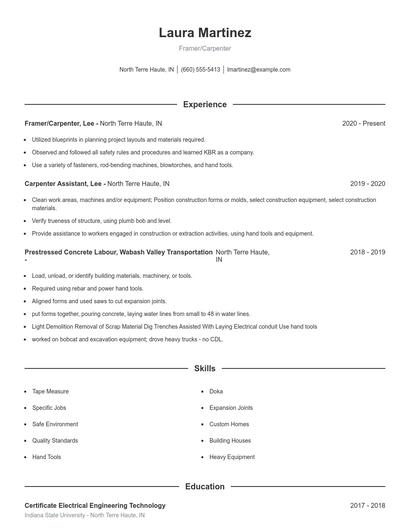
Choose from 10+ customizable framer/carpenter resume templates
Build a professional framer/carpenter resume in minutes. Our AI resume writing assistant will guide you through every step of the process, and you can choose from 10+ resume templates to create your framer/carpenter resume.




Compare different framer/carpenters
Framer/carpenter vs. Concrete finisher
A concrete finisher is responsible for smoothing out concrete surfaces, ensuring that the final result followed the design and client's specifications. Concrete finishers operate special construction equipment to stabilize concrete forms. They also analyze blueprints and construction plans to identify necessary techniques and adjustments to deliver a high-quality project. A concrete finisher must also observe strict safety guidelines and procedures for doing the task and making sure that all tools are maintained. A concrete finisher must show excellent time-management, as well as the ability to multi-task to perform duties within a fast-paced environment.
There are some key differences in the responsibilities of each position. For example, framer/carpenter responsibilities require skills like "install windows," "nail guns," "store remodels," and "residential homes." Meanwhile a typical concrete finisher has skills in areas such as "hand tools," "work ethic," "strong work ethic," and "finishers." This difference in skills reveals the differences in what each career does.
Concrete finishers tend to make the most money working in the construction industry, where they earn an average salary of $42,634. In contrast, framer/carpenters make the biggest average salary, $45,093, in the construction industry.On average, concrete finishers reach similar levels of education than framer/carpenters. Concrete finishers are 0.2% more likely to earn a Master's Degree and 0.0% more likely to graduate with a Doctoral Degree.Framer/carpenter vs. Helper
Helpers are employed by families or homeowners to provide overall assistance in the house. They are usually assigned to do household chores such as cleaning the house, doing the laundry, cooking meals, and tending the garden. They may also be assigned to do groceries or even drive the family around. They take care of children at home and assist them with their schoolwork should it be needed. They also address any other needs that the family may require assistance with. Helpers are expected to be patient and trustworthy since they will be working closely with the family members.
Each career also uses different skills, according to real framer/carpenter resumes. While framer/carpenter responsibilities can utilize skills like "install windows," "nail guns," "store remodels," and "residential homes," helpers use skills like "food handling," "safety procedures," "physical labor," and "windows."
Helpers may earn a lower salary than framer/carpenters, but helpers earn the most pay in the utilities industry with an average salary of $36,088. On the other hand, framer/carpenters receive higher pay in the construction industry, where they earn an average salary of $45,093.Average education levels between the two professions vary. Helpers tend to reach similar levels of education than framer/carpenters. In fact, they're 0.6% more likely to graduate with a Master's Degree and 0.0% less likely to earn a Doctoral Degree.Framer/carpenter vs. Mason
A mason is responsible for shaping artificial mineral products, concrete blocks, stone pieces, and bricks to create structures essential for construction or other building purposes using various machinery and equipment, following the highest safety standards and production procedures. Masons analyze schematics and blueprints, applying the clients' specifications and customization to their product expertise. They also inspect tools and equipment, ensuring that the materials are free from any defects to avoid hazards and construction delays.
The required skills of the two careers differ considerably. For example, framer/carpenters are more likely to have skills like "install windows," "safety rules," "nail guns," and "tape measure." But a mason is more likely to have skills like "masonry," "scaffolding," "safety regulations," and "dump truck."
When it comes to education, masons tend to earn similar degree levels compared to framer/carpenters. In fact, they're 5.0% more likely to earn a Master's Degree, and 1.2% more likely to graduate with a Doctoral Degree.Framer/carpenter vs. Construction assistant
A construction assistant performs various clerical and operational support tasks to assist construction managers and maintain smooth workflow operations. Their responsibilities usually include monitoring budgets and costs, handling calls and correspondence, purchasing construction materials according to project requirements, liaising with suppliers and construction contractors, and participating in managing the schedules and activities of the workers. A construction assistant may also perform inspections to identify problem areas and ensure that all procedures adhere to the safety codes and standards.
Types of framer/carpenter
Updated January 8, 2025
