What does a global information technology manager do?
Global Information Technology Managers are responsible for managing the IT operations for an organization. Their duties include liaising with external and internal service providers to provide customized technical solutions, develop technological capacity in IT personnel and systems, and manage acquisition, deployment, and destruction of IT assets. They are responsible for creating an IT plan, act as a technical advisor, and manage software and hardware procurement. Global Information Technology Managers prepare IT performance reports, assist in IT internal audits, develop IT policies, review documentation, and facilitate staff training.
Global information technology manager responsibilities
Here are examples of responsibilities from real global information technology manager resumes:
- Implement global CRM, salesforce.com, for leads generation and worldwide opportunities.
- Lead initiative to select training vendor for in-house ITIL training of company associates.
- Lead the PMO for a data center transition from one third-party to another (IBM).
- Implement ITIL service management principles and achieve significant service improvements.
- Lower costs for the desktop environment and introduce a strategy to centrally manage global applications.
- Direct and oversee network/systems/storage engineering, desktop support, documentation, security governance, telecommunication, and disaster recovery planning.
- Maintain SharePoint web sites and system documents.
- Evaluate CRM solutions to fit multi-cultural and language requirements for global standards.
- Assist the CIO to develop optimal computer software, hardware, and communication contacts.
- Lead a team of six driving numerous aspects of the organization on behalf of the CIO.
- Work with the compliance management team and vendors to ensure SOX evidence and requirements are incorporate into process flows.
- Develop testing procedures, perform testing projects, coordinate and review SOX work perform by contract personnel and direct report.
- Recommend PMO methodologies and resourcing.
- Prevent additional cost overruns and implementation of a non-compliant ERP system.
- Test integrated enterprise ERP application in mock environment, identifying and subsequently repairing numerous critical errors.
Global information technology manager skills and personality traits
We calculated that 14% of Global Information Technology Managers are proficient in Project Management, Portfolio, and Cloud. They’re also known for soft skills such as Analytical skills, Business skills, and Communication skills.
We break down the percentage of Global Information Technology Managers that have these skills listed on their resume here:
- Project Management, 14%
Participated in established project management processes such as Change Management, Risk Management and Issues Management.
- Portfolio, 7%
Supported initiatives leading to use/adoption of common tools and solutions, reducing portfolio size.
- Cloud, 6%
Provided increased collaborative capabilities and reduced costs through innovative and secure cloud solutions.
- Business Process, 6%
Represented technical and business process interests at senior stakeholder management levels.
- ERP, 5%
Negotiated contracts and managed contractors and service providers for installation, configuration and deployment of ERP and Mobile solutions.
- Internal Audit, 4%
Mentored group members in interfacing with upper management and internal audit conduct.
Common skills that a global information technology manager uses to do their job include "project management," "portfolio," and "cloud." You can find details on the most important global information technology manager responsibilities below.
Analytical skills. One of the key soft skills for a global information technology manager to have is analytical skills. You can see how this relates to what global information technology managers do because "it managers must analyze problems and consider and select the best ways to solve them." Additionally, a global information technology manager resume shows how global information technology managers use analytical skills: "converted hr & payroll data. "
Business skills. Another soft skill that's essential for fulfilling global information technology manager duties is business skills. The role rewards competence in this skill because "it managers must develop and implement strategic plans to reach the goals of their organizations." According to a global information technology manager resume, here's how global information technology managers can utilize business skills in their job responsibilities: "lead the company through global application consolidation program which defined and implemented corporate-wide business application architecture centered on sap erp solution. "
Communication skills. Another skill that relates to the job responsibilities of global information technology managers is communication skills. This skill is critical to many everyday global information technology manager duties, as "it managers must explain their work to top executives and give clear instructions to their subordinates." This example from a resume shows how this skill is used: "architected and completed a microsoft crm 4.0 and sharepoint server 2007 implementation for global intercommunication within twelve weeks of my hire. "
Leadership skills. For certain global information technology manager responsibilities to be completed, the job requires competence in "leadership skills." The day-to-day duties of a global information technology manager rely on this skill, as "it managers must lead and motivate it teams or departments so that workers are efficient and effective." For example, this snippet was taken directly from a resume about how this skill applies to what global information technology managers do: "provided risk management operational execution leadership, institutionalized risk management processes, and provided transparency into the risk landscape across it. "
Organizational skills. Another crucial skill for a global information technology manager to carry out their responsibilities is "organizational skills." A big part of what global information technology managers relies on this skill, since "some it managers must coordinate the work of several different it departments to make the organization run efficiently." How this skill relates to global information technology manager duties can be seen in an example from a global information technology manager resume snippet: "lead the organizational design and delivery of it services (itsm) for change and release management. "
The three companies that hire the most global information technology managers are:
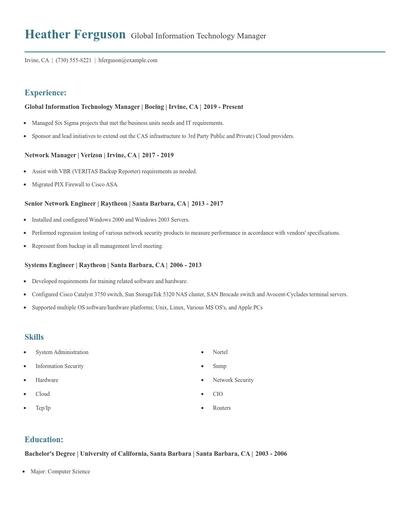
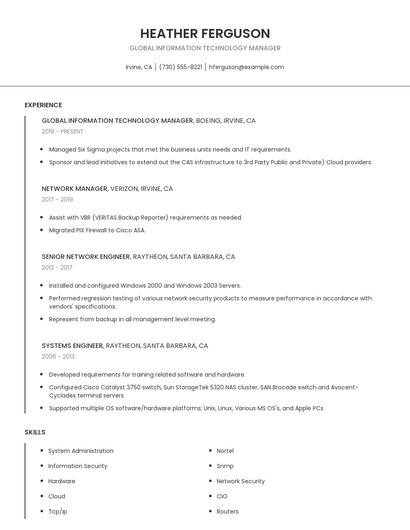
Choose from 10+ customizable global information technology manager resume templates
Build a professional global information technology manager resume in minutes. Our AI resume writing assistant will guide you through every step of the process, and you can choose from 10+ resume templates to create your global information technology manager resume.





Compare different global information technology managers
Global information technology manager vs. Systems manager
A systems manager is responsible for monitoring the operations of the information technology department, evaluating staff performance, developing strategic procedures to maximize productivity, and identifying business opportunities that would generate more revenues and profitability for the company. Systems managers inspect company networks to ensure the efficiency of the technology systems, conducting regular diagnostic tests, and installing upgrades to boost optimization. A systems manager must have excellent knowledge of the technology industry, as well as a strong command in programming languages and system codes to maintain the security of the company's database.
While similarities exist, there are also some differences between global information technology managers and systems manager. For instance, global information technology manager responsibilities require skills such as "portfolio," "cloud," "business process," and "internal audit." Whereas a systems manager is skilled in "customer service," "patients," "data entry," and "client facing." This is part of what separates the two careers.
Systems managers really shine in the technology industry with an average salary of $116,351. Comparatively, global information technology managers tend to make the most money in the energy industry with an average salary of $141,914.systems managers tend to reach lower levels of education than global information technology managers. In fact, systems managers are 5.1% less likely to graduate with a Master's Degree and 0.3% more likely to have a Doctoral Degree.Global information technology manager vs. Data manager
A data manager is responsible for monitoring the efficiency of the company's technology systems and network infrastructures. Data managers ensure the safety and security of the databases to avoid unauthorized access that may pose risks for business operations. They assist the technology team in developing data management protocols and smooth navigation of the network systems. A data manager must have excellent knowledge of the technology industry, as well as having a strong command on system codes and programming languages, to immediately identify inconsistencies, and perform troubleshooting to fix these discrepancies.
While some skills are similar in these professions, other skills aren't so similar. For example, resumes show us that global information technology manager responsibilities requires skills like "portfolio," "cloud," "business process," and "internal audit." But a data manager might use other skills in their typical duties, such as, "data analysis," "visualization," "data quality," and "data collection."
Data managers earn similar levels of education than global information technology managers in general. They're 1.2% less likely to graduate with a Master's Degree and 0.3% more likely to earn a Doctoral Degree.Global information technology manager vs. Delivery manager
A delivery manager oversees the delivery process and workforce in a company, ensuring accuracy and timeliness. Their responsibilities primarily revolve around coordinating all personnel, managing budgets and schedules, and monitoring all shipments and logistics. A delivery manager must also review orders, address issues and concerns to provide corrective measures quickly, evaluate team members' performance, and train new employees. They may also serve as the point of contact among clients and offer products or services. Furthermore, as a manager, it is essential to lead and encourage the team while implementing the company's policies and guidelines.
There are many key differences between these two careers, including some of the skills required to perform responsibilities within each role. For example, a global information technology manager is likely to be skilled in "business process," "internal audit," "gap analysis," and "technology solutions," while a typical delivery manager is skilled in "customer service," "exceptional client," "client facing," and "healthcare."
Delivery managers make a very good living in the technology industry with an average annual salary of $115,508. On the other hand, global information technology managers are paid the highest salary in the energy industry, with average annual pay of $141,914.Most delivery managers achieve a similar degree level compared to global information technology managers. For example, they're 4.1% less likely to graduate with a Master's Degree, and 0.2% less likely to earn a Doctoral Degree.Global information technology manager vs. Vending manager
A vending manager is in charge of overseeing and managing vending machine operations, ensuring efficiency and smooth workflow. Their responsibilities typically revolve around devising strategies to identify potential business areas, collecting cash from machines, liaising with clients, delegating tasks, and coordinating refilling and repair procedures. They must also produce progress and revenue reports, implement solutions, and resolve issues promptly. Furthermore, as a manager, it is essential to lead and encourage the team to reach goals, all while implementing the company's policies and regulations.
Types of global information technology manager
Updated January 8, 2025
