What does an information technology technical trainer do?
An information technology technical trainer must prepare and conduct employee training courses on IT, digital skills, and proper computer usage. They may also be tasked with identifying educational needs, design educational material, and ensuring all employees possess basic computer knowledge at the very least. A lot of people depend on the knowledge they possess, so communication and interpersonal skills are essential for this position.
Information technology technical trainer responsibilities
Here are examples of responsibilities from real information technology technical trainer resumes:
- Manage project SharePoint site as SharePoint administrator.
- Manage purchase / development/ customization, update and distribution of learning material for on corporate intranet.
- Introduce WBT/CBT eLearning modules for self-study.
- Coach web building language like HTML, CSS and JavaScript.
- Train staff on PC use, Microsoft applications and in-house applications.
- Install PC base shipping systems at client sites and sales offices.
- Maintain online training portal and SharePoint document library of end user training resources.
- Provide extensive telephone support as an SME during and after implementation and training.
- Serve as subject matter expert (SME) for technology needs assessment and program planning.
- Maintain the intranet site with document processes and eLearning for end users which serve as an early LMS site.
- Execute talent fulfillment processes and experience utilizing recruiting and ERP applications including set up.
- Certify technical professional to assist and educate patients and trouble shoot delivery devices for both insulin and treatment of osteoporosis.
- Network optimization for webcast (including provisioning of QoS, and router configurations . )
- Create code compliant architectural details using AutoCAD.
- Install, configure, and administer Solaris Jumpstart services for disaster recovery, rapid server provisioning, and application scalability.
Information technology technical trainer skills and personality traits
We calculated that 11% of Information Technology Technical Trainers are proficient in Training Materials, Learning Management System, and Training Sessions. They’re also known for soft skills such as Creativity, Instructional skills, and Analytical skills.
We break down the percentage of Information Technology Technical Trainers that have these skills listed on their resume here:
- Training Materials, 11%
Developed curricula and training materials for BlackBerry; P-card usage and monthly reconciliation; Hyperion Financial Management and Reporting; others.
- Learning Management System, 9%
Utilized learning management systems (LMS) to develop and track training content, including experience in developing online learning.
- Training Sessions, 7%
Developed learning material and conducted training sessions at various locations.
- Training Programs, 6%
Collaborate with team members to establish and clarify Epic course objectives, project development, and evaluate customized training programs.
- Course Materials, 6%
Developed course material and offered training in Business Analysis, Risk Analysis and Risk Mitigation Management and SDLC process steps.
- Photoshop, 5%
Designed and updated company logos, advertising posters and technical pamphlets using Adobe Photoshop.
Most information technology technical trainers use their skills in "training materials," "learning management system," and "training sessions" to do their jobs. You can find more detail on essential information technology technical trainer responsibilities here:
Creativity. To carry out their duties, the most important skill for an information technology technical trainer to have is creativity. Their role and responsibilities require that "specialists should be resourceful when developing training materials." Information technology technical trainers often use creativity in their day-to-day job, as shown by this real resume: "invented crm database using microsoft access & java (self-taught). "
Instructional skills. Another soft skill that's essential for fulfilling information technology technical trainer duties is instructional skills. The role rewards competence in this skill because "training and development specialists deliver employee training programs." According to an information technology technical trainer resume, here's how information technology technical trainers can utilize instructional skills in their job responsibilities: "created scrum and itil integration guides as well as serving as sme in instructional sessions. "
Analytical skills. Another skill that relates to the job responsibilities of information technology technical trainers is analytical skills. This skill is critical to many everyday information technology technical trainer duties, as "training and development specialists must evaluate training programs, methods, and materials and choose those that best fit each situation." This example from a resume shows how this skill is used: "performed systems analysis and programming tasks to maintain and control the use of computer systems software as a systems programmer. "
Communication skills. information technology technical trainer responsibilities often require "communication skills." The duties that rely on this skill are shown by the fact that "training and development specialists must convey information clearly and facilitate learning to diverse audiences." This resume example shows what information technology technical trainers do with communication skills on a typical day: "lead ten-day workshops that introduced telecommunications industry professionals to pc hardware, operating systems, and pc networking. "
See the full list of information technology technical trainer skills
The three companies that hire the most information technology technical trainers are:
- Atlantic Health11 information technology technical trainers jobs
- Genesys2 information technology technical trainers jobs
- Research Foundation of The City University of New York2 information technology technical trainers jobs
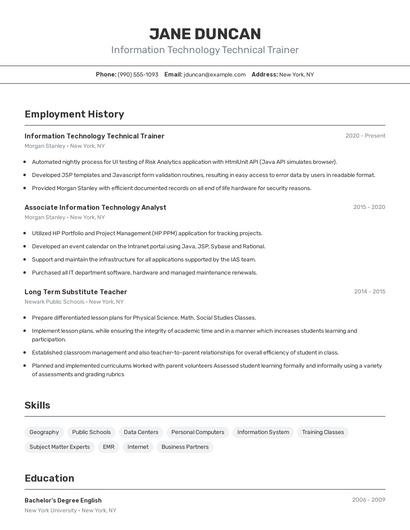
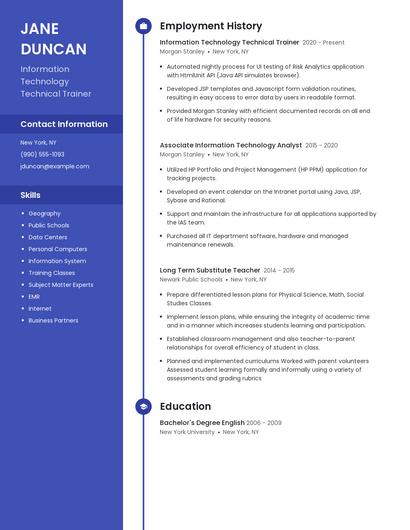
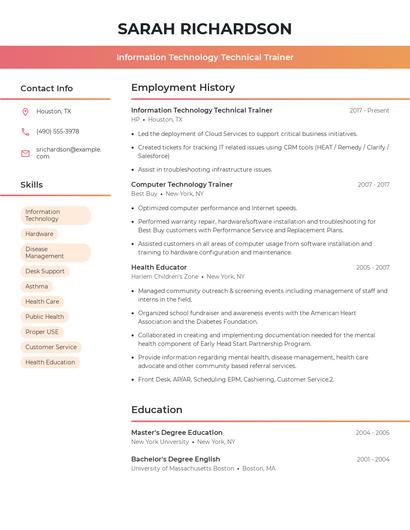
Choose from 10+ customizable information technology technical trainer resume templates
Build a professional information technology technical trainer resume in minutes. Our AI resume writing assistant will guide you through every step of the process, and you can choose from 10+ resume templates to create your information technology technical trainer resume.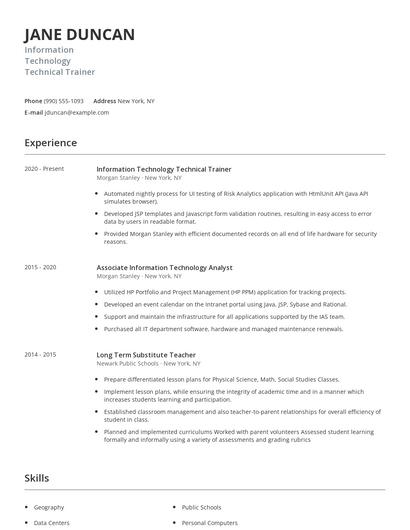
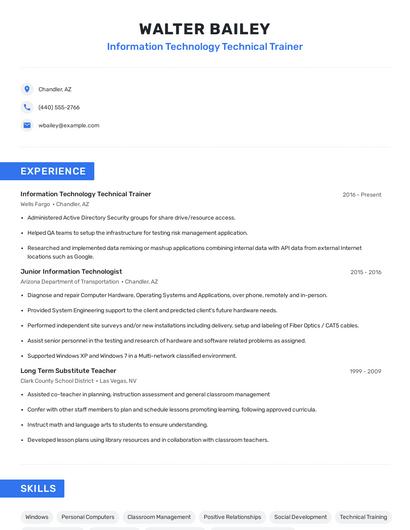
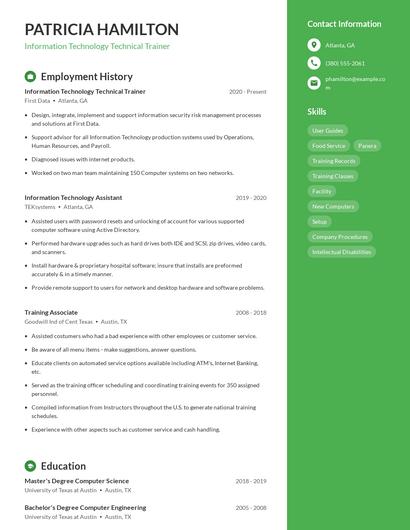
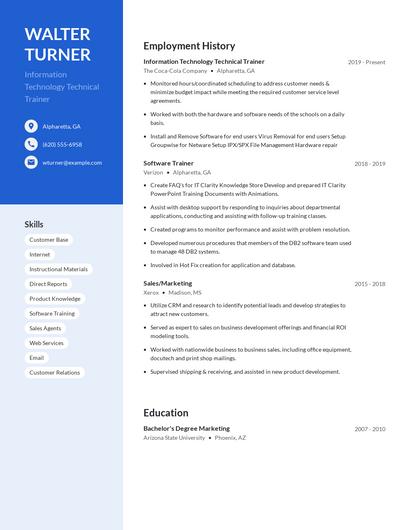
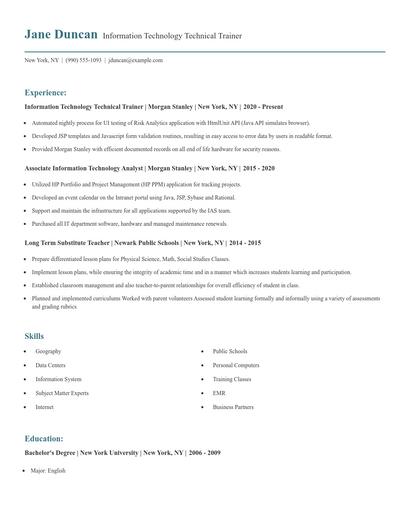
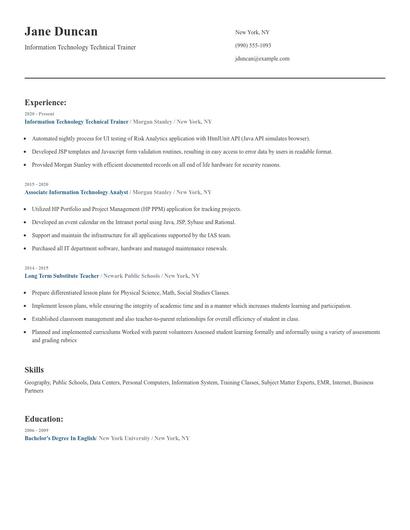
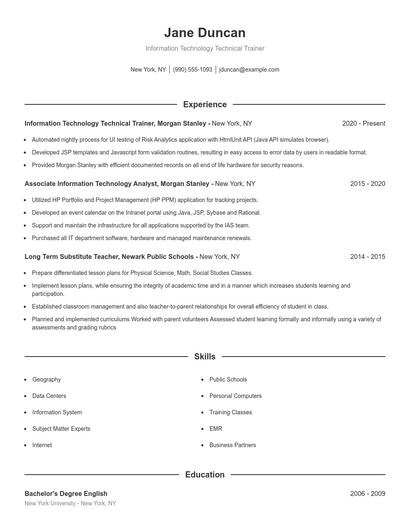
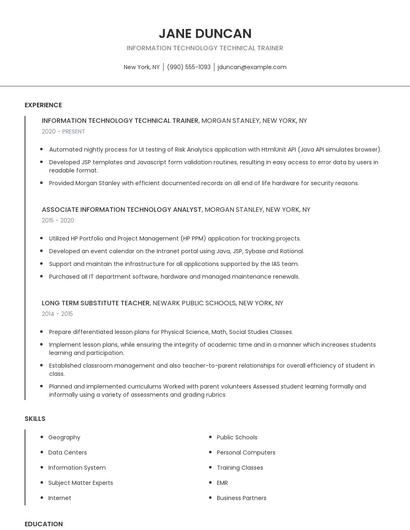
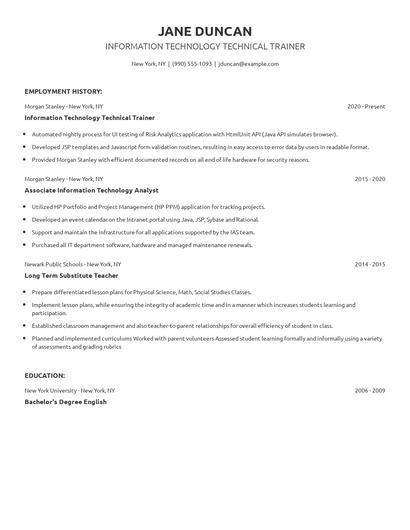
Compare different information technology technical trainers
Information technology technical trainer vs. Trainer
A trainer is responsible for instilling knowledge and process techniques for a specific business role. Duties of a trainer include facilitating engaging classes, identifying areas of improvement and opportunities for the learner, evaluating skills and attending to the learner's challenges, organizing training materials and scheduling training sessions, and submitting timely reports to the management on progress. Trainers are required to have excellent public communication skills and extensive product knowledge to provide effective learning methodologies and maintain strategic project management.
There are some key differences in the responsibilities of each position. For example, information technology technical trainer responsibilities require skills like "learning management system," "photoshop," "technical support," and "html." Meanwhile a typical trainer has skills in areas such as "pet," "leadership," "bonds," and "powerpoint." This difference in skills reveals the differences in what each career does.
Trainers tend to make the most money working in the technology industry, where they earn an average salary of $51,822. In contrast, information technology technical trainers make the biggest average salary, $63,791, in the professional industry.trainers tend to reach similar levels of education than information technology technical trainers. In fact, trainers are 2.9% less likely to graduate with a Master's Degree and 0.2% less likely to have a Doctoral Degree.Information technology technical trainer vs. Software trainer
Software Trainers are training specialists who teach computer programs and applications like desktop publishing programs, computer network systems software, and spreadsheets. They effectively explain the technical complexities of computer software. They plan, prepare, and research lessons for the trainees. They also check and assess the work of the students and give them feedback.
Each career also uses different skills, according to real information technology technical trainer resumes. While information technology technical trainer responsibilities can utilize skills like "learning management system," "photoshop," "technical support," and "adobe captivate," software trainers use skills like "windows," "software support," "depth training," and "customer support."
On average, software trainers earn a higher salary than information technology technical trainers. Some industries support higher salaries in each profession. Interestingly enough, software trainers earn the most pay in the utilities industry with an average salary of $80,929. Whereas information technology technical trainers have higher pay in the professional industry, with an average salary of $63,791.In general, software trainers achieve similar levels of education than information technology technical trainers. They're 0.8% less likely to obtain a Master's Degree while being 0.2% less likely to earn a Doctoral Degree.What technology do you think will become more important and prevalent for information technology technical trainers in the next 3-5 years?
Babak Beheshti Ph.D.
Dean, Professor, New York Institute of Technology
-We will be witnessing a more widespread commercial deployment of 5G in 2020. With the implementation of the Standalone 5G devices based on the 3gpp release 16, we should be seeing the more robust mobile broadband deployment of 5G, wider availability of 5G smartphones, and a push towards an all 5G Network in select urban areas around the world.
-Significant growth in AI-based technologies, from face recognition and voice recognition to business intelligence and market predictions. As machines and deep learning algorithms get integrated into many applications, many industries will undergo substantial changes. AI systems will continue to interact with our phones; cars will interpret and analyze their surroundings and intelligently drive themselves. Online vendors will monitor our browsing habits, and Google decides what kind of search results to give us, based on who it thinks we are.
Information technology technical trainer vs. Technical specialist
The role of technical specialists is to provide technical support for applications and programs to staff members and customers within an organization. They train staff and customers on products and apps and offer advice on the best practices for utilizing technical programs and applications. They also design training materials to teach other staff members the most effective methods of using its technology. It is also their job to reduce company costs by looking for ways to improve productivity and lessen expenses.
The required skills of the two careers differ considerably. For example, information technology technical trainers are more likely to have skills like "training materials," "learning management system," "training sessions," and "training programs." But a technical specialist is more likely to have skills like "customer service," "patients," "project management," and "customer satisfaction."
Technical specialists make a very good living in the technology industry with an average annual salary of $92,419. On the other hand, information technology technical trainers are paid the highest salary in the professional industry, with average annual pay of $63,791.When it comes to education, technical specialists tend to earn similar degree levels compared to information technology technical trainers. In fact, they're 2.7% less likely to earn a Master's Degree, and 0.0% less likely to graduate with a Doctoral Degree.Information technology technical trainer vs. Technical instructor
Technical instructor or trainer assists the training managers in educating and training technical employees to become competent and technically skilled workers. This job requires strong verbal communication, good teaching skills, and the ability to inspire and motivate learners since it involves skills assessments to track the progress of trainees individually. Also, a technical instructor regularly attends educational workshops and reviews publications to maintain his/her /her technical knowledge and quality service and to be able to design computer training manuals more effectively.
Types of information technology technical trainer
Updated January 8, 2025
