What does an institutional research coordinator do?
An institutional research coordinator is typically responsible for maintaining, monitoring, and assessing instructional databases to support and evaluate an institutional research, long term-planning, and decision making ideas of a researcher or a team. They help with other divisions' or departments' research-related activities, collect and interpret data, and provide technical support for teachers, researchers, and other coordinators. Also, they must monitor documents and research materials to ensure that they are used correctly.
Institutional research coordinator responsibilities
Here are examples of responsibilities from real institutional research coordinator resumes:
- Collect, manage and analyze preliminary data using SPSS statistical software.
- Answer phones, enter data into the computer using micrsoft excel, word, and powerpoint.
- Produce learning materials for workshops including PowerPoint presentations, group activities, program tools, and media delivery aids.
- Communicate with hospital physicians to educate them on the current NIH and FDA policies and guidelines regarding clinical research.
- Act as a liaison between the investigators and government agencies such as the FDA, DHHS, and OHRP.
- Participate in a sub-committee to provide comprehensive reports on all IRB activities to facilitate renewal of the AAHRPP accreditation
- Coordinate multiple phase II/III investigator-initiat and sponsor clinical trials focuse on bone marrow transplant, hematology, and oncology.
- Used SAS to read and extract raw data, and to clean data by multiple methods.
- Provide QA support to GLP murine studies.
- Develop advanced feature extraction methods using wavelet transform, Fourier transform and statistical time-series models for the recognition of acoustic sources.
Institutional research coordinator skills and personality traits
We calculated that 10% of Institutional Research Coordinators are proficient in Data Entry, PowerPoint, and IRB. They’re also known for soft skills such as Communication skills, Interpersonal skills, and Leadership skills.
We break down the percentage of Institutional Research Coordinators that have these skills listed on their resume here:
- Data Entry, 10%
Reviewed and implemented data entry into the database system and maintained speed and stamina in a fast-paced marketing research environment.
- PowerPoint, 8%
Produced learning materials for workshops including PowerPoint presentations, group activities, program tools, and media delivery aids.
- IRB, 7%
Participated in a sub-committee to provide comprehensive reports on all IRB activities to facilitate renewal of the AAHRPP accreditation
- Research Projects, 6%
Coordinated review process of daily university research projects involving human subjects.
- Research Studies, 5%
Developed and implemented applied research studies related to the education of medical students.
- Data Collection, 5%
Assisted Director of Institutional Research with data collection, compiling, analyzing, updates and interpreting.
Common skills that an institutional research coordinator uses to do their job include "data entry," "powerpoint," and "irb." You can find details on the most important institutional research coordinator responsibilities below.
Communication skills. One of the key soft skills for an institutional research coordinator to have is communication skills. You can see how this relates to what institutional research coordinators do because "natural sciences managers must be able to communicate clearly with a variety of audiences, such as scientists, policymakers, and the public." Additionally, an institutional research coordinator resume shows how institutional research coordinators use communication skills: "produced press releases and other necessary communication related to marketing and outreach. "
Interpersonal skills. Many institutional research coordinator duties rely on interpersonal skills. "natural sciences managers lead research teams and therefore need to work well with others in order to reach common goals," so an institutional research coordinator will need this skill often in their role. This resume example is just one of many ways institutional research coordinator responsibilities rely on interpersonal skills: "demonstrated excellent interpersonal skills ensuring smooth collaboration with cros, quintiles, rps & inventive health. "
Leadership skills. institutional research coordinators are also known for leadership skills, which are critical to their duties. You can see how this skill relates to institutional research coordinator responsibilities, because "natural sciences managers must be able to organize, direct, and motivate others." An institutional research coordinator resume example shows how leadership skills is used in the workplace: "provided a research paper along with a 20-minute presentation to the leadership of gerstein fisher. "
Problem-solving skills. institutional research coordinator responsibilities often require "problem-solving skills." The duties that rely on this skill are shown by the fact that "natural sciences managers use scientific observation and analysis to find answers to complex technical questions." This resume example shows what institutional research coordinators do with problem-solving skills on a typical day: "complete data entry, query resolution, and ae/sae reporting. "
Time-management skills. Another crucial skill for an institutional research coordinator to carry out their responsibilities is "time-management skills." A big part of what institutional research coordinators relies on this skill, since "natural sciences managers must be able to perform multiple administrative, supervisory, and technical tasks while ensuring that projects remain on schedule." How this skill relates to institutional research coordinator duties can be seen in an example from an institutional research coordinator resume snippet: "monitored program progress and students' accomplishments toward achieving established objectives and deadlines per guidelines from the nih ! "
The three companies that hire the most institutional research coordinators are:
- Baptist Health Home Care5 institutional research coordinators jobs
- Environmental Defense Fund4 institutional research coordinators jobs
- Cleveland Clinic3 institutional research coordinators jobs
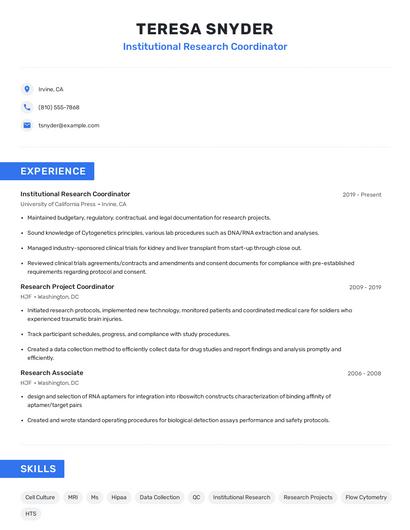
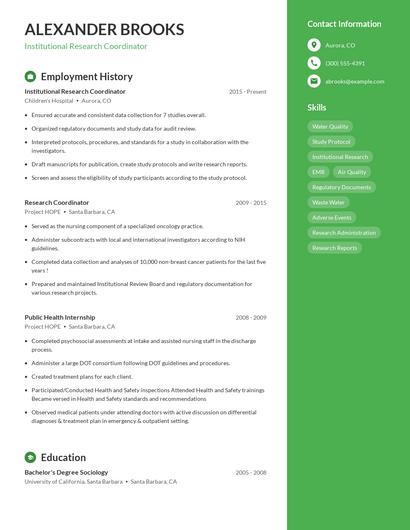
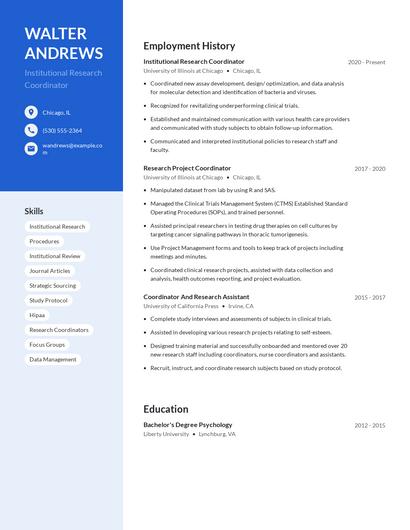
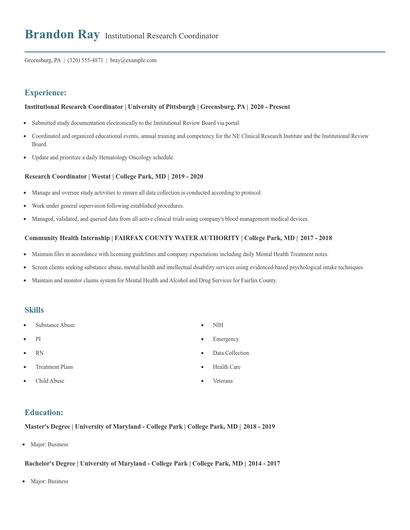
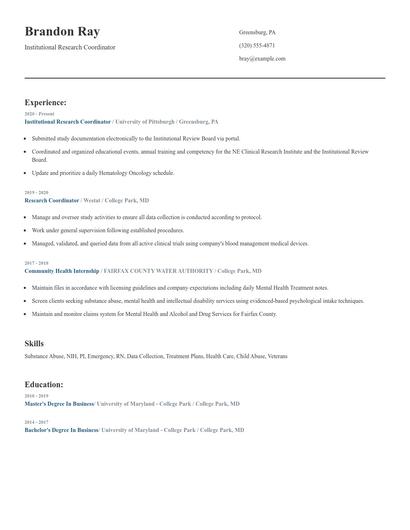
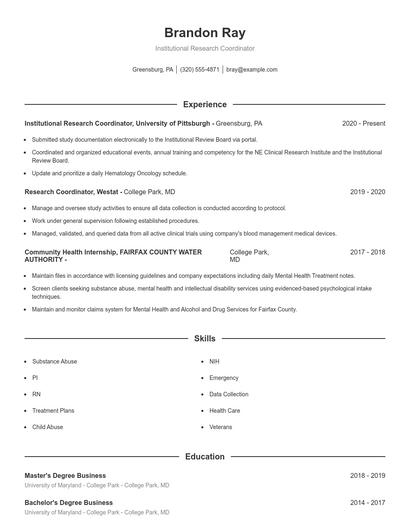
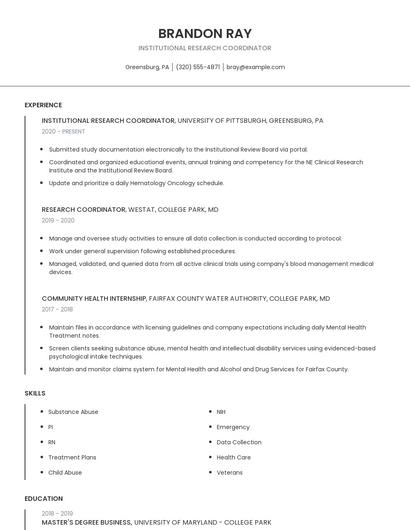
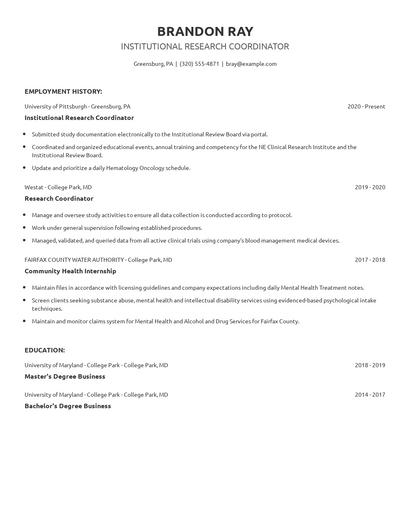
Choose from 10+ customizable institutional research coordinator resume templates
Build a professional institutional research coordinator resume in minutes. Our AI resume writing assistant will guide you through every step of the process, and you can choose from 10+ resume templates to create your institutional research coordinator resume.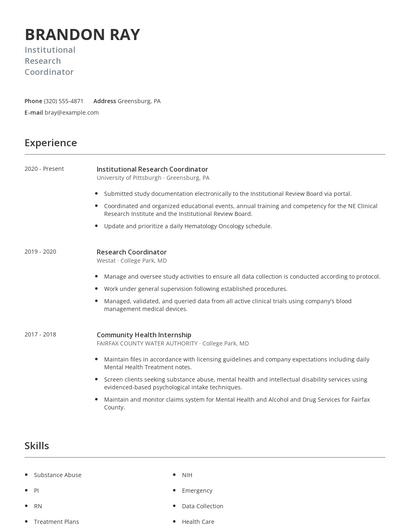
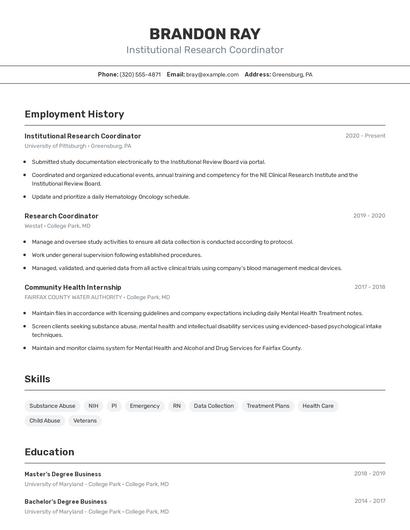
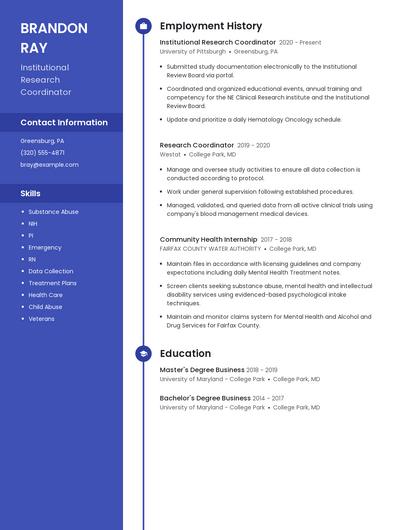
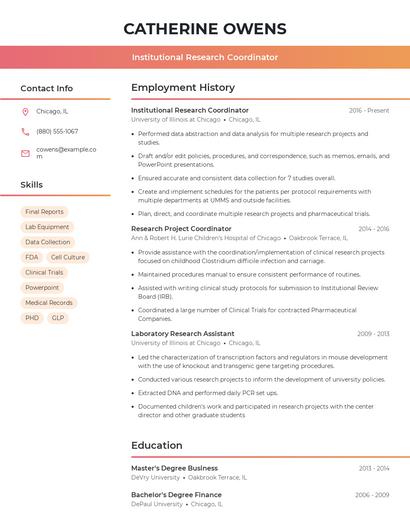
Compare different institutional research coordinators
Institutional research coordinator vs. Coordinator and research assistant
Technically, a study director carries out scientific responsibilities for protocol design or study plan and approval. Study directors supervise the gathering, analysis, interpretation, documentation, and reporting of data results. They handle the matriculation of students with regard to data management system development. Working with the computer systems team is part of their duties so they will be able to establish a data management system in tracking the study participants. They also support the toxicology team or group on different project teams.
While similarities exist, there are also some differences between institutional research coordinators and coordinator and research assistant. For instance, institutional research coordinator responsibilities require skills such as "research studies," "human subjects," "institutional research," and "federal regulations." Whereas a coordinator and research assistant is skilled in "patients," "emr," "surgical procedures," and "data analysis." This is part of what separates the two careers.
Coordinator and research assistants earn the highest salaries when working in the education industry, with an average yearly salary of $46,971. On the other hand, institutional research coordinators are paid more in the real estate industry with an average salary of $56,357.On average, coordinator and research assistants reach lower levels of education than institutional research coordinators. Coordinator and research assistants are 8.1% less likely to earn a Master's Degree and 0.9% less likely to graduate with a Doctoral Degree.Institutional research coordinator vs. Study director
A clinical project manager specializes in developing and organizing clinical trials. Their responsibilities revolve around planning and coordinating with all necessary personnel and experts, scheduling meetings, and preparing necessary documentation, ensuring compliance with all laws and regulations. Moreover, a clinical project manager must devise strategies and train all staff, develop protocols and guidelines, coordinate with vendors and suppliers, evaluate staff and verify documentation, and assist in all activities to ensure that every process aligns with the project's agenda. Should there be any issues or concerns, a clinical project manager must conduct corrective measures right away.
While some skills are similar in these professions, other skills aren't so similar. For example, resumes show us that institutional research coordinator responsibilities requires skills like "data entry," "human subjects," "institutional research," and "federal regulations." But a study director might use other skills in their typical duties, such as, "toxicology," "study design," "project management," and "data analysis."
Study directors may earn a higher salary than institutional research coordinators, but study directors earn the most pay in the health care industry with an average salary of $87,246. On the other hand, institutional research coordinators receive higher pay in the real estate industry, where they earn an average salary of $56,357.In general, study directors achieve similar levels of education than institutional research coordinators. They're 3.8% less likely to obtain a Master's Degree while being 0.9% more likely to earn a Doctoral Degree.Institutional research coordinator vs. Clinical project manager
A clinical trial manager is primarily responsible for organizing and supervising clinical trials, ensuring to meet all goals while maintaining smooth operations. They are also responsible for collaborating with managers to set targets, hiring staff and participants for studies, and arranging the event. This planning includes its location and schedule. A clinical trial manager must also maintain documentation of all processes, liaise with scientists and key personnel, acquire necessary legal paperwork and certifications, and gather data accurately. Furthermore, as a manager, it is essential to implement the company's policies and regulations at all times.
There are many key differences between these two careers, including some of the skills required to perform responsibilities within each role. For example, an institutional research coordinator is likely to be skilled in "data entry," "powerpoint," "research projects," and "research studies," while a typical clinical project manager is skilled in "manage cross," "patients," "clinical research," and "project management."
Clinical project managers earn the best pay in the pharmaceutical industry, where they command an average salary of $103,836. Institutional research coordinators earn the highest pay from the real estate industry, with an average salary of $56,357.clinical project managers typically earn similar educational levels compared to institutional research coordinators. Specifically, they're 2.4% less likely to graduate with a Master's Degree, and 0.1% less likely to earn a Doctoral Degree.Institutional research coordinator vs. Clinical trial manager
Types of institutional research coordinator
Updated January 8, 2025
