What does an integration consultant do?
An Integration Consultant works with the system developer to create, upgrade, and troubleshoot new company systems. This person is tasked to assess the company's existing technology and suggests new systems to enhance company productivity. Through the integration consultant, the network system of the company is dramatically enhanced.
Integration consultant responsibilities
Here are examples of responsibilities from real integration consultant resumes:
- Serve as liaison team member replacing WPS/Gentran mainframe with IBM manage services.
- Manage offshore IBM MQSI team and run integration testing between MVS, NT and UNIX environments.
- Manage a post-? production support team to resolve issues as required by the stipulated SLA.
- Manage the production support, new development, QA, UAT, through releases of the system.
- Manage post-conversion support including team supervision, documentation, and issue resolution within SLA timeframes.
- Create customize Inbound/Outbound maps involving various transactions relate to EDIFACT, CSV.
- Work on ERP integration's including e-commerce sites, EBS implementation process and support and issue resolution.
- Involve in securing the API's using OAuth 2.0and SSL.
- Create meaningful use education material for posting to internal PMO SharePoint site.
- Involve in designing a conceptual database for table driven ETL cleansing and transformation process.
- Schedule the workflows using windows task scheduler and also create batch files, log files.
- Create application files and transaction set maps for each EDIFACT document/verify the output with EDISIM.
- Create custom messages in the EBS for them to be used in the custom reports.
- Develop EDI monitoring report to analyze whether there are a success inbound and outbound EDI transactions.
- Used JDBC adapter, OracleApps adapter, JMS adapter, EDI adapter and configure all connections.
Integration consultant skills and personality traits
We calculated that 14% of Integration Consultants are proficient in Java, Client Facing, and HR. They’re also known for soft skills such as Analytical skills, Communication skills, and Creativity.
We break down the percentage of Integration Consultants that have these skills listed on their resume here:
- Java, 14%
Utilized Java to extend the capabilities of PeopleTools and control the UI to provide a Web 2.0 experience for users.
- Client Facing, 9%
Have good exposure to critical incident handling, escalation management and client facing functions and industry best practices.
- HR, 8%
Reviewed and documented the HR systems landscape of the company and worked on mapping out systems and components for Workday integration.
- Web Services, 7%
Consumed Web Services for transferring data between different applications.
- API, 6%
Developed clients using JMS API to publish the messages to the destinations (Queues and Topics).
- Http, 5%
Configured different Mule connectors like HTTP, Database, File, JDBC, FTP, SFTP, JMS.
Common skills that an integration consultant uses to do their job include "java," "client facing," and "hr." You can find details on the most important integration consultant responsibilities below.
Analytical skills. The most essential soft skill for an integration consultant to carry out their responsibilities is analytical skills. This skill is important for the role because "analysts must interpret complex information from various sources and decide the best way to move forward on a project." Additionally, an integration consultant resume shows how their duties depend on analytical skills: "exposed rest api to receive master data from sap erp system. "
Communication skills. Another essential skill to perform integration consultant duties is communication skills. Integration consultants responsibilities require that "analysts work as a go-between with management and the it department and must explain complex issues in a way that both will understand." Integration consultants also use communication skills in their role according to a real resume snippet: "configured other communication set ups like as2, sftp, ftp, jms (queue) and pgp. "
Creativity. integration consultants are also known for creativity, which are critical to their duties. You can see how this skill relates to integration consultant responsibilities, because "because analysts are tasked with finding innovative solutions to computer problems, an ability to “think outside the box” is important." An integration consultant resume example shows how creativity is used in the workplace: "develop scripts based on client defined business processes including manufacturing, distribution, inventory, shop floor and warehouse management modules. "
The three companies that hire the most integration consultants are:
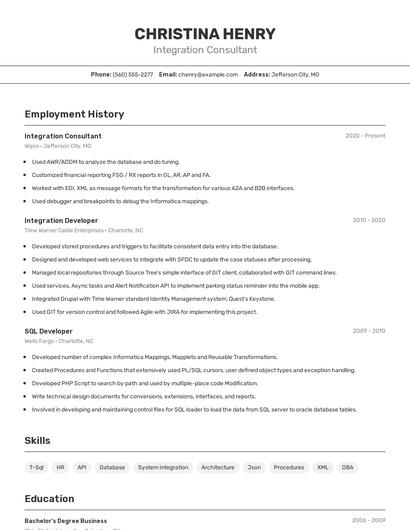
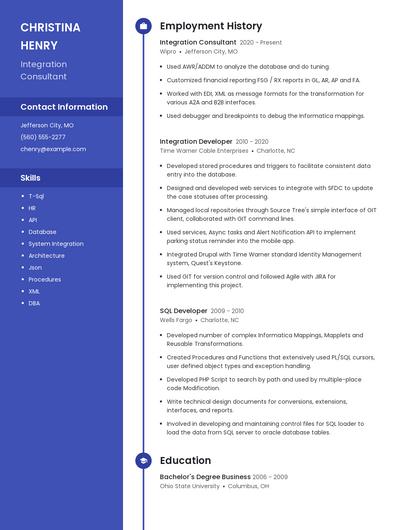
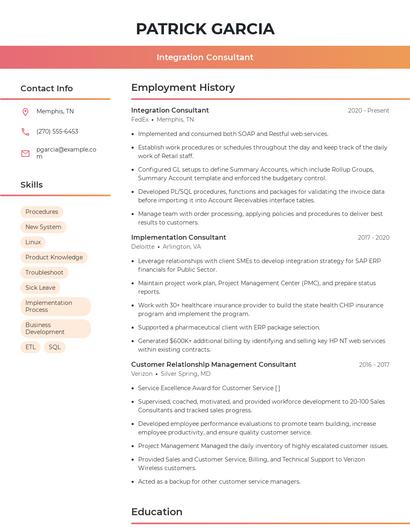
Choose from 10+ customizable integration consultant resume templates
Build a professional integration consultant resume in minutes. Our AI resume writing assistant will guide you through every step of the process, and you can choose from 10+ resume templates to create your integration consultant resume.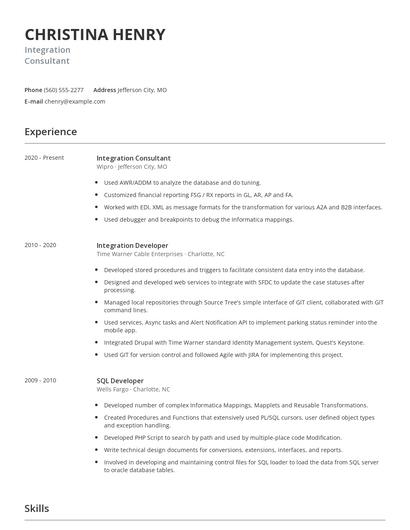
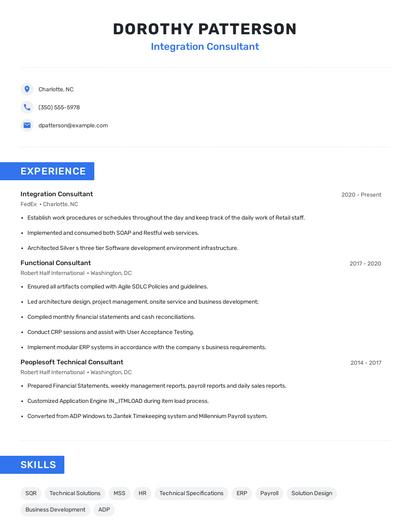
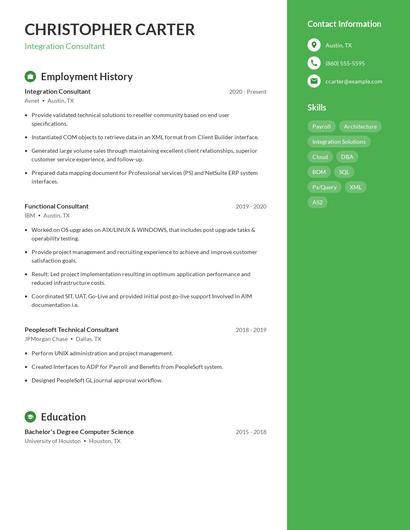
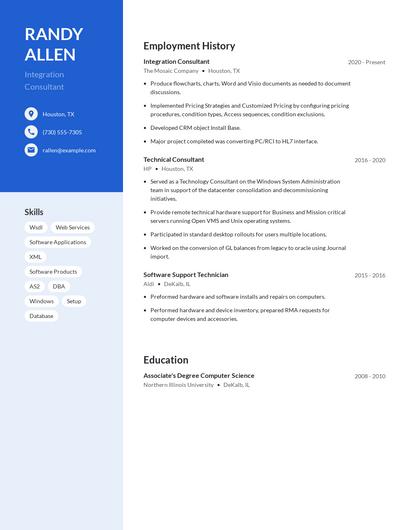
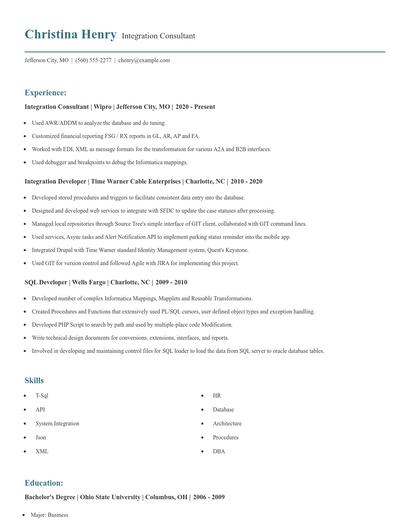
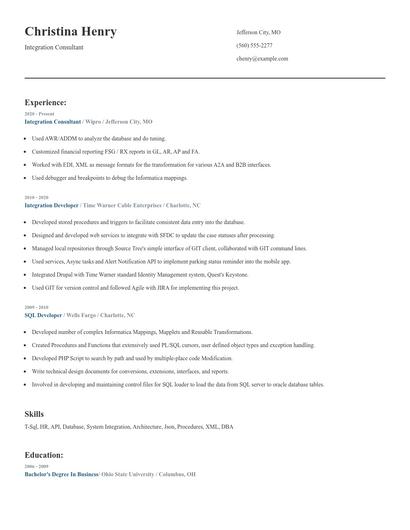
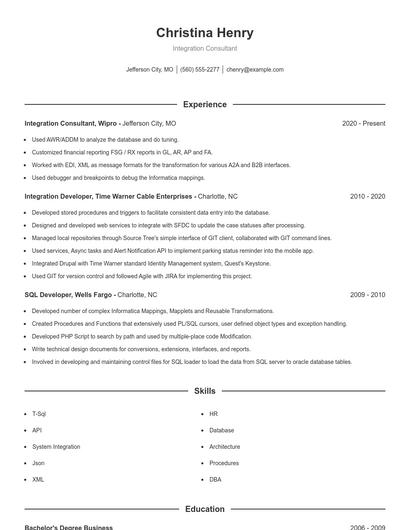
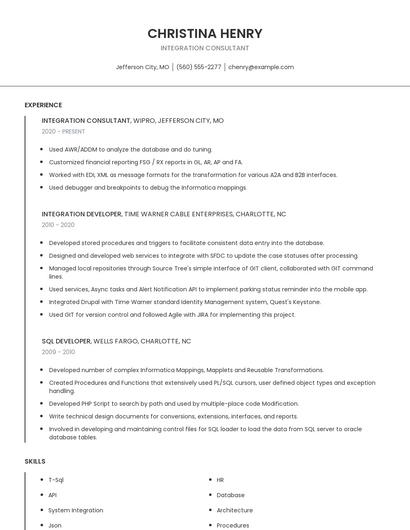
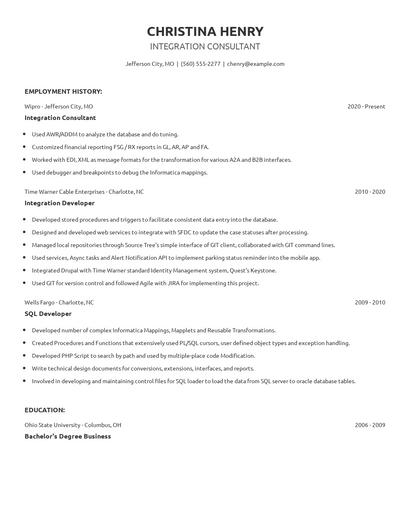
Compare different integration consultants
Integration consultant vs. Sap mm consultant
An SAP MM consultant specializes in helping clients attain their short and long-term goals when it comes to SAP systems and software. They primarily coordinate with clients to identify their needs, gather and analyze data to determine the strengths and weaknesses of existing systems, conduct research to identify the best practices to meet the clients' needs, and develop strategies to optimize overall operations. Above all, an SAP MM consultant must adhere to the company's policies and regulations, including its vision and mission.
There are some key differences in the responsibilities of each position. For example, integration consultant responsibilities require skills like "java," "client facing," "hr," and "web services." Meanwhile a typical sap mm consultant has skills in areas such as "purchase orders," "master data," "purchase requisitions," and "business process." This difference in skills reveals the differences in what each career does.
Sap mm consultants earn the highest salaries when working in the retail industry, with an average yearly salary of $107,868. On the other hand, integration consultants are paid more in the insurance industry with an average salary of $104,150.On average, sap mm consultants reach higher levels of education than integration consultants. Sap mm consultants are 6.6% more likely to earn a Master's Degree and 0.7% less likely to graduate with a Doctoral Degree.Integration consultant vs. Customer relationship management consultant
A customer relationship management consultant is responsible for providing management solutions for clients to develop successful customer relationships. Customer relationship management consultants evaluate business requirements and plans and identify potential risks that may affect the reputation and stability of an organization in the market. They also review the company's services, find strengths and weaknesses, and recommend solutions to enhance customer satisfaction. A customer relationship management consultant must be highly organizational and communicative, especially in finding opportunities to boost the company's brand image and maximize operational productivity to support the customers' needs and concerns.
Each career also uses different skills, according to real integration consultant resumes. While integration consultant responsibilities can utilize skills like "hr," "api," "http," and "payroll," customer relationship management consultants use skills like "power bi," "azure," "customer service," and "customer relationships."
Customer relationship management consultants earn a higher average salary than integration consultants. But customer relationship management consultants earn the highest pay in the retail industry, with an average salary of $105,565. Additionally, integration consultants earn the highest salaries in the insurance with average pay of $104,150 annually.In general, customer relationship management consultants achieve similar levels of education than integration consultants. They're 2.2% more likely to obtain a Master's Degree while being 0.7% less likely to earn a Doctoral Degree.What technology do you think will become more important and prevalent for integration consultants in the next 3-5 years?
Peter Woolley Ph.D.
Founding Director, Fairleigh Dickinson University
Integration consultant vs. Sap abap consultant
In the information technology industry, SAP ABAP Consultants specialize in developing and recommending strategies to optimize system operations and provide solutions against problem areas. They typically meet with clients to identify their needs and preferences, conduct research and assessments, gather and analyze data from various operations, develop action plans and cost estimates, conduct risk assessments, and identify existing issues, resolving them promptly and efficiently. Moreover, SAP ABAP consultants typically work in a team setting, which requires an active communication line for a smooth and efficient workflow.
Some important key differences between the two careers include a few of the skills necessary to fulfill the responsibilities of each. Some examples from integration consultant resumes include skills like "client facing," "web services," "api," and "http," whereas a sap abap consultant is more likely to list skills in "sap abap," "custom fields," "bdc," and "purchase orders. "
Sap abap consultants make a very good living in the manufacturing industry with an average annual salary of $104,734. On the other hand, integration consultants are paid the highest salary in the insurance industry, with average annual pay of $104,150.When it comes to education, sap abap consultants tend to earn similar degree levels compared to integration consultants. In fact, they're 4.8% more likely to earn a Master's Degree, and 1.3% more likely to graduate with a Doctoral Degree.Integration consultant vs. Sap consultant
An SAP consultant is responsible for analyzing, designing, and configuring new computer software and systems in agreement with their clients' or employer's specifications, as well as create programs, interfaces, and forms. They also check new interfaces to make sure that system workflows are optimized and work well with end-users, then make modifications as requested and get feedback. They have a complex task; thus, an SAP consultant must be patient and flexible because end-users regularly revise system requirements.
Types of integration consultant
Updated January 8, 2025
