What does an interface analyst do?
An interface analyst usually works as a member of a company's information technology department. They are responsible for ensuring that systems and programs work well together through various assessments and inspections. Part of their job is to conduct extensive research and analysis, identify and eliminate bugs, coordinate with developers, and produce reports along with recommendations to optimize operations and resolve other issues. Moreover, as an interface analyst, it is essential to maintain an active communication line with staff for a smooth and efficient workflow.
Interface analyst responsibilities
Here are examples of responsibilities from real interface analyst resumes:
- Coordinate with vendors; assist in EHR updates and go lives and manage all interface updates.
- Manage testing staff ensuring proper utilization of test environment and use of debugging programs and procedures.
- Configure, install, and create utilization base testing documentation for EHR and other relate system interfaces.
- Integrate IPeople software with vendor API s using VB.NET.
- Develop Wireframes, visual mockups, and UI specs.
- Assist in resolving issues in the hospital's Cerner application.
- Develop the radiology ADT and order interface for the CareVISION project.
- Identify, research, troubleshoot, document, and resolve report issues.
- Help staff interface analyst resolve eLink interface issues with the lab and radiology departments.
- Provide post-live support after interface go-live prior to transition to support by off-shore community.
- Used JQuery data tables to display the data and server side pagination, filtration and sorting.
- Used JQuery animations and additional animation toolkits to create a fun and engaging environment for users.
- Develop code to call the web service/APIs to fetch the data and populate on the UI using JQUERY/AJAX.
- Determine the frequency and content of status reports from the project team, analyze results, and troubleshoot problem areas.
- Coordinate the re-point of interfaces back and forth between the various end points for test windows and for production cutovers.
Interface analyst skills and personality traits
We calculated that 10% of Interface Analysts are proficient in EMR, Interface Engine, and Troubleshoot. They’re also known for soft skills such as Analytical skills, Communication skills, and Creativity.
We break down the percentage of Interface Analysts that have these skills listed on their resume here:
- EMR, 10%
Developed Perl Scripts to transfer files from EMR System to downstream system on daily basis.
- Interface Engine, 6%
Worked with interface engineers and facility analyst to ensure connectivity and monitor results and acknowledged HL7 interface messages.
- Troubleshoot, 4%
Create test plans and troubleshoot issues for new functionality or system upgrades.
- Java, 4%
Developed Java Program to read HL7 files and send an e-Mail alert with the count of the Messages.
- FTP, 4%
Used FTP, File and SQL adapters to connect both inbound and outbound applications.
- Cerner, 4%
Provided problem resolution and determination utilizing the Cerner Clinical system.
"emr," "interface engine," and "troubleshoot" are among the most common skills that interface analysts use at work. You can find even more interface analyst responsibilities below, including:
Analytical skills. One of the key soft skills for an interface analyst to have is analytical skills. You can see how this relates to what interface analysts do because "analysts must interpret complex information from various sources and decide the best way to move forward on a project." Additionally, an interface analyst resume shows how interface analysts use analytical skills: "experience working (or exposure to) with data formats such as hl7 and xml. "
Communication skills. Many interface analyst duties rely on communication skills. "analysts work as a go-between with management and the it department and must explain complex issues in a way that both will understand.," so an interface analyst will need this skill often in their role. This resume example is just one of many ways interface analyst responsibilities rely on communication skills: "maintain knowledge proficiency in various interface communication protocols such as hl7v2, hl7v3, ncpdp, xml, and x12. "
Creativity. This is an important skill for interface analysts to perform their duties. For an example of how interface analyst responsibilities depend on this skill, consider that "because analysts are tasked with finding innovative solutions to computer problems, an ability to “think outside the box” is important." This excerpt from a resume also shows how vital it is to everyday roles and responsibilities of an interface analyst: "improved inventory accuracy from 72% to 95% with proven process improvement methods. ".
The three companies that hire the most interface analysts are:
- Cedars-Sinai4 interface analysts jobs
- Texas4 interface analysts jobs
- Montrose Memorial Hospital3 interface analysts jobs
Choose from 10+ customizable interface analyst resume templates
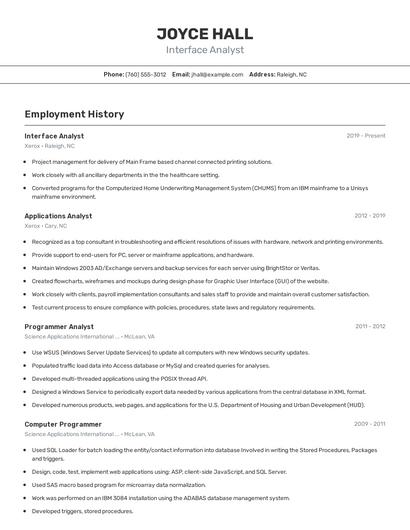
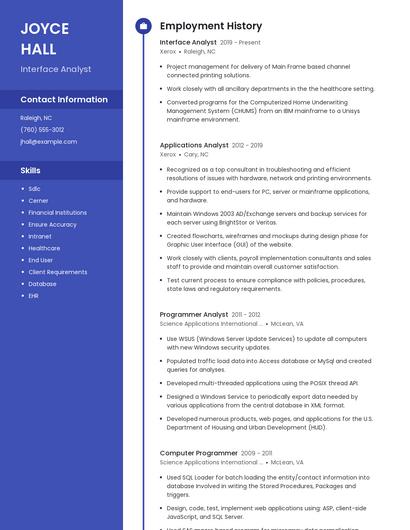
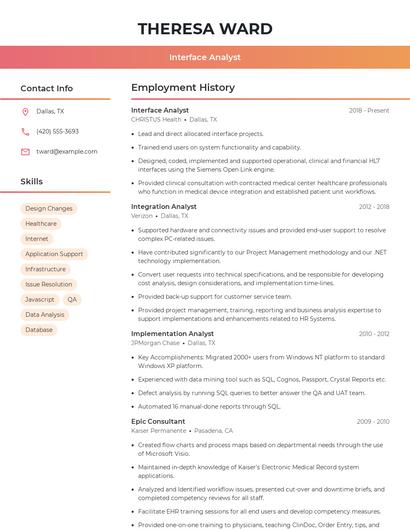
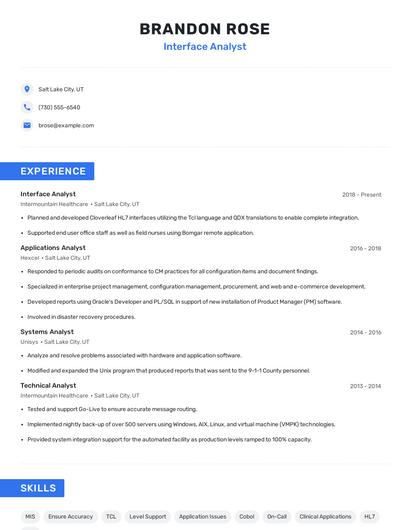
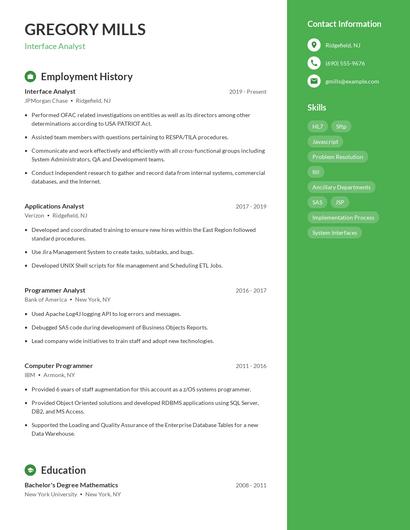
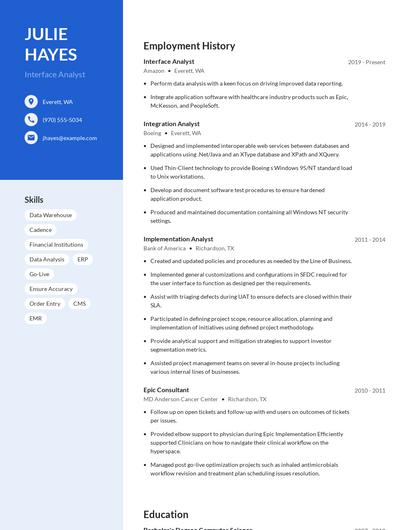
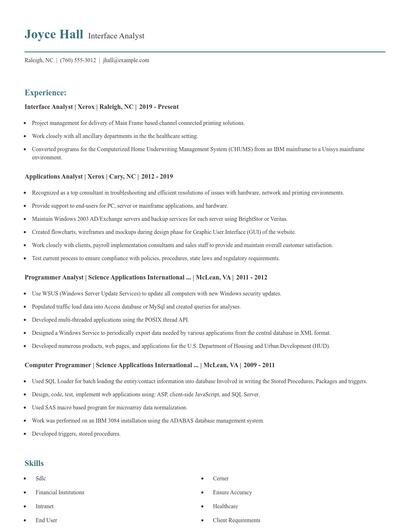
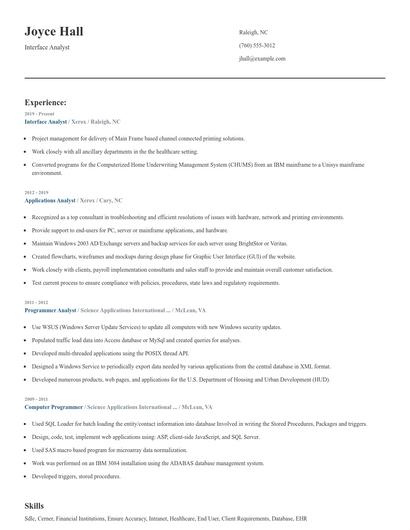
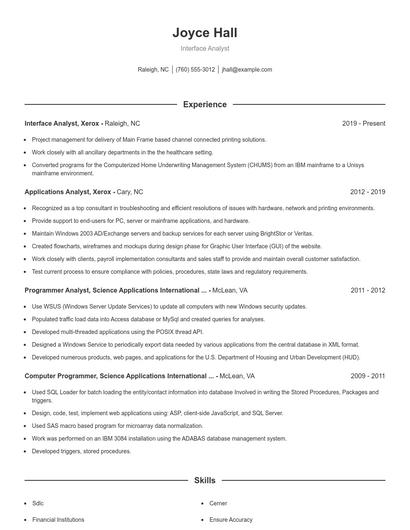
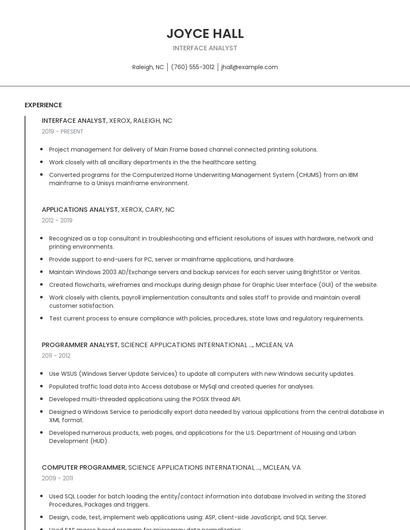
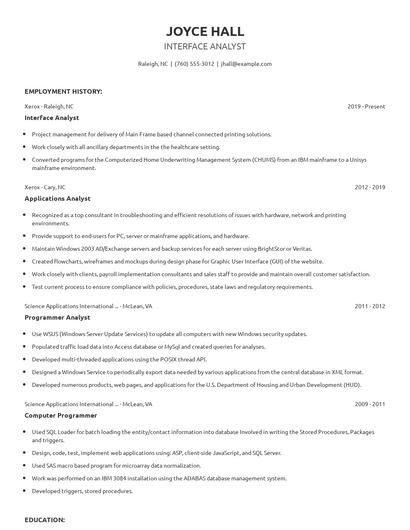
Build a professional interface analyst resume in minutes. Our AI resume writing assistant will guide you through every step of the process, and you can choose from 10+ resume templates to create your interface analyst resume.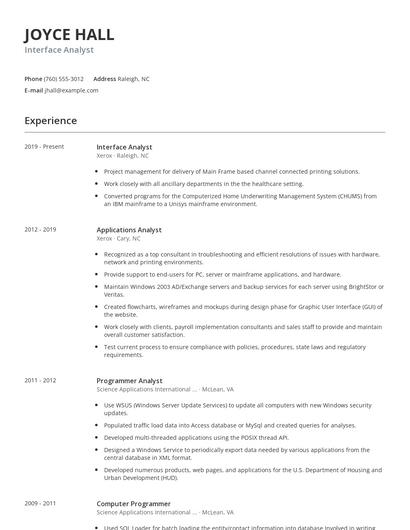
Compare different interface analysts
Interface analyst vs. Senior applications analyst
Senior Application Analysts are information technology (IT) professionals. They are responsible for addressing requests and concerns related to software applications. They may specialize in specific software or may be assigned to address concerns on a wide array of applications. They create reports related to software concerns. They take note of troubleshooting logs and how they were able to fix problems. Senior Application Analysts are in charge of understanding why such problems arise. They analyze the concerns and identify patterns to help mitigate any future problems.
These skill sets are where the common ground ends though. The responsibilities of an interface analyst are more likely to require skills like "interface engine," "ftp," "ehr," and "tcp ip." On the other hand, a job as a senior applications analyst requires skills like "healthcare," "project management," "home health," and "sr." As you can see, what employees do in each career varies considerably.
Senior applications analysts really shine in the finance industry with an average salary of $120,833. Comparatively, interface analysts tend to make the most money in the technology industry with an average salary of $86,617.senior applications analysts tend to reach similar levels of education than interface analysts. In fact, senior applications analysts are 1.5% more likely to graduate with a Master's Degree and 0.3% more likely to have a Doctoral Degree.Interface analyst vs. Analyst lead
The duties of an analyst lead depend on one's line of work or industry of employment. Typically, their responsibilities revolve around performing research and analysis, coordinating with different departments to gather leads and data, reviewing findings, and producing reports and presentations for the stakeholders and other higher-ranking officials. Through the results, an analyst lead can provide advice, devise strategies for business optimization, spearhead the development of processes, identify strengths and weaknesses, and offer recommendations on areas in need of improvement. All of this is done while in adherence to the company's vision and mission.
In addition to the difference in salary, there are some other key differences worth noting. For example, interface analyst responsibilities are more likely to require skills like "emr," "interface engine," "ftp," and "cerner." Meanwhile, an analyst lead has duties that require skills in areas such as "analytics," "data analysis," "project management," and "customer service." These differences highlight just how different the day-to-day in each role looks.
Analyst leads earn a lower average salary than interface analysts. But analyst leads earn the highest pay in the finance industry, with an average salary of $110,488. Additionally, interface analysts earn the highest salaries in the technology with average pay of $86,617 annually.analyst leads earn similar levels of education than interface analysts in general. They're 4.3% more likely to graduate with a Master's Degree and 0.3% more likely to earn a Doctoral Degree.Interface analyst vs. Applications analyst
An applications analyst is an individual hired by a company to administer, monitor, and maintain all its software infrastructure and applications. Applications analysts must ensure the integrity and safety of all data and applications so that the company business can run smoothly and succeed. They are required to collaborate with applications developers and software engineers to provide a diagnosis of application errors and create long- and short-term resolutions. Applications analysts should also provide training and support of staff in using applications.
There are many key differences between these two careers, including some of the skills required to perform responsibilities within each role. For example, an interface analyst is likely to be skilled in "interface engine," "ftp," "tcp ip," and "lis," while a typical applications analyst is skilled in "healthcare," "customer service," "patients," and "project management."
Applications analysts earn the best pay in the retail industry, where they command an average salary of $94,157. Interface analysts earn the highest pay from the technology industry, with an average salary of $86,617.When it comes to education, applications analysts tend to earn similar degree levels compared to interface analysts. In fact, they're 1.3% less likely to earn a Master's Degree, and 0.1% less likely to graduate with a Doctoral Degree.Interface analyst vs. Technical system analyst
Technical Systems Analysts are employees who are adept in information technology (IT). They work in the IT department, where they oversee the different networks and systems that exist in the company. They manage the technical systems and ensure that these systems are working properly at all times. They generate reports related to the networks and systems. They then study and analyze these reports to identify existing problems or anticipate challenges that may come their way. These reports help them craft solutions to problems and invest in infrastructure that will address challenges.
Types of interface analyst
Updated January 8, 2025
