What does a kit assembler do?
Kit assembler responsibilities
Here are examples of responsibilities from real kit assembler resumes:
- Excel in interpreting detail aligning units using jigs and fixtures, and inspecting complete components to ensure conformance to specifications.
- Assemble catheters, heart monitors, and pacemakers.
Kit assembler skills and personality traits
We calculated that 32% of Kit Assemblers are proficient in Medical Kits, Hand Tools, and Quality Checks.
We break down the percentage of Kit Assemblers that have these skills listed on their resume here:
- Medical Kits, 32%
Assembled medical kits on an assembly line with team members to ensure quality and high productivity.
- Hand Tools, 17%
Performed bench-type processes to complete mechanical and electrical assemblies and sub-assemblies; used hand tools and electric/pneumatic tooling.
- Quality Checks, 11%
Pull computer Kits from Inventory stock and quality check to prepare for shipping.
- FDA, 9%
Followed manufacturing instructions according to engineering procedures defined by FDA.
- Quality Inspection, 6%
Conduct quality inspection processing line in accordance with quality specifications.
- ISO, 5%
Used Material Management software to digitally process repair kits and qualitycheck orders, to uphold ISO 9001 standards.
"medical kits," "hand tools," and "quality checks" are among the most common skills that kit assemblers use at work. You can find even more kit assembler responsibilities below, including:
The three companies that hire the most kit assemblers are:
- Aerotek9 kit assemblers jobs
- Dover3 kit assemblers jobs
- Brunswick2 kit assemblers jobs
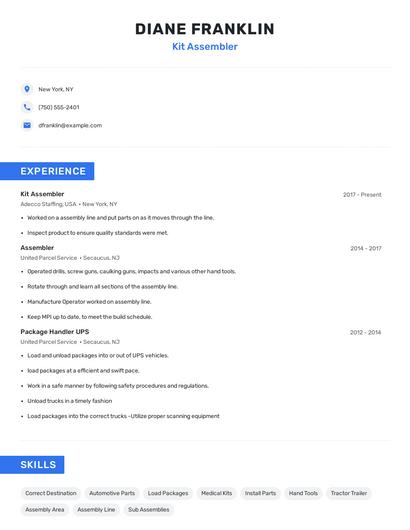
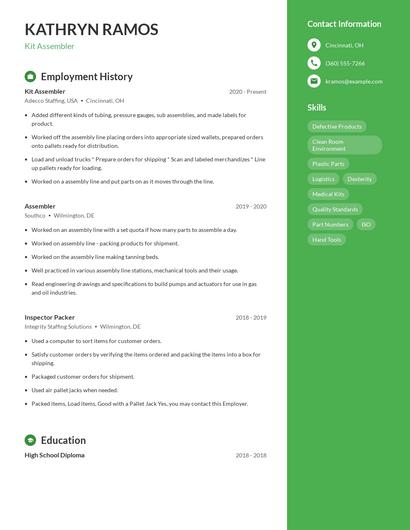
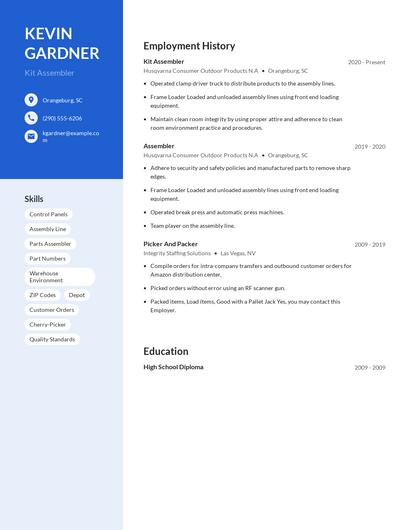
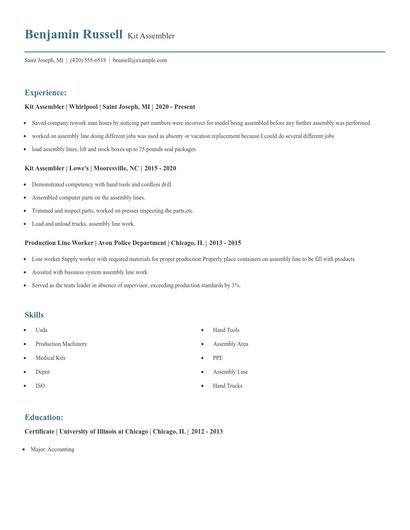
Choose from 10+ customizable kit assembler resume templates
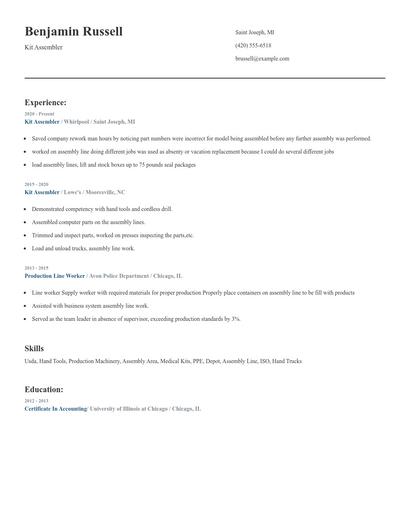
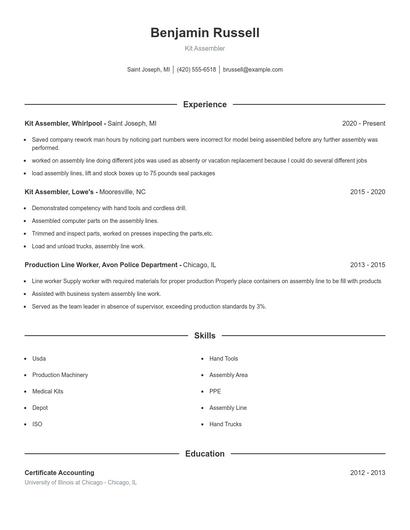
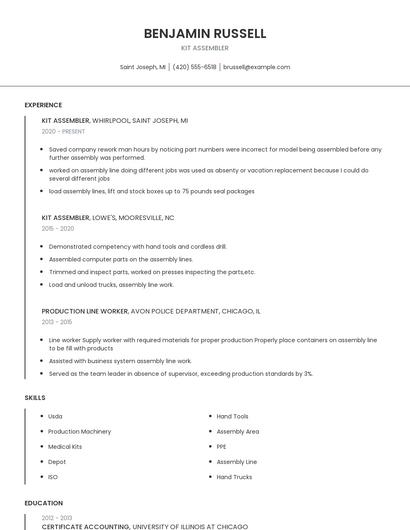
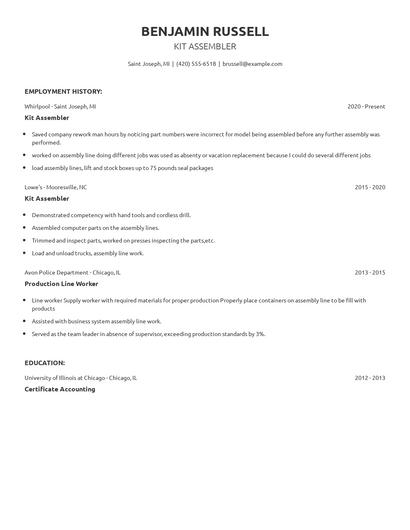
Build a professional kit assembler resume in minutes. Our AI resume writing assistant will guide you through every step of the process, and you can choose from 10+ resume templates to create your kit assembler resume.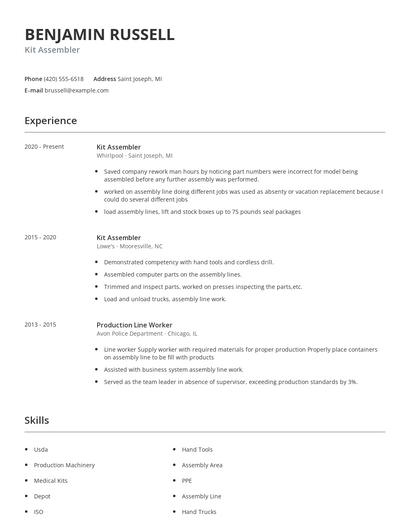
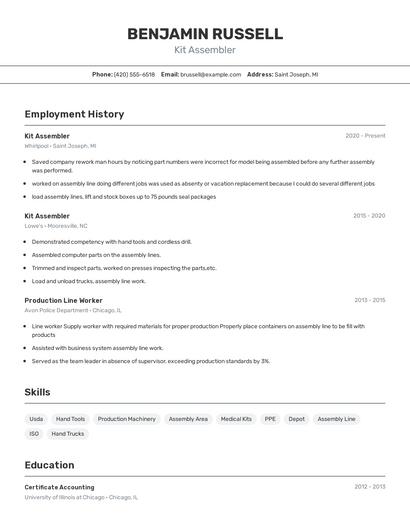
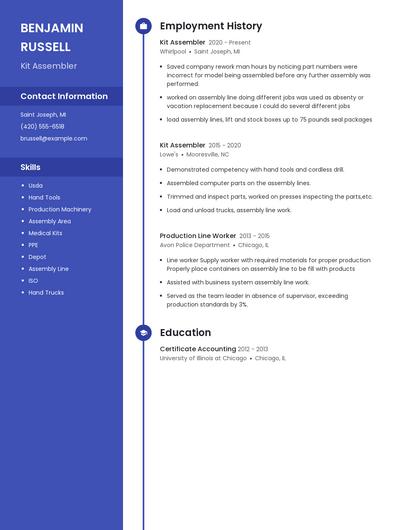
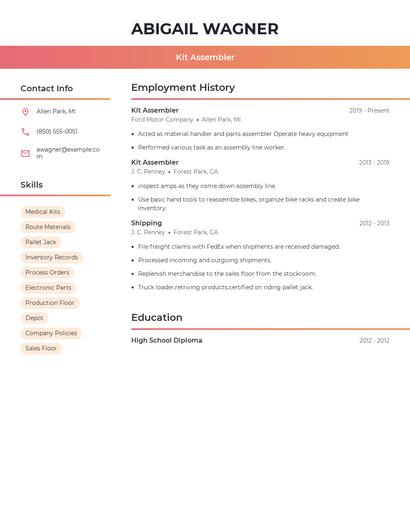
Compare different kit assemblers
Kit assembler vs. Manufacturing team member
Manufacturing team members are employees who are part of the group or department that fulfills the manufacturing need of the company or plant. They are trained workers who are familiar with the needs of the organization. They may handle machines or may also be assigned to work on their own using manual tools or their own hands, especially if such activities are not possible to do with a machine. Manufacturing team members work within manufacturing deadlines and ensure that products are made within the agreed timeline.
While similarities exist, there are also some differences between kit assemblers and manufacturing team member. For instance, kit assembler responsibilities require skills such as "medical kits," "hand tools," "quality checks," and "fda." Whereas a manufacturing team member is skilled in "customer service," "cleanliness," "guest service," and "safety standards." This is part of what separates the two careers.
Manufacturing team members tend to make the most money working in the retail industry, where they earn an average salary of $38,845. In contrast, kit assemblers make the biggest average salary, $37,700, in the health care industry.On average, manufacturing team members reach similar levels of education than kit assemblers. Manufacturing team members are 3.5% more likely to earn a Master's Degree and 0.5% more likely to graduate with a Doctoral Degree.Kit assembler vs. Production team member
A production team member is responsible for performing duties in manufacturing and industrial processes, conducting quality check procedures for the outputs, and inspecting the efficiency of items before distribution. Production team members operate various equipment and machinery, requiring them to ensure that the equipment works in the best state to avoid potential hazards and delay in operations. They also maintain the cleanliness and orderliness of the production area, escalate any defects and malfunctioning components, and coordinating with the whole team to reach production goals and objectives.
While some skills are similar in these professions, other skills aren't so similar. For example, resumes show us that kit assembler responsibilities requires skills like "medical kits," "fda," "pic," and "government agencies." But a production team member might use other skills in their typical duties, such as, "work ethic," "strong work ethic," "customer service," and "cleanliness."
On average, production team members earn a lower salary than kit assemblers. Some industries support higher salaries in each profession. Interestingly enough, production team members earn the most pay in the transportation industry with an average salary of $36,333. Whereas kit assemblers have higher pay in the health care industry, with an average salary of $37,700.Average education levels between the two professions vary. Production team members tend to reach similar levels of education than kit assemblers. In fact, they're 0.8% more likely to graduate with a Master's Degree and 0.5% more likely to earn a Doctoral Degree.Kit assembler vs. Assembly line technician
A support team member is responsible for assisting and connecting with the whole department group in meeting the company's goals and exceeding performance expectations. Support team members' duties generally include performing administrative tasks, familiarizing and adhering to the company's policies and procedures, providing recommendations for improving customer's experience, developing strategies to increase the company's revenue and profitability, and maintaining a positive work ethic. A support team member needs to have a strong organization and time-management skills to support daily operations and do extra tasks as needed.
The required skills of the two careers differ considerably. For example, kit assemblers are more likely to have skills like "medical kits," "hand tools," "fda," and "pic." But a assembly line technician is more likely to have skills like "assembly line production," "safety procedures," "assembly process," and "diesel engines."
Most assembly line technicians achieve a similar degree level compared to kit assemblers. For example, they're 0.1% more likely to graduate with a Master's Degree, and 0.0% more likely to earn a Doctoral Degree.Kit assembler vs. Support team member
Even though a few skill sets overlap between kit assemblers and support team members, there are some differences that are important to note. For one, a kit assembler might have more use for skills like "medical kits," "hand tools," "quality checks," and "fda." Meanwhile, some responsibilities of support team members require skills like "safety standards," "dexterity," "manual dexterity," and "cleanliness. "
In general, support team members earn the most working in the technology industry, with an average salary of $34,517. The highest-paying industry for a kit assembler is the health care industry.The average resume of support team members showed that they earn higher levels of education compared to kit assemblers. So much so that theyacirc;euro;trade;re 5.4% more likely to earn a Master's Degree and more likely to earn a Doctoral Degree by 0.7%.Types of kit assembler
Updated January 8, 2025
