
Automatically apply for jobs with Zippia
Upload your resume to get started.
Litigation assistant skills for your resume and career

15 litigation assistant skills for your resume and career
1. Litigation
- Supported attorneys in litigation office in an administrative/administrator capacity.
- Assisted legal team with litigation document management, including data loading, secondary review, and additional analysis using written summaries.
2. Phone Calls
Phone calls are a wireless or wired connection made over a telephone or a mobile phone between two people. Two parties are involved in a phone call, the caller and the receiver. A caller dials the number of the one he wants to call, and the recipient hears a bell or a tune to which he picks up the call. The call establishes a connection between them through which they can communicate. The voice is converted into signals and is transmitted through wired or wireless technology.
- Research websites or make phone calls to courts to follow up on status of cases.
- Take phone calls from Defendant's, Attorney'sand anyone else who may call.
3. Law Firm
- Provided Law Firms with requested workout solutions and Maintained access database for all legal pending settlement resolutions.
- Provided assistance to the law firm's document filing clerk and assisted the hiring coordinator with screening resumes from potential employees.
4. Discovery Responses
Discovery response is the response made by a person on trial once discoveries are made against them. Certain motions are filed against a person on trial, which may include a request for interrogations, request for production, etc, and they have to file a response within some time. The official response is filed in court and its copies can be distributed to the other parties.
- Prepared discovery to opposing counsel and discovery responses.
- Drafted correspondence, complaints, discovery responses, settlement agreements, various motions, and notices.
5. Attorney Review
- Analyzed investment portfolios in ascertaining potential securities violations and fraud for attorney review.
- Created chronological sets of production and/or other documents for attorney review.
6. Trial Preparation
Trial preparation is the practice of gathering sufficient raw material for a court case. This preparation is done to make the bases of a case stronger by bringing the facts to light in a way that will give the concerned law bodies a better comprehension of the entire scenario. The method for preparing for a case may differ depending upon its nature.
- Participated in discovery and document production, assisted in extensive trial preparation, and aided in general administrative duties.
- Assist counsel in all aspects of litigation management including investigation, document preparation, trial preparation and support.
Choose from 10+ customizable litigation assistant resume templates
Build a professional litigation assistant resume in minutes. Our AI resume writing assistant will guide you through every step of the process, and you can choose from 10+ resume templates to create your litigation assistant resume.7. Proofreading
- Prepare general correspondence, typing and proofreading document.
- Prepared motions by researching the relevant documents, proofreading papers, and creating the index.
8. Legal Research
- Supported attorneys in legal research, discovery preparation, document production, and e-filing requirements
- Performed legal research to obtain and gather case-relevant data.
9. Defense Counsel
A defence attorney is a counsel representing the defendant in a criminal prosecution or lawsuit. A defence attorney aims to solve court cases as swiftly and satisfactorily as possible. Client representations at arraignments, hearings, and court trials along with preparing and drafting legal documents, including legal briefs and appeals is all part of their job description. They are responsible for presenting convincing evidence to a jury and/or judge if the case goes to trial.
- Prepared responses to various pleadings and filing of pleadings, correspondence, witness and exhibit files for defense counsel.
- Arranged and scheduled meetings / conference calls with physicians, staff, plaintiff and defense counsel among others.
10. Subpoenas
Subpoenas are formal and legal documents issued mostly by a court or some other government agency that demands the presence of the person the document is addressed to, to show up at court. Subpoenas are issued to individuals whom the court wants to appear either as a witness in a particular case in order to testify or to provide any evidence such as an object or a document.
- Maintained database of information produced in response to third-party subpoenas and requests from creditors in accordance with enterprise-wide records retention policies.
- Organized and managed large volume discovery, including propounding and responding to discovery requests and subpoenas.
11. Office Equipment
- Research and order office equipment - printers, thumb-drives, external hard-drives, etc.
- Coordinated technical support and ongoing maintenance of all information management, telecommunication systems and office equipment.
12. Federal Courts
Federal courts refer to designated law system units mandated to rule cases that involve the constitution, the federal laws, cases entailing bankruptcy, the general conduct of the ambassadors and public ministers in treaties, and crimes that involve different states.
- Review local rules from district, appellate and federal courts to assist with filing and drafting of pleadings and motions.
- Prepared pleadings for attorneys' review, finalized and filed same in state and federal courts.
13. Litigation Support
- Provided litigation support in a variety of cases including medical malpractice, products liability, labor and employment and commercial litigation.
- Provided litigation support by assisting in case investigations, including gathering of underwriting, claim and agency information and subpoena responses.
14. Travel Arrangements
- Coordinate travel arrangements and generate expense reports.
- Experience with extensive calendaring, travel arrangements, high client interaction, and drafting and design of employee handbooks.
15. Interrogatories
- Edited briefs and interrogatories, abstracted depositions and interviewed clients.
- Assisted in drafting responses to interrogatories and discovery requests.
5 Litigation Assistant resume examples
Build a professional litigation assistant resume in minutes. Browse through our resume examples to identify the best way to word your resume. Then choose from 5+ resume templates to create your litigation assistant resume.

What skills help Litigation Assistants find jobs?
Tell us what job you are looking for, we’ll show you what skills employers want.
What skills stand out on litigation assistant resumes?
Shelly Grunsted
Executive Director - Center for Student Success, Director, First Fidelity Integrated Business Core Program (IBC), Associate Professor, The University of Oklahoma
What litigation assistant skills would you recommend for someone trying to advance their career?
Emily Allen-Hornblower
Associate Professor of Classics, Director of Undergraduate Studies, Rutgers, The State University of New Jersey
What type of skills will young litigation assistants need?
Deirdre Kelly
Assistant Dean for Career Development, Western State College of Law
List of litigation assistant skills to add to your resume
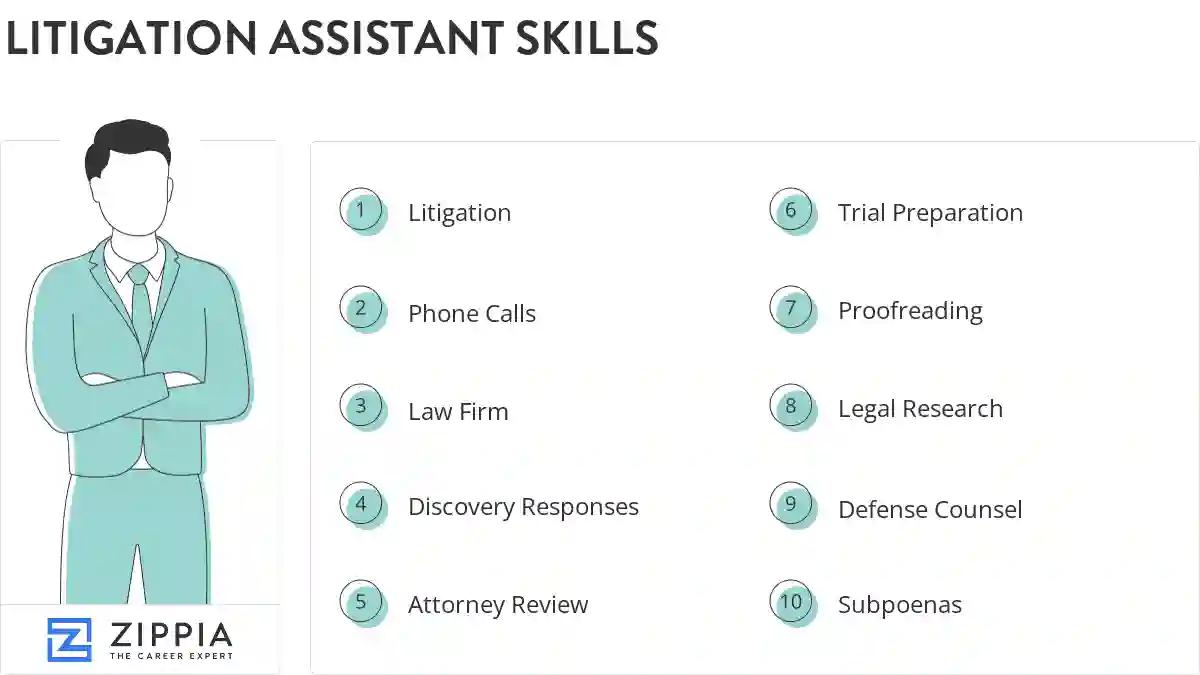
The most important skills for a litigation assistant resume and required skills for a litigation assistant to have include:
- Litigation
- Phone Calls
- Law Firm
- Discovery Responses
- Attorney Review
- Trial Preparation
- Proofreading
- Legal Research
- Defense Counsel
- Subpoenas
- Office Equipment
- Federal Courts
- Litigation Support
- Travel Arrangements
- Interrogatories
- Conference Calls
- Expense Reports
- Litigation Cases
- Civil Litigation
- Administrative Tasks
- Court Reporters
- Court Filings
- Arbitration
- Pacer
- Telephone Calls
- Employment Law
- Demand Letters
- Real Estate
- Legal Correspondence
- Commercial Litigation
- E-File
- Insurance Adjusters
- Court Dates
- Insurance Defense
- Deposition Summaries
- Medical Malpractice
- Plaintiff
- State Courts
- Product Liability
- Medical Bills
- Summonses
- Court Appearances
- Legal Assistants
- PowerPoint
- Court Hearings
- Status Reports
- District Court
- Deposition Preparation
- Litigation Process
- Family Law
Updated January 8, 2025
