What does a mail processing do?
A mail processor is responsible for sorting mail and documents to ensure accurate delivery and distribution across the recipients. Mail processors manage route orders, send delivery information to the receivers, and update completed distributions on the database. They also process cancellation orders, labeling mail and inspecting the quality of mail before loading it to the truck. A mail processor must have excellent communication and organizational skills, especially in handling information and resolving mail delivery failures and discrepancies.
Mail processing responsibilities
Here are examples of responsibilities from real mail processing resumes:
- Scan and load products onto FEDEX delivery trucks.
- Handle custodial duties in addition to standard PSE responsibilities as well as maintained the postal grounds.
- Receive, process, sort, log in and deliver USPS mail and courier packages for multiple corporate locations.
- Process mail on automate machines, sweep stackers from mail volume and place mail into letter trays for dispatch.
- Prepare metered USPS mail, and statements, organize brinks work for data entry; deliver interoffice mail to various departments.
- Process incoming and outgoing mail in the plant for the different post office facilities using different methods of sortation and distribution.
- Sweep-Separate mail from automate bin stackers.
- Operate OPEX machines which are used to open customer lockbox payment envelopes consistently meeting or exceeding productivity standards.
- Push APC's full of mail.
- Change APC's when they become full.
- Process zone mail (DPS )
- Execute daily operations of DPS, mail letters, merchandise samples and promotional literature to prospective customers.CRS
Mail processing skills and personality traits
We calculated that 75% of Mail Processings are proficient in Processing Equipment, ZIP Codes, and Processing Mail.
We break down the percentage of Mail Processings that have these skills listed on their resume here:
- Processing Equipment, 75%
Repaired and maintained mail-processing equipment, such as letter-canceling machines, mail-sorting machines and conveyor system
- ZIP Codes, 4%
Programmed machinery for zip code processing and reported any machinery failures to mechanics.
- Processing Mail, 3%
Executed daily operations of processing mail and placing correct zip code stickers on packages.
- Postal Service, 2%
Accept process and dispatch the mail according to Mail Services and the Postal Service's guidelines, goals and deadlines.
- USPS, 2%
Prepared metered USPS mail, and statements, organized brinks work for data entry; delivered interoffice mail to various departments.
- Pallet Jack, 2%
Transported shipment to particular areas by the electrical and manual pallet jack or other tools.
"processing equipment," "zip codes," and "processing mail" are among the most common skills that mail processings use at work. You can find even more mail processing responsibilities below, including:
Customer-service skills. To carry out their duties, the most important skill for a mail processing to have is customer-service skills. Their role and responsibilities require that "postal service workers, particularly clerks, regularly interact with customers." Mail processings often use customer-service skills in their day-to-day job, as shown by this real resume: "processed mail by zip code and customer specifications while performing data entry. "
Physical strength. Another essential skill to perform mail processing duties is physical strength. Mail processings responsibilities require that "postal service workers must be able to lift heavy mail bags and parcels without injuring themselves." Mail processings also use physical strength in their role according to a real resume snippet: "performed apo (army post office) duties including; mail manifests, mail pick-up, and physical inspections of packages. "
The three companies that hire the most mail processings are:
- LC Staffing
12 mail processings jobs
- Randstad North America, Inc.3 mail processings jobs
- VIVA USA
3 mail processings jobs
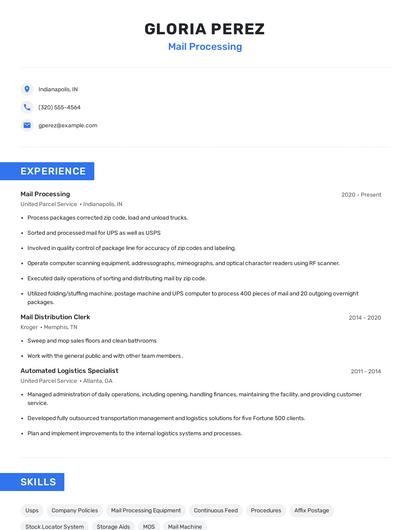
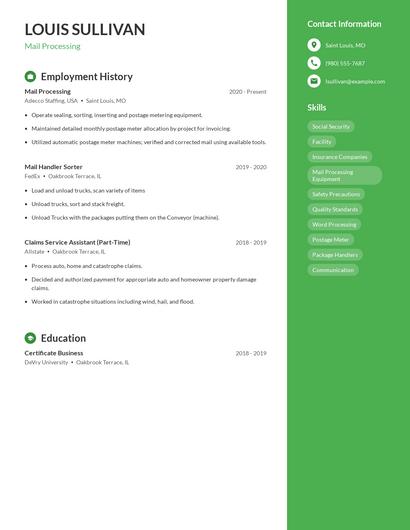
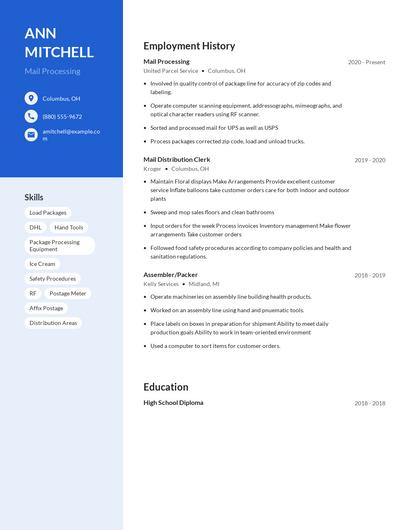
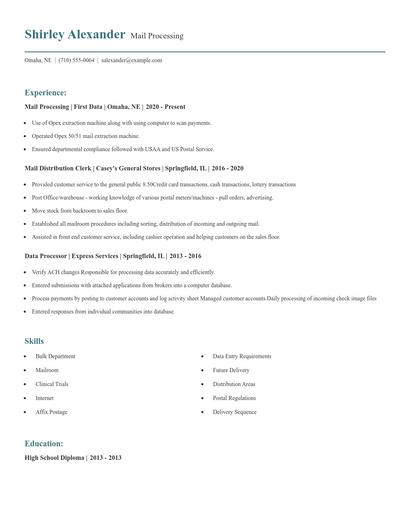
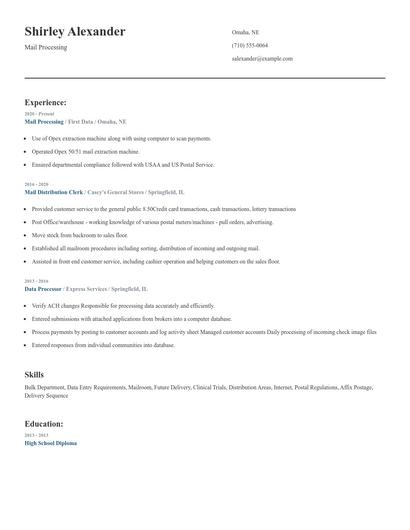
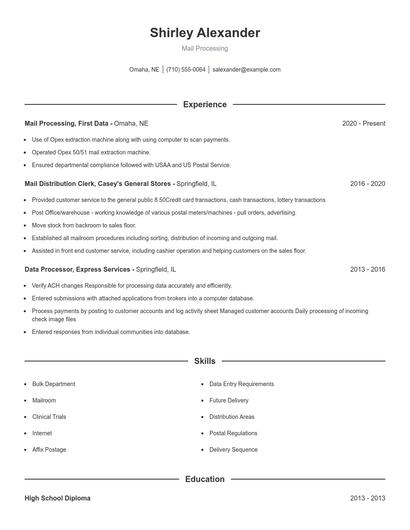
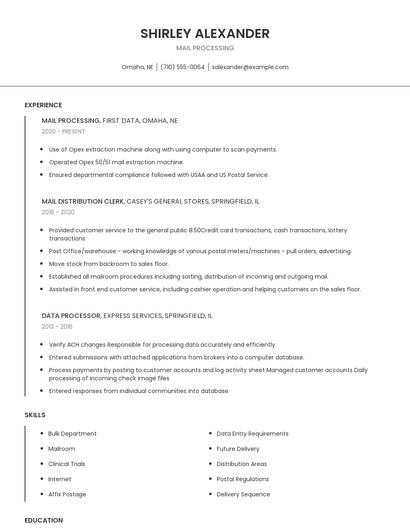
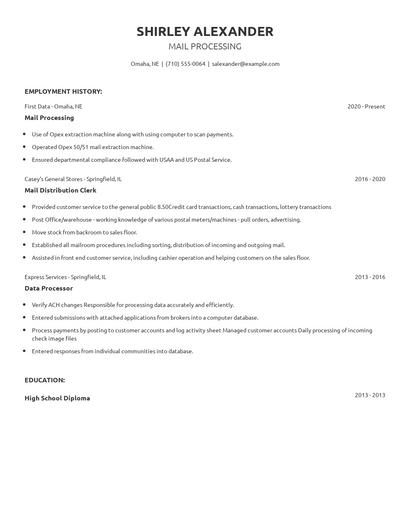
Choose from 10+ customizable mail processing resume templates
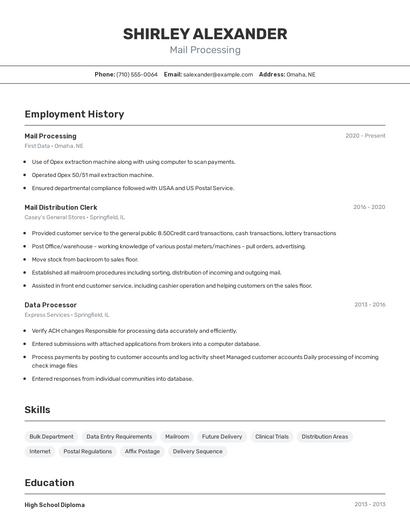
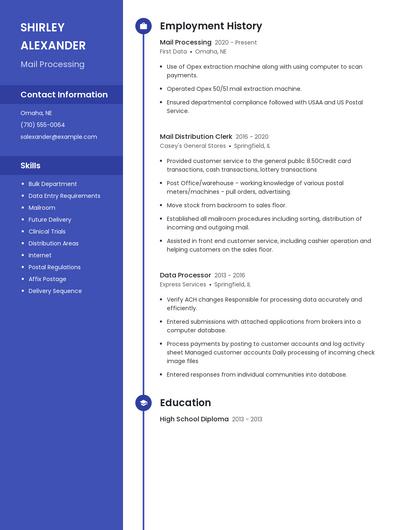
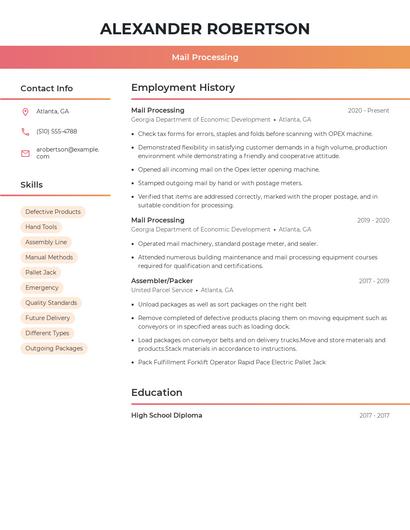
Build a professional mail processing resume in minutes. Our AI resume writing assistant will guide you through every step of the process, and you can choose from 10+ resume templates to create your mail processing resume.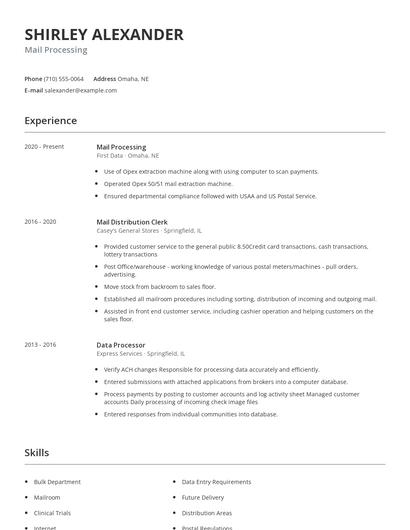
Compare different mail processings
Mail processing vs. Sorter operator
While similarities exist, there are also some differences between mail processings and sorter operator. For instance, mail processing responsibilities require skills such as "processing mail," "postal service," "usps," and "pallet jack." Whereas a sorter operator is skilled in "check processing," "safety procedures," "pod," and "assembly line." This is part of what separates the two careers.
The education levels that sorter operators earn slightly differ from mail processings. In particular, sorter operators are 0.8% less likely to graduate with a Master's Degree than a mail processing. Additionally, they're 0.3% less likely to earn a Doctoral Degree.Mail processing vs. Sorting machine operator
Each career also uses different skills, according to real mail processing resumes. While mail processing responsibilities can utilize skills like "processing equipment," "zip codes," "processing mail," and "pallet jack," sorting machine operators use skills like "safety guidelines," "ran," "assembly line," and "quality checks."
Sorting machine operators may earn a lower salary than mail processings, but sorting machine operators earn the most pay in the manufacturing industry with an average salary of $30,802. On the other hand, mail processings receive higher pay in the retail industry, where they earn an average salary of $39,382.In general, sorting machine operators achieve similar levels of education than mail processings. They're 1.4% less likely to obtain a Master's Degree while being 0.3% less likely to earn a Doctoral Degree.Mail processing vs. Centrifugal operator
The required skills of the two careers differ considerably. For example, mail processings are more likely to have skills like "processing equipment," "zip codes," "processing mail," and "postal service." But a centrifugal operator is more likely to have skills like "centrifuges," "repair pumps," "hand tools," and "safety procedures."
Centrifugal operators typically earn similar educational levels compared to mail processings. Specifically, they're 2.0% less likely to graduate with a Master's Degree, and 0.3% less likely to earn a Doctoral Degree.Mail processing vs. Posting machine operator
Types of mail processing
Updated January 8, 2025
