What does a manufacturing test engineer do?
A manufacturing test engineer specializes in designing and developing test structures to ensure the quality of products according to the company's policies and standards. Their responsibilities include coordinating with the design team to determine test parameters, producing test documentation, troubleshooting, and performing quality assurance procedures. A manufacturing test engineer must also assess the existing test procedures to identify its strengths and weaknesses, implementing solutions as needed. Furthermore, they may assist the quality assurance teams in conducting tests, all while enforcing the company's policies and regulations.
Manufacturing test engineer responsibilities
Here are examples of responsibilities from real manufacturing test engineer resumes:
- Collaborate with internal company users to manage software and database improvements.
- Used Altera development tools for several FPGA designs (( VHDL).
- Lead the implementation of the new or transferring test production equipment and procedures for NPI.
- Multi-Task to support procurement of test fixture/equipment/instrument and a debug test program for the HP3070/GR228X ICT tester.
- Support the NPI process by incorporating new products in the current code base without disruption to the legacy products.
- Work with RF power systems, vacuum and leak-detection systems, microwave systems, gas delivery systems, and robots.
- Debug test failures and maintain database of DVT test results and garner relevant data to author the DVT and EVT report.
- Experience with RF signal measurements and communication.
- Support SW regression testing for script modeling prior to manufacturing release
- Provide functional, regression, browser compatibility and OS compatibility testing.
- Design component-level circuits for precision parametric measurement and dynamic signal analysis of analog and mixed-signal integrate circuits.
- Determine manufacturing requirements and quality assurance measures through to use of operational process planning drawings and inspection reports for CNC machine components
- Develop automated temperature-cycle calibrations for analog and digital transducers.
- Develop, maintain and enhance the mfg scripts and tools require to support the process (e.g.
- Determine manufacturing requirements and quality assurance measures through to use of operational process planning drawings and inspection reports for CNC machine components
Manufacturing test engineer skills and personality traits
We calculated that 6% of Manufacturing Test Engineers are proficient in Test Equipment, LabVIEW, and Troubleshoot. They’re also known for soft skills such as Creativity, Listening skills, and Problem-solving skills.
We break down the percentage of Manufacturing Test Engineers that have these skills listed on their resume here:
- Test Equipment, 6%
Identified, procured and setup required test equipment for functional tests, troubleshooting and verification to product specifications.
- LabVIEW, 5%
Test programming & development for illuminated displays including; image data processing, light measurements and general instrument control using LabVIEW.
- Troubleshoot, 4%
Train technicians to troubleshoot and repair POS terminals and Back-Office-Computers for 30-day warranty replacements and RMA's.
- C++, 4%
Developed software in C++ to manipulate CAD data to CAM.
- Test Fixtures, 3%
Experience includes component tracing/ troubleshooting; creating test fixtures and developing automated computer based testing programs using Visual Basic.
- Test Software, 3%
Test software handled initial firmware loading/configuration/verification, module and full system testing.
"test equipment," "labview," and "troubleshoot" are among the most common skills that manufacturing test engineers use at work. You can find even more manufacturing test engineer responsibilities below, including:
Creativity. The most essential soft skill for a manufacturing test engineer to carry out their responsibilities is creativity. This skill is important for the role because "industrial engineers use creativity and ingenuity to design new production processes in many kinds of settings in order to reduce the use of material resources, time, or labor while accomplishing the same goal." Additionally, a manufacturing test engineer resume shows how their duties depend on creativity: "perform manufacturing process (testing, programming, debugging failures and releasing inventories) perform burn-in experiments and bench measurements. "
Listening skills. Another soft skill that's essential for fulfilling manufacturing test engineer duties is listening skills. The role rewards competence in this skill because "these engineers often operate in teams, but they also must solicit feedback from customers, vendors, and production staff." According to a manufacturing test engineer resume, here's how manufacturing test engineers can utilize listening skills in their job responsibilities: "designed and implemented a prototype signal tester board that communicated with the switches and verified its test results. "
Problem-solving skills. This is an important skill for manufacturing test engineers to perform their duties. For an example of how manufacturing test engineer responsibilities depend on this skill, consider that "in designing facilities for manufacturing and processes for providing services, these engineers deal with several issues at once, from workers’ safety to quality assurance." This excerpt from a resume also shows how vital it is to everyday roles and responsibilities of a manufacturing test engineer: "design and build custom test solutions to support the manufacturing assembly line and offsite contract manufacturers. ".
Math skills. A big part of what manufacturing test engineers do relies on "math skills." You can see how essential it is to manufacturing test engineer responsibilities because "industrial engineers use the principles of calculus, trigonometry, and other advanced topics in mathematics for analysis, design, and troubleshooting in their work." Here's an example of how this skill is used from a resume that represents typical manufacturing test engineer tasks: "developed and implemented format for fibersim geometry in catia v5 r17. "
Speaking skills. Another crucial skill for a manufacturing test engineer to carry out their responsibilities is "speaking skills." A big part of what manufacturing test engineers relies on this skill, since "industrial engineers sometimes have to explain their instructions to production staff or technicians before they can make written instructions available." How this skill relates to manufacturing test engineer duties can be seen in an example from a manufacturing test engineer resume snippet: "performed failure analysis and presented report summaries to management. "
Writing skills. Lastly, "writing skills" is an important element of what a manufacturing test engineer does. Manufacturing test engineer responsibilities require this skill because "industrial engineers must prepare documentation for other engineers or scientists, or for future reference." This resume example highlights how manufacturing test engineer duties rely on this skill: "involved in iso & as procedure writing and implementation. "
The three companies that hire the most manufacturing test engineers are:
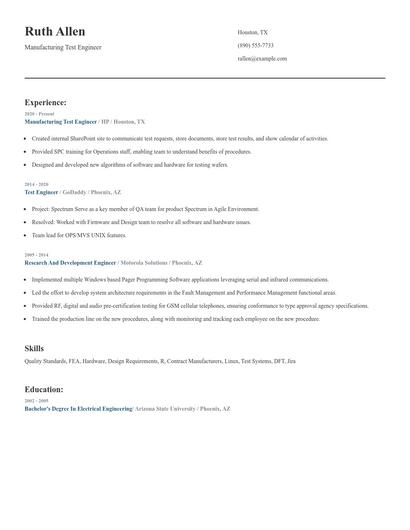
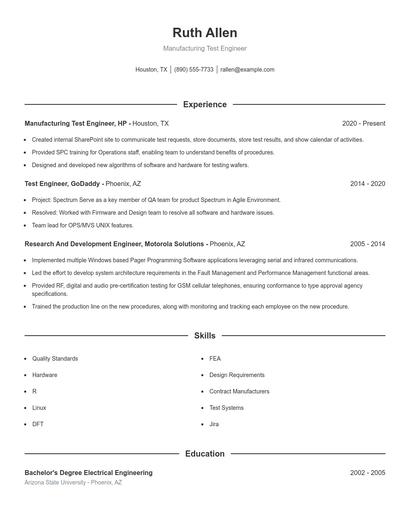
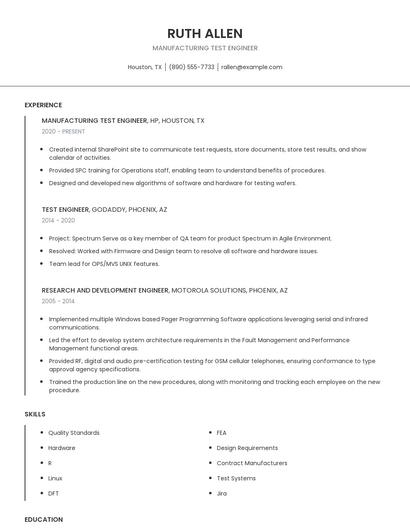
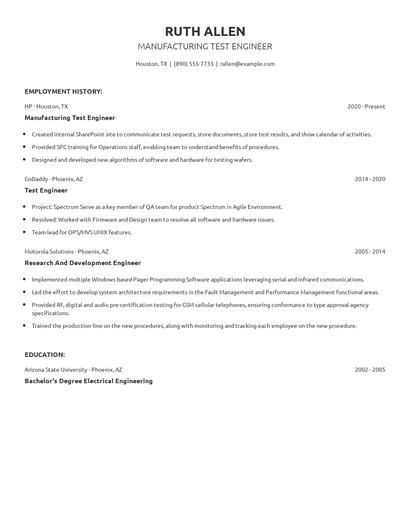
Choose from 10+ customizable manufacturing test engineer resume templates
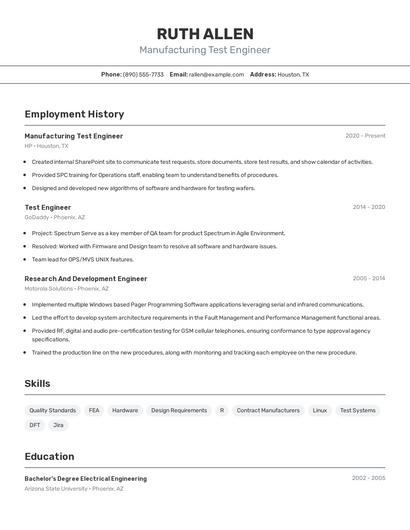
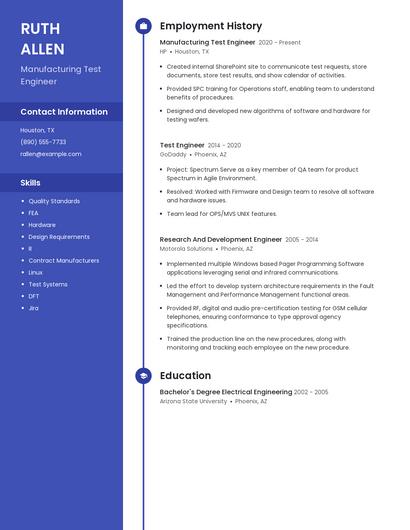
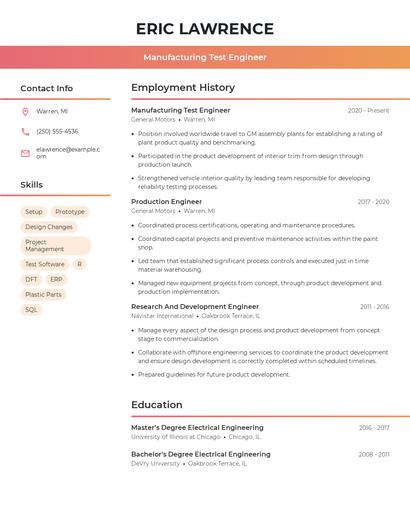
Build a professional manufacturing test engineer resume in minutes. Our AI resume writing assistant will guide you through every step of the process, and you can choose from 10+ resume templates to create your manufacturing test engineer resume.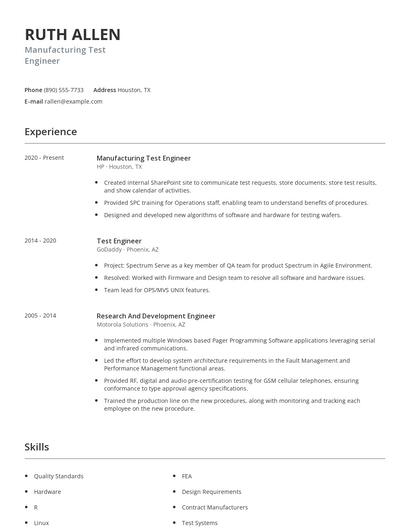
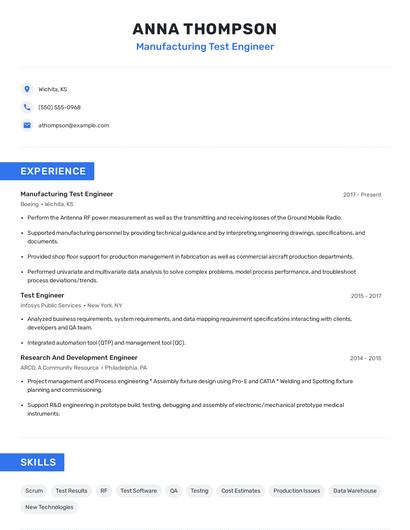
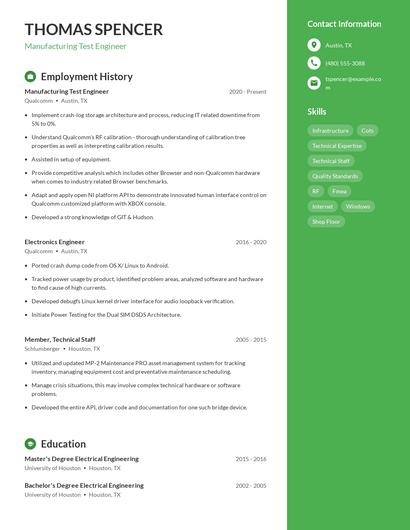
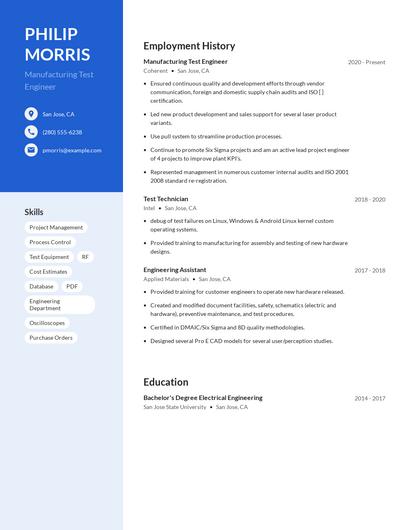
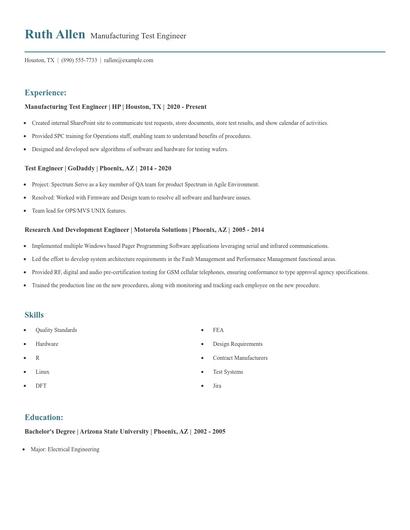
Compare different manufacturing test engineers
Manufacturing test engineer vs. Research and development engineer
Research and development engineers generally execute research and tests on product ideas, develop new products, and perform redesigns. They are employed in many industries, including manufacturing, electrical, and science-based companies. Their duties vary and depend on the industries they work in. Responsibilities of these engineers include developing new technologies, designing products, and managing the projects until they are completed. Additionally, they lead the project team members to manage their schedules, design the project plans, and collaborate with key departments in developing new products.
While similarities exist, there are also some differences between manufacturing test engineers and research and development engineer. For instance, manufacturing test engineer responsibilities require skills such as "troubleshoot," "test software," "test systems," and "continuous improvement." Whereas a research and development engineer is skilled in "python," "solidworks," "data analysis," and "patients." This is part of what separates the two careers.
Research and development engineers earn the highest salaries when working in the technology industry, with an average yearly salary of $107,654. On the other hand, manufacturing test engineers are paid more in the technology industry with an average salary of $95,561.The education levels that research and development engineers earn slightly differ from manufacturing test engineers. In particular, research and development engineers are 10.4% more likely to graduate with a Master's Degree than a manufacturing test engineer. Additionally, they're 3.9% more likely to earn a Doctoral Degree.Manufacturing test engineer vs. Engineer
Engineers are highly trained professionals who determine the feasibility of various projects, usually related to the construction industry. They are considered experts in mathematics and science, two disciplines that they need to use in designing and coming up with plans for projects. They should also be well-versed in different construction or industrial materials, and they ensure that appropriate materials are used for the project. They also ensure that the projects meet the requirements of the groups that hired them. They create spaces that would both address the needs of the end-users and the industry standards. They also ensure that the projects they make would stand the test of time.
Each career also uses different skills, according to real manufacturing test engineer resumes. While manufacturing test engineer responsibilities can utilize skills like "labview," "test fixtures," "test software," and "test systems," engineers use skills like "python," "cloud," "aws," and "java."
Engineers earn a lower average salary than manufacturing test engineers. But engineers earn the highest pay in the automotive industry, with an average salary of $97,672. Additionally, manufacturing test engineers earn the highest salaries in the technology with average pay of $95,561 annually.In general, engineers achieve similar levels of education than manufacturing test engineers. They're 4.8% more likely to obtain a Master's Degree while being 3.9% more likely to earn a Doctoral Degree.What technology do you think will become more important and prevalent for manufacturing test engineers in the next 3-5 years?
Jerry Leth
VP/General Manager, MANA
Manufacturing test engineer vs. Product development engineer
A Product Development Engineer is responsible for creating and testing new product designs. They collaborate with market researchers to evaluate market needs, existing competition, and potential costs.
The required skills of the two careers differ considerably. For example, manufacturing test engineers are more likely to have skills like "troubleshoot," "c #," "test software," and "test systems." But a product development engineer is more likely to have skills like "solidworks," "product development," "project management," and "data analysis."
Product development engineers earn the best pay in the technology industry, where they command an average salary of $86,062. Manufacturing test engineers earn the highest pay from the technology industry, with an average salary of $95,561.When it comes to education, product development engineers tend to earn higher degree levels compared to manufacturing test engineers. In fact, they're 7.5% more likely to earn a Master's Degree, and 1.6% more likely to graduate with a Doctoral Degree.Manufacturing test engineer vs. Project engineer
A Project Engineer develops the plan that the entire team or company will undertake. The project engineer develops the plans, strategies, and goals of a project and then gives it to the management for approval and allocation. The Project Engineer will also recommend material, equipment, and the type of personnel needed. This position is integral in the smooth flow of any project, so hiring someone to hold this position will decide the success of a project.
Types of manufacturing test engineer
Updated January 8, 2025
