What does a material controller do?
A material controller coordinates the movement of materials between departments. This position's duties include creating records of materials' movements in the company, negotiating with vendors, carrying out safety checks, and ensuring operations follow company and industry regulations. They must work in collaboration with other departments in the company to perform their duties effectively.
Material controller responsibilities
Here are examples of responsibilities from real material controller resumes:
- Manage and coordinate customer delivery commits between production, engineering and logistics.
- Assist to establish EDI with vendors.
- Perform cleaning duties, range from cleaning sales floor to cleaning windows.
- Provide training in SPC, wafer cleaning, final inspection and reactor operations.
- Enter data into RF scanner to load and manipulate data and to produce reports.
- Prepare and update weekly material report, material requirement planning (MRP) and end of life (EOL) report.
- Construct, prep processes, and seal windows, frames for various buildings along with loading and securing merchandise for shipment.
- Review MRP execution and ensures accuracy of information.
- Receive confidential FAA certifications and assure its accuracy.
- Compile data on standardization and interchangeability to expedite parts from warehouse.
- Establish and implement policies to standardize project wide logistics and material management processes.
- Receive EDI communications from internal trinary software, analyzing and resolving any discrepancies find.
- Process and categorize all classes of military aerospace parts according to their handling specifications.
- Create commercial invoices/packing lists, and communicate frequently with freight forwarders and export packers regarding service expectations.
- Work with the QA department to get product release for shipments.
Material controller skills and personality traits
We calculated that 12% of Material Controllers are proficient in Computer System, Purchase Orders, and Hazardous Materials. They’re also known for soft skills such as Customer-service skills, Detail oriented, and Math skills.
We break down the percentage of Material Controllers that have these skills listed on their resume here:
- Computer System, 12%
Record inventory via computer system to assure accuracy.
- Purchase Orders, 11%
Conducted Purchase Order Requisition Maintenance and assisted buyers with questions related to purchase activity in support of aircraft requirements.
- Hazardous Materials, 10%
Verify incoming parts for quantities, shortages and damages to include a multiple of hazardous materials also utilizing computers for research.
- FAA, 6%
Completed Engineer Order audits monthly to insure compliance with FAA.
- MSDS, 5%
Completed reports, wrote commodity descriptions, maintains MSDS and other environmental compliance records on materials.
- Inventory Control, 4%
Developed and implemented computerized inventory control system for permanent equipment shipped from the United States.
Common skills that a material controller uses to do their job include "computer system," "purchase orders," and "hazardous materials." You can find details on the most important material controller responsibilities below.
Customer-service skills. One of the key soft skills for a material controller to have is customer-service skills. You can see how this relates to what material controllers do because "material recording clerks may interact with customers in order to respond to problems or complaints." Additionally, a material controller resume shows how material controllers use customer-service skills: "read customer orders, work orders, shipping orders or requisitions to determine items to be moved. "
Detail oriented. Another essential skill to perform material controller duties is detail oriented. Material controllers responsibilities require that "material and product inspecting clerks must pay attention to detail when checking items for defects, some of which are small and difficult to spot." Material controllers also use detail oriented in their role according to a real resume snippet: "detailed matching purchasing orders.rma & warehouse organized and reported verified defective materials regularly. "
Math skills. This is an important skill for material controllers to perform their duties. For an example of how material controller responsibilities depend on this skill, consider that "material recording clerks may need to calculate shipping costs or take measurements." This excerpt from a resume also shows how vital it is to everyday roles and responsibilities of a material controller: "lift up to 35 lbs occasionally managed inventory for inventory accuracy using basic math. ".
Communication skills. For certain material controller responsibilities to be completed, the job requires competence in "communication skills." The day-to-day duties of a material controller rely on this skill, as "material recording clerks are frequently in contact with suppliers, vendors, or managers and need to convey their company’s needs effectively." For example, this snippet was taken directly from a resume about how this skill applies to what material controllers do: "job responsibilities include data entry, problem solving, interdepartmental communication, and use of organizational skills. "
The three companies that hire the most material controllers are:
- Stoughton Trailers50 material controllers jobs
- Northrop Grumman7 material controllers jobs
- Air Products4 material controllers jobs
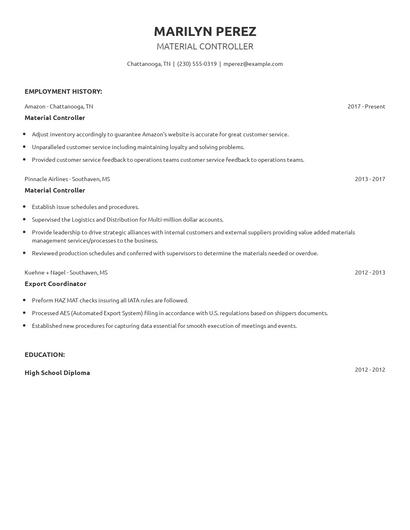
Choose from 10+ customizable material controller resume templates
Build a professional material controller resume in minutes. Our AI resume writing assistant will guide you through every step of the process, and you can choose from 10+ resume templates to create your material controller resume.


Compare different material controllers
Material controller vs. Expeditor
The role of expeditors is to ensure the timely and efficient preparation and delivery of food. To accomplish this task, they also perform other duties, including managing inventory levels, managing supply requisition, and coordinating with subcontractors. They are also responsible for streamlining interdepartmental communication, monitoring job progress, and collaborating with project managers to collect relevant information about job status. This role requires specific skills and qualifications, including a high school diploma or an associate degree in food service, business management, and hospitality management, relevant work experience, and certifications in CCP, CPSM, or CPPB.
While similarities exist, there are also some differences between material controllers and expeditor. For instance, material controller responsibilities require skills such as "hazardous materials," "faa," "msds," and "material control." Whereas a expeditor is skilled in "customer service," "cleanliness," "house training," and "team work." This is part of what separates the two careers.
Expeditors earn the highest salaries when working in the construction industry, with an average yearly salary of $46,040. On the other hand, material controllers are paid more in the energy industry with an average salary of $51,096.The education levels that expeditors earn slightly differ from material controllers. In particular, expeditors are 2.9% less likely to graduate with a Master's Degree than a material controller. Additionally, they're 0.1% more likely to earn a Doctoral Degree.Material controller vs. Production planner
Production planners or schedulers are employees who take charge of the timeliness and accuracy of the production process. The planners develop production schedules which detail the tasks that need to be done to meet the set completion date. They emphasize the goods and materials necessary in the production phase. It is their job to make sure that the working space is well-maintained for optimal performance. They also manage the flow of information during production.
While some skills are similar in these professions, other skills aren't so similar. For example, resumes show us that material controller responsibilities requires skills like "computer system," "hazardous materials," "faa," and "msds." But a production planner might use other skills in their typical duties, such as, "customer service," "continuous improvement," "on-time delivery," and "lean manufacturing."
On average, production planners earn a higher salary than material controllers. Some industries support higher salaries in each profession. Interestingly enough, production planners earn the most pay in the energy industry with an average salary of $64,353. Whereas material controllers have higher pay in the energy industry, with an average salary of $51,096.In general, production planners achieve similar levels of education than material controllers. They're 1.3% more likely to obtain a Master's Degree while being 0.1% more likely to earn a Doctoral Degree.Material controller vs. Project planner
A project planner is responsible for determining project management procedures according to business requirements and client specifications. Project planners schedule deliverables of outputs for every milestone to ensure that the team follows the track of guidelines, adhering to the company policies and project plans. They write status reports, conduct cost expenses analysis, and strategize techniques in maximizing the team's productivity and efficiency. A project planner also identifies opportunities to improve project workloads and adjust procedures as necessary to meet the highest goals and objectives.
There are many key differences between these two careers, including some of the skills required to perform responsibilities within each role. For example, a material controller is likely to be skilled in "computer system," "hazardous materials," "faa," and "msds," while a typical project planner is skilled in "project management," "project planning," "microsoft project," and "project scope."
Project planners make a very good living in the hospitality industry with an average annual salary of $87,022. On the other hand, material controllers are paid the highest salary in the energy industry, with average annual pay of $51,096.Most project planners achieve a higher degree level compared to material controllers. For example, they're 9.9% more likely to graduate with a Master's Degree, and 0.4% more likely to earn a Doctoral Degree.Material controller vs. Project scheduler
A project scheduler is responsible for organizing and managing project schedules, including meetings, appointments, and other related activities involved in the operational production. Project schedulers coordinate with clients and business partners to inform them of the schedule, respond to their inquiries and concerns, and take note of their availability, especially on cancellations and reschedules. They also perform administrative and clerical tasks as needed, such as writing meeting reports, updating clients' information on the database, operating the scheduling management system software, and evaluating progress reports and project deadlines.
Types of material controller
Updated January 8, 2025
