What does a model maker do?
A model maker is a specialist in creating three-dimensional scale models of product blueprints, drawings or CAD designs using materials such as wood or plastics. They should be able to accurately interpret and visualize preliminary designs and create models that are an accurate representation of the designs. Model makers are craftspeople who turn concepts into reality. Turning designs into three-dimensional pieces enables designers to better picture issues that need to be altered before production.
Model maker responsibilities
Here are examples of responsibilities from real model maker resumes:
- Draw out plans for test fixtures using Autocad.
- Develop and document operating procedures for CNC machines along with MasterCam CAD/CAM programming interface.
- Train in Mig, Tig, and stick welding.
- Improve system design with FEA and CFD.
- Programme and operate waterjet equipment and wire EDM.
- Spot weld assemblies using A/C and D/C welders.
- Used MasterCAM software for the manufacture of precision components.
- Build and assemble manufacturing fixtures for mig welding and spot welding.
- Design high end brass furniture trim and accessories, using AutoCAD.
- Employ the use of SolidWorks software to define tool paths for production fixtures.
- Order all shop expend materials on in house computer system (AS400).
- Build scale models from engineer drawings using aluminum, s.l.a., and composite materials.
- Read blueprints, calculate dimensions and tolerances using knowledge of mathematics and instruments such as micrometers and vernier calipers.
- Use of lathes, mills, drills, grinders and all shop equipment, including knowledge of safety procedures.
- Create machine parts from sketches and verbal instructions using vertical mills, lathes, grinders, and press brakes.
Model maker skills and personality traits
We calculated that 16% of Model Makers are proficient in CNC, Hand Tools, and Cad Cam. They’re also known for soft skills such as Computer skills, Dexterity, and Physical strength.
We break down the percentage of Model Makers that have these skills listed on their resume here:
- CNC, 16%
Created material recycling program that recycles waste CNC material and waste additive manufacturing material.
- Hand Tools, 7%
Designed and fabricated molds, models and machine accessories and modified hand tools used to cast metal and jewelry pieces.
- Cad Cam, 6%
Used Cad Cam system to draw and program.
- Calipers, 5%
Calculate dimensions and tolerances using knowledge of mathematics and instruments such as micrometers and vernier calipers.
- Model Shop, 5%
Re-organized model shop space and organizational systems.
- Grinders, 4%
Created machine parts from sketches and verbal instructions using vertical mills, lathes, grinders, and press brakes.
"cnc," "hand tools," and "cad cam" are among the most common skills that model makers use at work. You can find even more model maker responsibilities below, including:
Computer skills. To carry out their duties, the most important skill for a model maker to have is computer skills. Their role and responsibilities require that "metal and plastic machine workers must be able to use programmable devices, computers, and robots on the factory floor." Model makers often use computer skills in their day-to-day job, as shown by this real resume: "create new jewelry designs and modify existing designs, using computers as necessary. "
Physical strength. model makers are also known for physical strength, which are critical to their duties. You can see how this skill relates to model maker responsibilities, because "metal and plastic machine workers must be able to secure and tighten heavy fixtures into place." A model maker resume example shows how physical strength is used in the workplace: "assembled and maintained physical structures using hand tools and power tools. "
Mechanical skills. For certain model maker responsibilities to be completed, the job requires competence in "mechanical skills." The day-to-day duties of a model maker rely on this skill, as "these workers must be comfortable with machines and have a good understanding of how all the parts work." For example, this snippet was taken directly from a resume about how this skill applies to what model makers do: "cronstructed test fixtures for various mechanical components from verbal instructions and sketches. "
The three companies that hire the most model makers are:
- Mattel5 model makers jobs
- Crestron Electronics
4 model makers jobs
- S&C Electric4 model makers jobs
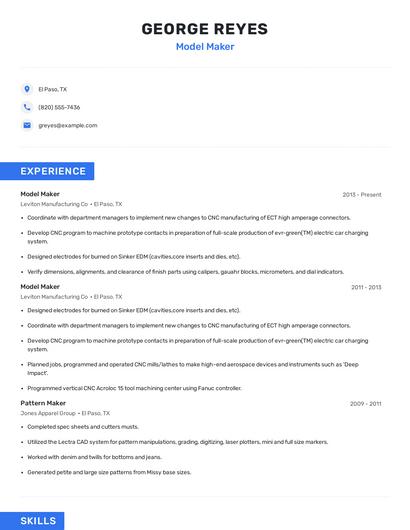
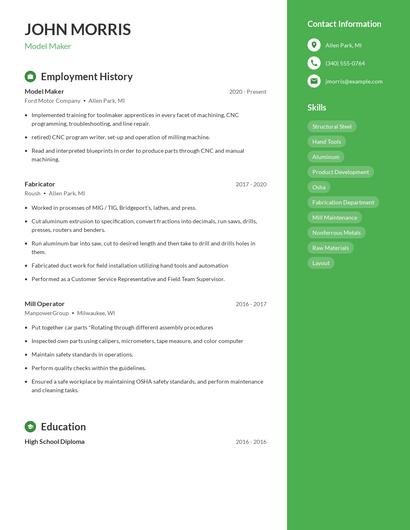
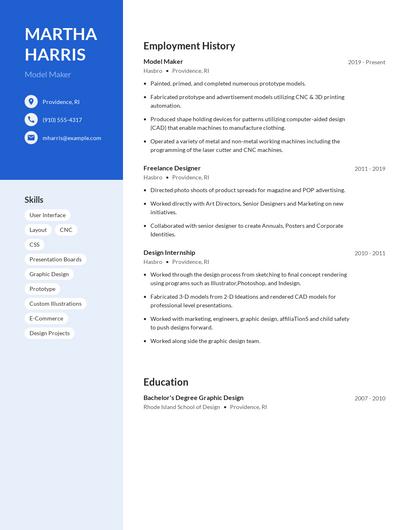
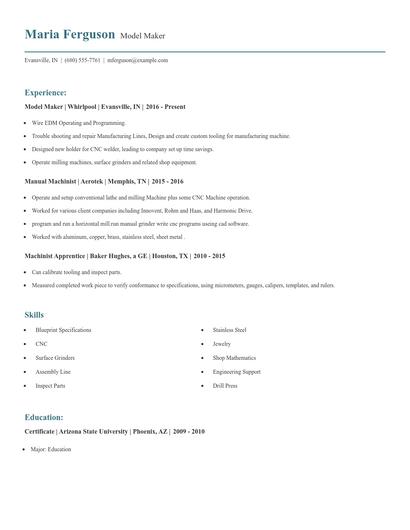
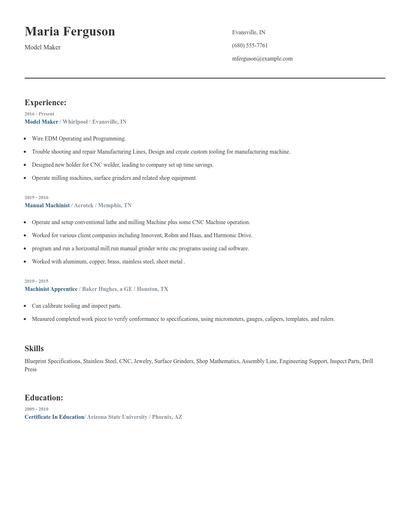
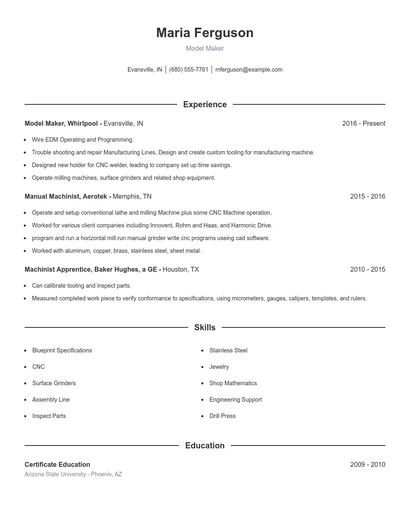
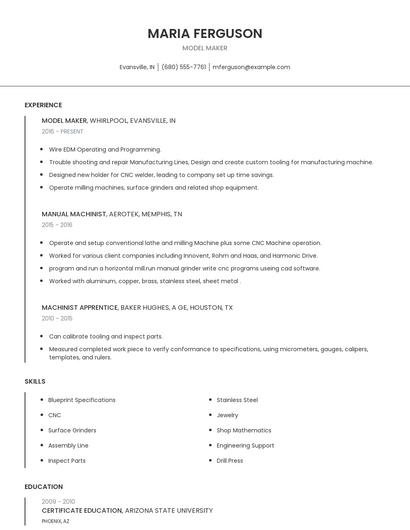
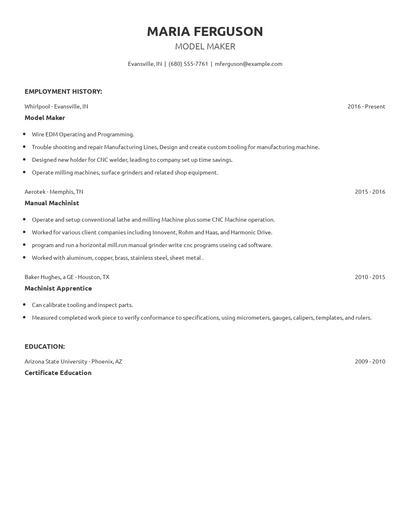
Choose from 10+ customizable model maker resume templates
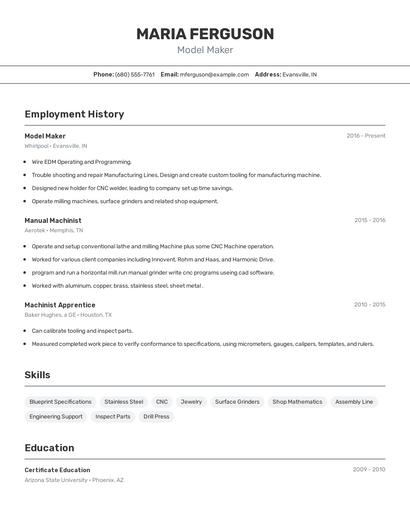
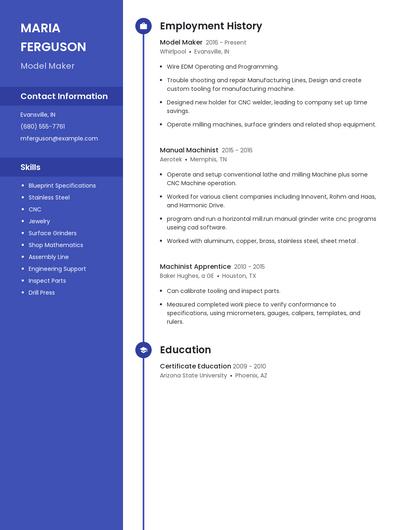
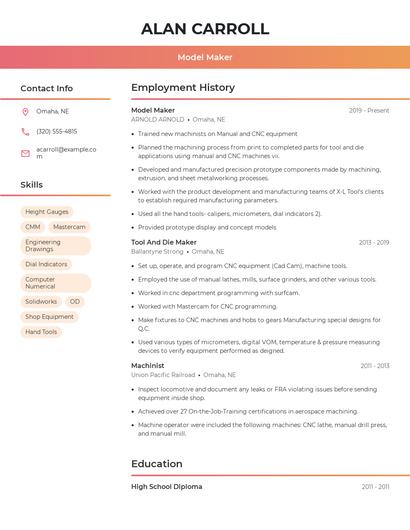
Build a professional model maker resume in minutes. Our AI resume writing assistant will guide you through every step of the process, and you can choose from 10+ resume templates to create your model maker resume.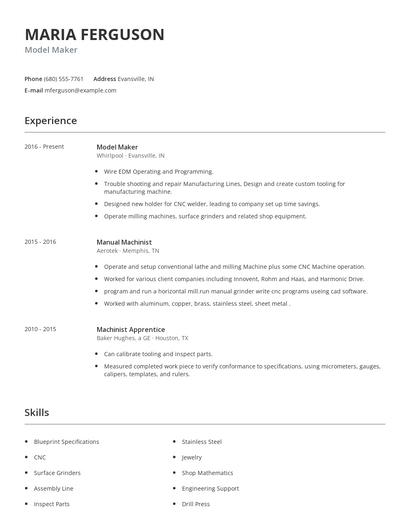
Compare different model makers
Model maker vs. Pattern finisher
While similarities exist, there are also some differences between model makers and pattern finisher. For instance, model maker responsibilities require skills such as "cnc," "cad cam," "calipers," and "model shop." Whereas a pattern finisher is skilled in "wax patterns," "quality standards," "coats," and "paint guns." This is part of what separates the two careers.
Pattern finishers tend to reach lower levels of education than model makers. In fact, pattern finishers are 6.0% less likely to graduate with a Master's Degree and 0.0% less likely to have a Doctoral Degree.Model maker vs. Fixture builder
While some skills are similar in these professions, other skills aren't so similar. For example, resumes show us that model maker responsibilities requires skills like "hand tools," "cad cam," "calipers," and "model shop." But a fixture builder might use other skills in their typical duties, such as, "build fixtures," "gauges," "blueprint specifications," and "gd."
Average education levels between the two professions vary. Fixture builders tend to reach similar levels of education than model makers. In fact, they're 4.6% less likely to graduate with a Master's Degree and 0.0% less likely to earn a Doctoral Degree.Model maker vs. Prototype special build
There are many key differences between these two careers, including some of the skills required to perform responsibilities within each role. For example, a model maker is likely to be skilled in "hand tools," "cad cam," "calipers," and "model shop," while a typical prototype special build is skilled in "cad," "chrysler," "electronic hand tools," and "eol."
Prototype special builds typically earn lower educational levels compared to model makers. Specifically, they're 6.0% less likely to graduate with a Master's Degree, and 0.0% less likely to earn a Doctoral Degree.Model maker vs. Model technician
Types of model maker
Updated January 8, 2025
