What does an operational risk analyst do?
An operational risk analyst is responsible for evaluating the company's operational processes and policies and identify procedures that pose risks for the business. Operational risk analysts strategize techniques to minimize financial loss and prevent operational hazards that may cause delays in operation and affect the quality of deliverables. They analyze incident reports and other underlying factors to improve services and develop opportunities that would bring more revenue resources and profits for the business. An operational risk analyst may also facilitate safety training and programs for employees to reiterate guidelines and regulations for compliance.
Operational risk analyst responsibilities
Here are examples of responsibilities from real operational risk analyst resumes:
- Manage and update SQL databases to solve technical problems.
- Manage treasury workstation steering team for automation of core treasury operations for increase reliability of financial reporting and decision making.
- Prepare SAR (suspicious activity reports) reports to cases.
- Apply knowledge of fixed-income securities to structure restrictions on exposure to risk.
- Review, document & investigate transactions to ensure rules set by BSA are followed.
- Perform reconciliations to improve efficiency and control of securities, commodities, and futures businesses.
- Conduct high risk entitlements quarterly audit on bank treasury products and work with affect companies on remediation requirements.
- Create processes and procedures, and create and write all SQL queries relate to the research that are performed.
- Track maker and checker summary of action and internal resources as reference documentation in line of business SharePoint site.
- Conduct complex data analysis using AML management tools and systems to detect patterns and trends consistent with money laundering activity.
- Perform QA testing of business unit processes (Sarbanes-Oxley compliance, disaster recovery protocols, corporate compliance, etc . )
- Test various SOX controls where subject matter experts are not available or segregation of duties exist between control owner and tester.
- Work 3rd shift (10PM - 8AM) with primary responsibilities for various system and sub-system updates/changes on the weekend maintenance windows
- Maintain compliance with Sarbanes-Oxley requirements.
- Assist investigators with obtaining information for SAR reports.
Operational risk analyst skills and personality traits
We calculated that 17% of Operational Risk Analysts are proficient in Risk Management, Operational Risk, and Risk Assessments. They’re also known for soft skills such as Writing skills, Math skills, and Interpersonal skills.
We break down the percentage of Operational Risk Analysts that have these skills listed on their resume here:
- Risk Management, 17%
Provide operational risk management coverage for Capital Markets, Investment Banking, Institutional Asset Management, and Enterprise Commercial Payments Division.
- Operational Risk, 15%
Provided education and support to internal and external risk areas to meet requirements of the operational risk framework and regulatory requirements.
- Risk Assessments, 8%
Represented the multifamily division on a working committee to develop guidance for business process risk assessments.
- Strong Analytical, 5%
Demonstrated strong analytical skills identifying areas of improvement in coding guidelines which helped increase and protect business unit assets.
- Internal Audit, 4%
Developed responses and benchmarks to regulatory and/or internal audit issues by working with internal customers and external auditors.
- Internal Controls, 4%
Assess adequacy of internal controls, documentation process and procedures intended to ensure compliant operations.
"risk management," "operational risk," and "risk assessments" are among the most common skills that operational risk analysts use at work. You can find even more operational risk analyst responsibilities below, including:
Math skills. Another soft skill that's essential for fulfilling operational risk analyst duties is math skills. The role rewards competence in this skill because "the models and methods used by operations research analysts are rooted in statistics, calculus, linear algebra, and other mathematics disciplines." According to an operational risk analyst resume, here's how operational risk analysts can utilize math skills in their job responsibilities: "utilized mathematical and statistical knowledge to assist with the building of risk/security models in support of operational risk management. "
Interpersonal skills. Another skill that relates to the job responsibilities of operational risk analysts is interpersonal skills. This skill is critical to many everyday operational risk analyst duties, as "operations research analysts typically work on teams." This example from a resume shows how this skill is used: "utilized excellent interpersonal skills and professionalism to forge productive business relationships. "
Problem-solving skills. For certain operational risk analyst responsibilities to be completed, the job requires competence in "problem-solving skills." The day-to-day duties of an operational risk analyst rely on this skill, as "operations research analysts need to be able to diagnose problems and study relevant information to solve them." For example, this snippet was taken directly from a resume about how this skill applies to what operational risk analysts do: "demonstrated excellent customer service via phone by assisting customers with the reporting and resolution of fraudulent transactions. "
Analytical skills. A commonly-found skill in operational risk analyst job descriptions, "analytical skills" is essential to what operational risk analysts do. Operational risk analyst responsibilities rely on this skill because "operations research analysts use a range of methods, including forecasting and data mining, to examine and interpret data." You can also see how operational risk analyst duties rely on analytical skills in this resume example: "researched and verified the parties involved in suspicious transactions against various databases, lexisnexis, ofac, world-check and internet searches. "
Communication skills. While "communication skills" is last on this skills list, don't underestimate its importance to operational risk analyst responsibilities. Much of what an operational risk analyst does relies on this skill, seeing as "operations research analysts write memos, reports, and other documents and often present their data and conclusions to managers and other executives." Here is a resume example of how this skill is used in the everyday duties of operational risk analysts: "conducted operational risk research and presented recommendations to senior management, leveraging strong analytical and communication skills. "
The three companies that hire the most operational risk analysts are:
- Citi75 operational risk analysts jobs
- USAA59 operational risk analysts jobs
- Navy Federal Credit Union14 operational risk analysts jobs
Choose from 10+ customizable operational risk analyst resume templates
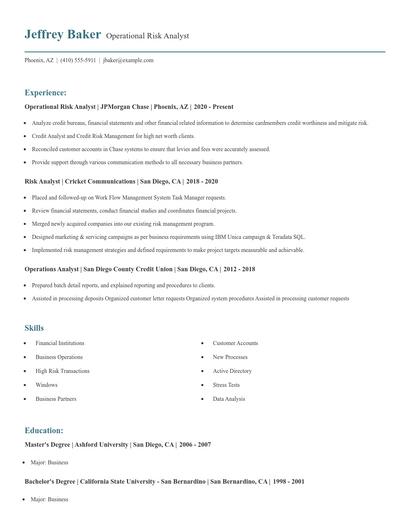
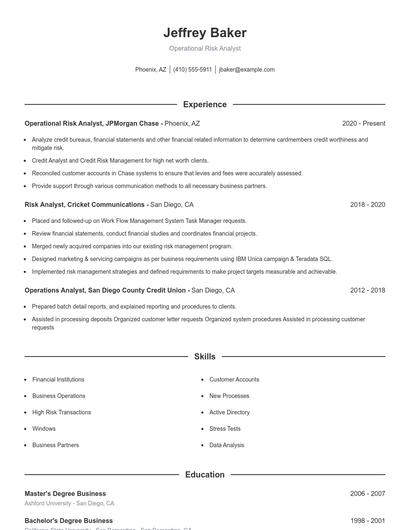
Build a professional operational risk analyst resume in minutes. Our AI resume writing assistant will guide you through every step of the process, and you can choose from 10+ resume templates to create your operational risk analyst resume.





Compare different operational risk analysts
Operational risk analyst vs. Method consultant
A graduate research associate is tasked with many responsibilities. Firstly, you may be required to monitor the progress of research projects and coordinate information between departmental sections. Secondly, depending on where you find a placement, you may be the one in charge of the laboratory. If so, you will perform a wide range of assays, tests, and studies. Your job may also involve the performance of advanced laboratory experiments. You may also collect, prepare, and analyze slides for tissue cultures.
While similarities exist, there are also some differences between operational risk analysts and method consultant. For instance, operational risk analyst responsibilities require skills such as "risk management," "operational risk," "risk assessments," and "strong analytical." Whereas a method consultant is skilled in "java," "mws," "interface design," and "sftp." This is part of what separates the two careers.
Method consultants earn the highest salaries when working in the professional industry, with an average yearly salary of $98,944. On the other hand, operational risk analysts are paid more in the automotive industry with an average salary of $81,102.On average, method consultants reach higher levels of education than operational risk analysts. Method consultants are 16.9% more likely to earn a Master's Degree and 0.2% more likely to graduate with a Doctoral Degree.Operational risk analyst vs. Graduate research associate
Analysts are employees or individual contributors with a vast experience in a particular field that help the organization address challenges. They help the organization improve processes, policies, and other operations protocol by studying the current processes in place and determining the effectiveness of those processes. They also research industry trends and data to make sound inferences and recommendations on what the company should do to improve their numbers. Analysts recommend business solutions and often help the organization roll out these solutions. They ensure that the proposed action plans are effective and produce the desired results.
While some skills are similar in these professions, other skills aren't so similar. For example, resumes show us that operational risk analyst responsibilities requires skills like "risk management," "operational risk," "risk assessments," and "strong analytical." But a graduate research associate might use other skills in their typical duties, such as, "r," "technical reports," "cell culture," and "research projects."
Average education levels between the two professions vary. Graduate research associates tend to reach higher levels of education than operational risk analysts. In fact, they're 11.9% more likely to graduate with a Master's Degree and 0.2% more likely to earn a Doctoral Degree.Operational risk analyst vs. Material liaison
Some important key differences between the two careers include a few of the skills necessary to fulfill the responsibilities of each. Some examples from operational risk analyst resumes include skills like "risk management," "operational risk," "risk assessments," and "strong analytical," whereas a material liaison is more likely to list skills in "logistics," "lean manufacturing," "inventory control," and "quality issues. "
Most material liaisons achieve a lower degree level compared to operational risk analysts. For example, they're 5.9% less likely to graduate with a Master's Degree, and 1.0% less likely to earn a Doctoral Degree.Operational risk analyst vs. Analyst
Types of operational risk analyst
Updated January 8, 2025
