What does a pathological technician do?
Pathology technicians, or sometimes referred to as pathology assistants, are professionals who assist pathologists review specimens and tissue samples by utilizing microscopes and other complex lab equipment. These technicians are required to audit lab equipment in the inventory system and provide minor maintenance and calibrations on the lab equipment to avoid errors in test results. They are required to evaluate laboratory test results and record known control values from technical instruments to ensure reliability. Pathological technicians must also handle and organize blood samples taken for pharmacological studies.
Pathological technician responsibilities
Here are examples of responsibilities from real pathological technician resumes:
- Recognize & investigate instrument malfunctions, perform calibrations, manage QC, and maintain comprehensive written records of tests & procedures.
- Perform manual IHC staining protocols or prepare slides send to remote lab for IHC staining.
- Cut tissue specimens using a microtome, mount and stain slides for examination.
- Assign patients to correct diagnosis-relate groups.
- Maintain and operate laboratory equipment and commendably troubleshoot and resolve an assortment of laboratory testing analyzers and perform diverse chemical tests.
- Emb and cut using manual and semi-automate microtomes.
- Implement PLC programming and troubleshooting procedures while also initiating and executing process improvements and conducting parts research when necessary.
Pathological technician skills and personality traits
We calculated that 12% of Pathological Technicians are proficient in Clinical Laboratory, Patients, and Specimen Handling. They’re also known for soft skills such as Customer-service skills, Detail oriented, and Dexterity.
We break down the percentage of Pathological Technicians that have these skills listed on their resume here:
- Clinical Laboratory, 12%
Assist with the collection and storage of hazardous waste from the clinical laboratory as needed.
- Patients, 11%
Provided assistance to physician, residents, and patients regarding specimens being submitted to Pathology.
- Specimen Handling, 9%
Follow laboratory technical procedures including specimen handling, analysis, quality control, and results reporting.
- Chemistry, 4%
Served as lead scientist in gene expression, hematology, and chemistry laboratories.
- Data Entry, 4%
Performed data entry of patient's demographics and billing information.
- Test Results, 4%
Provided Interpreting physician necessary documentation to dictate test results Submitted pertinent information to insurance providers for approval and reimbursement of procedures
"clinical laboratory," "patients," and "specimen handling" are among the most common skills that pathological technicians use at work. You can find even more pathological technician responsibilities below, including:
Customer-service skills. To carry out their duties, the most important skill for a pathological technician to have is customer-service skills. Their role and responsibilities require that "service technicians discuss automotive problems—along with options to fix them—with their customers." Pathological technicians often use customer-service skills in their day-to-day job, as shown by this real resume: "provide premier customer service to all orange park medical center patients, employees and vendors. "
Detail oriented. Many pathological technician duties rely on detail oriented. "service technicians must be aware of small details when inspecting or repairing vehicle systems, because mechanical and electronic malfunctions are often due to misalignments or other easy-to-miss causes.," so a pathological technician will need this skill often in their role. This resume example is just one of many ways pathological technician responsibilities rely on detail oriented: "provided detailed data entry of patient information and generated labels for specimens. "
Dexterity. This is an important skill for pathological technicians to perform their duties. For an example of how pathological technician responsibilities depend on this skill, consider that "service technicians perform many tasks that require steady hands and good hand–eye coordination, such as assembling or attaching components and subassemblies." This excerpt from a resume also shows how vital it is to everyday roles and responsibilities of a pathological technician: "inventory check lifting up to 50lbs proficient in powerpath system and well as epic. ".
Mechanical skills. A big part of what pathological technicians do relies on "mechanical skills." You can see how essential it is to pathological technician responsibilities because "service technicians must be familiar with engine components and systems and know how they interact with each other." Here's an example of how this skill is used from a resume that represents typical pathological technician tasks: "worked with 4 employees in data collection from mechanical, chemical, and hardness testing. "
Organizational skills. Another common skill required for pathological technician responsibilities is "organizational skills." This skill comes up in the duties of pathological technicians all the time, as "service technicians must keep workspaces clean and organized in order to maintain safety and ensure accountability of parts." An excerpt from a real pathological technician resume shows how this skill is central to what a pathological technician does: "formulate strategic plans, objectives, standard operating procedures (sops) and organizational plan to effectively utilize resources. "
Physical strength. Lastly, "physical strength" is an important element of what a pathological technician does. Pathological technician responsibilities require this skill because "service technicians must sometimes lift and maneuver heavy parts such as engines and body panels." This resume example highlights how pathological technician duties rely on this skill: "sampled incoming raw materials; test bulk and finished product - testing techniques included physical, wet chemistry and hplc"
The three companies that hire the most pathological technicians are:
- Northwell Health24 pathological technicians jobs
- Sanford Health12 pathological technicians jobs
- University of Washington10 pathological technicians jobs
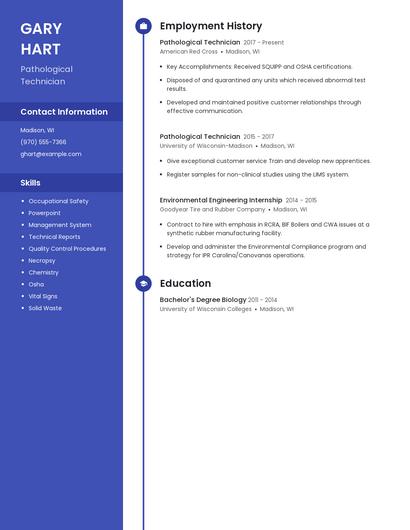
Choose from 10+ customizable pathological technician resume templates
Build a professional pathological technician resume in minutes. Our AI resume writing assistant will guide you through every step of the process, and you can choose from 10+ resume templates to create your pathological technician resume.



Compare different pathological technicians
Pathological technician vs. Laboratory aide
A laboratory aide is primarily responsible for maintaining the cleanliness and order in laboratories, all while performing support tasks for scientists. Their duties revolve around arranging specimens and samples, transporting materials from one laboratory to another, preparing apparatuses and machines, and storing them accordingly. A laboratory aide may also run errands, produce progress reports, sanitize areas and instruments, and properly dispose of chemicals and other hazardous waste. Furthermore, it is crucial to implement the laboratory's safety policies and regulations, ensuring a safe and healthy laboratory environment for everyone.
While similarities exist, there are also some differences between pathological technicians and laboratory aide. For instance, pathological technician responsibilities require skills such as "clinical laboratory," "chemistry," "biological samples," and "lis." Whereas a laboratory aide is skilled in "phlebotomy," "blood specimens," "patient care," and "hematology." This is part of what separates the two careers.
Laboratory aides earn the highest salaries when working in the technology industry, with an average yearly salary of $31,856. On the other hand, pathological technicians are paid more in the health care industry with an average salary of $53,058.laboratory aides tend to reach similar levels of education than pathological technicians. In fact, laboratory aides are 1.1% less likely to graduate with a Master's Degree and 1.9% less likely to have a Doctoral Degree.Pathological technician vs. Laboratory coordinator
A laboratory coordinator is responsible for supporting laboratory examinations and experiments, collecting laboratory samples, and ensuring the efficiency and performance of laboratory tools and equipment. Laboratory coordinators maintain the cleanliness and orderliness of the laboratory facility at all times to avoid contaminations and hazards that may affect laboratory results and accuracy of examinations. They also perform scientific processes under the supervision of a scientist or laboratory technicians and keep an organized report of findings in the database.
Each career also uses different skills, according to real pathological technician resumes. While pathological technician responsibilities can utilize skills like "clinical laboratory," "biological samples," "surgical pathology," and "frozen sections," laboratory coordinators use skills like "patient care," "laboratory safety," "clia," and "lab procedures."
On average, laboratory coordinators earn a higher salary than pathological technicians. Some industries support higher salaries in each profession. Interestingly enough, laboratory coordinators earn the most pay in the pharmaceutical industry with an average salary of $57,789. Whereas pathological technicians have higher pay in the health care industry, with an average salary of $53,058.laboratory coordinators earn higher levels of education than pathological technicians in general. They're 11.1% more likely to graduate with a Master's Degree and 1.9% more likely to earn a Doctoral Degree.Pathological technician vs. Laboratory assistant
Laboratory assistants work for researchers, scientists, or professors in the laboratory setting. They are expected to have a solid background in the field of study of the laboratory they are assigned to. They do a variety of tasks in the laboratory, such as setting up equipment, observing experiments, analyzing results, creating reports, and recommending improvements to the testing. They may also be assigned to clean and sanitize laboratory equipment as needed. Laboratory assistants should have good research skills, analytical skills, and organizational skills.
There are many key differences between these two careers, including some of the skills required to perform responsibilities within each role. For example, a pathological technician is likely to be skilled in "clinical laboratory," "chemistry," "biological samples," and "lis," while a typical laboratory assistant is skilled in "phlebotomy," "customer service," "lab procedures," and "specimen collection."
Laboratory assistants earn the highest salary when working in the manufacturing industry, where they receive an average salary of $35,997. Comparatively, pathological technicians have the highest earning potential in the health care industry, with an average salary of $53,058.Most laboratory assistants achieve a similar degree level compared to pathological technicians. For example, they're 1.5% more likely to graduate with a Master's Degree, and 1.4% more likely to earn a Doctoral Degree.Pathological technician vs. Laboratory associate
A laboratory associate's responsibilities revolve around preparing test samples and subjecting them into different examination processes for scientific purposes. Aside from performing extensive analysis, they are also responsible for recording data, reviewing findings, collaborating with other scientists, and producing various reports and presentations. A laboratory associate can work for an institution or private company; they may also choose to contribute their studies in different publications and research activities. Furthermore, as a laboratory practitioner, it is essential to adhere to all the laboratory safety policies and regulations, ensuring a safe and healthy work environment.
Even though a few skill sets overlap between pathological technicians and laboratory associates, there are some differences that are important to note. For one, a pathological technician might have more use for skills like "clinical laboratory," "lab equipment," "biological samples," and "lis." Meanwhile, some responsibilities of laboratory associates require skills like "phlebotomy," "customer service," "patient care," and "specimen collection. "
The pharmaceutical industry tends to pay the highest salaries for laboratory associates, with average annual pay of $43,992. Comparatively, the highest pathological technician annual salary comes from the health care industry.In general, laboratory associates hold similar degree levels compared to pathological technicians. Laboratory associates are 3.0% more likely to earn their Master's Degree and 1.2% less likely to graduate with a Doctoral Degree.Types of pathological technician
Updated January 8, 2025
