What does a pneudraulic systems mechanic do?
Pneudraulic systems mechanic responsibilities
Here are examples of responsibilities from real pneudraulic systems mechanic resumes:
- Manage aerospace propulsion functions and activities.
- Work in there fleet department repairing and diagnosis on all emergency apparatuses and ambulances and police vehicles also include maintenance schedules.
- Perform complete disassembly and assembly of the T56-A-14 engine's power section, propeller reduction gearbox, and accessories
Pneudraulic systems mechanic skills and personality traits
We calculated that 21% of Pneudraulic Systems Mechanics are proficient in Hand Tools, Technical Manuals, and Test Equipment. They’re also known for soft skills such as Detail oriented, Dexterity, and Customer-service skills.
We break down the percentage of Pneudraulic Systems Mechanics that have these skills listed on their resume here:
- Hand Tools, 21%
Experienced using hand tools and test equipment.
- Technical Manuals, 11%
Utilize and interpreting technical manuals, quality/ work procedures, engineering drawings and other technical references.
- Test Equipment, 10%
Trained personnel, utilizing test equipment and technical publications.
- Troubleshoot, 9%
Performed various tasks necessary to overhaul, troubleshoot, and repair A-7, T29, and C131 aircraft.
- Mechanical Principles, 8%
Have extensive knowledge of pneumatic, hydraulic, and basic electrical and mechanical principles.
- Technical Publications, 4%
Performed maintenance research and data analysis utilizing various Air Force Technical Publications, contractor supplied data.
"hand tools," "technical manuals," and "test equipment" are among the most common skills that pneudraulic systems mechanics use at work. You can find even more pneudraulic systems mechanic responsibilities below, including:
Detail oriented. To carry out their duties, the most important skill for a pneudraulic systems mechanic to have is detail oriented. Their role and responsibilities require that "mechanics and technicians need to adjust airplane parts to exact specifications." Pneudraulic systems mechanics often use detail oriented in their day-to-day job, as shown by this real resume: "exhibited attention to detail in pre-maintenance inspections, closing day duties, and day-to-day safety practices. "
Dexterity. Many pneudraulic systems mechanic duties rely on dexterity. "mechanics and technicians need to coordinate the movement of their fingers and hands in order to grasp, manipulate, or assemble parts.," so a pneudraulic systems mechanic will need this skill often in their role. This resume example is just one of many ways pneudraulic systems mechanic responsibilities rely on dexterity: "operated wide variety of equipment including cranes, forklift and basic hand tools. "
The three companies that hire the most pneudraulic systems mechanics are:
- Butler America Inc
1 pneudraulic systems mechanics jobs
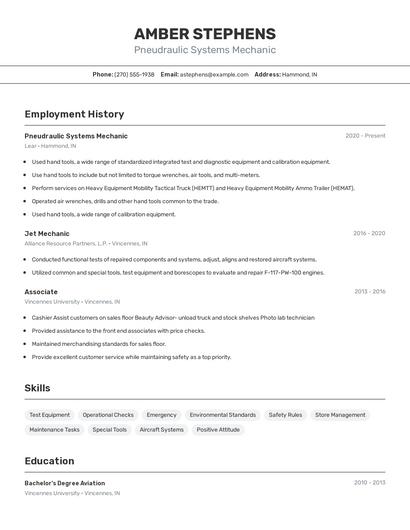
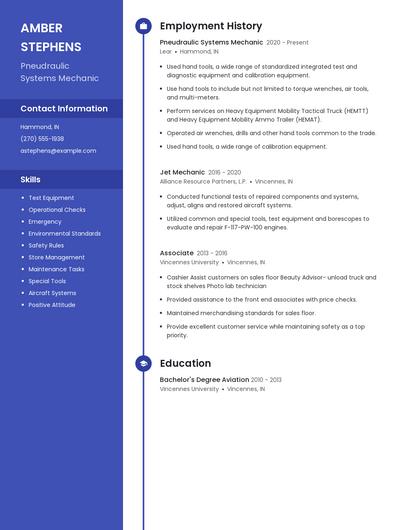
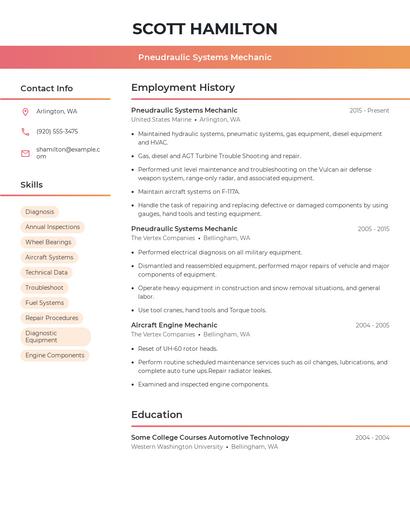
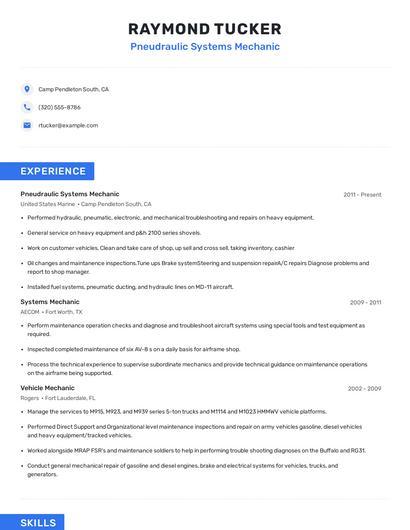
Choose from 10+ customizable pneudraulic systems mechanic resume templates
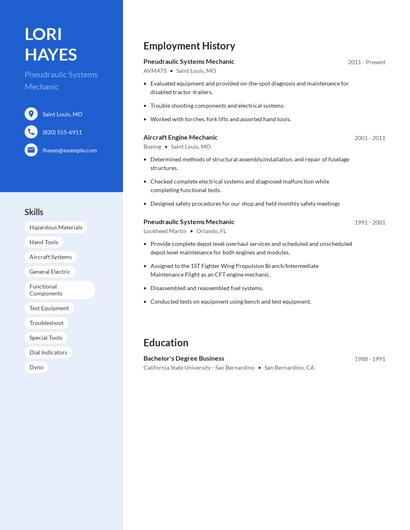
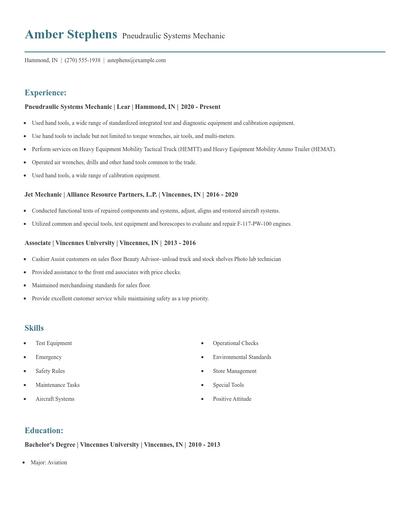
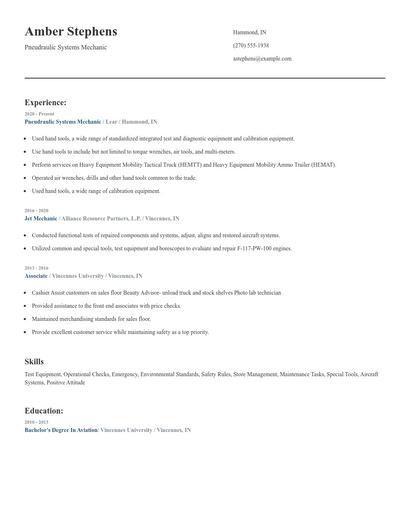
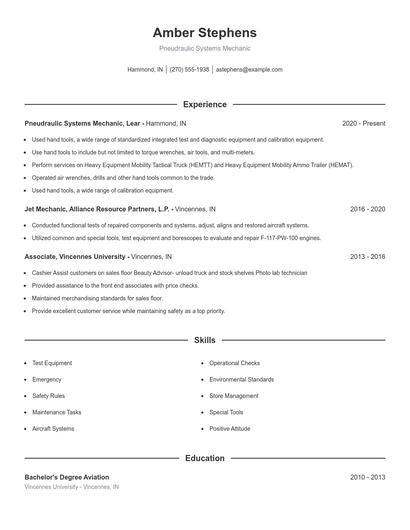
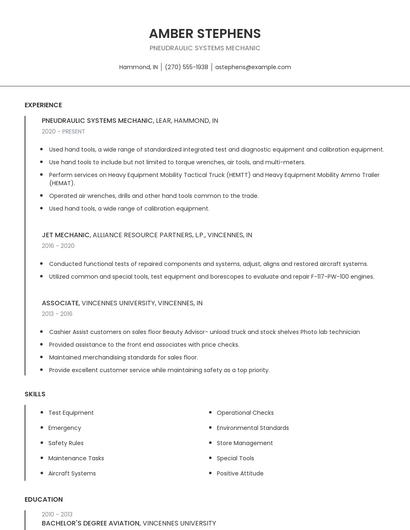
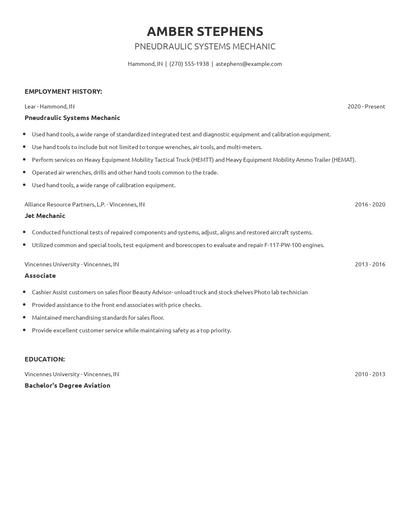
Build a professional pneudraulic systems mechanic resume in minutes. Our AI resume writing assistant will guide you through every step of the process, and you can choose from 10+ resume templates to create your pneudraulic systems mechanic resume.

Compare different pneudraulic systems mechanics
Pneudraulic systems mechanic vs. Aircraft fueler
Aircraft fuelers' primary role is to ensure the proper refueling of aircraft before and after a flight. The position is essential, as proper refueling determines the safety of an aircraft. An aircraft fueler manages refueling equipment, transports fuel, and ensures adherence to safety protocols. They are also responsible for monitoring the functionality of all equipment and ordering repairs. This position requires a high level of safety-consciousness.
These skill sets are where the common ground ends though. The responsibilities of a pneudraulic systems mechanic are more likely to require skills like "hand tools," "technical manuals," "test equipment," and "mechanical principles." On the other hand, a job as an aircraft fueler requires skills like "basic math," "commercial vehicles," "aircraft weight," and "safety procedures." As you can see, what employees do in each career varies considerably.
Aircraft fuelers tend to make the most money working in the transportation industry, where they earn an average salary of $33,369. In contrast, pneudraulic systems mechanics make the biggest average salary, $61,155, in the government industry.aircraft fuelers tend to reach lower levels of education than pneudraulic systems mechanics. In fact, aircraft fuelers are 7.7% less likely to graduate with a Master's Degree and 0.0% less likely to have a Doctoral Degree.Pneudraulic systems mechanic vs. Aircraft electrician
An aircraft electrician specializes in installing and repairing electrical systems in an aircraft, ensuring quality and efficiency. Their responsibilities typically include running diagnostic tests and examinations, troubleshooting problems, replacing and fixing components, understanding diagrams, and keeping records. There are also instances where they must solder wires, climb up high places, and perform regular maintenance checks. Moreover, an aircraft electrician typically works in a team setting, which requires an active communication line for an efficient and safe workflow.
In addition to the difference in salary, there are some other key differences worth noting. For example, pneudraulic systems mechanic responsibilities are more likely to require skills like "mechanical principles," "relief valves," "safety practices," and "safety rules." Meanwhile, an aircraft electrician has duties that require skills in areas such as "electrical systems," "diagnose malfunctions," "switchboards," and "electrical components." These differences highlight just how different the day-to-day in each role looks.
Aircraft electricians earn a lower average salary than pneudraulic systems mechanics. But aircraft electricians earn the highest pay in the manufacturing industry, with an average salary of $63,434. Additionally, pneudraulic systems mechanics earn the highest salaries in the government with average pay of $61,155 annually.Average education levels between the two professions vary. Aircraft electricians tend to reach similar levels of education than pneudraulic systems mechanics. In fact, they're 4.3% less likely to graduate with a Master's Degree and 0.0% less likely to earn a Doctoral Degree.Pneudraulic systems mechanic vs. Power plant technician
Power plant technicians, paid at an average of $790K per year, must have skills in concentration, dexterity, mechanics, and problem-solving. They will need a high school diploma or GED at the very least, though some employers do prefer a college or vocational school degree, as well as strong math and science backgrounds. Those who choose this career will be called on to controlling and monitoring -power plant equipment, like boilers, turbines, and generators.
There are many key differences between these two careers, including some of the skills required to perform responsibilities within each role. For example, a pneudraulic systems mechanic is likely to be skilled in "hand tools," "technical manuals," "troubleshoot," and "mechanical principles," while a typical power plant technician is skilled in "plant equipment," "preventive maintenance," "electrical equipment," and "safety procedures."
Power plant technicians typically earn similar educational levels compared to pneudraulic systems mechanics. Specifically, they're 4.4% less likely to graduate with a Master's Degree, and 0.5% less likely to earn a Doctoral Degree.Pneudraulic systems mechanic vs. Structures technician
Structures technicians design buildings or monuments. They plan construction, select materials, and create models. They must investigate the properties of possible materials, including steel, concrete, cement, and brick.
Types of pneudraulic systems mechanic
Updated January 8, 2025
