What does a postdoc do?
Postdoc responsibilities
Here are examples of responsibilities from real postdoc resumes:
- Collaborate with software engineers to automate identification of 15N- and 13C- labele LC-MS features.
- Succeed in the synthesis and encapsulation of the reactive nanoparticles.
- Develop the nonlinear spectroscopy scattering method to study the surface chemistry on soot particle.
- Determine the effects of herpes viruses upon cellular cancer pathways using, immunology, cell biology, and virology techniques.
- Conduct the synthesis and characterization of poly (N-isopropyl acrylamide) /polystyrene (PNIPAM/PS) hybrid nanoparticles with a core-shell structure.
- Developed/Optimize HPLC and FPLC purification methods for monoclonal and polyclonal antibody.
- Develop a structural determination software StructOpt using python and parallel programming for materials design.
- Participate in a nuclear reactor visualization simulator project which incorporate passive safety features to prevent meltdown of nuclear reactor.
- Perform expression profiling on primary promyelocyte samples and identify candidate genes that may be involve in SCN pathogenesis and malignant transformation.
- Perform ELISAs and capture ELISAs for quantification of endotoxins.
- Used SAS to analyze database, to obtain effective statistical results for further references.
- Work on a meta-optimization project for a notional many-body space situational awareness (SAS) problem.
- Performedadvance statistical modeling and regression analyses to test and validate novel methodologies.
Postdoc skills and personality traits
We calculated that 22% of Postdocs are proficient in Python, C++, and Data Analysis.
We break down the percentage of Postdocs that have these skills listed on their resume here:
- Python, 22%
Implemented a Python version of the deep neural network algorithm that runs on a CUDA-capable GPU for processing multi-modal speech data.
- C++, 16%
Developed C++ programs for simulating superconducting tunnel junctions and extracting physical parameters from its tunneling spectrum.
- Data Analysis, 14%
Train and supervise undergraduate students in study design, assay development and validation, experiments, and data analysis and interpretation.
- Mathematics, 13%
Studied the application of wavelet methods in numerical analysis and financial mathematics.
- Synthesis, 5%
Advised by Dr. Kenner Rice, who patented the process for the total synthesis of morphine.
- Fortran, 5%
Programed in Fortran to simulate models, diagnose problems and examine results.
"python," "c++," and "data analysis" are among the most common skills that postdocs use at work. You can find even more postdoc responsibilities below, including:
Communication skills. One of the key soft skills for a postdoc to have is communication skills. You can see how this relates to what postdocs do because "medical scientists must be able to explain their research in nontechnical ways." Additionally, a postdoc resume shows how postdocs use communication skills: "demonstrated clear written and oral communications skills when working with health care professionals, patients and caregivers. "
Observation skills. Another soft skill that's essential for fulfilling postdoc duties is observation skills. The role rewards competence in this skill because "medical scientists conduct experiments that require monitoring samples and other health-related data." According to a postdoc resume, here's how postdocs can utilize observation skills in their job responsibilities: "used monte carlo methods to simulate astronomical observations and to aid statistical analysis. "
The three companies that hire the most postdocs are:
- Los Alamos National Laboratory44 postdocs jobs
- Jet Propulsion Laboratory14 postdocs jobs
- Brookhaven National Laboratory3 postdocs jobs
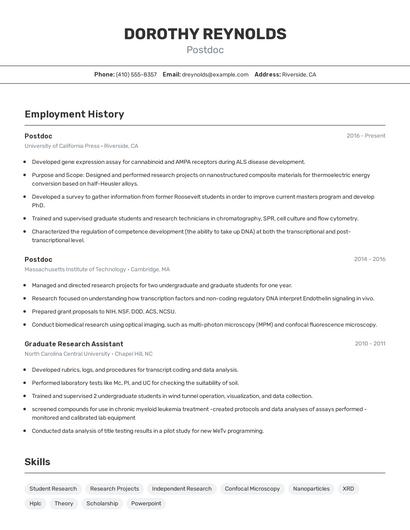
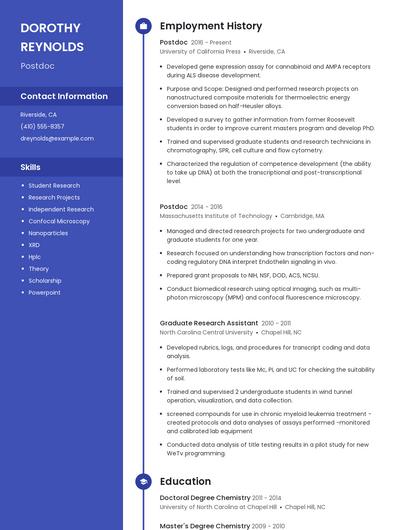
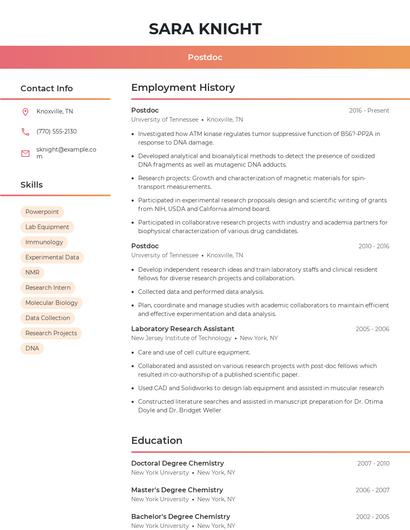
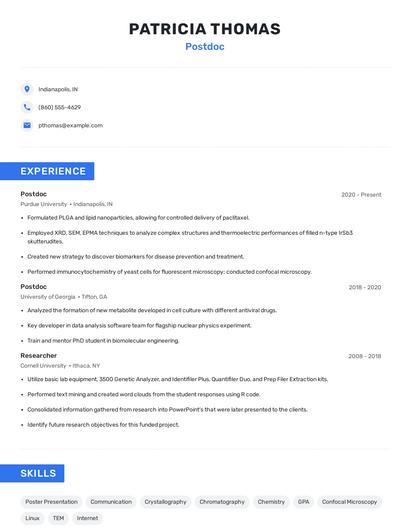
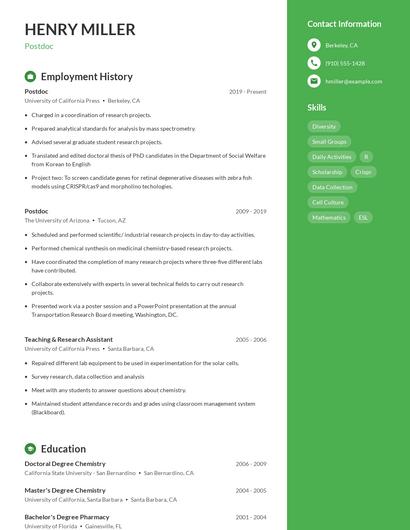
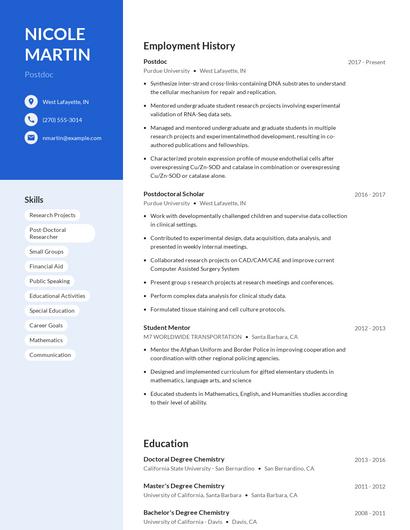
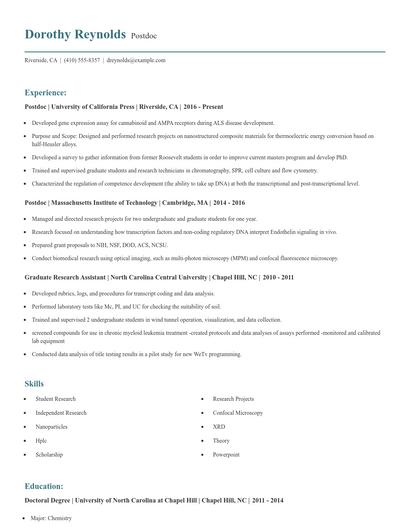
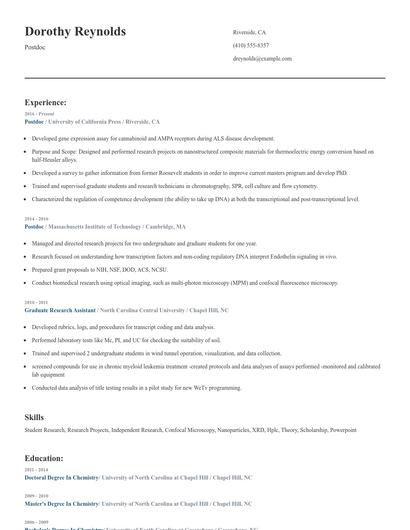
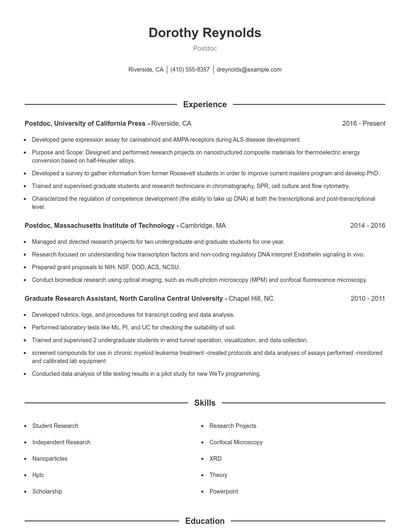
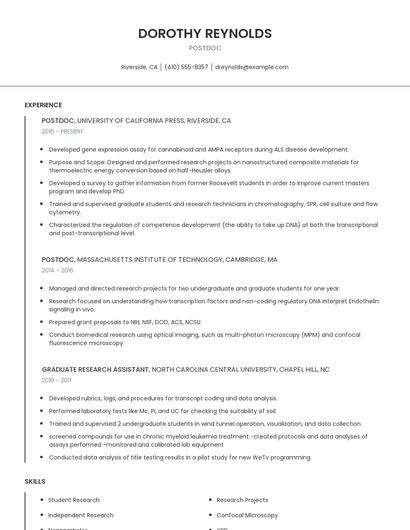
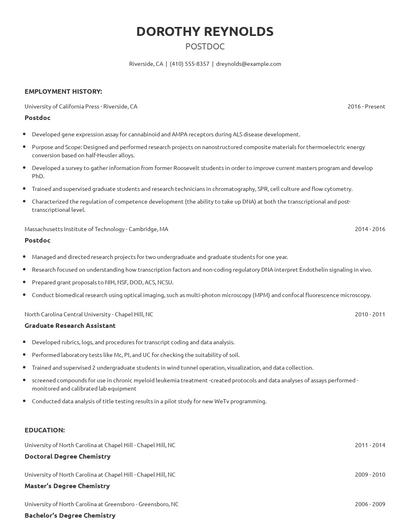
Choose from 10+ customizable postdoc resume templates
Build a professional postdoc resume in minutes. Our AI resume writing assistant will guide you through every step of the process, and you can choose from 10+ resume templates to create your postdoc resume.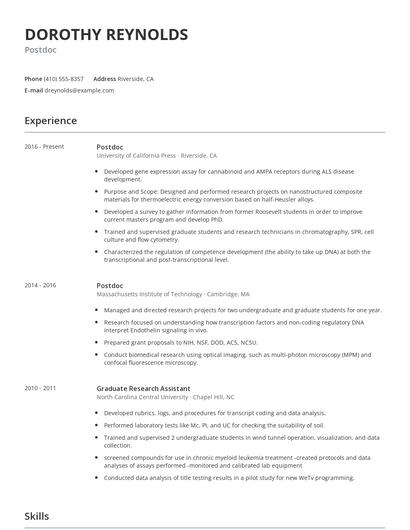
Compare different postdocs
Postdoc vs. Medical science liaison
A medical science liaison (MSL) is a scientific professional who facilitates a working relationship between healthcare companies and leading physicians, researchers, and clinicians. Also referred to as key opinion leaders (KOL), medical science liaisons represent their company to the decision-makers in the medical community as well as to investors and government regulatory agencies. They analyze clinical trends and monitor the scientific literature for new developments in the medical community. Medical science liaisons also prepare medical samples and data to investigate the causes of chronic diseases, pathogens, and toxicity.
There are some key differences in the responsibilities of each position. For example, postdoc responsibilities require skills like "python," "c++," "data analysis," and "mathematics." Meanwhile a typical medical science liaison has skills in areas such as "patients," "medical affairs," "msl," and "medical science." This difference in skills reveals the differences in what each career does.
Medical science liaisons earn the highest salaries when working in the manufacturing industry, with an average yearly salary of $152,658. On the other hand, postdocs are paid more in the technology industry with an average salary of $74,207.medical science liaisons tend to reach similar levels of education than postdocs. In fact, medical science liaisons are 0.5% less likely to graduate with a Master's Degree and 47.2% less likely to have a Doctoral Degree.Postdoc vs. Research fellow
A research fellow is an academic researcher who conducts research and analysis of comprehensive literature, data, and results and provides literature reviews. He/She supervises research assistants and recruits study participants to interview them for a particular study. To become a research fellow, a candidate should have a doctorate in a relevant discipline and publish peer-reviewed papers. Also, a research fellow can be an independent investigator or be supervised by a principal investigator.
Each career also uses different skills, according to real postdoc resumes. While postdoc responsibilities can utilize skills like "mathematics," "fortran," "labview," and "biochemistry," research fellows use skills like "patients," "crispr," "cell biology," and "rna."
On average, research fellows earn a lower salary than postdocs. Some industries support higher salaries in each profession. Interestingly enough, research fellows earn the most pay in the non profits industry with an average salary of $57,261. Whereas postdocs have higher pay in the technology industry, with an average salary of $74,207.Average education levels between the two professions vary. Research fellows tend to reach higher levels of education than postdocs. In fact, they're 6.3% more likely to graduate with a Master's Degree and 47.2% less likely to earn a Doctoral Degree.Postdoc vs. Research and development scientist
A research and development scientist specializes in conducting scientific studies and experiments to develop new products and technologies. They usually work at laboratories where they are in charge of conducting research and assessments, coming up with new ideas, performing tests, streamlining product requirements and guidelines, collaborating with fellow experts, utilizing previous studies and advanced software, and maintaining records of all procedures. Additionally, as a research and development scientist, it is essential to conduct reviews and assessments to ensure products adhere to safety standards and regulations.
There are many key differences between these two careers, including some of the skills required to perform responsibilities within each role. For example, a postdoc is likely to be skilled in "mathematics," "fortran," "labview," and "biochemistry," while a typical research and development scientist is skilled in "patients," "technical support," "c #," and "product development."
Research and development scientists earn the best pay in the health care industry, where they command an average salary of $91,180. Postdocs earn the highest pay from the technology industry, with an average salary of $74,207.research and development scientists typically earn similar educational levels compared to postdocs. Specifically, they're 4.7% more likely to graduate with a Master's Degree, and 55.5% more likely to earn a Doctoral Degree.Postdoc vs. Fellow
A fellow's responsibility will depend on the organization or industry where one belongs. However, most of the time, a fellow's duty will revolve around conducting research and analysis, presiding discussions and attending dialogues, handle lectures while complying with the guidelines or tasks set by supervisors, and assist in various projects and activities. Furthermore, a fellow must adhere to the institution or organization's policies and regulations at all times, meet all the requirements and outputs involved, and coordinate with every person in the workforce.
Types of postdoc
Updated January 8, 2025
