What does a principal technologist do?
A principal technologist is responsible for developing and delivering innovative solutions and providing contributions technically to various projects. Your duties will include providing assistance in improving the chemical supply chain that will benefit key product units (KPU), managing and creating user accounts, directory access, and server permissions, and managing the in-house services related to the internet. In addition, you will train and educate customers on how to use certain software and hardware as requested and performing development and architecture for database, software, and infrastructure.
Principal technologist responsibilities
Here are examples of responsibilities from real principal technologist resumes:
- Manage the Tru64 UNIX 5.1b, Solaris 2.6, and Solaris 2.8 servers.
- Manage client lease information and generate reports using SQL and PHP.
- Manage the daily scrum planning meetings and sprint meetings for scrum teams.
- Develop checklists management system, to get rid of innumerable Xls files and automate work of QA departments.
- Lead system conversion/transition to PACS; research, negotiate, and seamlessly implement dual server Philips EasyAccess system.
- Lead team for first-office deployments of optical access and backhaul systems for Ethernet and IP services, enhancing service offerings.
- Perform radiography, mammography, special procedures and ultrasound.
- Provide cloud architecture continuous monitoring security designs and system security plan support.
- Institute first diagnostic ultrasound department including computer system for calculating prenatal measurements.
- Perform architecture and development for software, database, third-party integration, internationalization and infrastructure.
- Used a small bit of Linux operating system.
- Qualify the rotating equipment with API and NEMA standards.
- Cloud base storage services, email, and backup for WinTel platform.
- Use ENDEVOR/Changeman to move code to and from production and QA regions.
- Work with a project team to build JAVA classes for a back-end server.
Principal technologist skills and personality traits
We calculated that 10% of Principal Technologists are proficient in Java, Cloud, and Infrastructure. They’re also known for soft skills such as Business skills, Organizational skills, and Analytical skills.
We break down the percentage of Principal Technologists that have these skills listed on their resume here:
- Java, 10%
Collaborated with HP R&D to deploy several specialized RUM patches to monitor thick Java client applications.
- Cloud, 7%
Provided cloud architecture continuous monitoring security designs and system security plan support.
- Infrastructure, 6%
Worked with infrastructure support personnel and business units to ensure multiple database technologies were patched to current supported levels.
- Architecture, 6%
Defined new tool functionality for architecture development, worked with developers to implement then delivered beta code to lead customers.
- Project Management, 5%
Provided technical guidance to program and project management regarding new and emerging IT technologies applicable to existing Business Unit operations.
- Hyperion, 4%
Delivered several workshops in US and Latin America which included Oracle Hyperion and Oracle BIEE.
Most principal technologists use their skills in "java," "cloud," and "infrastructure" to do their jobs. You can find more detail on essential principal technologist responsibilities here:
Business skills. The most essential soft skill for a principal technologist to carry out their responsibilities is business skills. This skill is important for the role because "it managers must develop and implement strategic plans to reach the goals of their organizations." Additionally, a principal technologist resume shows how their duties depend on business skills: "led and mentored junior developers and team members by providing technical guidance and business knowledge. "
Organizational skills. Another soft skill that's essential for fulfilling principal technologist duties is organizational skills. The role rewards competence in this skill because "some it managers must coordinate the work of several different it departments to make the organization run efficiently." According to a principal technologist resume, here's how principal technologists can utilize organizational skills in their job responsibilities: "developed and coordinated organizational relationships across dod, air force, mitre, mit lincoln, and draper labs. "
Analytical skills. This is an important skill for principal technologists to perform their duties. For an example of how principal technologist responsibilities depend on this skill, consider that "it managers must analyze problems and consider and select the best ways to solve them." This excerpt from a resume also shows how vital it is to everyday roles and responsibilities of a principal technologist: "key technologies were java, swing, j2ee, corba, toplink, datasynapse, and clearcase".
Leadership skills. A big part of what principal technologists do relies on "leadership skills." You can see how essential it is to principal technologist responsibilities because "it managers must lead and motivate it teams or departments so that workers are efficient and effective." Here's an example of how this skill is used from a resume that represents typical principal technologist tasks: "created leadership presentations, technical marketing literature, and visio graphics. "
Communication skills. Another crucial skill for a principal technologist to carry out their responsibilities is "communication skills." A big part of what principal technologists relies on this skill, since "it managers must explain their work to top executives and give clear instructions to their subordinates." How this skill relates to principal technologist duties can be seen in an example from a principal technologist resume snippet: "collaborate with it technology teams to develop solutions encompassing infrastructure, communications and technology products. "
The three companies that hire the most principal technologists are:
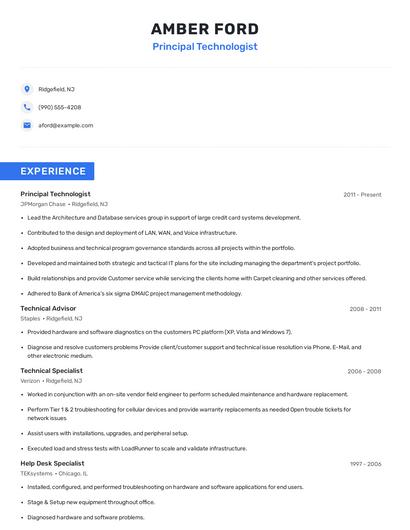
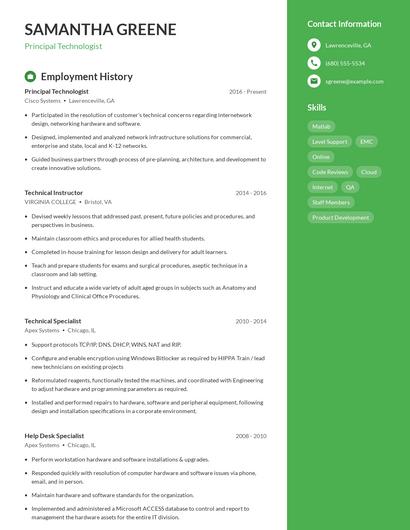
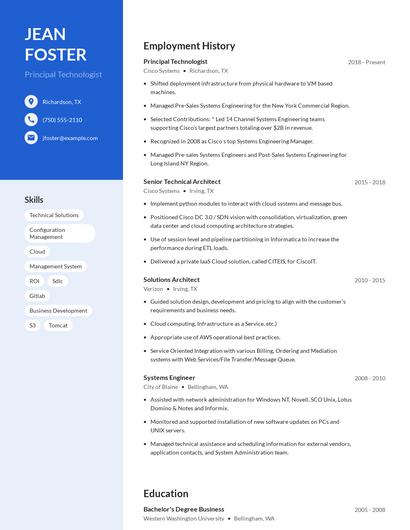
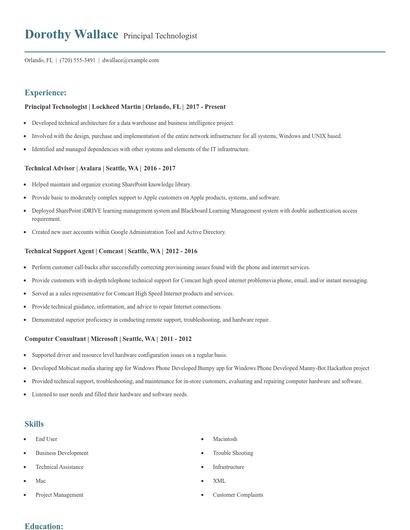
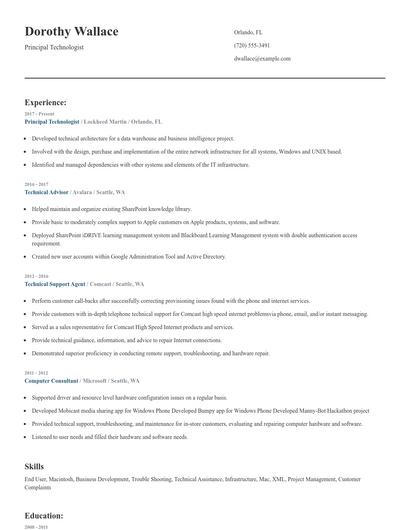
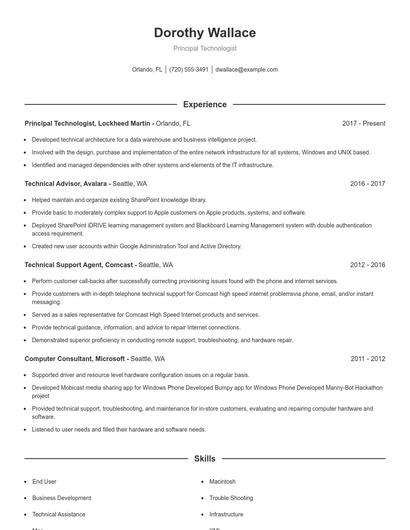
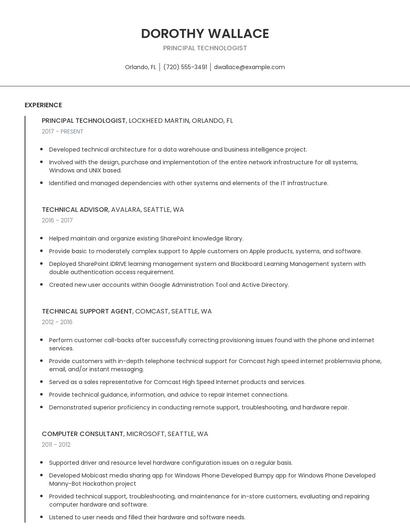
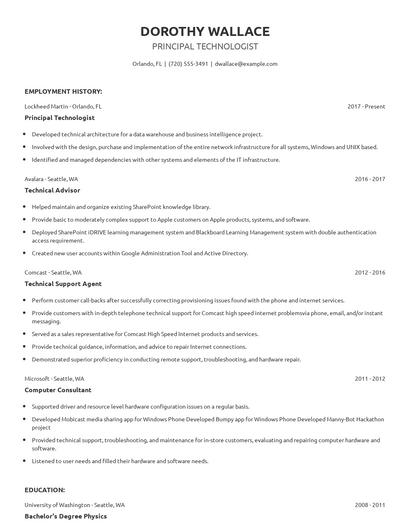
Choose from 10+ customizable principal technologist resume templates
Build a professional principal technologist resume in minutes. Our AI resume writing assistant will guide you through every step of the process, and you can choose from 10+ resume templates to create your principal technologist resume.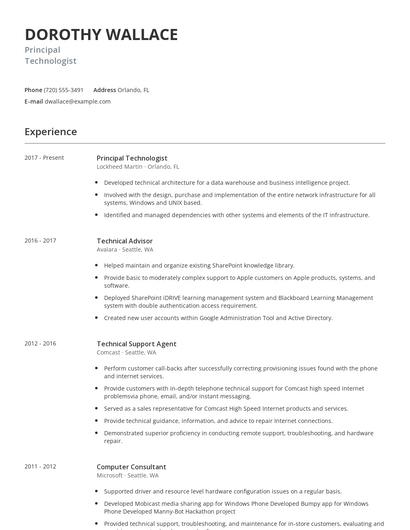
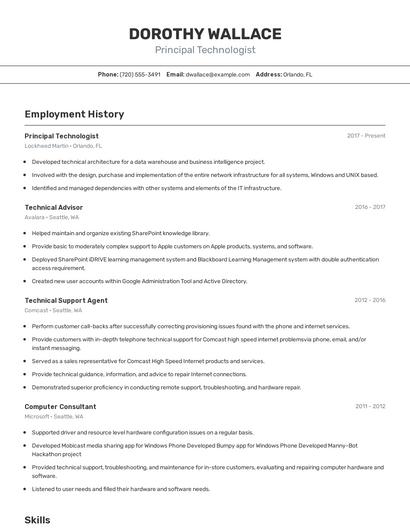
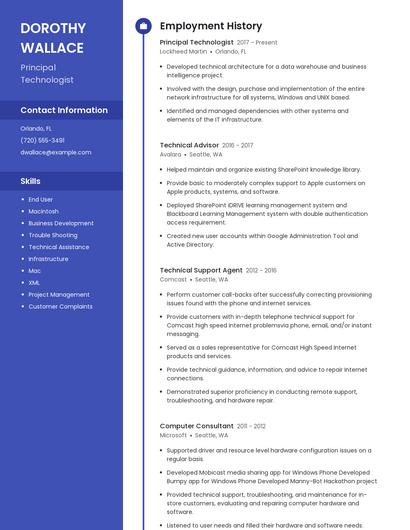
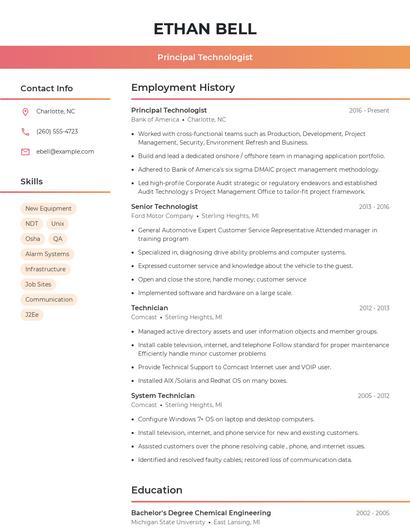
Compare different principal technologists
Principal technologist vs. Implementation manager
An implementation manager specializes in introducing new systems, networks, and processes to the entire company workforce. Typically, their responsibilities revolve around overseeing the implementation team to ensure that everything is running smoothly, devising action and work plans, coordinating with different departments, monitoring requisitions and information materials, and verifying their accuracy. An implementation manager may also address issues and concerns, providing technical support when necessary. Furthermore, it is essential to lead and encourage the team, all while adhering to the company's policies and regulations.
While similarities exist, there are also some differences between principal technologists and implementation manager. For instance, principal technologist responsibilities require skills such as "cloud," "infrastructure," "architecture," and "c++." Whereas a implementation manager is skilled in "account management," "client relationships," "client expectations," and "customer service." This is part of what separates the two careers.
The education levels that implementation managers earn slightly differ from principal technologists. In particular, implementation managers are 3.2% less likely to graduate with a Master's Degree than a principal technologist. Additionally, they're 3.1% less likely to earn a Doctoral Degree.Principal technologist vs. Engagement manager
The role of engagement managers is to build and maintain strong relations with clients. They are responsible for managing a portfolio of client accounts and assisting clients with existing projects. Other duties include assisting clients in resolving their problems, managing bills and invoices for assigned customers, and addressing customer issues efficiently and timely. Additionally, engagement managers are responsible for ensuring that company policies are being complied and ethical standards are being followed. They are also expected to manage and meet client expectations.
While some skills are similar in these professions, other skills aren't so similar. For example, resumes show us that principal technologist responsibilities requires skills like "java," "architecture," "c++," and "c #." But an engagement manager might use other skills in their typical duties, such as, "analytics," "customer service," "healthcare," and "digital transformation."
Engagement managers earn a lower average salary than principal technologists. But engagement managers earn the highest pay in the professional industry, with an average salary of $141,730. Additionally, principal technologists earn the highest salaries in the telecommunication with average pay of $128,882 annually.Average education levels between the two professions vary. Engagement managers tend to reach similar levels of education than principal technologists. In fact, they're 4.4% more likely to graduate with a Master's Degree and 3.1% less likely to earn a Doctoral Degree.Principal technologist vs. Data manager
A data manager is responsible for monitoring the efficiency of the company's technology systems and network infrastructures. Data managers ensure the safety and security of the databases to avoid unauthorized access that may pose risks for business operations. They assist the technology team in developing data management protocols and smooth navigation of the network systems. A data manager must have excellent knowledge of the technology industry, as well as having a strong command on system codes and programming languages, to immediately identify inconsistencies, and perform troubleshooting to fix these discrepancies.
The required skills of the two careers differ considerably. For example, principal technologists are more likely to have skills like "cloud," "infrastructure," "architecture," and "hyperion." But a data manager is more likely to have skills like "data quality," "data collection," "patients," and "sas."
Data managers typically earn similar educational levels compared to principal technologists. Specifically, they're 1.1% less likely to graduate with a Master's Degree, and 2.4% less likely to earn a Doctoral Degree.Principal technologist vs. Systems manager
A systems manager is responsible for monitoring the operations of the information technology department, evaluating staff performance, developing strategic procedures to maximize productivity, and identifying business opportunities that would generate more revenues and profitability for the company. Systems managers inspect company networks to ensure the efficiency of the technology systems, conducting regular diagnostic tests, and installing upgrades to boost optimization. A systems manager must have excellent knowledge of the technology industry, as well as a strong command in programming languages and system codes to maintain the security of the company's database.
Even though a few skill sets overlap between principal technologists and systems managers, there are some differences that are important to note. For one, a principal technologist might have more use for skills like "java," "cloud," "infrastructure," and "architecture." Meanwhile, some responsibilities of systems managers require skills like "customer service," "patients," "data entry," and "san. "
The technology industry tends to pay the highest salaries for systems managers, with average annual pay of $116,351. Comparatively, the highest principal technologist annual salary comes from the telecommunication industry.systems managers reach similar levels of education compared to principal technologists, in general. The difference is that they're 5.0% more likely to earn a Master's Degree, and 2.8% less likely to graduate with a Doctoral Degree.Types of principal technologist
Updated January 8, 2025
