What does a process development do?
A process development professional is responsible for performing extensive research and analysis to design and develop strategies that will optimize the daily procedures in a company. Among their responsibilities include gathering and analyzing data to identify the strengths and weaknesses of current operations, studying the needs of various programs and projects, and developing solutions against problem areas. They may also provide technical guidance and support to staff, all while enforcing and promoting the company's policies and regulations.
Process development responsibilities
Here are examples of responsibilities from real process development resumes:
- Lead a team of 46 members for agents to troubleshoot websites relate issues.
- Manage synthesis and production of specialty chemicals for carpet and textile industry.
- Obtain referrals, track hospitalized patients, interface with manage care intermediaries/medical personnel.
- Ensure homogeneity and batch-to-batch consistency via IP and FP HPLC and GC assays.
- Characterize in process products by using analytical methods such as HPLC, AKTA UV, TLC and NMR.
- Initiate a document control system for QC.
- Complete sample analysis using GPC, HPLC and DSC.
- Conduct weekly safety audits complying with ISO 9001 and OSHA regulations.
- Conduct CRP, UAT and training for end users and production support.
- Used CSS and to create grids and adopt cross browsing interactive features.
- Analyze compounds using a variety of scientific data instrumentation, such as NMR.
- Perform maintenance and troubleshooting for GC and GC/MS in accordance with qualify training.
- Develop the complete layout of the pages of websites using CSS for multiple browsers.
- Perform QC testing of raw material, in-process and finish products following USP methods.
- Evaluate results and interpret data by statistical analysis (JMP) to modify process parameters.
Process development skills and personality traits
We calculated that 17% of Process Development are proficient in Java, Business Process, and Architecture. They’re also known for soft skills such as Listening skills, Speaking skills, and Writing skills.
We break down the percentage of Process Development that have these skills listed on their resume here:
- Java, 17%
Worked with backend programmers to troubleshoot Java Script related issues with front-end connectivity.
- Business Process, 9%
Established innovative business processes for vendor relationships to leverage payment industry knowledge as consultant.
- Architecture, 8%
Partnered with Business Architecture to ensure departmental level processes are included in the enterprise level process management architecture.
- JavaScript, 8%
Designed layouts on the front-end using JavaScript, HTML, and CSS.
- Post Implementation, 4%
Defined post implementation strategies for continuous process improvement and transitioned ownership of the processes to the business stakeholders.
- Data Analysis, 4%
Conducted data analysis using statistical process control (SPC) techniques and Pareto Analysis.
"java," "business process," and "architecture" are among the most common skills that process development use at work. You can find even more process development responsibilities below, including:
Listening skills. The most essential soft skill for a process development to carry out their responsibilities is listening skills. This skill is important for the role because "these engineers often operate in teams, but they also must solicit feedback from customers, vendors, and production staff." Additionally, a process development resume shows how their duties depend on listening skills: "quantified and communicated experimental results in the form of technical memos, technical reports, and oral presentations. "
Speaking skills. Another soft skill that's essential for fulfilling process development duties is speaking skills. The role rewards competence in this skill because "industrial engineers sometimes have to explain their instructions to production staff or technicians before they can make written instructions available." According to a process development resume, here's how process development can utilize speaking skills in their job responsibilities: "represented function as a core team member for clinical product development project for tavi delivery systems. "
Writing skills. This is an important skill for process development to perform their duties. For an example of how process development responsibilities depend on this skill, consider that "industrial engineers must prepare documentation for other engineers or scientists, or for future reference." This excerpt from a resume also shows how vital it is to everyday roles and responsibilities of a process development: "involved in writing jsps, javascript and servlets to generate dynamic web pages and web content when new clients were added. ".
Creativity. A big part of what process development do relies on "creativity." You can see how essential it is to process development responsibilities because "industrial engineers use creativity and ingenuity to design new production processes in many kinds of settings in order to reduce the use of material resources, time, or labor while accomplishing the same goal." Here's an example of how this skill is used from a resume that represents typical process development tasks: "managed inventory configuration for warehouses, uat support for ap, ar and gl transactions testing. "
Problem-solving skills. Another common skill required for process development responsibilities is "problem-solving skills." This skill comes up in the duties of process development all the time, as "in designing facilities for manufacturing and processes for providing services, these engineers deal with several issues at once, from workers’ safety to quality assurance." An excerpt from a real process development resume shows how this skill is central to what a process development does: "worked with key stakeholders to identify, analyze, and define business process solutions. "
Math skills. Another skill commonly found on process development job descriptions is "math skills." It can come up quite often in process development duties, since "industrial engineers use the principles of calculus, trigonometry, and other advanced topics in mathematics for analysis, design, and troubleshooting in their work." Here's an example from a resume of how this skill fits into day-to-day process development responsibilities: "performed experimental design, quantitative analysis and statistical process control. "
The three companies that hire the most process developments are:
- Gilead Sciences6 process development jobs
- Navy Federal Credit Union6 process development jobs
- Maximus4 process development jobs
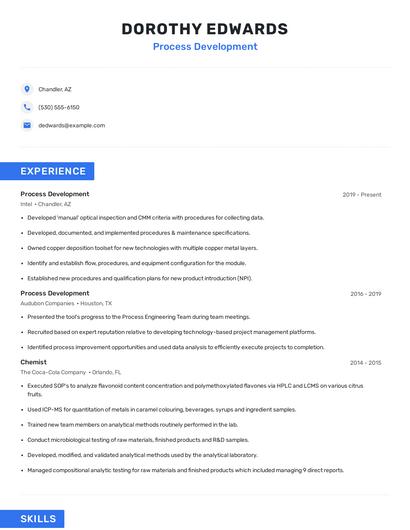
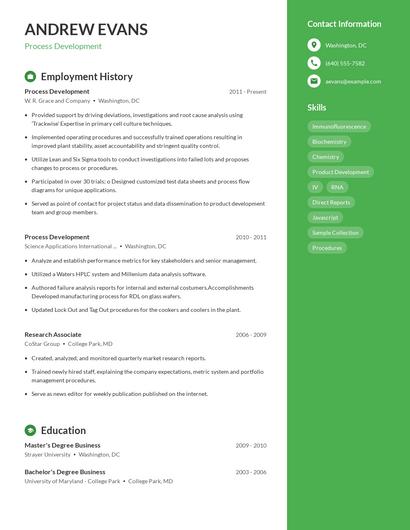
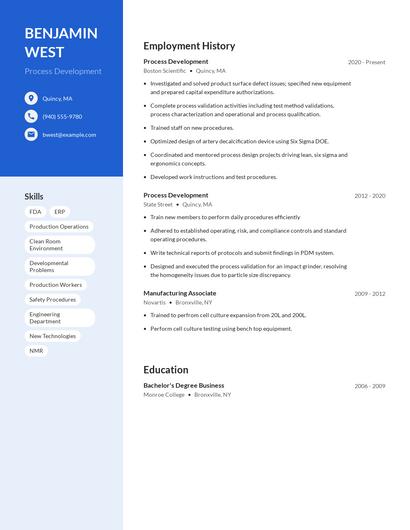
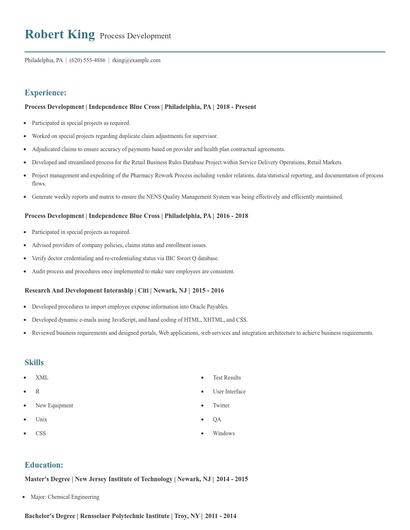
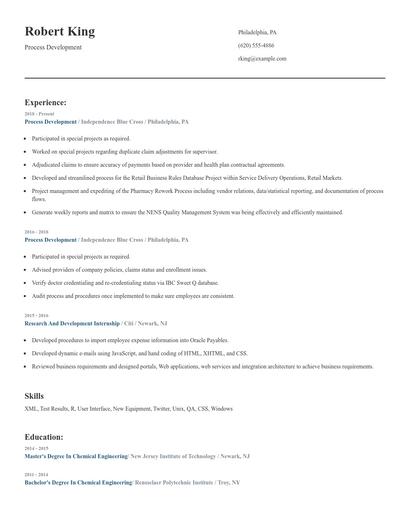
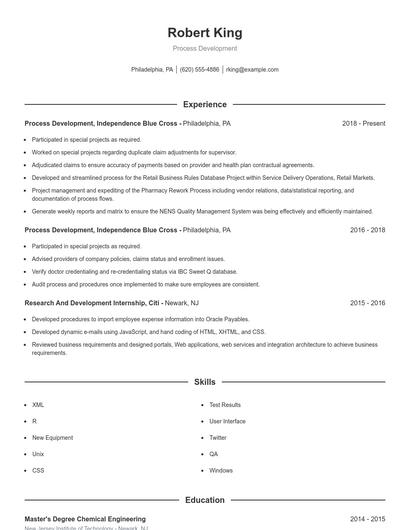
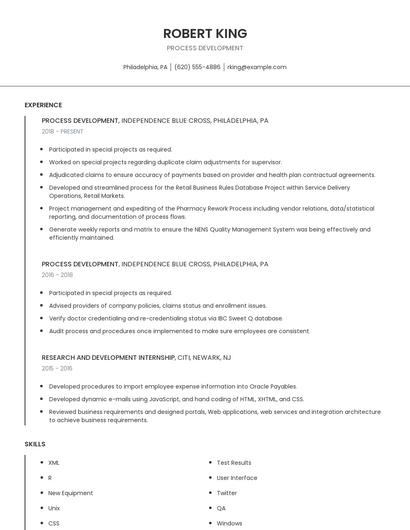
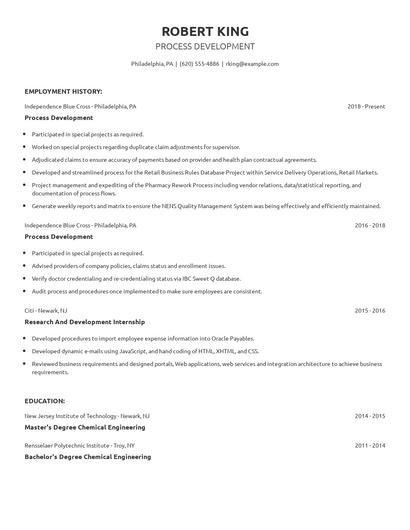
Choose from 10+ customizable process development resume templates
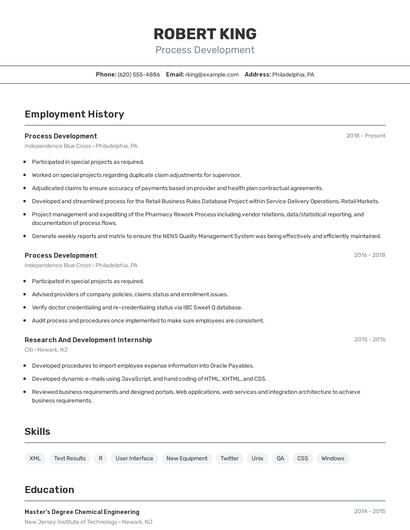
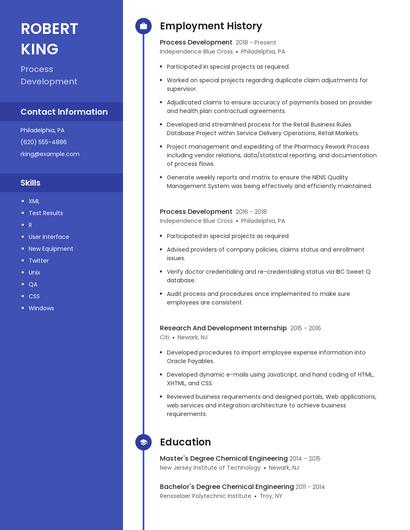
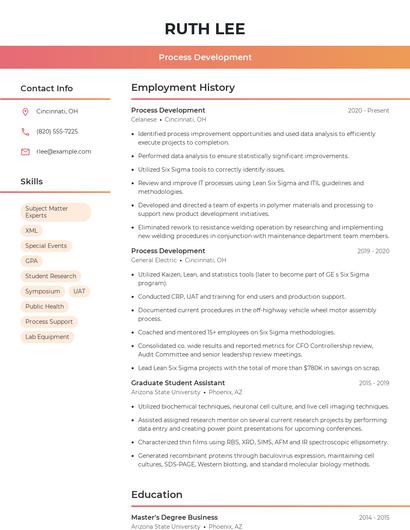
Build a professional process development resume in minutes. Our AI resume writing assistant will guide you through every step of the process, and you can choose from 10+ resume templates to create your process development resume.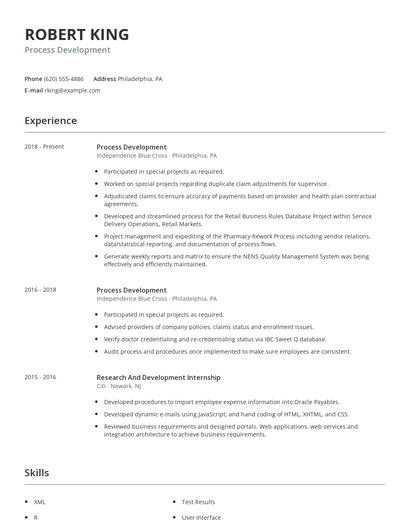
Compare different process development
Process development vs. Quality engineer
A quality engineer's responsibilities include ensuring that the manufacturing processes are efficient and accurate, documenting findings that would raise concerns, conducting quality tests while observing parameters, and implementing changes as necessary to meet the highest quality standards. Quality engineers need to have excellent problem-solving and observation skills to detect any irregularities and possible malfunctions. They also must be able to communicate effectively with the clients for feedbacks and corrective adjustments, address complaints, and immediately resolve any inconsistencies made.
While similarities exist, there are also some differences between process development and quality engineer. For instance, process development responsibilities require skills such as "c #," "business process," "architecture," and "javascript." Whereas a quality engineer is skilled in "corrective action," "continuous improvement," "quality standards," and "quality issues." This is part of what separates the two careers.
Quality engineers tend to make the most money working in the technology industry, where they earn an average salary of $84,890. In contrast, process development make the biggest average salary, $90,881, in the technology industry.On average, quality engineers reach similar levels of education than process development. Quality engineers are 3.4% less likely to earn a Master's Degree and 3.2% less likely to graduate with a Doctoral Degree.Process development vs. Packaging engineer
A Packaging Engineer plans and implements packaging designs to ensure product integrity and appeal. Their primary duties include supervising and managing the complete packaging development process, analyzing engineering drawings, and conducting periodic vendor reviews.
While some skills are similar in these professions, other skills aren't so similar. For example, resumes show us that process development responsibilities requires skills like "java," "c #," "business process," and "architecture." But a packaging engineer might use other skills in their typical duties, such as, "project management," "solidworks," "astm," and "package design."
Packaging engineers earn a higher average salary than process development. But packaging engineers earn the highest pay in the technology industry, with an average salary of $100,934. Additionally, process development earn the highest salaries in the technology with average pay of $90,881 annually.In general, packaging engineers achieve lower levels of education than process development. They're 7.1% less likely to obtain a Master's Degree while being 3.2% less likely to earn a Doctoral Degree.Process development vs. Planning engineer
A planning engineer is in charge of developing plans and systems to organize and schedule project procedures, ensuring efficiency and timeliness. Their responsibilities revolve around learning and understanding the extent of all operations, setting schedules and objectives, liaising with external parties such as vendors or distributors, and maintaining an active communication line with other departments. Furthermore, a planning engineer must monitor the progress of the workflow and the performance of the workforce, all while implementing the company's policies and regulations.
The required skills of the two careers differ considerably. For example, process development are more likely to have skills like "java," "c #," "business process," and "architecture." But a planning engineer is more likely to have skills like "project management," "infrastructure," "transmission planning," and "nerc."
Planning engineers earn the highest salary when working in the energy industry, where they receive an average salary of $86,256. Comparatively, process development have the highest earning potential in the technology industry, with an average salary of $90,881.When it comes to education, planning engineers tend to earn similar degree levels compared to process development. In fact, they're 0.5% less likely to earn a Master's Degree, and 3.1% less likely to graduate with a Doctoral Degree.Process development vs. Supplier quality engineer
A Supplier Quality Engineer ensures that the supplier's quality standards are in accordance with the requirement of the organization. They also report supplier performance and quality to management.
Types of process development
Updated January 8, 2025
