What does a production control analyst do?
Production control analysts require skills in inventory management, as well as production schedules. Those who choose this career path will be expected to monitor production processes and computer programs in order to ensure their reliability and accuracy. They will also need to be able to suggest updates to or replacement of technology or equipment to increase production efficiency. And finally, they will oversee system issue resolutions.
Production control analyst responsibilities
Here are examples of responsibilities from real production control analyst resumes:
- Manage and successfully deliver multiple customer migration efforts to allow processing moves from mainframe environments to client/server environments.
- Maintain and troubleshoot FTP/NDM scripts to effectively execute file transfers to various UNIX and NT servers.
- Develop batch processing runs with distribute and mainframe job schedulers, code JCL, and document job scheduler configurations.
- Ensure GMP regulations are satisfied.
- Monitor file transfers to ensure files are transmitted successfully with no SLA infractions.
- Provide ongoing training to team members in SQL, CloverETL and product support responsibilities.
- Set up scheduling for CA7 jobs using triggers, schedule scan & job dependencies.
- Develop Perl scripts to fetch, load and parse the data from the database.
- Process the nightly batch cycle on mainframe and various other platforms to meet hospital SLA's.
- Work with automation team to enable TPF and MVS to batch process jobs within similar applications.
- Work with application programmers to develop and implement test schedules using CA7 to ensure Y2K compliance.
- Serve as ISO committee spokesperson for the department during audits as well as creating ISO documentation.
- Perform root cause analysis and provide solutions to problems.Install and deploy software onto windows servers as requested.
- Use report distribution software and utilities to troubleshoot print problems, distribution problems and user access problems.
- Used MRP and CRP with an online system to schedule factory orders and purchase orders to meet customer requirements.
Production control analyst skills and personality traits
We calculated that 8% of Production Control Analysts are proficient in Production Schedules, Windows, and Lean Manufacturing. They’re also known for soft skills such as Detail oriented, Math skills, and Customer-service skills.
We break down the percentage of Production Control Analysts that have these skills listed on their resume here:
- Production Schedules, 8%
Translated the monthly Master Production Schedule into weekly and daily production plans based on capacity constraints and material availability.
- Windows, 7%
Documented help desk tickets/resolutions, and provided overall assistance in daily administration of a Microsoft Windows 2000 Network.
- Lean Manufacturing, 7%
Coordinate Lean manufacturing and 5S initiatives by analyzing data sets that outline the systemic improvement opportunities.
- MRP, 5%
Worked for several weeks to update all SNP's, lot sizes, min/max levels and other perimeters in MRP system.
- SQL, 4%
Supervised conversion of all legacy scheduling systems (AS400, FTP, SQL) to Enterprise scheduling software package Control-M.
- Production Environment, 4%
Designed, developed and implemented Version Control system which secures and auto promotes application code to production environment.
"production schedules," "windows," and "lean manufacturing" are among the most common skills that production control analysts use at work. You can find even more production control analyst responsibilities below, including:
Detail oriented. The most essential soft skill for a production control analyst to carry out their responsibilities is detail oriented. This skill is important for the role because "market research analysts must pay attention to minutiae to evaluate data." Additionally, a production control analyst resume shows how their duties depend on detail oriented: "required detailed knowledge of bmc control-m. ensured any corresponding reports created by the jobs scheduled were set up correctly. "
The three companies that hire the most production control analysts are:
- Spirit AeroSystems4 production control analysts jobs
- Early Warning3 production control analysts jobs
- Raytheon Technologies2 production control analysts jobs
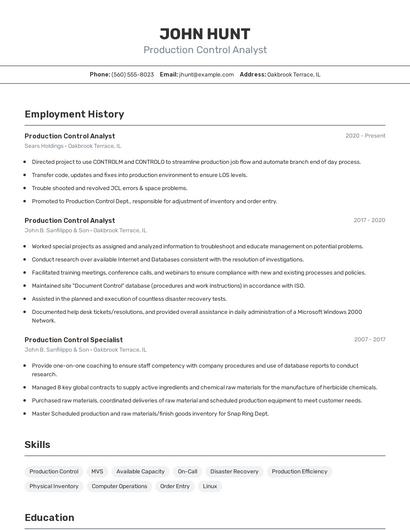
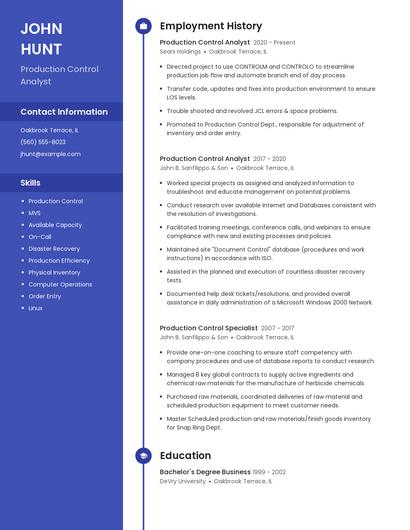
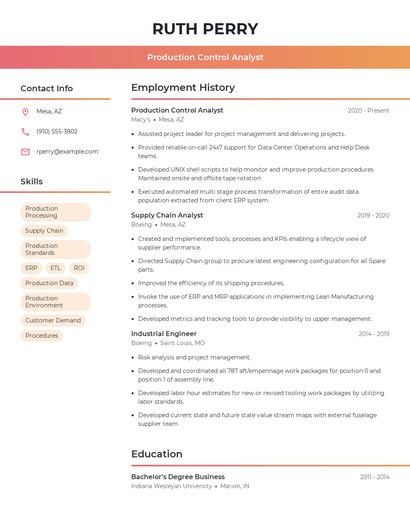
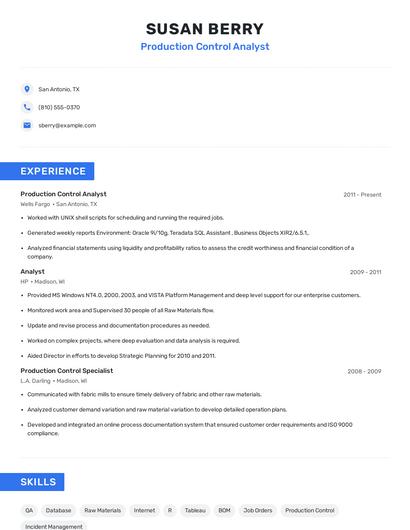
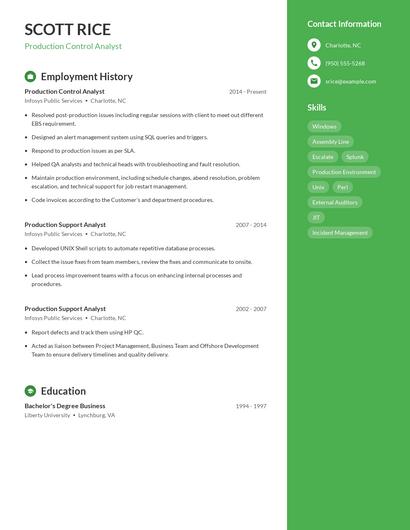
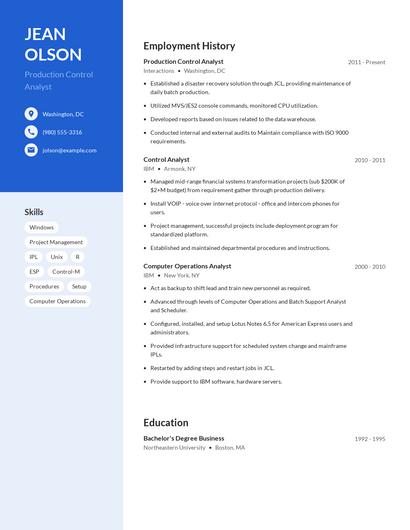
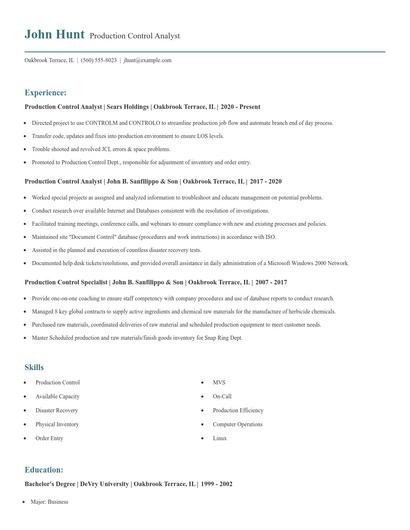
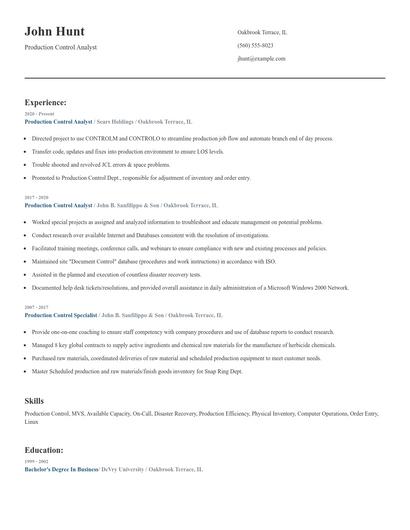
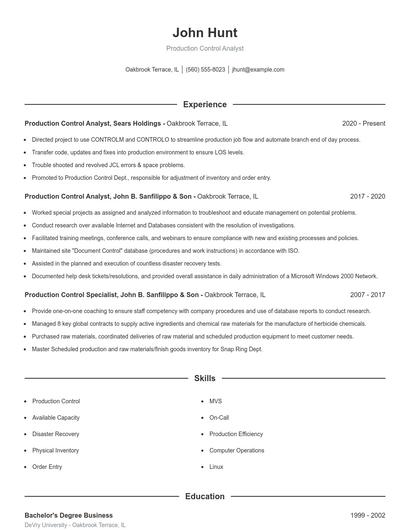
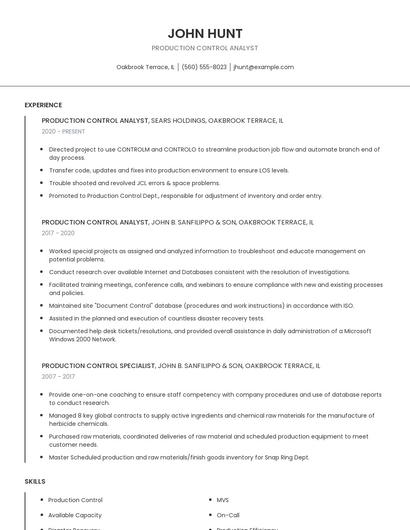
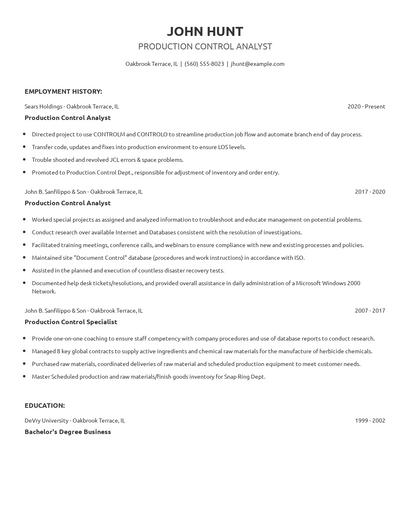
Choose from 10+ customizable production control analyst resume templates
Build a professional production control analyst resume in minutes. Our AI resume writing assistant will guide you through every step of the process, and you can choose from 10+ resume templates to create your production control analyst resume.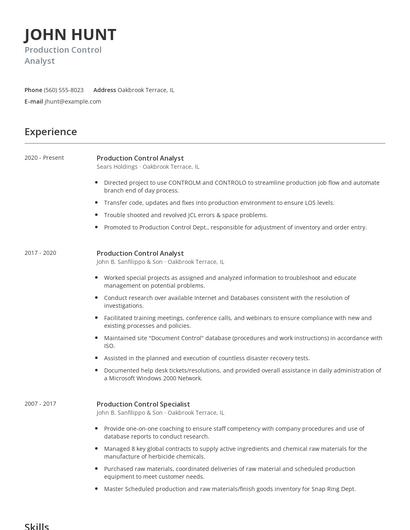
Compare different production control analysts
Production control analyst vs. Analyst
Analysts are employees or individual contributors with a vast experience in a particular field that help the organization address challenges. They help the organization improve processes, policies, and other operations protocol by studying the current processes in place and determining the effectiveness of those processes. They also research industry trends and data to make sound inferences and recommendations on what the company should do to improve their numbers. Analysts recommend business solutions and often help the organization roll out these solutions. They ensure that the proposed action plans are effective and produce the desired results.
There are some key differences in the responsibilities of each position. For example, production control analyst responsibilities require skills like "production schedules," "windows," "lean manufacturing," and "mrp." Meanwhile a typical analyst has skills in areas such as "customer service," "data analysis," "project management," and "strong analytical." This difference in skills reveals the differences in what each career does.
Analysts tend to make the most money working in the technology industry, where they earn an average salary of $79,330. In contrast, production control analysts make the biggest average salary, $84,021, in the automotive industry.analysts tend to reach higher levels of education than production control analysts. In fact, analysts are 6.2% more likely to graduate with a Master's Degree and 1.1% more likely to have a Doctoral Degree.Production control analyst vs. Efficiency analyst
A control analyst is an individual who is responsible for identifying weaknesses in the work process of an organization and implement methods to minimize risks. Control analysts are required to supervise the process for incident reports and provide technical guidance to their personnel. They must prepare monthly general ledger account analysis and balance sheets reconciliations that are according to the generally accepted accounting principles (GAAP). Control analysts should also assist with the organization's ISO audit procedures and findings.
In addition to the difference in salary, there are some other key differences worth noting. For example, production control analyst responsibilities are more likely to require skills like "production schedules," "windows," "lean manufacturing," and "mrp." Meanwhile, an efficiency analyst has duties that require skills in areas such as "energy efficiency," "market research," "regulatory filings," and "doe." These differences highlight just how different the day-to-day in each role looks.
Efficiency analysts earn higher levels of education than production control analysts in general. They're 8.3% more likely to graduate with a Master's Degree and 1.1% more likely to earn a Doctoral Degree.Production control analyst vs. Control analyst
Production Analysts help manage the production flow of a company's goods or data. They are responsible for optimizing labor cost, volume, and efficiency of production, ensuring quality assurance, correcting equipment failure and hardware problem as well as monitoring production process proactively improving from slowdowns or bottlenecks. They also coordinate employee training or retraining on software or controls to improve efficiency. Production Analysts work with other teams to estimate production runs within the manufacturing or data process. They create production reports for customers and management.
The required skills of the two careers differ considerably. For example, production control analysts are more likely to have skills like "production schedules," "lean manufacturing," "production environment," and "ibm mainframe." But a control analyst is more likely to have skills like "internal controls," "risk assessments," "sox," and "internal audit."
Control analysts earn the best pay in the energy industry, where they command an average salary of $89,191. Production control analysts earn the highest pay from the automotive industry, with an average salary of $84,021.Most control analysts achieve a similar degree level compared to production control analysts. For example, they're 4.9% more likely to graduate with a Master's Degree, and 0.1% more likely to earn a Doctoral Degree.Production control analyst vs. Production analyst
Types of production control analyst
Updated January 8, 2025
