What does a production scientist do?
A production scientist analyzes production operations and manufacturing processes to identify gaps, modify current procedures that would increase process efficiency, and maximize optimal performance. Production scientists inspect the tools and materials utilized for the production and oversee research trials for process formulations. They also develop opportunities and design models that support business functions, generating more innovation and increasing more revenue resources for the business. A production scientist writes research findings, manages resources, and determines various process feasibility.
Production scientist responsibilities
Here are examples of responsibilities from real production scientist resumes:
- Manage a team focuse on genotyping, purification, and quantitation assays, including training of new scientists.
- Develop and manage third party claim investigations and contractor remedial oversight for various insurance companies.
- Follow current GMP, GDP and FDA regulations to maintain documentation and improve work instructions.
- Extract biological samples and analyze via HPLC and LC/MS/MS analysis in accordance with GLP regulations.
- Acquire good laboratory practice (GLP) and good manufacturing practice (GMP) in industry.
- Direct technology transfer from bench top to pilot scale and then to production scale at CMO.
- Manufacture ELISA immunoassay kits and validate procedures.
- Prepare and test products and materials for use on immunoassay instruments.
- Develop, optimize, and transfer both upstream and downstream processes to CMO.
- Complete work orders and ensure inventory compliance to GLP, cGMP and ISO [] standards.
- Act as liaison and consultant for project developments relate to GMO and Non-GMO ELISA base products.
- Mentor and provide training to new hires and other colleagues as they learn new formulation and QC assays.
- Work in the cRNA laboratory on the manufacturing of a variety of oligonucleotides siRNA's and miRNA's.
- Conduct quality control testing using agarose gel electrophoresis
- Design experiments to problem solve and improve existing manufacturing protocols and QC methods.
Production scientist skills and personality traits
We calculated that 14% of Production Scientists are proficient in Process Improvement, QC, and Lab Equipment.
We break down the percentage of Production Scientists that have these skills listed on their resume here:
- Process Improvement, 14%
Sustained process improvement initiatives utilizing defined manufacturing processes and methodologies.
- QC, 8%
Designed experiments to problem solve and improve existing manufacturing protocols and QC methods.
- Lab Equipment, 7%
Operate semi-automated and automated basic lab equipment.
- GMP, 6%
Acquired good laboratory practice (GLP) and good manufacturing practice (GMP) in industry.
- Molecular Biology, 4%
Perform various molecular biology and microbiology methodologies in accordance with client needs.
- PCR, 4%
Purified DNA and PCR products using Agencourt's SPRI (Solid Phase Reversible Immobilization) technology.
Most production scientists use their skills in "process improvement," "qc," and "lab equipment" to do their jobs. You can find more detail on essential production scientist responsibilities here:
Communication skills. One of the key soft skills for a production scientist to have is communication skills. You can see how this relates to what production scientists do because "medical scientists must be able to explain their research in nontechnical ways." Additionally, a production scientist resume shows how production scientists use communication skills: "coordinated and maintained communication between multiple cros for the production of monoclonal antibodies. "
Observation skills. Many production scientist duties rely on observation skills. "medical scientists conduct experiments that require monitoring samples and other health-related data.," so a production scientist will need this skill often in their role. This resume example is just one of many ways production scientist responsibilities rely on observation skills: "performed an evaluation of the cam simulations by the comparisons with observational data involving extensive data analysis. "
The three companies that hire the most production scientists are:
- EMD Millipore
6 production scientists jobs
- Thermo Fisher Scientific4 production scientists jobs
- Flagship Pioneering4 production scientists jobs
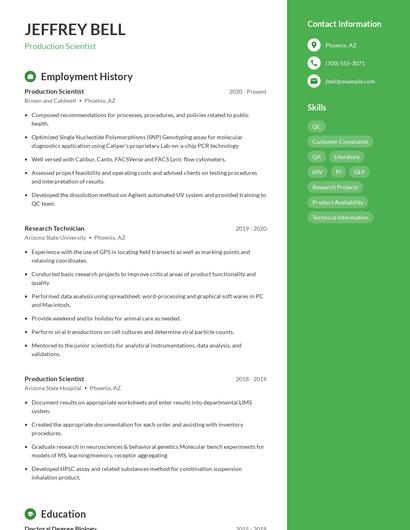
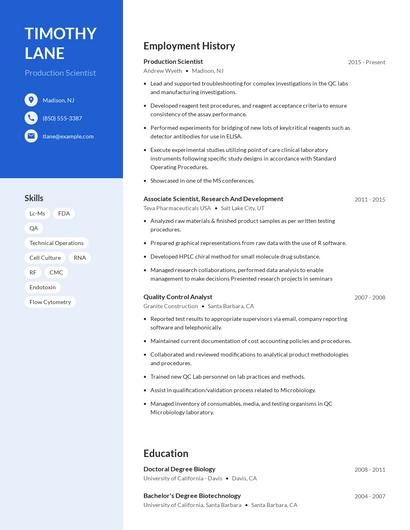
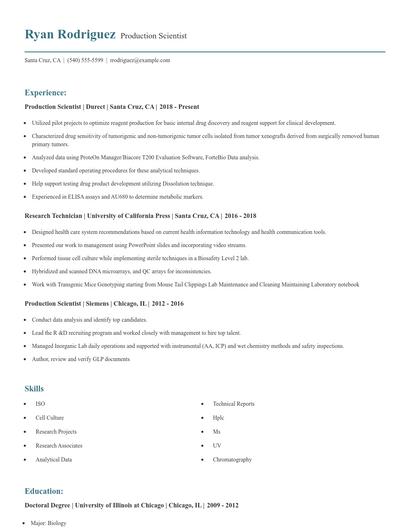
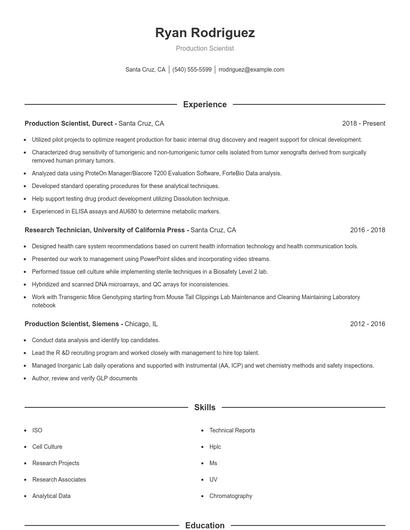
Choose from 10+ customizable production scientist resume templates
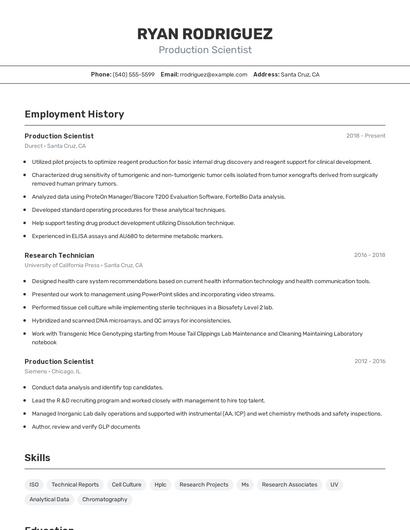
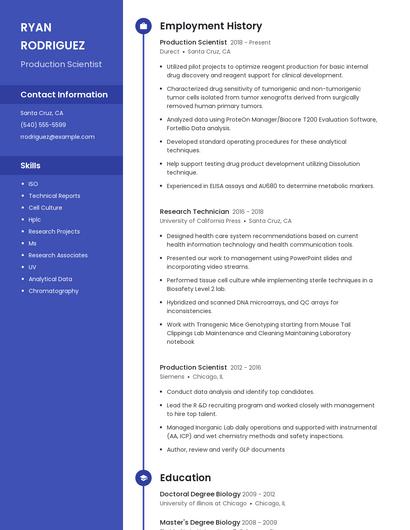
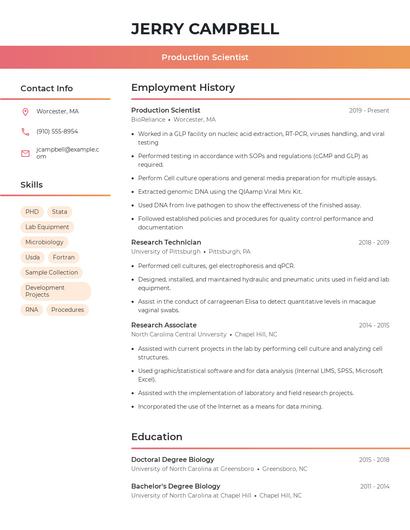
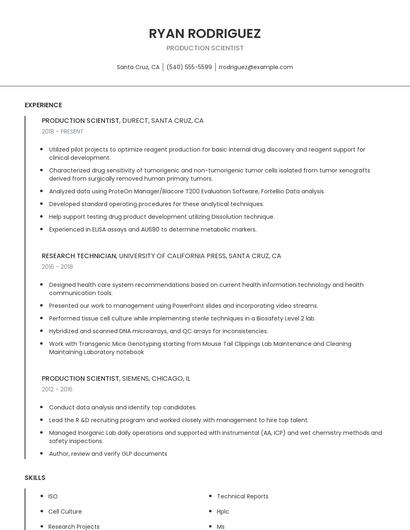
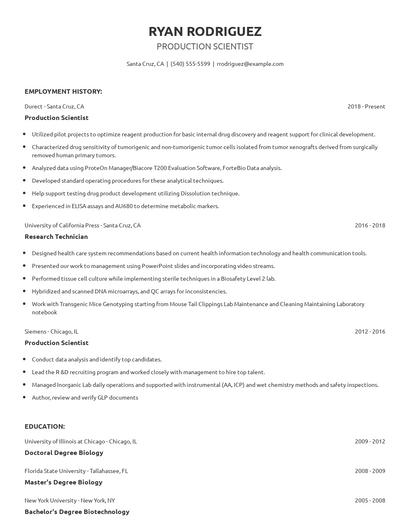
Build a professional production scientist resume in minutes. Our AI resume writing assistant will guide you through every step of the process, and you can choose from 10+ resume templates to create your production scientist resume.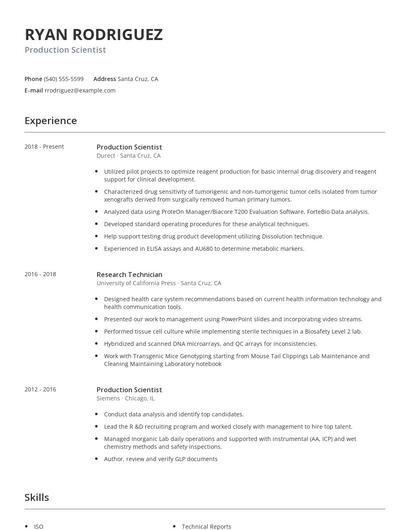


Compare different production scientists
Production scientist vs. Research fellow
A research fellow is an academic researcher who conducts research and analysis of comprehensive literature, data, and results and provides literature reviews. He/She supervises research assistants and recruits study participants to interview them for a particular study. To become a research fellow, a candidate should have a doctorate in a relevant discipline and publish peer-reviewed papers. Also, a research fellow can be an independent investigator or be supervised by a principal investigator.
While similarities exist, there are also some differences between production scientists and research fellow. For instance, production scientist responsibilities require skills such as "process improvement," "quality standards," "qc," and "lab equipment." Whereas a research fellow is skilled in "patients," "research projects," "immunology," and "cell biology." This is part of what separates the two careers.
Research fellows tend to make the most money working in the non profits industry, where they earn an average salary of $57,261. In contrast, production scientists make the biggest average salary, $94,629, in the health care industry.The education levels that research fellows earn slightly differ from production scientists. In particular, research fellows are 8.4% more likely to graduate with a Master's Degree than a production scientist. Additionally, they're 29.9% more likely to earn a Doctoral Degree.Production scientist vs. Quality control analyst
Quality assurance representatives are professionals who are responsible for ensuring the quality of units produced or manufactured is following the standards set by the industry. These representatives supervise the entire production process to identify erroneous methods or tools being used by workers and observing produced for visible defects. They are required to perform various tests to check for the durability of the product and other desirable characteristics. Quality assurance representatives must also collaborate with the manufacturing engineer to implement quality control programs and preparing training manuals and quality guidelines.
Each career also uses different skills, according to real production scientist resumes. While production scientist responsibilities can utilize skills like "gmp," "molecular biology," "pcr," and "cell culture," quality control analysts use skills like "microbiology," "test methods," "fda," and "analytical methods."
Quality control analysts may earn a lower salary than production scientists, but quality control analysts earn the most pay in the manufacturing industry with an average salary of $62,870. On the other hand, production scientists receive higher pay in the health care industry, where they earn an average salary of $94,629.quality control analysts earn similar levels of education than production scientists in general. They're 0.4% less likely to graduate with a Master's Degree and 29.9% less likely to earn a Doctoral Degree.What technology do you think will become more important and prevalent for production scientists in the next 3-5 years?
Bryan Spiegelberg Ph.D.
Associate Professor of Molecular Sciences, Rider University
Production scientist vs. Chemical technician
A chemical technician is responsible for supporting chemists and laboratory technicians in performing laboratory investigations and examining chemical components and structures. Chemical technicians ensure the stability of laboratory tools and equipment, performing proper sterilization and segregation of disposable materials, and maintaining the adequacy of inventory. They also record the research progress, including scientific methods, and write observation reports for reference. A chemical technician manages the cleanliness and orderliness of the facility to avoid potential hazards and complications during chemical operations.
There are many key differences between these two careers, including some of the skills required to perform responsibilities within each role. For example, a production scientist is likely to be skilled in "process improvement," "molecular biology," "pcr," and "cell culture," while a typical chemical technician is skilled in "safety procedures," "hazardous materials," "osha," and "math."
Chemical technicians earn the best pay in the pharmaceutical industry, where they command an average salary of $66,439. Production scientists earn the highest pay from the health care industry, with an average salary of $94,629.Most chemical technicians achieve a lower degree level compared to production scientists. For example, they're 7.1% less likely to graduate with a Master's Degree, and 1.9% less likely to earn a Doctoral Degree.Production scientist vs. Laboratory analyst
A Laboratory Analyst helps conduct experiments, run laboratory tests, and analyze results. They compile and record data for the documentation needed for testing and report preparation.
Even though a few skill sets overlap between production scientists and laboratory analysts, there are some differences that are important to note. For one, a production scientist might have more use for skills like "process improvement," "quality standards," "qc," and "molecular biology." Meanwhile, some responsibilities of laboratory analysts require skills like "test methods," "laboratory procedures," "sample preparation," and "analytical methods. "
Laboratory analysts enjoy the best pay in the pharmaceutical industry, with an average salary of $47,806. For comparison, production scientists earn the highest salary in the health care industry.The average resume of laboratory analysts showed that they earn similar levels of education compared to production scientists. So much so that theyacirc;euro;trade;re 3.3% less likely to earn a Master's Degree and less likely to earn a Doctoral Degree by 1.5%.Types of production scientist
Updated January 8, 2025
