What does a project/process manager do?
Project/process managers supervise the improvement implementation process in an organization. They work with fellow managers, members of the team, and other employees for clear, efficient, and quick application. They lead the planning sessions for different projects. For efficiency, they coordinate staff and internal resources to make sure that projects meet the set deadlines. It is their responsibility to establish harmonious relationships with stakeholders and clients.
Project/process manager responsibilities
Here are examples of responsibilities from real project/process manager resumes:
- Manage compliance with OSHA, USDA and FDA regulations on projects.
- Direct and manage logistics and execution of photography and videos shoots for marketing collateral.
- Lead requirements gathering, systems analysis, data warehouse requirements, and data architecture refinements, reviewing RFP for solicitation.
- Lead professional services engagements from assessment analysis to completion by partnering directly with healthcare providers to enhance revenue collection and efficiency.
- Coordinate and conduct project activities (meetings, reports, documentation, QA and UAT).
- Create process documentation, training, UAT.
- Collaborate with the PMO on deliverables for this global project.
- Coordinate lessons learned to review test procedures and best practices with fellow QA project managers.
- Coordinate UAT, usability, scalability and regression testing.
- Plan and implement an external audit site using Microsoft SharePoint.
- Develop communication process for project status reporting and escalate issue to PMO and other affect business management.
- Design and institutionalize a successful SharePoint document library to meet operational, compliance, change control and audit needs.
- Institute technology processes to compliment the new healthcare facility and current business operations in order to increase productivity and patient experience.
- Contribute to development of company's methodology for e-business consulting.
Project/process manager skills and personality traits
We calculated that 23% of Project/Process Managers are proficient in Project Management, Sigma, and Business Process. They’re also known for soft skills such as Management skills, Problem-solving skills, and Time-management skills.
We break down the percentage of Project/Process Managers that have these skills listed on their resume here:
- Project Management, 23%
Provided results-driven project management and leadership for the definition, development, and implementation of processes resulting in improved performance.
- Sigma, 10%
Provided Lean/Six Sigma training to approximately 500 individuals, which created a process-improvement culture and mindset within the organization.
- Business Process, 8%
Delivered performance management strategies and supporting business processes leveraging subject matter expertise in support chain and inventory management.
- Lean Six Sigma, 5%
Collaborate leverage Lean Six Sigma knowledge to identify, prioritize and implement continuous improvement projects within Servicing.
- Process Improvement, 4%
Represented department by working on various process improvements teams, special project initiatives, and supported implementation of new technology.
- Project Scope, 4%
Managed project scope and ensured project tasks, action items and deliverables were completed.
Most project/process managers use their skills in "project management," "sigma," and "business process" to do their jobs. You can find more detail on essential project/process manager responsibilities here:
Problem-solving skills. Another essential skill to perform project/process manager duties is problem-solving skills. Project/process managers responsibilities require that "top executives need to identify and resolve issues within an organization." Project/process managers also use problem-solving skills in their role according to a real resume snippet: "coached and directed all levels of management on corrective/preventive action solutions resulting in exceeding customer satisfaction and improving business processes. "
Time-management skills. This is an important skill for project/process managers to perform their duties. For an example of how project/process manager responsibilities depend on this skill, consider that "top executives do many tasks concurrently to ensure that their work gets done and that the organization meets its goals." This excerpt from a resume also shows how vital it is to everyday roles and responsibilities of a project/process manager: "develop customized business process model notation (bpmn) to match with the company environment monitored team progress and enforced deadlines. ".
Communication skills. For certain project/process manager responsibilities to be completed, the job requires competence in "communication skills." The day-to-day duties of a project/process manager rely on this skill, as "top executives must be able to convey information clearly and persuasively." For example, this snippet was taken directly from a resume about how this skill applies to what project/process managers do: "facilitated pharmaceutical program integration through research, project management, collaboration, and assisting in the development of communications. "
Leadership skills. Another common skill required for project/process manager responsibilities is "leadership skills." This skill comes up in the duties of project/process managers all the time, as "top executives must be able to shape and direct an organization by coordinating policies, people, and resources." An excerpt from a real project/process manager resume shows how this skill is central to what a project/process manager does: "assessed titles and job functions of leadership team including 48 vp's, and generated reports with recommendations for hr. "
The three companies that hire the most project/process managers are:
- Black & Veatch91 project/process managers jobs
- Meta28 project/process managers jobs
- Barry-Wehmiller8 project/process managers jobs
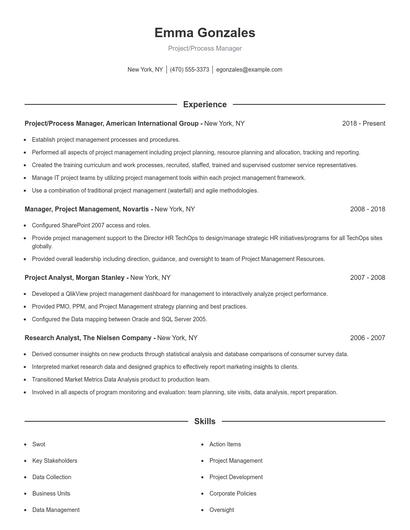
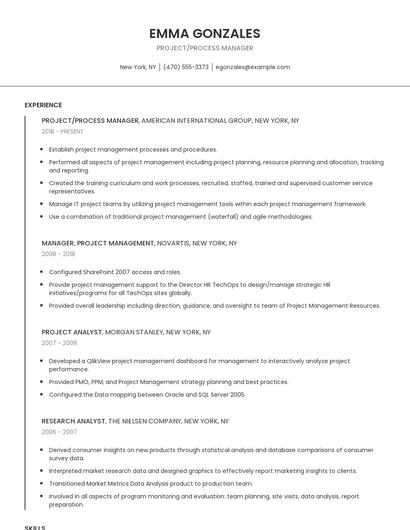
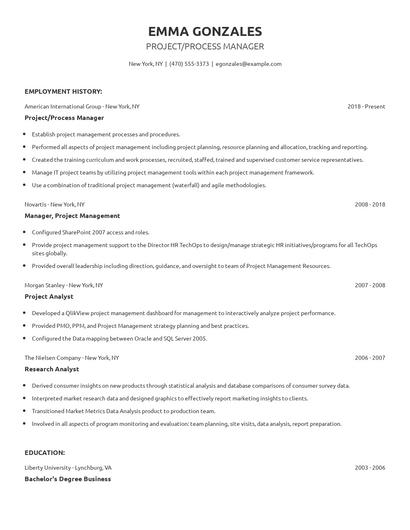
Choose from 10+ customizable project/process manager resume templates
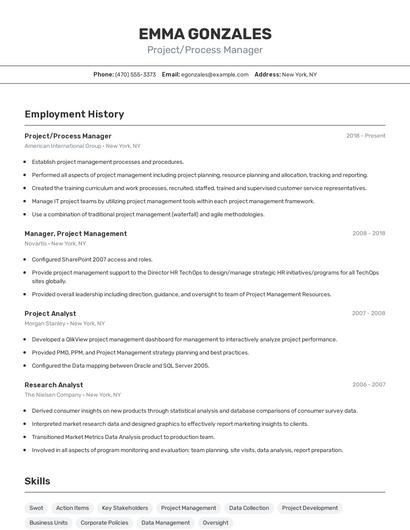
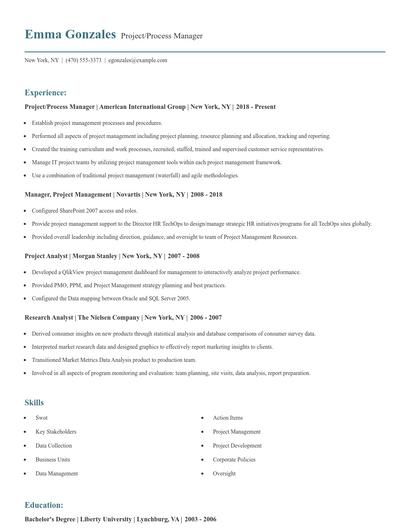
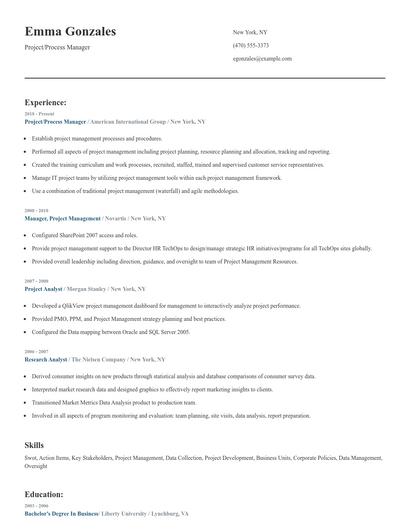
Build a professional project/process manager resume in minutes. Our AI resume writing assistant will guide you through every step of the process, and you can choose from 10+ resume templates to create your project/process manager resume.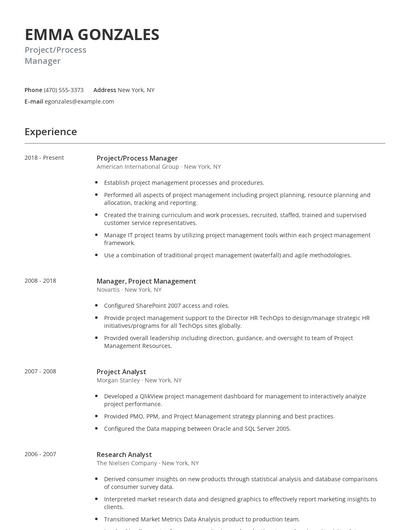


Compare different project/process managers
Project/process manager vs. Information technology project manager
An information technology project manager is responsible for supervising the technology department, ensuring that all tasks are being done by following technological strategies and solutions. Information technology project managers' duties include monitoring the technology team's daily operation, handling team members' concerns, managing customers' inquiries and complaints, helping team members' in achieving their professional growth, creating reports, sharing updates during team and board meetings, and maintaining effectivity of operational procedures. An information technology project manager must have excellent leadership and decision-making skills to decide on the best strategies in meeting the company's objectives.
While similarities exist, there are also some differences between project/process managers and information technology project manager. For instance, project/process manager responsibilities require skills such as "lean six sigma," "logistics," "process design," and "project stakeholders." Whereas a information technology project manager is skilled in "scrum," "software development," "risk management," and "technical support." This is part of what separates the two careers.
Information technology project managers earn the highest salaries when working in the technology industry, with an average yearly salary of $120,713. On the other hand, project/process managers are paid more in the energy industry with an average salary of $117,902.information technology project managers tend to reach similar levels of education than project/process managers. In fact, information technology project managers are 0.8% more likely to graduate with a Master's Degree and 0.1% less likely to have a Doctoral Degree.Project/process manager vs. Project analyst
A project analyst is responsible for overseeing the development of new projects upon completion of data gathering. A project analyst must provide plans and design the project to its full potential. For this, it is essential to conduct extensive research and coordinate with all staff and departments involved through regular reports and various forms of communication. Furthermore, a project analyst must devise strategies to improve particular projects for it to succeed and achieve better results, all in adherence to the company policies and regulations.
In addition to the difference in salary, there are some other key differences worth noting. For example, project/process manager responsibilities are more likely to require skills like "lean six sigma," "process design," "project stakeholders," and "qa." Meanwhile, a project analyst has duties that require skills in areas such as "customer service," "pmp," "financial analysis," and "visio." These differences highlight just how different the day-to-day in each role looks.
Project analysts earn a lower average salary than project/process managers. But project analysts earn the highest pay in the manufacturing industry, with an average salary of $76,006. Additionally, project/process managers earn the highest salaries in the energy with average pay of $117,902 annually.In general, project analysts achieve similar levels of education than project/process managers. They're 1.5% less likely to obtain a Master's Degree while being 0.1% more likely to earn a Doctoral Degree.Project/process manager vs. Business analyst/project manager
A business analyst/project manager is responsible for developing project management procedures, analyzing processes, and ensuring the accuracy and efficiency of project deliverables, following clients' specifications and requirements to meet their highest satisfaction. Business analysts/project managers manage project resources, delegate tasks to project staff, setting deadlines, and coordinating with the clients for regular updates and suggest strategic adjustments as needed. They also mitigate potential risks and manage changes during the project execution, maintaining the quality of the outputs, and balancing costs to meet the clients' budget goals.
There are many key differences between these two careers, including some of the skills required to perform responsibilities within each role. For example, a project/process manager is likely to be skilled in "sigma," "lean six sigma," "infrastructure," and "logistics," while a typical business analyst/project manager is skilled in "business stakeholders," "business analysis," "visio," and "test cases."
Business analyst/project managers make a very good living in the finance industry with an average annual salary of $120,172. On the other hand, project/process managers are paid the highest salary in the energy industry, with average annual pay of $117,902.business analyst/project managers typically earn similar educational levels compared to project/process managers. Specifically, they're 3.6% more likely to graduate with a Master's Degree, and 0.3% more likely to earn a Doctoral Degree.Project/process manager vs. Manager, project management
The role of a project management manager involves the planning, execution, monitoring, control, and closure of projects. Project managers oversee the scope of the entire project, the team, success or failure, and its resources. They facilitate productivity and commitment, remove obstacles, and motivate their team members. Their skills should include leadership, critical thinking, communication, negotiating, and risk management. They should also know about cost management, scheduling, and task management.
Even though a few skill sets overlap between project/process managers and managers, project management, there are some differences that are important to note. For one, a project/process manager might have more use for skills like "logistics," "process design," "project stakeholders," and "project documentation." Meanwhile, some responsibilities of managers, project management require skills like "risk management," "portfolio," "customer service," and "on-time delivery. "
In general, managers, project management earn the most working in the pharmaceutical industry, with an average salary of $115,297. The highest-paying industry for a project/process manager is the energy industry.managers, project management reach similar levels of education compared to project/process managers, in general. The difference is that they're 0.5% more likely to earn a Master's Degree, and 0.0% less likely to graduate with a Doctoral Degree.Types of project/process manager
Updated January 8, 2025
